A record plunge puts regulators under pressure
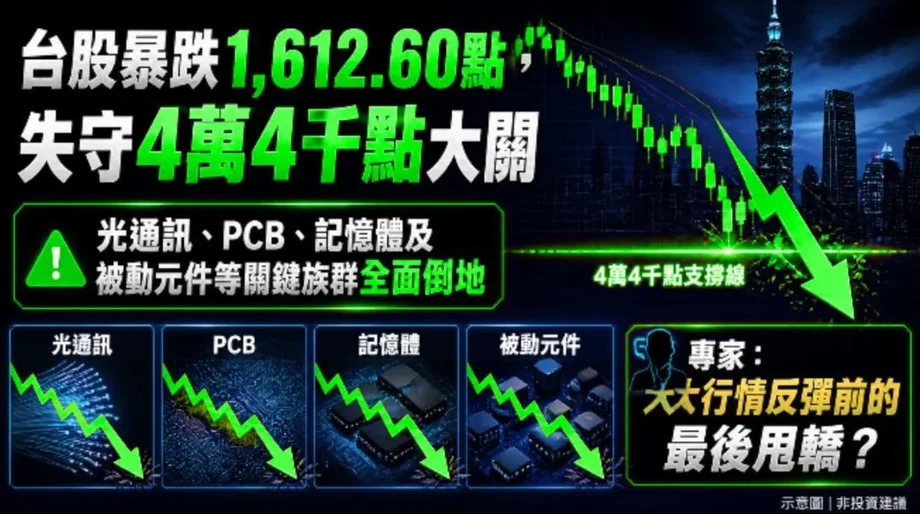
Taiwan's benchmark stock index plunged as much as 3,737.67 points to 37,837.05 in early trading on November 6, prompting Premier Cho Jung-tai to direct the Financial Supervisory Commission to prepare measures to stabilize the market. The fall was the largest intraday point loss in the market's history.
Contents
- A record plunge puts regulators under pressure
- What is driving the selling?
- The 2025 package provides a concrete precedent
- How the restrictions on borrowed shares work
- Why collateral relief matters during a crash
- Why foreign selling remains central
- How the tariff response unfolded
- What earlier interventions achieved
- What the afternoon decision will change
- Key Points
The index was down about 9% at its lowest point, before the losses narrowed substantially ahead of noon. The selloff followed sharp declines in U.S. stocks and continued selling by foreign investors, with shares linked to artificial intelligence and semiconductors under pressure.
FSC Chairman Peng Jin-long, speaking before attending Taiwan Week activities in Kaohsiung, said the commission would meet that afternoon to review trading and put forward its response. He urged investors to remain calm and said Taiwan's economic fundamentals remained sound despite severe volatility across international markets.
Restrictions on short selling were among the measures attracting attention. Peng referred to the commission's experience during earlier market disruptions but had not confirmed the contents, starting date or duration of the new package by the time of his morning remarks. An announcement was expected that afternoon.
What is driving the selling?
The November 6 decline followed selling in U.S. technology shares after the American midterm election results, amid uncertainty about policies affecting AI data centers. Taiwan's AI and semiconductor shares faced pressure as investors reassessed that outlook. Cho also pointed to uncertainty in the Middle East and sharp movements across major world markets.
Foreign and mainland Chinese investors had sold a net NT$102.461 billion of Taiwan shares on November 5, according to Taiwan Stock Exchange figures. Net selling means their sales exceeded their purchases by that amount. Taiwan's benchmark had already fallen 16.55% from its October 6 level of 49,822.55 by the November 5 close, before the next morning's plunge.
Cho said the government would closely monitor both domestic and international trading and respond as conditions changed. He also said market transactions should be determined by the market, while expressing confidence in the profitability and potential of Taiwan's industries.
The government's immediate task is to manage disorderly trading while investors react to developments overseas. Its proposed tools focus on how shares are sold and how investors meet borrowing obligations, rather than setting a floor under the index.
The 2025 package provides a concrete precedent
The clearest guide to the measures now under discussion is the FSC's April 2025 announcement. Published on April 6, 2025, it introduced three temporary measures for April 7 through April 11, following the Qingming holiday closure.
The commission said U.S. reciprocal tariff policies had caused major declines overseas while Taiwan's market was shut for the holiday. Investors returning to trading would therefore have to respond to several days of international developments at once, with trade policy still uncertain.
The package reduced a daily limit on orders to sell borrowed shares, raised the minimum collateral requirement for another form of short selling, and allowed a broader range of assets to meet certain margin obligations. Two measures made betting on falling prices harder or more expensive. The third gave investors more flexibility when brokers demanded additional collateral.
Those rules are the precedent for the November discussion. Peng's morning comments left open whether the commission would repeat them, choose a different combination or introduce other measures.
How the restrictions on borrowed shares work
Short sellers borrow shares, sell them and hope to buy them back later at a lower price before returning them. Their potential profit is the difference between the selling and buying prices, after borrowing costs and other expenses. If the price rises instead, buying back the shares becomes more expensive.
Taiwan's 2025 package addressed two borrowing channels. For securities lending sales, the FSC cut the daily intraday order limit from 30% to 3% of the security's average daily trading volume over the previous 30 business days.
That was a 90% reduction in the permitted order quantity under this particular limit. For example, if a stock's average daily volume over those 30 days were 1 million shares, the relevant ceiling would fall from 300,000 shares to 30,000 shares.
For margin short sales, the FSC raised the minimum margin requirement from 90% to 130% for listed securities and securities traded over the counter. Margin is collateral that a borrower must provide. Raising the requirement means committing more collateral to make the same short sale.
The April announcement preserved exceptions for specified activities, including certain hedging and market making operations. Market makers provide buy and sell quotes so other investors can trade. Hedging uses an offsetting position to reduce the risk of another investment or financial product.
Why collateral relief matters during a crash
The third part of the 2025 package dealt with investors facing demands for more collateral. Investors who buy shares using borrowed money must maintain sufficient backing for their loans. A steep fall in the shares' value can trigger a margin call, requiring them to add funds or assets.
An investor unable to meet that demand may face the forced sale of shares. During a broad market decline, many investors can face margin calls together, adding selling pressure when buyers are already cautious.
The FSC allowed investors, with the agreement of their securities firm or securities finance company, to use other assets with market liquidity and an objectively assessable value to cover specified shortfalls. The permission applied to margin purchase contributions and short sale margin differences.
The practical benefit was flexibility. An investor with acceptable assets elsewhere could offer those assets as collateral rather than immediately finding cash or selling shares. Broker approval remained necessary, and the assets had to be capable of being valued reasonably and traded in the market.
Why foreign selling remains central
The NT$102.461 billion in net sales by foreign and mainland Chinese investors on November 5 helps explain why a short selling package would address only part of the pressure. Investors can sell shares they already own without borrowing them, and restrictions on short sales leave that activity available.
The scope of the earlier restrictions also left futures trading outside those particular rules and allowed specified hedging transactions. The effect of a new package would therefore depend on its wording and on how much selling comes through the channels it covers.
The FSC had said on November 5 that it would assess short selling restrictions if the market showed panic without a reasonable basis and excessive declines compared with international markets. That approach makes the scale of Taiwan's losses relative to overseas exchanges part of the decision.
For investors, the central issue is whether selling reflects a temporary rush to exit positions, a change in expectations for company earnings, or both. Tighter borrowing rules directly change trading conditions. Expectations for AI investment, semiconductor demand and U.S. policy continue to shape decisions about owning shares.
How the tariff response unfolded
Taiwan's response to the 2025 tariff shock developed over several weeks rather than ending with the initial announcement. The sequence shows how trading restrictions, government buying capacity and changes in U.S. policy arrived close together.
- April 6, 2025: The FSC announced tighter short selling limits, higher margin requirements and greater collateral flexibility, initially for April 7 through April 11.
- April 8, 2025: Taiwan announced activation of its stock stabilization fund, described at the time as having capacity of about US$15 billion.
- April 9, 2025: Taiwan's benchmark reached a closing low of 17,391.76. Later that day in the United States, President Donald Trump announced a pause of 90 days in reciprocal tariffs.
- April 10, 2025: Taiwan shares rose 9.25% following the U.S. tariff pause.
- April 12, 2025: The FSC extended the temporary restrictions for another week.
- April 19, 2025: The restrictions continued without a fixed expiry date.
- May 26, 2025: The affected trading requirements returned to their normal settings.
The FSC said investor confidence was gradually recovering when it announced the April 12 extension, while tariff policies and responses by other countries remained uncertain. The regulator said international market swings were likely to continue affecting Taiwan.
What earlier interventions achieved
The FSC gave a positive assessment of the April 2025 restrictions when it extended them. In its statement, the commission described their effect on speculative selling:
indeed had the expected effect of effectively curbing speculative selling
Taiwan's benchmark subsequently closed at 21,652.24 on May 23, up 24.50% from its April 9 closing low of 17,391.76. During the same recovery period, investors were also responding to the tariff pause and Taiwan's activation of its stabilization fund.
A review of five major episodes of short selling restrictions since 2008 found that the market reached a closing bottom within roughly three weeks in four cases. In 2015 and 2020, the first trading day under the relevant restrictions was the lowest closing point of the episode. In 2022, the low came on October 25, about three weeks after the first measures began.
The exception was the 2008 financial crisis, when the market continued falling and lost roughly another 30% despite a comprehensive short selling ban. Across those episodes, governments and central banks were also taking other actions, from stabilization fund purchases to U.S. monetary support.
Short selling restrictions also involve costs. A 2013 study by Alessandro Beber and Marco Pagano in the Journal of Finance examined restrictions across about 30 countries around the 2008 crisis. It found reduced liquidity, slower adjustment of prices to information and little general support for share prices, with a possible exception for U.S. financial stocks. Lower liquidity means investors may find fewer willing counterparties when trying to buy or sell.
What the afternoon decision will change
The FSC's afternoon decision would determine which investors face new requirements and how quickly those requirements take effect. A higher margin requirement would increase the collateral needed for short sales. A lower lending sale ceiling would reduce permitted order quantities. Broader collateral rules would give eligible investors more ways to meet calls from brokers.
The duration and exceptions would matter as much as the headline announcement. Taiwan's April 2025 package began with a short, fixed period and was extended as uncertainty continued. Exemptions for market makers and specified hedging activities helped preserve particular trading functions while restrictions applied elsewhere.
Any role for the stock stabilization fund would involve a different mechanism: using authorized resources to support the market through purchases. Borrowing restrictions change the conditions under which investors can sell shares short; fund intervention adds buying capacity.
For households holding shares or funds, the immediate developments to watch were the afternoon announcement and the market's response. Taiwan's experience in April 2025 shows that domestic action can arrive alongside abrupt changes in U.S. policy, with both affecting the prices investors see.
Key Points
- Taiwan's benchmark fell as much as 3,737.67 points to 37,837.05 on November 6 before losses narrowed ahead of noon.
- Premier Cho Jung-tai directed the FSC to prepare a response, with an announcement expected that afternoon.
- Chairman Peng Jin-long had not confirmed whether the package would include short selling restrictions.
- The April 2025 precedent cut a securities lending sale limit from 30% to 3%, raised short sale margin requirements from 90% to 130%, and expanded acceptable collateral.
- Foreign and mainland Chinese investors sold a net NT$102.461 billion of Taiwan shares on November 5.
- Restrictions on borrowed share sales leave investors able to sell shares they already own, while overseas technology stocks and U.S. policy remain central to market sentiment.