Heavy selling knocks Taiwan below 44,000 points
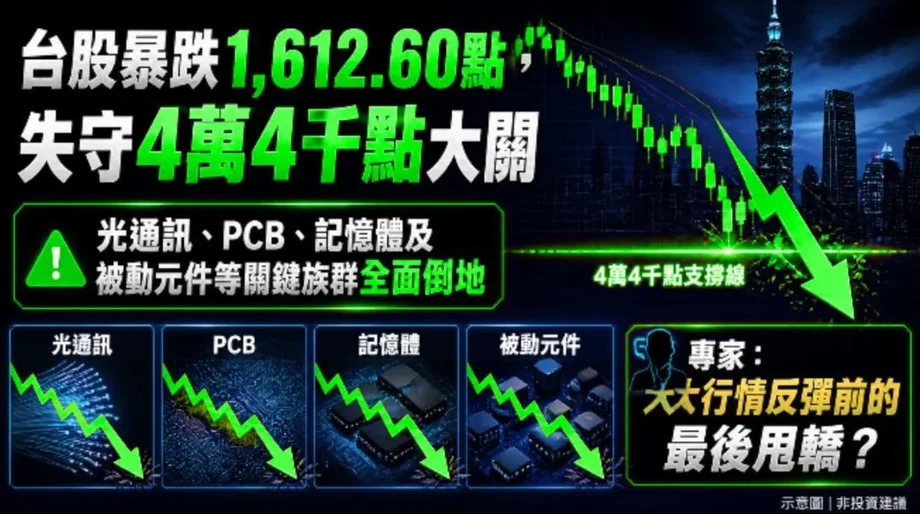
Taiwan's benchmark Taiex fell 1,612.60 points, or 3.59%, to 43,307.54 on Tuesday, November 3, 2026, recording its seventh largest single session point decline as investors sold technology shares and foreign institutions withdrew a net NT$107.31 billion from the main board.
Contents
- Heavy selling knocks Taiwan below 44,000 points
- Why AI spending worries reached Taiwan
- TSMC fell less than several major suppliers
- Four sessions of foreign selling added up
- Active ETFs became major selling targets
- Smaller and expensive shares suffered deeper losses
- Borrowed money added another source of pressure
- The Taiwan dollar weakened as funds moved out
- Regulators pointed to revenue growth amid the selloff
- Key Points
Trading reached NT$928.06 billion (US$28.48 billion), up from NT$799.69 billion on Monday. The increase of NT$128.37 billion, about 16.1%, accompanied losses across chipmakers, electronics suppliers, financial companies and smaller stocks. The index traded between 43,191.58 and 44,614.64, finishing just 115.96 points above its session low.
The Taiwan dollar weakened alongside shares, closing at NT$32.760 against the US dollar after touching NT$32.860. Foreign investors were net sellers for a fourth consecutive trading session, while domestic investment trusts continued buying.
Technology stocks carried much of the pressure. Taiwan Semiconductor Manufacturing Co. fell 1.50%, MediaTek lost 7.43%, and ASE Technology Holding dropped 8.61%. The smaller company market suffered an even deeper decline, with the TPEx Index falling 6.42% to 345.52.
Investors were weighing the cost of artificial intelligence expansion, weakness in American semiconductor stocks and uncertainty surrounding the US midterm elections. Taiwan's financial regulator pointed to growing company revenue and said it had asked the exchanges to closely monitor international market developments.
Why AI spending worries reached Taiwan
American technology shares had fallen before Taiwan opened. The Philadelphia Semiconductor Index lost 3.37% overnight, while the Nasdaq declined 1.07%. Those moves put pressure on a market whose largest companies manufacture chips, assemble servers and supply equipment used in AI computing.
Kerry Huang, an analyst at Concord Securities, linked Taiwan's heavier trading to investors cutting their holdings after further losses in American AI shares.
"Look at the expanded turnover. I think many investors simply scrambled to trim their holdings in panic as they witnessed the further heavy losses suffered by AI-related stocks on the U.S. markets. Fears over AI investments continued to hurt sentiment," Huang said.
Huang also described how expensive borrowing could affect the large cloud computing companies building AI infrastructure.
"With yields hovering at high levels, large cloud service providers could see a higher financial burden in fund raising, which could make it harder to deliver comfortable returns," Huang said.
A bond yield is the return investors demand for lending money. When companies must offer higher yields to borrow, financing a data center becomes more expensive. Investors then look more closely at whether the revenue from AI services will cover the cost of chips, buildings, electricity and debt.
Taiwanese suppliers sit directly in that spending chain. Large construction budgets can bring them orders, while doubts about the eventual returns can cause investors to lower the prices they are willing to pay for their shares.
TSMC fell less than several major suppliers
TSMC closed at NT$2,295, down NT$35, after its American depositary receipts fell 1.85%. Those receipts allow investors to trade an interest in the company on a US exchange.
TSMC accounts for more than 40% of the main market's value, giving its price movements a large effect on the Taiex. Its decline contributed about 280 points to Tuesday's loss, roughly 17.4% of the index's 1,612.60 point fall. Most of the remaining decline came from other shares.
MediaTek, which designs chips, fell NT$295 to NT$3,675. ASE Technology, which packages and tests semiconductors, closed at NT$816. Nanya Technology dropped 10%, the maximum daily decline, to NT$411 after selling in South Korean memory producers Samsung Electronics and SK Hynix added pressure to the sector.
Hon Hai Precision Industry, an iPhone assembler and AI server manufacturer, lost 2.19% to NT$245.50. Delta Electronics, a supplier of power management products, dropped 6.27% to NT$1,270. Quanta Computer fell 2.04% to NT$311.50.
The range of companies affected shows how broadly the AI investment debate reaches through Taiwan's production network, from chip design and manufacturing to testing, server assembly and power equipment.
Four sessions of foreign selling added up
The Taiwan Stock Exchange's trading figures put foreign net selling at NT$107.307 billion on Tuesday, the eighth largest daily total on record. Net selling means the value of shares sold exceeded the value bought by that amount.
Foreign investors had already sold heavily over the preceding three sessions. The sequence was:
- October 29: Net selling of NT$68.815 billion.
- October 30: Net selling of NT$112.467 billion.
- November 2: Net selling of NT$73.520 billion.
- November 3: Net selling of NT$107.307 billion.
Those daily figures add up to approximately NT$353.01 billion over four sessions. Tuesday's withdrawal was larger than Monday's, although it remained below the October 30 total, which ranked as the seventh largest daily foreign net sale.
Domestic securities dealers also sold a net NT$59.055 billion on Tuesday. Their activity included about NT$8.704 billion in trading for their own accounts and NT$50.351 billion in hedging transactions, which are used to offset financial risks.
Investment trusts moved in the opposite direction, buying a net NT$19.905 billion for their 16th consecutive session of net purchases. Their buying partly absorbed the selling, leaving the three major institutional groups with combined net sales of approximately NT$146.457 billion.
Active ETFs became major selling targets
Foreign selling extended beyond individual companies into actively managed exchange traded funds. An ETF holds a collection of investments and trades on an exchange like a share. In an active ETF, managers choose and adjust the holdings rather than simply following a set index.
The largest reductions included approximately 164,000 trading lots of CTBC Taiwan Income Active ETF, 134,000 lots of UPAMC Taiwan Growth Active ETF and 101,000 lots of UPAMC Upgrade 50 Active ETF. These are quantities of fund units traded, rather than cash amounts.
Five of the six largest foreign net selling positions were active ETFs, with combined reductions exceeding 460,000 lots. Foreign investors also reduced the passive Yuanta Taiwan 50 ETF by about 78,000 lots. The concentration in funds marked a shift from November 2, when individual companies headed the selling list.
Among individual stocks, foreign investors sold a net 36,740 lots of Winbond Electronics, 33,154 lots of Powerchip Semiconductor Manufacturing and 13,284 lots of Nanya Technology. TSMC recorded net foreign selling of 11,703 lots.
Plastics, financial and industrial companies also appeared among the major reductions, including Nan Ya Plastics, KGI Financial, Innolux and Formosa Plastics. The withdrawal therefore reached well beyond the largest AI names.
Smaller and expensive shares suffered deeper losses
The TPEx Index's 6.42% decline was 2.83 percentage points larger than the Taiex's 3.59% fall. Smaller companies listed on that market faced particularly strong selling alongside the main board's technology heavyweights.
A closing breakdown counted 76 shares reaching their daily lower price limits across the two markets, comprising 33 on the main board and 43 on the TPEx; another tally put the combined number at 74. A daily price limit restricts how far an individual share can move during a trading session.
Shares priced at NT$1,000 or more were among the hardest hit. Fourteen names in that group touched their lower limits, including Largan Precision, MPI and Hermes Testing Solutions. Gold Circuit Electronics, Materials Analysis Technology and Genius Electronic Optical fell below NT$1,000, reducing the number of shares above that threshold from 46 to 43.
Aspeed Technology initially rose to NT$15,800 before reversing to close at NT$14,730, down NT$895, or 5.73%. The reversal illustrated how early buying gave way to selling even in some of the market's most expensive shares.
Good Finance analyst Huang Tzu-tung identified the weaker Taiwan dollar and uncertainty before the US elections as pressures on large and expensive stocks. For overseas investors, a falling local currency can reduce the value of their Taiwanese holdings when converted back into dollars.
Borrowed money added another source of pressure
Analyst Chen Lung offered a different emphasis from the concerns about AI spending, arguing that selling by investors using borrowed money was a major driver of the decline. He viewed the session as an emotional reduction of leveraged positions rather than a deterioration in company operations.
Margin trading allows an investor to borrow part of the money used to buy shares. When prices fall, the shares supporting that loan become less valuable. An investor may then need to add cash or reduce the position, creating more selling during an already weak market.
Chen estimated that outstanding margin financing on listed shares could fall by more than NT$30 billion and argued that a further reduction of NT$20 billion to NT$30 billion might be needed before positioning became more stable. These were his estimates, not completed daily financing figures.
The Securities and Futures Bureau gave a margin account maintenance ratio of 173.62% as of November 2. That measure compares the collateral supporting margin accounts with their financing obligations. It was a marketwide figure from before Tuesday's decline, while individual investors faced different levels of exposure.
Chen remained positive about orders for TSMC, MediaTek and ASE as Microsoft, Meta and Oracle expanded AI infrastructure. His expectation of a rebound contrasted with Kerry Huang's warning that the Taiex could face further pressure toward 39,384, its intraday low on July 29. The timing of any recovery was uncertain.
The Taiwan dollar weakened as funds moved out
The Taiwan dollar opened at NT$32.610 per US dollar, weakened to NT$32.860 and ended at NT$32.760. Compared with Monday's close of NT$32.592, the closing move was a depreciation of NT$0.168 per US dollar. Trading through Taipei Forex Inc. reached US$3.94 billion, up from US$3.078 billion the previous day.
Foreign investors selling Taiwanese shares and converting the proceeds into dollars increased demand for the US currency. That connection helped transmit pressure from the stock market to the foreign exchange market.
The central bank temporarily relaxed the daily cap on exporters selling US dollars. Exporters that receive payment in dollars can exchange those earnings for Taiwan dollars, adding dollar supply when overseas investors are seeking to buy it.
OCBC Bank foreign exchange strategist Huang Ching-lung said the relaxation could help limit further depreciation, although continued foreign share sales and transfers of funds overseas would constrain a rebound.
The currency's late recovery from NT$32.860 to NT$32.760 reduced the day's decline. Investors still faced pressure in both markets: falling share prices reduced the local value of their holdings, while the weaker Taiwan dollar reduced their value in US dollar terms.
Regulators pointed to revenue growth amid the selloff
Huang Chung-hao, deputy director general of the Financial Supervisory Commission's Securities and Futures Bureau, linked volatility to the financial performance of large international technology companies, disagreements over valuations and geopolitical instability. The commission asked the Taiwan Stock Exchange and TPEx to monitor international developments closely.
The bureau said listed and TPEx companies generated NT$49.89 trillion in revenue during the first nine months of 2026, up 38.21% from a year earlier. At the end of September, the market's price to earnings ratio was about 26.68, while the cash dividend yield was 1.54%, or 1.58% including stock dividends.
A price to earnings ratio compares share prices with company profits. The figures help explain the competing forces facing investors: company sales had grown strongly, while investors were reassessing how much to pay for future earnings.
Financial Supervisory Commission Chairman Peng Jin-lung also pointed to the market's earlier expansion. He said Taiwan's total stock market value rose from NT$98 trillion at the end of October 2025 to NT$158 trillion a year later, growth of more than 61%.
Some shares rose despite Tuesday's losses. Taiwan Glass gained 6.28% to NT$67.70 and led foreign purchases of individual stocks with 54,775 lots. EVA Airways rose 1.27% to NT$43.70, China Airlines gained 0.24% to NT$20.70, and Uni-President Enterprises added 0.62% to NT$81.10.
Financial stocks still fell 2.54%, even as domestic investment trusts bought selected names in the sector. Fubon Financial lost 3.45% to NT$154, while Cathay Financial declined 2.59% to NT$113.
Investors next faced US election results, further technology company earnings and the October US employment report scheduled for Friday, November 6. Those events would provide fresh information about policy, corporate returns and the economic conditions shaping borrowing costs.
Key Points
- The Taiex closed at 43,307.54 on November 3, down 1,612.60 points, or 3.59%, in its seventh largest daily point decline.
- Turnover rose about 16.1% from Monday to NT$928.06 billion.
- Foreign institutions sold a net NT$107.307 billion, extending their selling streak to four sessions.
- MediaTek, ASE Technology, Nanya Technology and Delta Electronics suffered sharper percentage losses than TSMC.
- The TPEx Index fell 6.42%, while selling also spread to financial and industrial shares.
- The Taiwan dollar closed at NT$32.760 per US dollar, compared with NT$32.592 on Monday.
- Regulators cited revenue growth of 38.21% for listed and TPEx companies during the first nine months of 2026.