A private life opens onto six decades of Indian politics
Sonia Gandhi says she decided months before the 2004 general election that she would not become prime minister, kept that decision from Manmohan Singh and briefly yielded to pressure from allies before her children persuaded her to stand firm. Her memoir, Belonging: A Journey of Love, places that account alongside recollections of the Emergency, political divisions inside the Gandhi household and her distant relationship with Narendra Modi.
Contents
- A private life opens onto six decades of Indian politics
- From a Cambridge restaurant to a public engagement
- The first child they lost
- The Emergency divided the household
- How the split with Maneka became political
- Punjab's peace effort and repeated violence
- Why Sonia refused the prime minister's office
- Who held power during the UPA years?
- Formal greetings with Modi, warmer contact with Vajpayee
- World leaders beyond the official photographs
- A disputed publication and an immediate backlash
- Key Points
Published in India by HarperCollins and released on November 10, 2026, the book follows Gandhi from Italy and Cambridge into the family that produced three Indian prime ministers. Alfred A Knopf publishes the memoir in the United States.
Gandhi, the Congress party's longest serving president, presents the book as a personal account of people she loved, including their mistakes. Its political reach is nevertheless broad: she criticises Sanjay Gandhi's conduct during the Emergency, rejects allegations that she controlled government files during Singh's premiership and describes having almost no substantive conversation with Modi during his 12 years in office.
The publication has drawn criticism from the BJP and Aam Aadmi Party over its treatment of the Gandhi family's record, Operation Blue Star and Congress governance. Pranab Mukherjee's daughter has also challenged Gandhi's reaction to her father's ambition to become prime minister. Together, those responses turn an intimate family narrative into a renewed argument over power, responsibility and political inheritance.
From a Cambridge restaurant to a public engagement
Sonia Maino first noticed Rajiv Gandhi at the Varsity restaurant in Cambridge. His quiet manner stood out among his noisier companions. A mutual friend, Christian von Stieglitz, introduced them, and Sonia recalls an immediate attraction that Rajiv later said he shared.
Rajiv was 21 and studying engineering at Trinity College. Sonia subsequently learned that he was the grandson of Jawaharlal Nehru, India's first prime minister. An outing to Ely Cathedral became part of a courtship that would take her far from her family in Italy.
News of their engagement reached her parents before she could explain her decision herself. During a visit to India, Indira Gandhi suggested marriage before Rajiv departed for training. The announcement leaked, and Sonia's family heard it on the radio while eating at home in Orbassano. Reporters and photographers soon gathered outside.
Her father was upset because she had promised to return before making a final decision. Sonia wrote asking her parents' forgiveness. Meanwhile, Indira helped her choose a sari and gave her jewellery; Teji Bachchan helped her learn to drape it. Sonia and Rajiv married in New Delhi in 1968, joining a household where private milestones quickly became public events.
The first child they lost
One of the memoir's most intimate disclosures concerns the couple's first son, born prematurely on January 18, 1969, two months before his expected arrival. He survived only a few hours.
Gandhi describes seeing him in an incubator, with thick black hair and long fingers. Recalling their first response to the baby, the future Congress president writes:
We fell in love with him immediately.
Indira cut short a tour to return to the hospital after the child's death. Sonia remembers her embracing the grieving couple, her eyes swollen and red. Rajiv and Sanjay later buried the baby beneath a pink bougainvillea bush at Feroze Gandhi's farm in Mehrauli, south Delhi. The family would pause there to leave a flower.
Sonia also recalls the pain of a publication questioning the child's legitimacy. Another pregnancy brought anxiety as well as hope, before Rahul Gandhi's birth on June 19, 1970. These memories place grief and intrusive public attention near the beginning of her life in India, long before she took charge of Congress.
The Emergency divided the household
Indira Gandhi's declaration of the Emergency in June 1975 began 21 months during which civil liberties were suspended, opponents were jailed and the press faced censorship. Sonia's account describes the arguments inside the family before that decision.
Rajiv suggested resignation, believing it could strengthen his mother's political position over time. Sanjay favoured confronting the Opposition. Sonia portrays Indira as torn between leaving office and taking drastic action against opponents she believed threatened national stability.
Consultations involved Siddhartha Shankar Ray, Law Minister H. R. Gokhale and constitutional specialists. Sonia says Indira regarded opposition leader Jayaprakash Narayan's June 25 appeal to government servants and security personnel to disobey wrongful orders as a dangerous challenge to constitutional authority.
Sonia's criticism of Sanjay is most concrete on sterilisation and slum clearance. She describes a family planning programme driven by targets, rewards for officials and competition among local authorities, producing coercion and resentment. She also acknowledges deaths and injuries when police fired during protests against demolitions around Delhi's Turkman Gate.
Sanjay exercised influence without constitutional authority for several interventions, she writes. Her portrait combines affection with criticism: she considers him fearless, sometimes recklessly so. Alongside those judgments, she describes Indira's loneliness before the Emergency and her own later isolation in Congress leadership, a theme she also recalls discussing with Hillary Clinton in 2012.
How the split with Maneka became political
Sanjay met Maneka toward the end of 1973, and they married within a year. Sonia recalls initially welcoming a lively younger sister in law, before household tensions spread into disagreements between Sanjay and Rajiv.
Sanjay's death in an aircraft crash on June 23, 1980, intensified arguments about succession. According to Sonia, his supporters promoted Maneka as his political heir, while Indira considered the widow, then 23, too inexperienced for a leadership role.
Sonia identifies several flashpoints: Maneka's sale of Surya magazine to someone associated with the RSS, a birthday celebration for her son Varun at Vasundhara Raje's home in March 1981, and her participation in a Lucknow rally organised by Congress dissidents. The RSS is the Hindu nationalist organisation that provides the BJP's principal ideological roots.
Indira eventually told Maneka to stop activities she regarded as disloyal or live elsewhere. Sonia acknowledges that neither she nor Rajiv was present during the final confrontation. Her account accuses Maneka of arranging her departure to put public blame on Indira. The estrangement later extended to a legal dispute over family visits to Varun.
Punjab's peace effort and repeated violence
The memoir links Rajiv's premiership to the violence surrounding Operation Blue Star, the 1984 Army operation against armed Sikh separatists at the Golden Temple in Amritsar. Indira was assassinated by her bodyguards later that year. Sonia recalls Indira weeping while watching footage of the operation's aftermath, interpreting her tears as pain and regret over the deaths.
Rajiv subsequently sought a political settlement in Punjab. Sonia presents negotiations and security operations as connected parts of that effort, repeatedly disrupted by attacks and assassinations. The sequence she describes includes:
- May 1985: Transistor bomb attacks in Delhi and neighbouring states killed 50 people.
- June 1985: The bombing of Air India Flight 182 killed all 329 people aboard, including more than 80 children. Another bomb exploded at Japan's Narita airport.
- July 24, 1985: Rajiv signed the Punjab Accord with Shiromani Akali Dal president Sant Harchand Singh Longowal.
- August 20, 1985: Longowal was assassinated on Rajiv's 41st birthday, less than a month after the agreement.
- August 1986: Former Army chief General A. S. Vaidya was assassinated in Pune.
- 1986 and 1988: Operations Black Thunder I and II targeted armed militants occupying the Golden Temple complex.
Sonia identifies Babbar Khalsa as responsible for the Flight 182 bombing and the Khalistan Commando Force as responsible for Vaidya's assassination. Khalistan is the independent Sikh state sought by those militant organisations.
Her account says Rajiv wanted to avoid repeating Operation Blue Star and instructed security forces to keep out of the temple complex and make every effort to avoid casualties. She records no deaths in the first Black Thunder operation and 41 militant deaths during the second, which lasted nine days and was televised on Doordarshan.
The transistor bombing prosecution collapsed after 35 years, with the court criticising the investigation. That long delay sits beside another memory: a staff member handing Rajiv news of Longowal's killing just as his family began his birthday dinner. The attempted political settlement and its violent disruption entered the household in the same moment.
Why Sonia refused the prime minister's office
Indira's assassination in 1984 and Rajiv's assassination in 1991 shaped Rahul and Priyanka's opposition to their mother becoming prime minister. Sonia says they associated the office with danger and were relieved when, before the 2004 election, she rejected the possibility.
Gandhi recalls being asked whether she would accept the post if Congress won. Her answer was:
Absolutely not!
She kept her decision private because she feared an early announcement would trigger a leadership contest. Even Manmohan Singh, who accompanied her to meet President A. P. J. Abdul Kalam on May 18, 2004, did not know her intentions.
Sonia rejects the claim that Kalam blocked her appointment because of her foreign birth. She cites his later account in Turning Points, in which he said he would have sworn her in had she formally claimed the office as the constitutionally tenable choice.
Pressure from alliance leaders briefly unsettled her refusal. After more than an hour of persuasion, she murmured "Theek hai", meaning agreement, and congratulations began. Priyanka alerted Rahul, who confronted Sonia about reversing her decision. After a difficult night, she reaffirmed her original position.
Her explanation combines personal fear with party management. She had led the campaign while planning to remain outside government, then faced the task of persuading colleagues to accept that separation. She says she chose Singh for his integrity, experience, economic knowledge and role in the reforms of the 1990s.
Who held power during the UPA years?
Congress led the United Progressive Alliance government from 2004 to 2014. Singh served as prime minister while Sonia led the party, an arrangement that opponents attacked as government by two competing centres of power.
Sonia describes a division of responsibility: Singh ran the government and she managed Congress. She rejects allegations that she called for confidential Prime Minister's Office files, intervened in administrative matters or controlled appointments. She also recalls the PMO denying that official files had been shown to her.
A weekly coordination group brought together Singh, Sonia, Pranab Mukherjee, Arjun Singh, A. K. Antony and Ahmed Patel. Its purpose, in her telling, was to connect government decisions with the party sustaining the coalition. She says she could offer opinions and disagree, while accepting Singh's authority as prime minister.
Mukherjee's ambitions tested that arrangement. Sonia recalls that in 2010 he suggested a change at the top, which she interpreted as an indication that he wanted to replace Singh. She changed the subject. Congress later nominated Mukherjee for president in 2012, and he won.
His daughter Sharmistha Mukherjee has challenged Sonia's surprise, arguing that an experienced politician could reasonably aspire to the premiership. She says her father believed any politician worth his salt had that ambition, and that he held no resentment over the outcome.
Formal greetings with Modi, warmer contact with Vajpayee
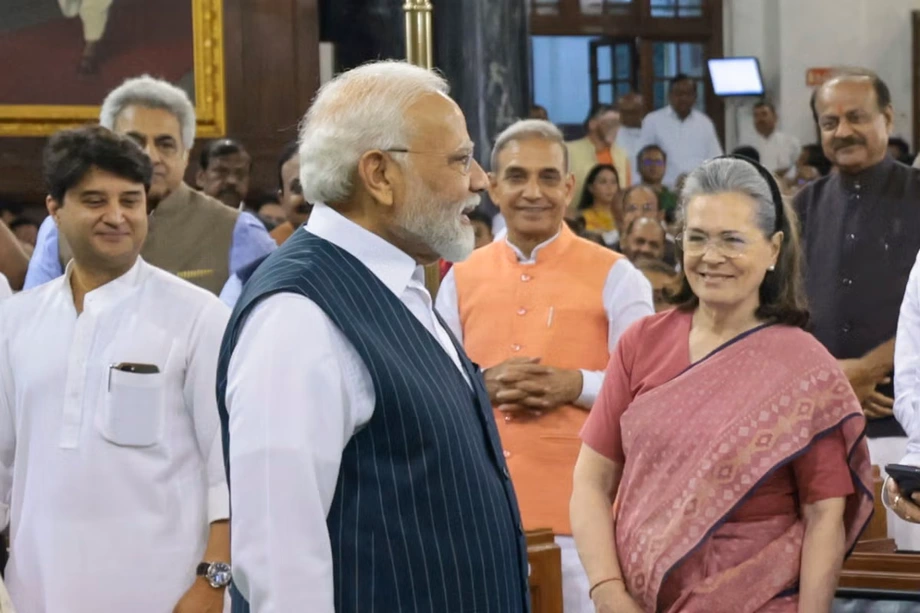
Sonia says her encounters with Modi largely consist of formal greetings at parliamentary gatherings, occasional questions about her health and birthday or New Year messages. Introducing her description of their relationship, the former Congress president writes:
practically no real contact
She describes meetings in the Lok Sabha Speaker's small chamber where Modi tends to look away after exchanging a namaste. Her account contrasts those moments with an earlier political culture in which opponents could maintain cordial personal relations. After the 2001 terrorist attack on Parliament, she recalls calling then prime minister Atal Bihari Vajpayee to ask about his safety.
Sonia places her disagreement with Modi in ideological terms, contrasting her commitment to secularism, inclusion and social justice with his grounding in the RSS. She acknowledges his rise from an underprivileged background while questioning the presentation of his origins and criticising his language toward opponents in Parliament.
Her memories of opposition politics also include insults aimed at her Italian birth during the Vajpayee years. She recalls being called a spy and a cabaret dancer, and accused of seeking to impose Rome Raj. She presents her continued campaigning against the BJP as a contest over India's political values.
World leaders beyond the official photographs
International encounters supply a more personal register. Sonia recalls Bill Clinton's 2000 India visit, saying he seemed more interested in presenting his views on Kashmir than hearing the Indian position. At a reception hosted by Vajpayee, she says she noticed him looking over women in the room.
Nicolas Sarkozy appears in an anecdote from his 2008 visit, answering questions about his relationship with Carla Bruni while messaging her during an official banquet. Sonia later found his manner toward Singh at a private dinner overly instructive.
Princess Diana receives a warmer portrait. Sonia remembers her apparent unhappiness during the 1992 royal visit, when Diana and Prince Charles came for tea on the day of her famous solitary photograph at the Taj Mahal. Diana greeted Sonia's Italian mother in Italian and later called out to her as Nonna, meaning grandmother.
The memoir also recalls Rahul expressing alarm about Rajiv's security two months before his assassination. Sonia questions the withdrawal of Rajiv's Special Protection Group cover in 1989, saying a recommended fresh assessment of the threat had not taken place. Such memories connect the book's diplomatic scenes with the family's persistent anxiety about safety.
A disputed publication and an immediate backlash
Penguin Random House India withdrew from publishing the memoir in August. Sonia says the company was uneasy about criticism of the government and ended the arrangement after she declined suggested changes. Penguin disputes that explanation, saying the suggestion it withdrew because she rejected edits inaccurately describes the circumstances. HarperCollins subsequently published the book in India.
BJP national spokesperson C. R. Kesavan accused the memoir of softening the Gandhi family's historical wrongs. His colleague Pradeep Bhandari revived questions about alleged connections involving the family and businessman Ottavio Quattrocchi in the Bofors controversy, while accusing Sonia of avoiding it. The dispute concerned alleged bribes associated with a $1.4 billion artillery contract signed in March 1986. The remaining appeals were dismissed in August 2026, ending the litigation without a criminal conviction.
Congress leaders Salman Khurshid and Rajeev Shukla defended the memoir against the BJP's criticism. Shashi Tharoor welcomed its publication and said he had received a copy in Thiruvananthapuram. The book's combination of family recollection, political defence and criticism of opponents has made its reception as contested as many of the events it revisits.
Key Points
- Belonging: A Journey of Love was released on November 10, 2026, with HarperCollins publishing it in India.
- Sonia Gandhi says she decided before the 2004 election not to become prime minister and rejects claims that President Kalam blocked her.
- She criticises coercive sterilisation and slum clearance during the Emergency while describing divisions within the Gandhi family.
- Her Punjab account follows Rajiv's 1985 agreement with Longowal through assassinations and later security operations.
- She denies accessing confidential PMO files during Manmohan Singh's government.
- Gandhi describes minimal personal contact with Modi, while her accounts of Pranab Mukherjee and the publishing dispute have drawn direct challenges.