One charge now carries the case against the vice president
Philippine Vice President Sara Duterte's impeachment trial has narrowed to a single allegation involving about 817 million pesos in unexplained wealth, with prosecutors seeking a verdict before the end of 2026 and her lawyers beginning to challenge the financial evidence.
Contents
- One charge now carries the case against the vice president
- What the P817 million allegation covers
- The salary comparison needs careful arithmetic
- Why net worth and account balances need different treatment
- Defense opens with a Davao property dispute
- Samal records bring another declaration into focus
- Why prosecutors abandoned three articles
- Fourteen votes under the current court rule
- How the case reached its November defense phase
- Key Points
Gerville Luistro, who leads the House of Representatives prosecution panel, said on November 10 that pursuing the remaining wealth charge offered the strongest route to a conclusion before political attention shifts toward the 2028 presidential election. Prosecutors withdrew three other impeachment articles in October.
Duterte denies wrongdoing and describes the proceedings as political harassment. Her lawyers opened their defense on November 9, presenting property records that they say answer allegations of missing asset disclosures. They have listed 24 witnesses, including accountants, bankers and corporate lawyers.
The stakes extend beyond Duterte's current position. A conviction could remove her from office and disqualify her from future public office, potentially ending a presidential bid. She has consistently led opinion polls for the 2028 election, which President Ferdinand Marcos Jr. cannot contest because presidents are limited to one term.
The immediate contest is over documents: what Duterte declared, what records show she and her husband owned, and how the prosecution calculated the alleged financial gap. Senators sitting as judges must assess those claims while the defense presents its answers.
Luistro described the prosecution's commitment to the remaining charge in a November 10 statement:
We're all in
Her decision puts the prosecution's case, and much of Duterte's political future, on the Senate's assessment of Article II, the remaining impeachment article.
What the P817 million allegation covers
Forensic accounting expert Alexander Cabrera estimated at least 817.87 million pesos in alleged undeclared assets and unexplained wealth between 2022 and 2025. Duterte's defense disputes that estimate.
Luistro said the evidence includes statements of assets, liabilities and net worth, corporate financial statements, tax and property records, firearms registrations and financial transaction reports. A statement of assets, liabilities and net worth, commonly called a SALN, records what an official owns, what the official owes and the balance between those amounts.
Cabrera's analysis also included remittances from entities in China and Hong Kong. He said further evaluation of liabilities could bring his estimate to approximately 1.5 billion pesos. That larger figure remains a projection within the prosecution's financial analysis; the central estimate being contested is about 817.87 million pesos.
The Senate impeachment court admitted key financial records and most of Cabrera's report before the defense presentation, while excluding specific corporate records. The senators must now weigh the admitted evidence alongside testimony and documents presented by Duterte's lawyers.
Luistro said Duterte personally prepared, signed and filed her asset declarations. She argued that the vice president's long experience in government made an explanation based on oversight difficult to accept.
The salary comparison needs careful arithmetic
Senator Risa Hontiveros examined the scale of the allegation on November 10, the trial's 41st day, by comparing alleged undeclared assets of 817,874,867 pesos with Duterte's estimated government compensation from 2016 to 2025.
Davao City Accountant Vingelin Bajan provided estimated monthly mayoral salaries ranging from 96,000 pesos in 2016 to 188,726 pesos in 2022. Using the figures presented, Hontiveros estimated Duterte's mayoral salary during 2016 to 2022 at 12,950,964 pesos.
Hontiveros then used vice presidential salary schedules of approximately 330,000 to 350,000 pesos a month to estimate another 13.86 million to 14.7 million pesos in compensation during 2022 to 2025. Her combined estimate was approximately 26.81 million to 27.65 million pesos.
Hontiveros described the alleged assets as roughly 40 times the salary total. Dividing 817.87 million pesos by her stated compensation range produces approximately 29.6 to 30.5 times, or about 30 times. She also acknowledged that an assessment of the couple's finances would need to consider income earned by Duterte and her husband, lawyer Manases Carpio.
Why net worth and account balances need different treatment
Representative Terry Ridon, a member of the prosecution panel, identified another disputed comparison at a November 7 forum in Quezon City. He said Duterte's 2023 SALN reported net worth below 80 million pesos, while financial records examined by prosecutors showed more than 100 million pesos in the couple's bank deposits, insurance and investments.
Net worth means assets minus liabilities, such as outstanding loans. Bank deposits and investments are assets, so a complete comparison requires checking debts, ownership, valuation dates and which entries appeared in the declaration.
Ridon urged the defense to explain the alleged discrepancies. Prosecutors contend that Duterte failed to disclose assets and financial interests fully; her legal team continues to challenge both the evidence and the prosecution's conclusions.
The dispute therefore involves several connected tasks: identifying each asset, determining who owned it, checking its value and comparing the relevant records with the declaration for the same period. The defense's opening witnesses focused on the property identification part of that process.
Defense opens with a Davao property dispute
Davao City assessor Jaime Adalin became the defense's first witness on November 9, when proceedings resumed after a recess of nearly a month. The hearing marked Day 40 of the trial.
Adalin testified about tax declarations and assessment records that the defense said supported its position that a disputed property appeared in Duterte's 2024 asset declaration. He gave an assessed value of 82,046 pesos and a market value of 2.5 million pesos for a property discussed during the hearing.
An assessed value is the value used for property taxation, while a market value estimates what a property is worth. Those figures can be different, making the description and valuation method important when matching a property across documents.
Under questioning, Adalin said he had examined the documents specified in his subpoena rather than checking for every other property Duterte might own in the area. He also said a property covered by a title ending in 0775 could be the one listed in the declarations, but that further verification was needed for certainty.
Prosecutors presented purported Google Maps views and questioned the property's use. Adalin said classification depended on its actual use following inspection. His testimony leaves senators to assess how firmly the tax records, title and SALN entry identify the same property.
Samal records bring another declaration into focus
John Kenneth Enumerables, the assessor of the Island Garden City of Samal, was expected to become the defense's second witness on November 10. His scheduled testimony concerned tax declarations and tax maps for a property allegedly owned by Carpio.
The acting Samal register of deeds had earlier testified that Carpio bought the property for 3.4 million pesos in 2018. The prosecution panel said it was absent from Duterte's 2019 SALN.
The Samal dispute concerns a different declaration year from the Davao evidence presented at the defense's opening. Senators must examine the ownership records and disclosure for each property separately as they consider the broader wealth allegation.
The defense also plans testimony from accountants, bankers and corporate counsel for firms linked to Duterte. Senate impeachment court spokesperson Reginald Tongol said 22 of the 24 subpoenas requested by the defense had been served.
Whether Duterte herself will testify has not been decided publicly. Defense spokesperson Michael Poa said on November 9 that it was too early to say, while Luistro urged the vice president to take the witness stand.
Why prosecutors abandoned three articles
The Senate accepted the withdrawal of three articles on October 13, leaving allegations of unexplained wealth and incomplete financial disclosures under Article II. The discarded articles concerned alleged misuse of public funds, bribery and threats against Marcos, the first lady and a former House speaker.
Luistro said keeping all four articles would give the defense more allegations to contest and could extend proceedings into 2027. She cited public weariness after investigations dating to 2024 and impeachment proceedings beginning in 2025.
The lead prosecutor described that concern directly:
Impeachment fatigue is real
Japhet Quitzon, an associate fellow with the Southeast Asia Program at the Center for Strategic and International Studies, said withdrawing the threats allegation could cost prosecutors a significant part of their narrative. The alleged threats were captured on video and concerned Duterte's conduct as well as financial accountability.
Duterte also faces three criminal counts of grave threats relating to comments about Marcos, the first lady and a former House speaker. Those charges proceed separately from the impeachment trial. She denies wrongdoing.
Fourteen votes under the current court rule
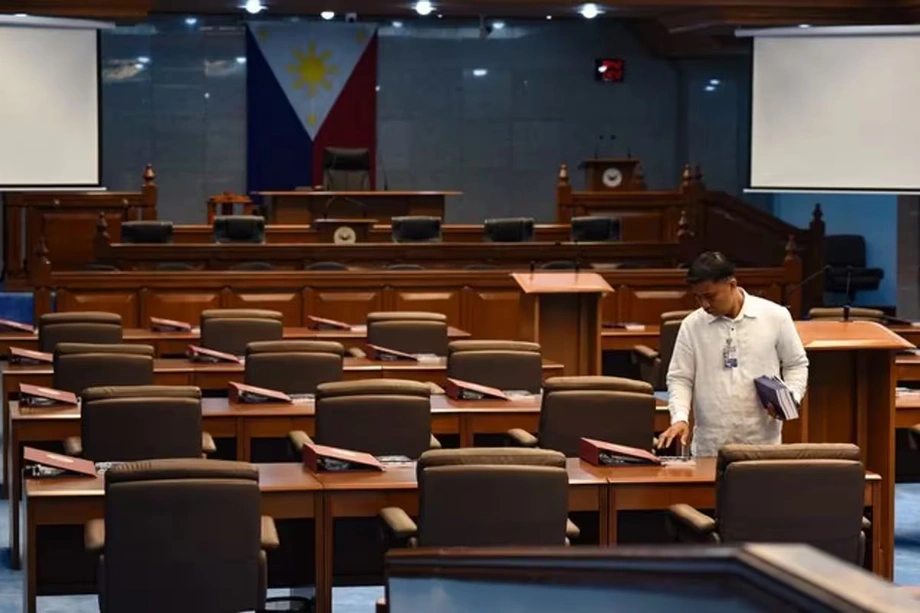
The impeachment court ruled in September that only senator judges able to participate would count toward the constitutional requirement of a two thirds majority for conviction. With four of the Senate's 24 members unable to participate, the court's calculation requires 14 votes rather than 16.
Fourteen is the smallest whole number that reaches two thirds of 20. Under that calculation, seven participating senators withholding support would leave the prosecution short of a conviction.
A pending voting rule challenge before the Supreme Court could affect whether the threshold is based on the participating senators or the full Senate membership. The current trial rule uses 14 votes.
Luistro acknowledged that the smaller voting pool affects both sides:
The number for conviction was reduced, but we should not overlook the fact that the number for acquittal was also reduced.
Quitzon said senators would weigh shifting alliances and their political interests before 2028. His assessment reflects the political setting of a trial decided by elected legislators, who must also judge the evidence presented in court.
How the case reached its November defense phase
Duterte and Marcos won the 2022 election on a joint ticket before their alliance broke apart. Marcos has described impeachment as a legislative matter.
The dispute has already passed through a major constitutional interruption. The Senate archived impeachment articles in August 2025 following a Supreme Court ruling that declared those proceedings unconstitutional. The current trial began in July 2026.
- 2024: Investigations began into allegations that later formed part of the impeachment dispute.
- July 2026: The current Senate impeachment trial began.
- September 2026: The impeachment court adopted its voting calculation based on participating senator judges.
- October 13, 2026: The court accepted withdrawal of three articles, leaving Article II.
- November 9, 2026: Duterte's lawyers began presenting defense evidence on Day 40.
- November 10, 2026: The trial reached Day 41 as prosecutors reiterated their goal of finishing in 2026.
The defense had been allotted 30 trial days, although prosecutors have pressed for a shorter presentation following the withdrawal of three articles. The November calendar listed further sittings on November 11, 12, 13, 19, 20 and 23.
Both sides have expressed hope for a conclusion before the end of the year, but no verdict date has been fixed. The November trial schedule also has to accommodate the Senate's work on the proposed 2027 national budget.
Key Points
- Prosecutors are pursuing one remaining impeachment article against Sara Duterte, centered on alleged unexplained wealth.
- Forensic expert Alexander Cabrera estimated about 817.87 million pesos in alleged undeclared assets and unexplained wealth. The defense disputes the figure.
- Duterte's lawyers began their defense on November 9 with testimony about property disclosures and have listed 24 witnesses.
- The impeachment court currently requires 14 votes for conviction, with a Supreme Court challenge concerning the threshold pending.
- Prosecutors want a verdict before the end of 2026. No verdict date has been fixed.
- Duterte denies wrongdoing. A conviction could remove her from office and disqualify her from future public office.