Manila seeks more missiles and a new space partnership
The Philippines is seeking more BrahMos supersonic cruise missiles from India in negotiations that could produce a purchase worth $700 million to $800 million, alongside a request for Indian help with a military satellite programme. The proposed missile order would follow a $375 million contract signed in January 2022 that made Manila the weapon's first foreign customer.
Contents
- Manila seeks more missiles and a new space partnership
- How large could the new missile purchase be?
- Why roads and bridges matter to a missile force
- What the first contract provides
- What BrahMos can do
- Manila presents the purchase as deterrence
- What Manila is asking India to do in space
- India's defence export business is growing
- Missile plans advance alongside diplomacy
- Key Points
Three people with direct knowledge of the negotiations described the talks as being in their final stages. Two Indian sources put the prospective purchase at about five systems containing nearly 60 missiles. Philippine defence ministry spokesperson Arsenio Andolong confirmed that President Ferdinand Marcos Jr wanted additional BrahMos missiles, without giving quantities or a price.
Defence Secretary Gilberto Teodoro Jr publicly outlined the Philippine interest during a video appearance at the third Delhi Defence Dialogue, hosted by the Manohar Parrikar Institute for Defence Studies and Analyses in New Delhi. His request went beyond buying more weapons: Manila has sent Indian authorities a list of changes intended to make the systems better suited to Philippine roads, bridges and transport conditions.
Teodoro also said Marcos had directed the Armed Forces of the Philippines to pursue a satellite acquisition programme. He described India as a potential partner, opening another area of cooperation as Manila strengthens its coastal defences amid confrontations with China in the South China Sea.
The two requests connect different military needs. Coastal missiles give Philippine forces a way to threaten hostile ships approaching defended areas. Satellites could support military operations from space, although the functions, cost and timetable of the proposed Philippine network have not been announced.
How large could the new missile purchase be?
A contract worth $700 million to $800 million would be roughly 1.9 to 2.1 times the value of the original $375 million order. The difference would amount to another $325 million to $425 million in spending compared with the first purchase.
The initial agreement covered three coastal missile batteries, together with training and logistics support. The prospective order is described as about five systems with nearly 60 missiles. A system or battery is a group of equipment used together, rather than a single missile, so the numbers refer to different parts of the purchase.
An earlier August account described Philippine consideration of as many as nine additional batteries under its Integrated Shore-Based Anti-Ship Missile System plan. The more recent negotiating estimate is about five systems. Neither government has publicly confirmed the quantity, final price or signing date of a second contract.
India's defence and foreign ministries and BrahMos Aerospace did not respond to requests for comment on the prospective agreement. Andolong's statement confirms presidential interest, while the detailed estimates of size and value come from people familiar with the discussions.
Why roads and bridges matter to a missile force
Teodoro's request for changes focuses attention on an everyday constraint: heavy military equipment must reach the places where it will operate. A coastal missile force depends on launchers, monitoring and tracking equipment, support vehicles and crews moving together.
The defence secretary explained the transport difficulties while discussing Manila's request for a system better suited to local conditions:
We hope to increase the number of BrahMos units we have… Given the fact that our roads are less durable and bridges are less durable than India's, we don't have any rolling stock or any active railroad, and it is also a challenge to transport,
The Philippine request therefore concerns the practical use of the weapon as well as its performance in flight. A launcher that has to avoid weak bridges or take longer routes can be harder to move between coastal positions. Across an archipelago, moving equipment between islands adds another transport task.
Teodoro said Manila had shared a wish list with Indian authorities. He did not describe the engineering changes sought, leaving the manufacturers and military planners to work through how the equipment could fit Philippine operating conditions.
What the first contract provides
The January 2022 agreement established a coastal missile capability for the Philippine Marine Corps. The missiles were acquired under Horizon 2 of the Armed Forces of the Philippines' modernisation programme, which runs for 15 years.
Then defence secretary Delfin Lorenzana said the purchase included three batteries, training for operators and maintainers, and an integrated logistics support package. Logistics support covers the arrangements needed to keep equipment supplied, maintained and usable after delivery. The Coastal Defense Regiment of the Philippine Marines was identified as the main user.
Lorenzana and BrahMos Aerospace Director General Atul Dinkar Rane signed the contract, valued at approximately 18.9 billion Philippine pesos. The procurement followed an agreement between India and the Philippines in March 2021 that created a framework for defence equipment purchases.
The delivery schedule has stretched across several years:
- March 2021: India and the Philippines signed a defence equipment procurement agreement.
- January 2022: Manila signed the $375 million contract for three coastal BrahMos batteries, training and support.
- April 2024: India delivered the first battery by air.
- April 2025: The second battery arrived by sea.
- August 2026: The third battery was described as being prepared for shipment, with completion of the original deliveries expected during 2026.
Neither government had confirmed delivery of the third battery in the accounts describing its preparation for shipment. The first two deliveries show that the next purchase is being discussed while the original programme is still being completed.
What BrahMos can do
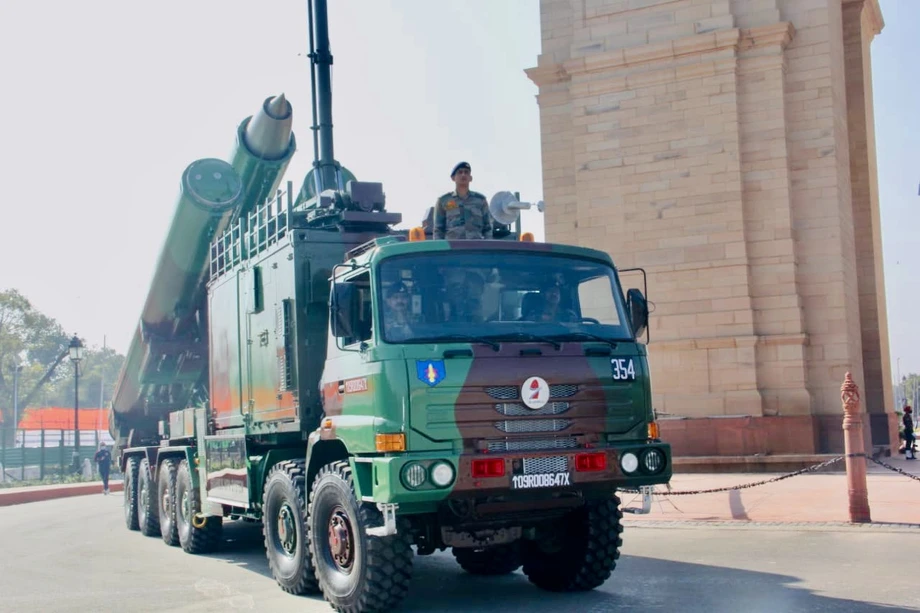
BrahMos is produced by BrahMos Aerospace, a joint venture between India's Defence Research and Development Organisation and Russia's NPO Mashinostroyeniya. The coastal version bought by the Philippines is designed to attack ships from launchers positioned on land.
The missile has a range of about 290 to 300 kilometres and travels at close to Mach 2.8, or almost three times the speed of sound. A cruise missile uses an engine to sustain its flight toward a target. Supersonic means it travels faster than sound, reducing the time available for a targeted ship to respond.
BrahMos also exists in versions launched from warships and aircraft. A version launched from ships can strike land targets, while India has also worked on an underwater version for submarines. Manila's existing purchase concerns coastal defence, with launchers on shore threatening ships at sea.
A battery brings together the equipment and people needed to perform that mission. Launch vehicles carry the missiles, monitoring and tracking components help identify and follow targets, and support vehicles keep the unit operating. This explains why transport, training and maintenance account for an important part of the Philippine request.
Manila presents the purchase as deterrence
Philippine officials describe BrahMos as a way to discourage an attack by making the potential cost higher. That is the basic idea of deterrence: a country builds a credible ability to respond so that an opponent has a reason to avoid starting a conflict.
Teodoro said India's willingness to sell the system reflected confidence in Philippine intentions. He described the acquisition as a "seal of good housekeeping" and said the weapons would be used for defensive purposes and consistently with international law.
Philippine Ambassador to India Josel F. Ignacio also framed the purchase around preventing conflict. In a television interview, he said:
We don't want to see it used. We are a peace loving country. So, all of this is about deterrence but credible deterrence,
The immediate setting is the South China Sea, where Philippine and Chinese vessels have repeatedly confronted one another around disputed areas. Vietnam also has maritime disputes with China. For Manila, a larger coastal missile force would add military options alongside patrols, diplomacy and legal action.
The Philippines has pursued those other routes at the same time. Its July seabed submission sought recognition of rights to the seabed and subsoil beyond 200 nautical miles off western Palawan. That process addresses resources beneath the sea, while the missile purchase concerns military defence.
What Manila is asking India to do in space
Marcos has directed the Philippine military to enter a satellite acquisition programme, Teodoro said. The defence secretary called space cooperation a "special request" and described India as a "very, very important potential partner".
India's likely counterparts include the Indian Space Research Organisation and its defence space bodies. Their possible involvement would extend the relationship beyond missile production into a field requiring spacecraft, ground facilities, communications links and personnel trained to operate them.
Military satellites can perform different jobs. Some carry communications between distant units; others collect images or other information. Teodoro's announcement identifies a Philippine ambition to acquire space capabilities, with the eventual design determining which tasks the programme can carry out.
The satellite request also broadens the significance of the missile negotiations. Manila is considering India as a supplier across more than one area of military technology, rather than approaching it solely for another batch of BrahMos missiles.
India's defence export business is growing
India's defence exports reached 384.24 billion rupees, or $4.11 billion, in the financial year ending in March, according to government figures cited in accounts of the negotiations. That represented growth of more than 62% compared with the previous year.
BrahMos is part of that export push. India announced supplies to Indonesia in July and has signed a separate agreement with Vietnam. Discussions on the missile system have also involved the United Arab Emirates, Thailand, South Africa and Brazil.
Interest in the weapon increased after India used BrahMos in combat during the conflict with Pakistan that lasted four days the previous year, an operation India called Operation Sindoor. The Philippine relationship, however, began earlier, with the procurement framework in 2021 and the first export contract in 2022.
Ignacio has said India has joined the countries Manila regards as credible sources of defence technology. He also indicated that the Philippine defence ministry and military could increasingly look to India for other purchases. The satellite request provides a concrete example of that wider interest.
Missile plans advance alongside diplomacy
Manila's procurement effort is proceeding alongside its push for a South China Sea code of conduct during its 2026 chairmanship of the Association of Southeast Asian Nations. Foreign ministers have expressed hope that negotiations with China can conclude by December 2026.
The Philippine effort to secure a regional conduct code concerns rules for encounters at sea, including ways to reduce dangerous confrontations. The BrahMos expansion concerns the military capacity Manila would have if deterrence failed. Both are responses to the same security pressures, using different tools.
For Philippine forces, the practical priorities are connected: complete the original missile deliveries, make additional equipment suitable for local transport conditions, and determine what a military satellite programme should provide. The proposed second missile order would be much larger in value than the first, while its usefulness would also depend on training, maintenance and the ability to move and operate the batteries.
For India, securing another Philippine contract would build on its first BrahMos export sale. A space partnership would widen that relationship further, linking coastal defence procurement with Manila's plans for military capabilities beyond land and sea.
Key Points
- The Philippines is seeking additional BrahMos missiles and Indian help with a military satellite programme.
- Negotiating estimates describe about five missile systems, nearly 60 missiles and a possible value of $700 million to $800 million.
- The original $375 million contract covers three coastal batteries, training and logistics support.
- Teodoro wants equipment better suited to Philippine roads, bridges and transport conditions.
- The first two batteries arrived in April 2024 and April 2025; preparation of the third for shipment was described in August 2026.
- Philippine officials present the missile purchase as defensive deterrence amid South China Sea tensions.
- The potential second missile contract and the satellite programme have no publicly confirmed final price or delivery timetable.