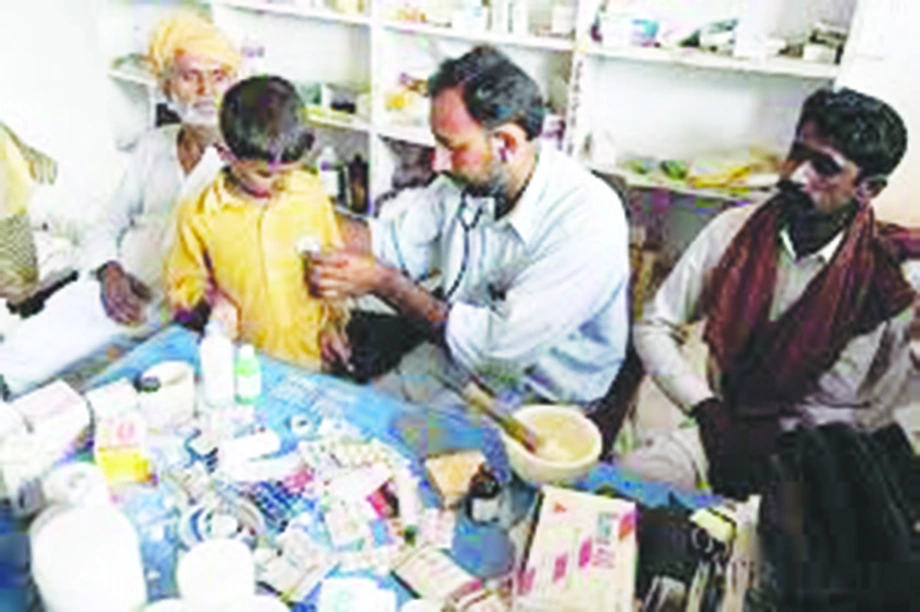
More registered doctors, yet hospitals remain under pressure
Pakistan needs an estimated 179,000 additional doctors as overcrowded public hospitals struggle to meet demand. Yet the government's Pakistan Economic Survey 2024-25 records 319,572 registered doctors in 2024, up from 299,113 in 2023, and a national ratio of one registered doctor for every 723 people.
Contents
- More registered doctors, yet hospitals remain under pressure
- What the official doctor counts show
- Why local shortages can be much worse
- Which staffing benchmark applies?
- Nurses and beds are part of the same problem
- Regional totals reveal different needs
- What shortages mean for routine treatment
- Turning workforce growth into accessible care
- Key Points
The apparent contradiction sits at the centre of the country's healthcare problem: a growing medical register can exist alongside shortages in the hospitals and clinics where patients seek treatment. Registration counts people listed with the medical regulator. Staffing measures the doctors available to provide care at a particular facility.
The account accompanying the shortage estimate puts total registrations at 340,780 and describes teaching hospitals as having one doctor for every 1,300 people. It gives a much lower figure for Tehsil and District Headquarters hospitals and basic health units: 0.23 doctors for every 1,000 patients. These are facilities intended to provide care closer to people's homes.
The Finance Ministry's Pakistan Economic Survey 2024-25 provides a dated national baseline, marking its 2024 figures as provisional. The 340,780 registration total and the estimated shortage of 179,000 have no accompanying reference date or calculation method, leaving their relationship to that baseline unclear.
For patients, the central issue is practical: whether a nearby facility has enough staff, beds and medicines to treat them. The national register has grown substantially, while the reported pressure on government hospitals points to a continuing gap between medical qualifications and accessible services.
What the official doctor counts show
Pakistan's registered medical workforce has expanded for more than a decade. The Finance Ministry's Pakistan Economic Survey 2023-24 lists 152,368 doctors in 2011 and 299,113 in 2023. That is an increase of 146,745, or about 96%, bringing the register close to twice its earlier size.
The latest survey extends that growth to 319,572 in 2024. Compared with the 220,829 doctors registered in 2018, the increase is 98,743, or about 45%. The figures describe sustained growth rather than a recent surge alone.
The surveys provide this timeline:
- 2011: 152,368 registered doctors, with 1,162 people per registered doctor.
- 2017: 208,007 registered doctors, with 957 people per registered doctor.
- 2022: 282,383 registered doctors.
- 2023: 299,113 registered doctors, with the newer survey giving 760 people per registered doctor.
- 2024: A provisional 319,572 registered doctors and 723 people per registered doctor.
The 2024-25 survey describes the annual increase in doctors as 5.9%. Its table, however, shows an increase of 20,459 between 2023 and 2024, which works out to about 6.8%. The earlier increase, from 282,383 in 2022 to 299,113 in 2023, was approximately 5.9%.
The register therefore shows clear growth even though the latest survey's stated percentage and its underlying counts differ. For workforce planning, the next task is connecting those registrations to actual services: the number of doctors working, their locations, their specialties and the hours of care they provide.
Why local shortages can be much worse
Teaching hospitals and smaller public facilities occupy different positions in the healthcare system. Teaching hospitals combine treatment with medical training and often receive patients needing specialist care. District hospitals, Tehsil hospitals and basic health units are intended to meet needs nearer to communities.
The reported ratio of one doctor for every 1,300 people at teaching hospitals is equivalent to about 0.77 doctors per 1,000 people. The figure of 0.23 doctors per 1,000 patients at smaller facilities uses a different denominator: patients rather than the population. Each describes pressure on services, but calculating a direct comparison requires matching the groups being counted.
A national population ratio spreads registered doctors across the country on paper. A patient needs a doctor in a reachable place, at the time care is required. Uneven staffing and limited facilities help explain why government hospitals can remain crowded while national registration figures improve.
Which staffing benchmark applies?
The shortage account cites one doctor per 1,000 people as a World Health Organization recommendation. Babar Tasneem Shaikh's universal health coverage study, published on June 24, 2024, uses a different reference point: it describes Pakistan as having about one doctor per 1,000 people, against a stated recommendation of three to four.
The government's 2024 ratio of one registered doctor per 723 people is equivalent to about 1.38 registered doctors per 1,000 people. The different figures concern different dates, definitions and reference levels. Any national staffing target needs to specify the population covered, the doctors counted and the services those doctors are expected to deliver.
Shaikh's study also considers the workforce through a wider measure. It gives Pakistan's essential health workforce density indicator a score of 54.6% in 2021, drawing on the Ministry of National Health Services, Regulations and Coordination and WHO's 2023 monitoring report. This is a score against a workforce threshold, rather than a count of doctors at individual hospitals.
The distinction matters when explaining the estimated need for 179,000 more doctors. A shortage calculation depends on its target: meeting a national population ratio, filling vacant posts and ensuring specialist services in every district are different tasks, each requiring its own staffing plan.
Nurses and beds are part of the same problem
Pakistan's medical workforce includes far more than doctors. Nurses monitor patients and deliver continuing care, midwives support pregnancy and childbirth, and community workers connect households with health services. A hospital needs these roles alongside doctors to keep treatment moving.
The 2024-25 survey records 138,391 registered nurses in 2024, compared with 134,708 in 2023. It also lists 46,801 midwives and 29,163 workers in its lady health worker category. Registered dentists increased from 36,032 to 39,088 over the same period.
The newer survey revises some earlier workforce figures. For 2023, the 2023-24 edition had listed 127,855 nurses, 46,110 midwives and 24,022 lady health workers. The following edition records 134,708, 46,404 and 26,405 respectively. Comparisons across years therefore need to use the revised series consistently.
Shaikh's study describes a nurse density of 0.5 per 1,000 people against a desired level of four. It also gives a hospital bed density of six per 10,000 people against a stated recommendation of 25. At those reference levels, the nursing figure is one eighth of the desired density, while the bed figure is just under one quarter.
These shortages affect what additional doctors can do. A doctor may assess a patient, but treatment requiring admission also needs a bed, nursing care, equipment and medicines. Expanding one part of that chain leaves other capacity limits to be addressed.
Regional totals reveal different needs
Azad Jammu and Kashmir provides a more detailed example of how the workforce is divided. The 2024-25 survey lists 1,230 doctors in the region: 68 health managers, 352 specialists, 82 dental surgeons and 728 medical officers.
Those categories add up to the regional total, but their daily duties differ. Health managers organise services, specialists treat particular conditions, dental surgeons provide oral care, and medical officers deliver broader medical services. Planning patient care requires knowing the mix of roles as well as the total headcount.
The survey also records approximately 2,950 hospital beds in the region, or one for every 1,468 people. It gives specialist availability as 0.81 per 10,000 people and medical officer availability as 1.68 per 10,000. These figures provide a closer view of local capacity than a single national doctor ratio.
Specialised services have their own staffing needs. The survey records 250 doctors among 2,600 personnel at Atomic Energy Cancer Hospitals, alongside medical physicists, biomedical engineers, radiopharmacists and scientists. Cancer treatment illustrates why workforce planning must account for teams with different technical skills.
What shortages mean for routine treatment
Pregnancy care, childhood pneumonia and chronic illnesses all depend on services that people can reach regularly. Shaikh's study identifies limited opening hours, staff shortages and shortages of essential medicines as barriers to antenatal care. Its 2021 indicators put the proportion completing at least four antenatal visits at 51.4%.
For childhood pneumonia, the study describes a shortage of paediatric facilities and skilled staff, limited operating hours at public facilities, and expensive medicines and diagnostic tests. Families also face difficulties recognising symptoms and judging when treatment is urgent. Access depends on both a functioning service and the ability to seek it promptly.
High blood pressure and diabetes place another kind of demand on local care: screening, continuing treatment and follow-up. Shaikh, the study's sole author, calls for primary care physicians to have the training needed to identify diabetes earlier:
Primary care physicians must be equipped with skills and training to screen such individuals at early stage so that a large proportion of the population, including the young ones, can be saved from this disease.
The study also points to home visits by community health workers, backed by nearby public facilities, as a way to help people continue prescribed blood pressure treatment. This connects workforce planning directly to care outside hospital wards, where regular contact can support patients managing illness over many years.
Turning workforce growth into accessible care
Pakistan has already set out health policy commitments beyond increasing doctor numbers. Shaikh's study describes an essential health services package for different levels of care and a National Action Plan for 2019-2023 covering governance, financing, staffing, service access and quality.
The shortage account identifies the lack of a comprehensive national policy for distributing medical facilities fairly across provinces and cities as a reason for pressure on public hospitals. The study describes existing national and provincial initiatives, while also documenting continuing gaps in access. The practical policy task is to turn those commitments into staffed and equipped services in the places that need them.
Pakistan's universal health coverage service index rose from 49.9 in 2021 to 52 in 2022, according to the study. The index combines measures of access to essential services, including maternal care, infectious disease treatment and service capacity. Its improvement of 2.1 points shows progress, alongside the workforce and facility shortages documented in the same analysis.
A useful measure of success will be whether growth in medical registrations brings more reliable care at basic health units, district hospitals and specialist centres. For patients, that means a nearby consultation, timely testing, available medicines and a staffed bed when admission is necessary.
Key Points
- Pakistan faces an estimated need for 179,000 additional doctors, alongside overcrowding and limited facilities in public hospitals.
- The Pakistan Economic Survey records a provisional 319,572 registered doctors in 2024, up from 299,113 in 2023.
- The official national ratio improved from 760 people per registered doctor in 2023 to 723 in 2024.
- Local staffing, professional roles and access to facilities determine how registration growth translates into treatment.
- Nursing shortages, limited beds and gaps in medicines and operating hours add to pressure on services.
- Pakistan's health coverage index improved from 49.9 in 2021 to 52 in 2022, while substantial access gaps continued.