A 45 Day Opportunity With an Earlier Pressure Point
Fubon Guardians reliever Jyun-Yue Tseng is entering Major League Baseball's posting system with 25 saves, a 1.80 earned run average and a negotiating window scheduled to run from 8 a.m. Eastern time on November 8 through December 22, 2026. MLB announced through social media that Tseng had entered the posting process and that all 30 clubs could begin contact at 8 a.m. Eastern time on November 8, or 9 p.m. Taiwan time. A possible labor stoppage could leave the pitcher and interested clubs working toward a much earlier date.
Contents
- A 45 Day Opportunity With an Earlier Pressure Point
- Why December 1 Matters
- What His Latest Season Shows
- Six Seasons Behind the Breakthrough
- International Experience and the Pitching Question
- How Fubon's Transfer Payment Works
- A Minor League Deal Has Different Terms
- A Potential First Through Taiwan's Overseas Free Agency Route
- Key Points
MLB's collective bargaining agreement with the Major League Baseball Players Association expires at 11:59 p.m. Eastern time on December 1. A lockout is expected, potentially interrupting the period in which the 25-year-old right-handed pitcher can negotiate a move from Taiwan to an American club.
Tseng arrives on the market after striking out 65 batters and walking 13 in 52 1/3 innings in the Chinese Professional Baseball League, or CPBL. His combination of speed, control and experience finishing games gives clubs a concrete record to examine as they consider how he might fit into an MLB bullpen.
The Pittsburgh Pirates and Chicago Cubs have been linked with interest. No signing club, contract value or agreement has been announced.
Why December 1 Matters
The posting process allows MLB clubs to negotiate with Tseng during a defined period, with compensation payable to Fubon if he signs. His scheduled window lasts 45 days, counting November 8 and December 22.
A lockout would be a stoppage imposed by club owners during negotiations with the players' union. For Tseng, the immediate concern is the possibility that it interrupts normal signing activity before his posting period ends.
December 1 therefore becomes a practical target for completing a deal, while December 22 remains the scheduled posting deadline. The key dates are:
- November 8, 2026, at 8 a.m. Eastern time: MLB clubs can begin negotiations.
- December 1, 2026, at 11:59 p.m. Eastern time: The collective bargaining agreement expires, with a lockout expected.
- December 22, 2026: Tseng's scheduled negotiating period ends.
A stoppage beginning after December 1 would put roughly the final three weeks of the window at risk. How MLB would handle his remaining posting time during a lockout has not been specified.
What His Latest Season Shows
Tseng finished the season with five wins, three losses and 25 saves in 48 appearances for Fubon. A save generally rewards a relief pitcher who protects a lead through the end of a game under defined conditions. His total reflects regular responsibility for getting the final outs.
His 1.80 earned run average means he allowed an average of 1.8 earned runs for every nine innings pitched. Earned runs exclude runs attributed to certain defensive mistakes, making ERA a common measure of a pitcher's ability to limit scoring.
The strikeout and walk figures offer another useful comparison. Tseng recorded exactly five strikeouts for every walk, based on 65 strikeouts and 13 walks. Across 52 1/3 innings, those totals work out to approximately 11.2 strikeouts and 2.2 walks per nine innings.
For a reliever asked to protect a narrow lead, that combination matters: strikeouts remove the chance of a ball falling safely between fielders, while limiting walks reduces the number of runners who reach base without a hit. MLB clubs will weigh those results alongside his pitches and how they might work against different hitters.
Six Seasons Behind the Breakthrough
Fubon selected Tseng in the seventh round of the 2020 CPBL draft. He won the league's Rookie of the Year award in 2021 and has since built a record extending well beyond his latest season.
Across his first six CPBL seasons, Tseng appeared in 287 games and pitched 292 innings. He accumulated 342 strikeouts, 91 saves and 59 holds, with a career ERA of 1.94. A hold recognizes a relief appearance in which a pitcher protects a lead before handing the game to another reliever.
His career WHIP was 1.00. The statistic counts walks and hits allowed per inning pitched, meaning he allowed an average of one runner per inning through those two routes.
Tseng's latest ERA of 1.80 was below his career mark of 1.94. His 25 saves also accounted for about 27% of his career total of 91. Together, the figures show both sustained run prevention and a substantial recent workload in the closer's role.
International Experience and the Pitching Question
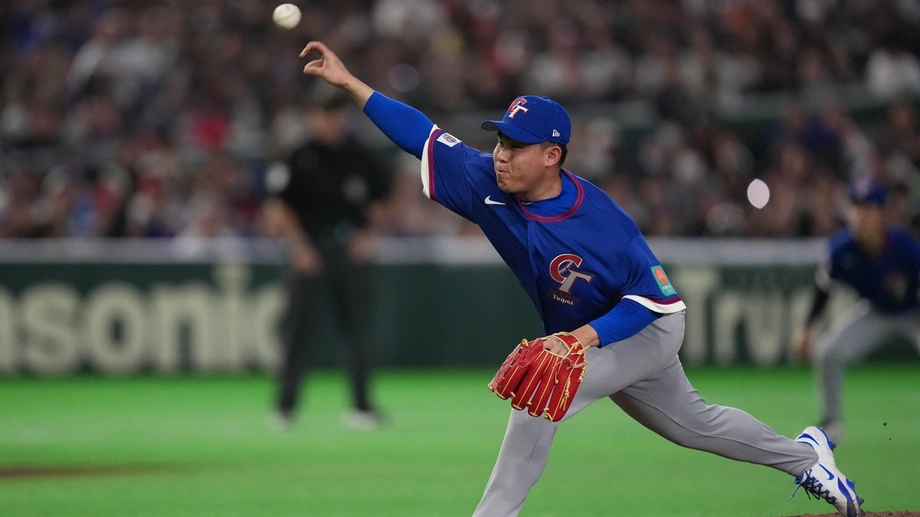
Tseng represented Chinese Taipei at the World Baseball Classic in 2023 and 2026. In the latest tournament, he threw hitless innings against South Korea and the Czech Republic and recorded one save.
Against South Korea, his four-seam fastball averaged 93.7 mph, approximately 150.8 km/h. He also used a cutter, a fastball variation that moves sideways as it approaches the hitter. His fastest pitches have been measured at around 158 km/h.
Tseng's velocity gives him a clear attraction for MLB clubs, although the quality of his other pitches is likely to help determine his role. His secondary pitches have been identified as an area needing further development if he is to become more than a middle reliever in MLB.
A middle reliever usually pitches between the starter and the pitchers assigned to finish close games. Tseng has regularly closed games for Fubon, but an American club could initially consider a different assignment as it evaluates how his fastball and cutter work against MLB hitters.
His international experience began much earlier than the Classic. Tseng also played in the 2014 Little League World Series, adding another stage to a career that has taken him from youth competition to Taiwan's professional league and now the MLB market.
How Fubon's Transfer Payment Works
MLB's posting agreement with the CPBL sets a sliding scale for the payment an American club would owe Fubon if Tseng signs a major league contract. The payment goes to his Taiwanese club and is calculated from the contract's value.
- For the first $25 million of a major league contract, the posting fee is 20%.
- For the next $25 million, the fee is 17.5%.
- For any amount above $50 million, the fee is 15%.
Each percentage applies only to the portion of the contract within that band. For example, a hypothetical $10 million major league contract would generate a $2 million payment to Fubon. A hypothetical $30 million contract would produce $5 million on the first $25 million and $875,000 on the remaining $5 million, totaling $5.875 million.
Those examples explain the formula rather than predict Tseng's eventual contract. Fubon would also receive a supplemental payment equal to 15% of earned bonuses, salary increases triggered by contract conditions and payments from options that a club exercises.
A Minor League Deal Has Different Terms
A minor league contract would use a different calculation: Fubon's initial posting payment would equal 25% of Tseng's signing bonus. For example, a hypothetical $200,000 bonus would result in a $50,000 payment to the Guardians.
A contract could also specify major league pay if Tseng is selected to an MLB club's roster of 40 players. That roster includes the players a club can draw upon for its major league team, subject to other roster rules.
If Tseng earns money under those major league terms, Fubon would receive a supplemental posting payment equal to 15% of those earnings. The distinction gives interested clubs two different contract structures to consider, each with its own compensation rules.
For Tseng, the contract type would also shape the immediate next step in his career. A major league agreement would place him on the club's major league roster structure, while a minor league deal would provide a route toward earning that place.
A Potential First Through Taiwan's Overseas Free Agency Route
Tseng exercised his rights under Taiwan's overseas free agent system before entering the MLB posting process. If he completes the move, he would become the first CPBL player to reach American professional baseball through that overseas free agency route.
The prospect comes just after his 25th birthday. In a social media post accompanied by a family photograph, Tseng thanked those who had supported him. The Fubon relief pitcher wrote in Chinese:
勇敢跨出每一步,感謝給我祝福的每一個人。
His message means: take every step bravely, and thank you to everyone who has sent good wishes.
The Pirates and Cubs are among the clubs reported to have followed him. For any interested team, the decision combines an assessment of his pitching with the cost of a contract, the payment to Fubon and the possibility of a shortened negotiating period.
Key Points
- Tseng's scheduled MLB negotiating window runs from November 8 through December 22, 2026.
- An expected lockout after the labor agreement expires on December 1 could interrupt that window.
- The Fubon reliever recorded 25 saves, a 1.80 ERA and 65 strikeouts against 13 walks in his latest season.
- His six CPBL seasons produced 91 saves, 342 strikeouts and a career ERA of 1.94.
- Fubon's compensation depends on whether he signs a major league or minor league contract and on any later qualifying earnings.
- The Pirates and Cubs have been linked with interest, with no deal announced.