A national health crisis meets a new funding pledge
Air pollution is reducing average life expectancy in Pakistan by an estimated 3.9 years, contributing to about 128,000 premature deaths annually and imposing costs equivalent to 6.5 percent of the economy, according to an assessment by the Pakistan Air Quality Initiative (PAQI). In Lahore, sustained exposure to current pollution levels could shorten lives by as much as seven years.
Contents
- A national health crisis meets a new funding pledge
- What the national assessment measures
- Why Lahore faces such severe exposure
- A month of warnings across several pollutants
- Transport leads in Lahore, industry in Karachi
- Dust suppression and industrial enforcement
- What the $10 million announcement commits
- The economic cost reaches households
- Key Points
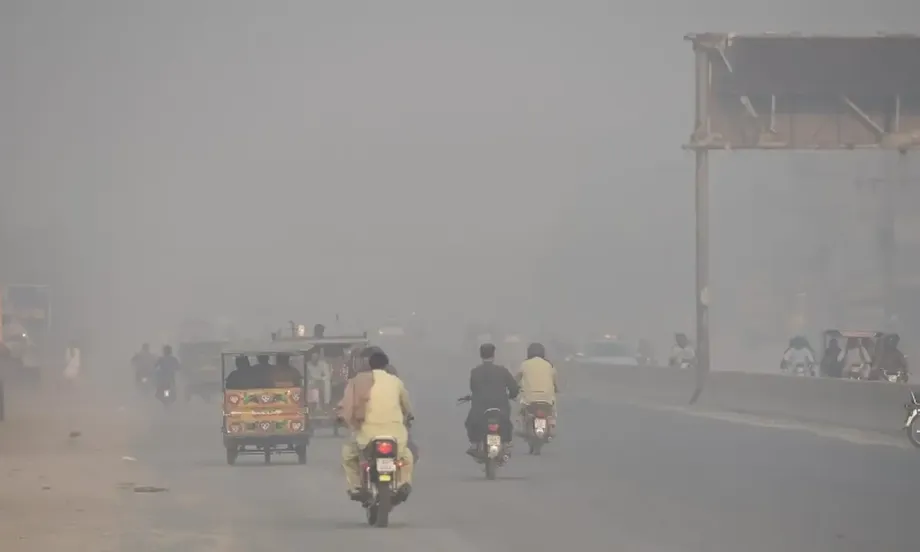
The findings give a national measure of a crisis that became visible again on October 28, 2026. At 10am, Lahore topped IQAir's live ranking of major cities with an Air Quality Index (AQI) reading of 296, in the very unhealthy category. Karachi ranked fifth at 173, classified as unhealthy.
That same day, Climate Change Minister Musadik Masood Malik announced a $10 million allocation to establish a dedicated Clean Air Fund at the Pakistan National Clean Air Conference in Islamabad. He said the government had allocated its own resources and described access to a clean and healthy environment as a fundamental right.
The immediate response includes industrial inspections, action against crop residue burning and additional equipment to suppress dust. PAQI's findings point to a broader task: reducing emissions from transport, factories and brick kilns, with priorities that differ between cities.
What the national assessment measures
PAQI's assessment, titled Unveiling Pakistan's Air Pollution: A National Landscape Report on Health Risks, Sources, and Solutions, combines a national emissions inventory with air quality assessments for Lahore, Karachi, Islamabad-Rawalpindi and Peshawar. An emissions inventory estimates how much pollution different activities release, helping authorities identify where reductions could have the greatest effect.
The study brings together measurements taken near the ground, satellite observations and local information on fuel consumption, vehicle fleets, industrial activity and emissions from economic sectors. It examines fine particulate matter, carbon monoxide, nitrogen oxides and sulphur dioxide.
Fine particulate matter, known as PM2.5, consists of particles measuring 2.5 micrometres or less across. These particles are small enough to travel deep into the lungs, and some can enter the bloodstream. Repeated exposure increases the risk of serious heart and lung disease.
The estimated loss of 3.9 years describes the effect of pollution across a population. Individual outcomes vary with exposure, age and health. The estimate of approximately 128,000 premature deaths expresses another part of the same health burden: people dying earlier because polluted air contributes to illness.
Why Lahore faces such severe exposure
Lahore's annual average PM2.5 concentration exceeds an estimated 110 micrograms per cubic metre. The World Health Organization recommends an annual level of five micrograms per cubic metre, putting Lahore's estimate at more than 22 times that guideline.
The seven years of potential life expectancy loss associated with sustained exposure in Lahore is about 1.8 times the national estimate of 3.9 years. That comparison shows how much more severe the long term health burden can be in a heavily polluted city.
Winter weather makes the situation worse. During a temperature inversion, warmer air sits above cooler air near the ground, restricting the upward movement that would normally help disperse pollution. Emissions then accumulate in the air people breathe.
Lahore's AQI reading of 296 on October 28 captured conditions at a particular time. The annual PM2.5 figure measures exposure over a much longer period. AQI converts pollution measurements into a scale that communicates immediate health risk, while an annual concentration helps describe persistent exposure.
A month of warnings across several pollutants
Lahore's October pollution alerts included particulate pollution and ozone. Ozone near the ground forms when other pollutants react in sunlight and can irritate the lungs. An analysis released by the European Union's Copernicus Atmosphere Monitoring Service on October 1 described Lahore's ozone levels as extremely poor.
The sequence of alerts and policy announcements shows how the crisis developed during the month:
- October 1, 2026: The Copernicus analysis identified extremely poor ozone levels in Lahore.
- October 2: Lahore topped IQAir's live major city ranking with an AQI of 167, classified as unhealthy.
- October 28, at 10am: Lahore recorded an AQI of 296 and Karachi 173, placing them first and fifth respectively in the live ranking.
- October 28: Malik announced the clean air funding initiative at the national conference in Islamabad.
- October 29: Approval of the proposed fund's board was expected, according to the minister's announcement.
Children, older people and those with asthma or other heart and lung conditions face particular risks during severe pollution episodes. Residents were advised to limit prolonged outdoor exertion when pollution levels were high, especially those with respiratory conditions.
Transport leads in Lahore, industry in Karachi
Transport accounts for 35 percent of Lahore's primary PM2.5 emissions, followed by industry at 28 percent and brick kilns at 17 percent, according to PAQI. Together, those three categories account for 80 percent of the city's primary PM2.5 emissions.
Primary PM2.5 means fine particles released directly into the air. Other fine particles form later through chemical reactions involving gases. The inventory therefore helps identify major direct sources while the wider assessment examines several pollutants.
Karachi has a different profile: industry accounts for 49 percent of emissions in the assessment. That makes factories and other industrial activity central to the city's response, while Lahore's figures give transport the largest share of directly emitted fine particles.
The practical lesson is that each city needs measures matched to its emissions. Lahore's inventory directs attention toward vehicle pollution alongside factories and kilns. Karachi's industrial share gives authorities a different starting point for inspections, fuel choices and emissions controls.
Dust suppression and industrial enforcement
Punjab authorities were procuring and installing 30 additional fog cannons mounted on electric trucks, according to Environment Protection Agency spokesperson Sajid Bashir. Anti-smog guns were being deployed first in places with higher pollution readings, particularly elevated PM10 levels.
PM10 includes particles up to 10 micrometres across and can include dust from roads and construction. Fog cannons spray water to suppress airborne dust and limit its spread from roads and nearby areas. The emissions inventory also identifies sources that require action at vehicles, factories and kilns.
Bashir identified construction as another contributor to pollution in Lahore and elsewhere in Punjab. Describing the effect of ongoing projects, the EPA spokesperson said:
Development work in Lahore and other cities of the province was also contributing to pollution,
Punjab Climate Watch was monitoring Lahore's industries in three shifts, with teams inspecting violations, registering cases and imposing fines. Bashir also said authorities had installed devices to record pollution levels and were taking steps to prevent crop residue burning.
Easterly winds were carrying polluted air from India's border regions into Lahore and central Punjab, Bashir said. His account places incoming pollution alongside the local emissions identified by PAQI, showing why weather conditions and action on domestic sources both matter to daily exposure.
What the $10 million announcement commits
Malik described a government allocation of $10 million for a dedicated Clean Air Fund. In his conference remarks, he also presented the initiative as a planned fund for clean air startups, with approval of its board expected the following day. The announcement combined a funding commitment with governance arrangements still awaiting approval.
The minister said the money would come from Pakistan's limited government resources after efforts to secure support from development partners. He described the initiative as an obligation to future generations rather than a grant or loan.
No application timetable, eligibility rules or date for releasing money was given. Those details will determine which businesses or projects can receive support and when the allocation can begin paying for practical work.
Malik acknowledged the World Bank, Asian Development Bank, UNICEF and the German development agency GIZ for their contributions to climate initiatives. He said the government would pursue clean air measures with or without external support and called for engineering solutions, effective policies and financial commitments.
The economic cost reaches households
Pakistan's pollution burden is estimated at the equivalent of 6.5 percent of gross domestic product, both in the PAQI assessment and in Malik's conference remarks. GDP measures the value of goods and services produced in an economy. Expressed in simple terms, the estimated burden equals 6.5 out of every 100 units of annual economic output.
Malik connected that cost to illness, hospitalisation and financial pressure on families. For households, polluted air can mean treatment bills and time away from work while someone is sick or caring for a relative.
People with fewer resources bear a heavier burden, the minister said, because they have less ability to protect themselves. He also noted that agricultural communities whose practices contribute to pollution suffer its effects themselves. Measures addressing farming emissions therefore need to account for livelihoods as well as air quality.
The combined findings make the priorities concrete: reduce the emissions identified in each city, enforce controls on polluting activities and turn the funding announcement into projects with clear rules and delivery dates. Dust suppression addresses one immediate problem; transport, industrial and kiln emissions require sustained action at their sources.
Key Points
- PAQI estimates that air pollution reduces average life expectancy in Pakistan by 3.9 years and contributes to about 128,000 premature deaths annually.
- Lahore's estimated annual PM2.5 concentration exceeds 110 micrograms per cubic metre, more than 22 times the WHO guideline.
- Transport, industry and brick kilns account for a combined 80 percent of Lahore's primary PM2.5 emissions.
- Industry accounts for 49 percent of Karachi's emissions in the assessment.
- The government announced a $10 million clean air initiative, with board approval expected on October 29, 2026.
- Punjab's response includes industrial inspections, action against crop residue burning and 30 additional fog cannons mounted on electric trucks.