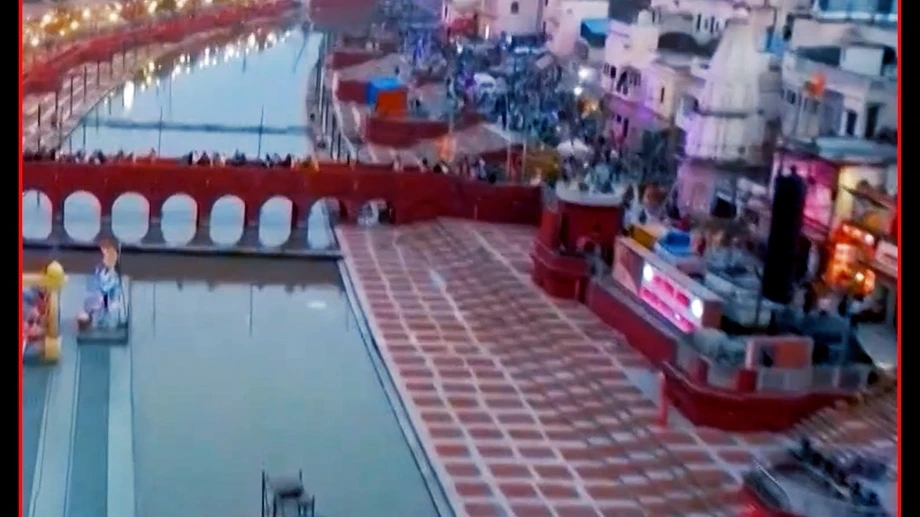
A bigger festival along the Saryu
Ayodhya plans to light more than 3 million earthen lamps across 56 riverfront ghats on November 7, 2026, as the Uttar Pradesh city prepares for its tenth Deepotsav. Around 35,000 volunteers will help arrange and light the diyas, while a fleet of 2,100 drones is scheduled to recreate scenes from the Ramayana above the Saryu riverfront.
Contents
- A bigger festival along the Saryu
- How the lamp display has grown
- Students take charge of the ghats
- What happens from November 5 to 9
- The Ramayana on stage and in the sky
- Sand art and digital scenes reshape the venues
- What the orders mean for local potters
- Road restrictions put residents at the centre
- A cultural celebration before the 2027 election
- Key Points
Dr Rammanohar Lohia Avadh University, which is coordinating the lamp arrangements, has procured 3.3 million diyas. The extra 300,000 lamps provide a buffer for breakage during transport and placement, giving organisers 10% more than the central target of 3 million.
The celebrations are scheduled to run from November 5 to November 9, combining religious ceremonies, performances by international Ramlila troupes, sand art, projection mapping and fireworks. Chief Minister Yogi Adityanath is expected to attend the main event.
The proposed lighting would exceed the 2025 Guinness World Record benchmark of 2.617 million lamps cited in festival preparations. A historical festival tally gives a higher 2025 total of more than 2.8 million. The final number successfully lit and any new Guinness certification will be known after the event.
For residents, the preparations bring both work and disruption. Potters have received large orders, students have been assigned stretches of the riverfront, and vehicles will be barred from Ram Path and Dharma Path during the main programme. A separate drone show on November 9 is planned exclusively for Ayodhya residents.
How the lamp display has grown
Deepotsav began in 2017 with approximately 171,000 lamps. The 2026 target of 3 million is about 17.5 times that opening display, showing how much the festival has expanded within a decade.
Compared with the 2.617 million benchmark cited for 2025, lighting 3 million lamps would mean an increase of 383,000, or about 14.6%. The riverfront footprint is also growing, from 55 ghats previously to 56 this year. Ghats are the stepped areas and platforms beside the water where people gather for worship and ceremonies.
The lighting arrangements include the expanded Ram Ki Paidi, Chaudhary Charan Singh Ghat and Bhajan Sandhya Sthal. Organisers are dividing the space into marked blocks so volunteers can place lamps in orderly rows and patterns rather than work from an unstructured pile.
The scale makes preparation as important as the moment of lighting. Millions of small clay lamps must reach their assigned positions, survive handling and be ready for coordinated ignition across the riverfront.
Students take charge of the ghats
About 35,000 volunteers are being drawn from 30 degree colleges, 40 intermediate colleges and the university campus. By November 4, students were arriving at Ram Ki Paidi by bus and beginning to arrange diyas at their assigned ghats.
Avadh University Vice Chancellor Bijendra Singh has reviewed the arrangements. Festival nodal officer Professor S. S. Mishra has described a supervision structure involving 900 ghat coordinators, 112 ghat officers and 27 supervisors, giving the large volunteer force several levels of local oversight.
Volunteers will register online and receive identity cards carrying a photograph, contact details, a deployment location and a QR code. The cards are intended to help officials verify who belongs in each area and prevent duplicate registrations.
Safety instructions require volunteers to wear cotton clothing, avoid loose or synthetic garments and keep flammable materials away from the lamps. With thousands of people working close to open flames, clothing choices and clear working areas are practical parts of the lighting operation.
The university and district administration are coordinating lamp supplies, volunteer assignments, ghat management and security. Initial preparations included cleaning the ghats, marking the placement blocks and scheduling a bhoomi pujan, a ceremony held before work begins, at ghat number 10.
What happens from November 5 to 9
November 7 is the centrepiece of a programme spread across five days. The longer schedule gives the city several opportunities to present its performances and displays, including an evening reserved for local residents.
- November 5: The five days of Deepotsav celebrations are scheduled to begin.
- November 7: The main lamp lighting, riverfront ceremonies and principal cultural programme are planned.
- November 8: Additional public presentations are scheduled.
- November 9: Celebrations conclude, with a separate drone show planned exclusively for Ayodhya residents.
The Saryu Maha Aarti is planned to involve 2,147 participants, including public representatives, councillors and members of the public. Aarti is a Hindu ceremony in which light is offered in worship, often accompanied by chanting and music.
Sixty women associated with the Prajapita Brahma Kumaris Ishwariya Vishwa Vidyalaya will participate under Brahma Kumari Shashi. The riverbank ceremony is intended to carry messages of women's empowerment, spiritual awareness and social harmony.
Preparations also include a separate display of 100,000 lamps within the Ram Janmabhoomi complex. The temple arrangements divide the grounds into five sectors, with 1,500 personnel overseeing the lighting. Decorative facade lighting is planned for the main temple and the other temples within the complex.
The Ramayana on stage and in the sky
A fleet of 2,100 drones made in India will form images from the Ramayana in the night sky. That is 1,000 more drones than the 1,100 used in 2025, an increase of about 91%.
The Ramayana tells the story of Ram, including his exile and return to Ayodhya. Deepotsav's programme draws on that return through several forms of storytelling. A floating stage will combine dance, music and Hindi narration, while 22 tableaux will depict episodes drawn from the epic's seven books, known as kands.
The procession will include Ram Rath, Ram Darbar and Pushpak Viman displays. These represent a ceremonial chariot, Ram's royal court and the flying vehicle associated with his return in the epic.
About 2,500 artists are scheduled to perform across 12 stages: six small, four medium and two large. Artists from 16 districts of Uttar Pradesh will join performers from other states. The programme includes Karnataka's Dollu Kunitha, Rajasthan's Ghoomar, Bihar's Jhijhiya, Tharu traditions from Pilibhit and Vantangiya performances from Gorakhpur.
Ramlila troupes from South Africa, Sri Lanka, Nepal, Laos and Thailand will present their interpretations of the story through their own languages, costumes, music and theatrical traditions. The international performances place different cultural expressions of the same epic alongside those familiar to local audiences.
Sand art and digital scenes reshape the venues
Artist Madhurendra Kumar is creating a ceremonial installation covering 2,500 square feet with 220 tonnes of sand from the Saryu. The work at Ram Ki Paidi will depict the Shri Ram Temple and members of the divine family, creating a large physical counterpart to the aerial and digital displays.
Ram Katha Park will feature rangoli designs and decorations using lotus, kalash and diya motifs. A kalash is a ceremonial vessel used in Hindu rituals. Displays along the route between Lata Mangeshkar Chowk and Ram Ki Paidi will portray episodes from the Ramayana.
The evening programme includes an eight minute laser show, a 20 minute projection mapping presentation and musical fireworks. Projection mapping uses carefully aligned moving images to turn a building or another surface into part of a visual performance.
Visitors will also be able to use an augmented reality application on Android and iOS to view five three dimensional Ramayana scenes. Scanning designated locations at Ram Ki Paidi will place the digital scenes over the surroundings shown through a phone's camera, with options to record and share them.
City decorations include 13 themed gateways and 20 designated photo locations. Along Dharma Path, 50 digital pillars, each 12 feet high, are planned to display Ramayana episodes and lighting effects. Nationwide competitions for short videos and paintings form part of a digital outreach campaign targeting 50 million people.
What the orders mean for local potters
Twenty five women potters in Gyaspur in Ayodhya, and Kajiyapur and Bhaghar Jheel in Barabanki, have received an order worth Rs 12.8 lakh for 160,000 diyas. The order is worth Rs 1.28 million, equivalent to an average of Rs 8 per lamp across the contract.
Those 160,000 lamps represent about 5.3% of the main target of 3 million. The figures show how even a relatively small share of the festival's supply requirement can create a substantial production order for a group of rural artisans.
Other potters have also secured large assignments. Braj Kishore Prajapati said his family completed an order for 100,000 lamps, while artisan Rajesh Prajapati received an order for 200,000. By October 2026, 197 potters had received electric pottery wheels intended to increase production capacity.
Uttar Pradesh Tourism and Culture Minister Jaiveer Singh has put the estimated contribution of the five days of celebrations in 2025 to Ayodhya's local economy at Rs 55 crore, or Rs 550 million. The figure is an estimate for the wider festival economy, while the pottery contracts identify specific orders reaching individual producers.
Road restrictions put residents at the centre
Police plan three layers of security across the event area. Additional Director General Praveen Kumar has reviewed arrangements covering crowd control, movement of dignitaries, traffic and venue protection, with officers assigned specific responsibilities.
All vehicle movement on Ram Path and Dharma Path will be prohibited during the main programme on November 7. Police will be deployed at major routes, entrances and sensitive locations. Residents and visitors using those roads will need to account for the restrictions when planning journeys.
District Magistrate Shashank Tripathi has made coordination between departments, visitor convenience and safe operation priorities for the event. Those concerns extend beyond the riverfront: a festival of this size also depends on clean public spaces, reliable services and routes that people can use safely.
Amrit Abhijat, Uttar Pradesh Additional Chief Secretary for Tourism, Culture and Religious Affairs, explained the connection between everyday services and welcoming visitors:
The idea is that the city that works well for its people is better equipped to welcome visitors,
The November 9 drone presentation reserved for residents gives local people a dedicated place in a programme that otherwise draws national attention and visiting crowds. For the city, the practical task is to accommodate the spectacle while keeping daily movement and public services working.
A cultural celebration before the 2027 election
Deepotsav's tenth edition comes before the Uttar Pradesh Assembly election in 2027. The festival began in 2017, during the first year of Adityanath's government, and its expansion has accompanied the construction of the Ram Mandir, its consecration in January 2024 and investment in Ayodhya's transport and visitor infrastructure.
The Bharatiya Janata Party has connected the city with its religious and cultural agenda for decades. The annual festival now gives the government a recurring occasion to present that agenda through tourism, public works and cultural events.
Adityanath linked the festival to social unity in a November 3 message:
Lamps burn in different hands, but their light unites the entire society. This is the message of Deepotsav,
Electoral competition in the area remains close. In the 2024 parliamentary election, Samajwadi Party candidate Awadhesh Prasad won the Faizabad constituency, which includes Ayodhya, with 554,289 votes against BJP candidate Lallu Singh's 499,722, a margin of 54,567. Within the Ayodhya Assembly segment, however, the BJP retained a lead of 4,667 votes.
Those results provide the immediate political setting for the celebrations. Local services, livelihoods and representation sit alongside religious identity in the contest for voters. The pottery orders, road arrangements and attention to residents therefore concern both the daily running of the festival and the government's wider presentation of Ayodhya's development.
Key Points
- Ayodhya targets more than 3 million diyas across 56 ghats for the main Deepotsav event on November 7, 2026.
- Avadh University has procured 3.3 million lamps and is coordinating about 35,000 volunteers.
- The November 5 to 9 programme includes 2,100 drones, about 2,500 artists and Ramlila troupes from five countries.
- Twenty five women potters have received an order worth Rs 12.8 lakh for 160,000 lamps.
- Vehicles will be barred from Ram Path and Dharma Path during the main programme.
- A separate drone show on November 9 is planned exclusively for Ayodhya residents.