Nine aircraft cross the Taiwan Strait median line
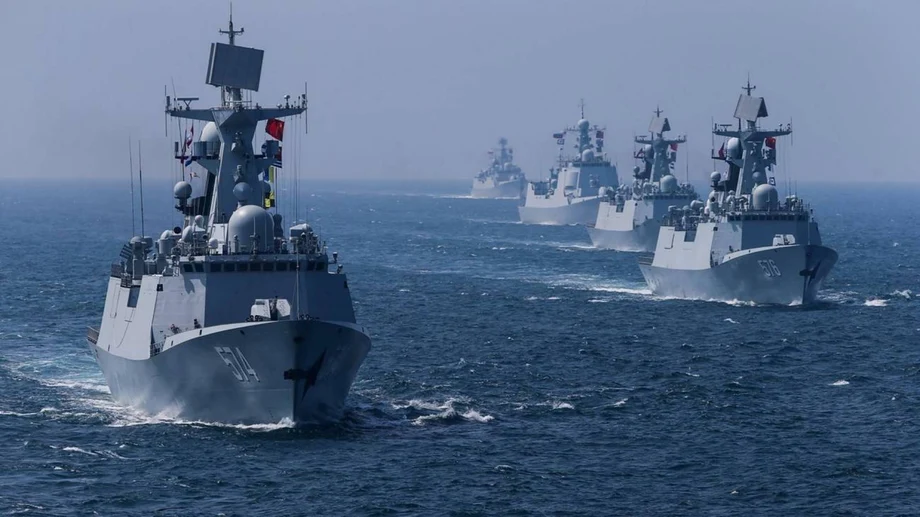
Taiwan's Ministry of National Defense detected 11 Chinese military aircraft, 10 warships and three other official Chinese vessels during a 24 hour period ending at 6 a.m. Saturday. Nine aircraft crossed the Taiwan Strait median line and entered Taiwan's northern and southwestern air defense identification zones, the ministry said.
Contents
- Nine aircraft cross the Taiwan Strait median line
- Aircraft numbers fluctuate, while ships stay nearby
- How the activity developed
- What an unannounced exercise can achieve
- Why naval persistence matters for a blockade
- Government vessels and civilian fleets widen the picture
- Japan and the Philippines prepare around key routes
- Defense spending exposes a large resource gap
- The pressure reaches trade and diplomacy
- Key Points
Taiwan responded with aircraft, naval vessels and coastal missile systems to monitor the activity. The median line is an informal dividing line in the strait between Taiwan and China. An air defense identification zone, or ADIZ, is an area where authorities monitor approaching aircraft for security purposes; it extends beyond the territorial airspace immediately above a country's land and surrounding waters.
The ministry's running count for the month reached 125 aircraft detections and 83 naval vessel detections. These figures count activity across reporting periods, so an aircraft or ship operating repeatedly can appear more than once. The calendar date of the Saturday bulletin was not specified.
The combination of aircraft crossings, warships and other government vessels illustrates the pressure Taiwan faces across several fronts at once. Beijing claims Taiwan, which governs itself, and has threatened to use force to take control. Taipei must track the movements while keeping forces available for further activity.
Aircraft numbers fluctuate, while ships stay nearby
October 2026 figures compiled from Taiwan's daily defense bulletins show a more persistent Chinese presence at sea than in the air. The People's Liberation Army Navy maintained an average of six or seven vessels around Taiwan each day, with at least five present on 29 of the month's 31 days.
Aircraft activity was less consistent. October's reports recorded 223 sorties, meaning individual aircraft flights, with 149 entering Taiwan's ADIZ. Seven days passed without any Chinese military aircraft being detected. About two thirds of the month's recorded flights entered the identification zone.
The figures help explain why a quieter day in the air can still leave Taiwan facing sustained military pressure. Ships can remain nearby while aircraft return to their bases. Monitoring both requires attention to the duration and location of deployments as well as the daily totals.
The ChinaPower Project at the Center for Strategic and International Studies recorded 3,764 Chinese aircraft incursions into Taiwan's ADIZ in 2025, an increase of 22.4% from 2024. October 2026's 149 entries were below the monthly average of 319 recorded from May 2024 through December 2025, while the naval presence remained close to the earlier pace of 221 vessel detections a month.
How the activity developed
Taiwan's bulletins and regional tracking describe several changes in activity across late October and early November. The geographical coverage varies: some counts concern the waters immediately around Taiwan, while others cover a much wider stretch of the western Pacific.
- October 2026: Daily reports recorded 223 Chinese military aircraft sorties, including 149 ADIZ entries, and at least five navy ships on 29 days.
- October 28: Taiwan published a regional map showing 53 Chinese naval and other official vessels from southern Japan to waters east of the Philippines.
- November 1: The preceding 24 hours brought 32 aircraft sorties, including 26 median line crossings and ADIZ entries, alongside seven warships and two official vessels.
- November 2: Taiwan recorded 19 aircraft, seven warships and six official vessels.
- November 4: The defense ministry recorded 49 aircraft, six warships and six government vessels in the preceding 24 hours.
The November 4 aircraft total was more than two and a half times the 19 recorded on November 2. The warship count moved in the opposite direction, from seven to six, showing how the air and sea components can change independently.
What an unannounced exercise can achieve
Su Tzu-yun, director of the Defense Strategy and Resources Division at Taiwan's Institute for National Defense and Security Research, described the surge to 49 aircraft as a "quiet exercise." He said Beijing was maintaining intense pressure without formally announcing military drills.
Gray zone tactics pursue security objectives through actions below the level of open warfare. The International Institute for Strategic Studies describes them as efforts beyond routine deterrence and reassurance that seek results without a direct and sizable use of force. Around Taiwan, repeated flights and ship deployments can make an intrusive military presence increasingly familiar.
Su said the activity extended Beijing's effort to normalize such operations and expand the China Coast Guard's asserted jurisdiction into the Taiwan Strait. He argued that Taiwan needed to focus on how it responded, as well as the size of each deployment.
"The frequency and number of Chinese aircraft and ship sorties will likely continue to increase, but the important thing for Taiwan is to remain vigilant despite Chinese numbers," he said.
Taiwan has tracked an increase in this form of pressure since September 2020. Its response requires surveillance, decisions about which forces to deploy and continued readiness for the next movement. The practical burden comes from repetition as much as from any single large formation.
Why naval persistence matters for a blockade
China's standing naval presence is particularly relevant to preparations for a possible blockade, an operation intended to restrict ships or aircraft entering and leaving Taiwan. Taiwan depends on open sea routes, while a blockade would seek to control access without first landing a large army on the island.
The Center for Strategic and International Studies assessed that China's December 2025 Justice Mission-2025 drills simulated blockading and encircling Taiwan. October's persistent ship deployments give Taipei and its partners another reason to examine how Chinese forces could sustain operations around the island.
The Pentagon's annual report on China's military, published on December 23, 2025, described substantial forces under the Eastern Theater Command opposite Taiwan, including three group armies, air force bases, destroyer and frigate flotillas, submarine units and a Rocket Force base. It assessed that China expects to be able to fight and win a war over Taiwan by the end of 2027.
The Pentagon also assessed that China lacked sufficient transport capacity for a large amphibious assault. Taiwan's defense ministry reached a similar judgment in its August 31 assessment, while describing the incorporation of ferries, cargo ships and other civilian vessels into landing drills. Moving an invasion force ashore requires a different combination of ships, equipment and support from restricting access at sea.
Government vessels and civilian fleets widen the picture
The three official vessels in the Saturday bulletin were counted separately from the 10 warships. That separation matters because Taiwan is monitoring a Chinese maritime presence extending beyond the navy, including government agencies with different equipment and operating roles.
Satellite tracking in March showed as many as 2,000 Chinese fishing vessels holding grid formations near Taiwan for hours. The scale and coordination of those movements add to the task of tracking civilian and military traffic in waters where a crisis could involve several kinds of vessel.
Taiwan's coast guard has also described Chinese maritime research activity as preparation of the underwater battlefield. During expanded seabed surveys, Chinese vessels repeatedly sailed parallel routes south and east of Taiwan. Information about depth, underwater terrain and water conditions can help submarines navigate and affect sonar, which uses sound to locate objects underwater.
The geographical spread was visible in Taiwan's 53 vessel deployment map published on October 28. It identified 34 navy ships and 19 Coast Guard or other official vessels. The aircraft carrier Liaoning and its accompanying group were east of the Philippines, while other formations operated near Taiwan and southern Japan.
Japan and the Philippines prepare around key routes
Su connected the increased activity to diplomatic and military developments across the region. He cited joint support for Taiwan Strait peace and stability from the United States, Japan and South Korea at a G20 foreign ministers' meeting, the transit of the US aircraft carrier Theodore Roosevelt, and Liaoning's deployment east of the Philippines.
Japan and the Philippines sit beside important approaches to Taiwan. Yonaguni, Japan's westernmost island, lies about 110 kilometers away. The Philippines' Batanes islands extend across much of the Luzon Strait, the passage south of Taiwan into the Pacific.
Japan planned to bring a US Marine Corps NMESIS launcher, which fires missiles at ships, to Yonaguni during the October 19 to 29 Keen Sword 27 exercise. Tokyo also plans to station Type 03 surface to air missiles on the island by fiscal 2030. Chinese carriers spent 58 days beyond the First Island Chain in 2025, compared with 32 in 2024, according to Japanese defense ministry data compiled by CSIS.
The Philippines hosted about 17,000 personnel from seven countries during the Balikatan exercise in April and May. About 1,400 Japanese personnel participated, and a Japanese launcher fired two Type 88 missiles that sank a decommissioned Philippine warship on May 6.
Philippine Defense Secretary Gilberto Teodoro described the demonstration as relevant to future cooperation between forces.
"We have seen how it works and it is something that we can interoperate with in the future," he said.
Manila is also preparing for the possible evacuation of more than 200,000 Filipinos living in Taiwan. Its public cooperation with Taipei remains limited: on October 26, the Philippine Department of Foreign Affairs denied having an arrangement with Taiwan to protect undersea cables or other critical underwater infrastructure.
Defense spending exposes a large resource gap
Taiwan increased military spending by 14% in 2025 to $18.2 billion, equivalent to 2.1% of its economy, according to the Stockholm International Peace Research Institute. China's estimated spending reached $336 billion, up 7.4%, its 31st consecutive annual increase.
China's total was about 18.5 times Taiwan's, using those two figures. Beijing funds forces operating across a much larger area, while Taipei must prioritize the weapons, personnel and infrastructure it needs to defend the island. Taiwan has pledged to move toward defense spending equivalent to 5% of its economy by 2030.
Domestic budget negotiations affect how those plans translate into purchases. Taiwan's opposition controlled legislature cut TWD470 billion from the cabinet's TWD1.25 trillion special defense budget in May. The cabinet returned in September with a TWD606 billion supplementary request for drones and missile defense.
Washington proposed an $11.1 billion package of rocket launchers, drones and antitank missiles in December 2025. Taipei signed $6.59 billion in contracts in April, largely for HIMARS rocket systems and Paladin howitzers. Such procurement decisions sit alongside the daily cost of keeping aircraft, ships and surveillance systems ready.
The pressure reaches trade and diplomacy
Britain's parliamentary investigation into Taiwan Strait deterrence described economic dependence on China as a potential constraint on responding to a crisis. The committee identified 3,380 categories of British imports from China as vulnerable to disruption, including 911 considered critical.
About 20% of global maritime trade passes through the Taiwan Strait each year, according to figures cited in that investigation. A confrontation affecting shipping would therefore reach businesses and consumers far beyond Taiwan, Japan and the Philippines. Governments considering a response would also have to manage disruption to their own supplies.
Su identified a possible further period of pressure before the end of the year. He said China routinely conducts a year end strategic exercise to assess military development and predicted that the aircraft carrier Shandong would join a naval exercise over long distances in mid December.
His assessment places continued surveillance at the center of Taiwan's immediate task. Aircraft totals can rise sharply, ships can remain nearby through quieter periods, and deployments elsewhere in the western Pacific can affect the forces available around Taiwan. For Taipei, the challenge is to follow that wider pattern while responding to each day's movements.
Key Points
- Taiwan detected 11 Chinese military aircraft, 10 warships and three official vessels during a reporting period ending Saturday morning.
- Nine aircraft crossed the Taiwan Strait median line and entered Taiwan's northern and southwestern ADIZ sectors.
- October 2026 records showed at least five Chinese navy ships nearby on 29 of 31 days, despite seven days without aircraft detections.
- A November 4 bulletin recorded 49 aircraft, six warships and six government vessels.
- Taiwanese researcher Su Tzu-yun described the surge as a quiet exercise and predicted possible further pressure around a mid December naval exercise.
- Japan and the Philippines are preparing around routes important to Taiwan, while defense purchases and regional diplomacy continue.