A genetic map of Vietnam's rice diversity
VinUni University's Big Data Research Institute (VIBD) has introduced VN1K-RICE, a project to sequence the complete genomes of 1,000 Vietnamese rice samples, beginning with a core collection of 150. Researchers plan to combine the genetic information with assessments across three ecological regions to help identify rice suited to drought, salty soils, heat and flooding, while also studying grain quality and greenhouse gas emissions.
Contents
- A genetic map of Vietnam's rice diversity
- Why begin with 150 samples?
- Bringing stored rice collections into research
- Why Vietnamese reference genomes matter
- Testing what the DNA means in the field
- How genetic information could guide breeding
- AI tools and a database for shared use
- What is planned through 2030?
- Key Points
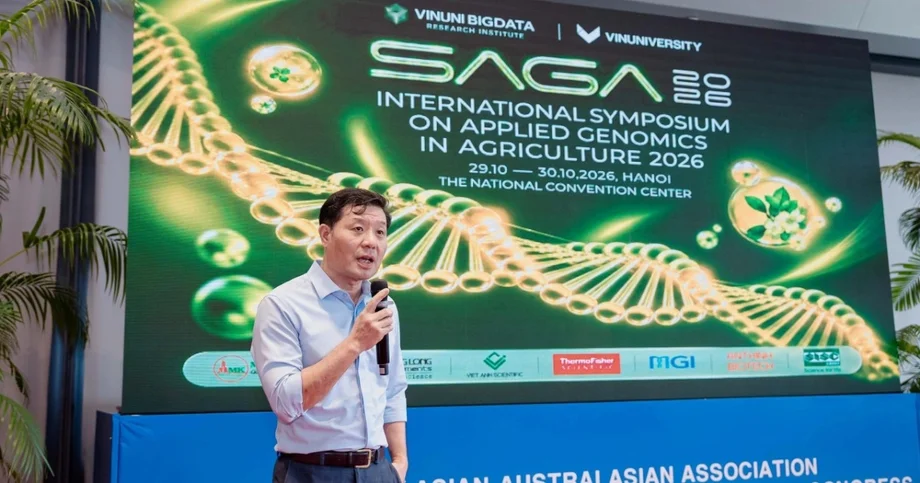
Presented at the International Symposium on Applications of Gene Technology in Agriculture, SAGA 2026, the project belongs to VIBD's AgriOmics-AI research programme for 2026 to 2030. Its planned outputs include a database of rice genomes, high quality reference genomes for traditional Vietnamese rice and information about gene activity.
The research brings together two kinds of evidence: what is written in a plant's DNA and how that plant actually performs. Connecting them could help breeders select useful material from Vietnam's traditional and wild rice collections, including plants carrying traits valuable for farming under difficult conditions.
Professor Vu Ha Van, VIBD's scientific director, leads VN1K-RICE. Professor Robert Henry, founding director of the Queensland Alliance for Agriculture and Food Innovation at Australia's University of Queensland and an affiliated lecturer at VinUni, is the project's co-leader.
Why begin with 150 samples?
The initial 150 samples represent 15% of the planned collection of 1,000. Researchers will start with this core group before expanding the sequencing effort. The selection covers irrigated lowland rice, upland rice, saline coastal areas and land affected by tidal flooding, alongside wild rice samples.
Those environments matter because rice plants face different pressures in each. A variety growing in a saline coastal area may carry useful characteristics different from those found in upland rice. Sampling across these settings gives researchers a way to examine a wider range of Vietnam's rice diversity.
The project will read whole genomes, meaning the complete set of genetic instructions contained in each sample's DNA. Differences in those instructions help shape characteristics such as grain aroma, stickiness, resistance to disease and tolerance of environmental stress.
The 1,000 samples are the project's sequencing target. Work begins with the smaller core collection, allowing the research to expand from a defined starting group rather than treating the entire collection as a single first step.
Bringing stored rice collections into research
Vietnam's traditional and wild rice collections are held by institutions including the Plant Resources Center, the Cuu Long Delta Rice Research Institute, Can Tho University and the Vietnam National University of Agriculture. These collections preserve material that scientists can study and use in breeding.
Most of these rice varieties have not had their whole genomes sequenced. Vietnam also lacks national genomic data infrastructure, limiting researchers' ability to identify useful genetic differences and work with them across collections.
VN1K-RICE aims to connect that preserved material with data researchers can analyse and share. A stored seed sample can then be studied alongside a record of its DNA and measurements of the plant's characteristics. This makes it easier to search for promising material, such as rice that combines desirable grain quality with tolerance of salt.
The project is being developed with domestic institutions that hold genetic resources and with international partners. Its breeding goals also connect with Vietnam's rice sector development strategy to 2030, with a vision to 2050, particularly the search for quality, climate adaptation and lower emissions.
VinUniversity's official announcement names the four collection-holding institutions, confirms collaboration with domestic genetic-resource holders and international partners, and links the project's planned national genomic data infrastructure to that strategy. It also describes participation by ministries, research institutes, universities and local representatives from across Vietnam, together with international experts.
Why Vietnamese reference genomes matter
A reference genome is a detailed genetic sequence used as a comparison guide. Researchers compare other rice genomes against it to locate differences and investigate which of those differences may be linked to useful characteristics.
VN1K-RICE plans to build reference genomes specifically for traditional Vietnamese rice. References closely related to the plants under study can help researchers examine local genetic material more accurately and identify regions worth investigating.
Robert Henry, the project's co-leader and founding director of the Queensland Alliance for Agriculture and Food Innovation, explained why the team wants references that reflect local diversity. In remarks translated from Vietnamese, he said:
A single genome cannot represent the entire genetic diversity of a species. Scientists need reference genomes that are closely related to the material being studied.
For Vietnamese breeders, the practical benefit would be a comparison framework built around rice closer to their own research material. The planned reference genomes and the wider collection of 1,000 sequences serve related purposes: detailed guides for comparison, and a broader record of the differences among samples.
Testing what the DNA means in the field
The team plans to combine genome sequences with assessments of rice characteristics in three ecological regions. The measurements cover food quality, nutrition, environmental stress, disease resistance and greenhouse gas emissions during cultivation.
For grain quality, researchers will examine stickiness and aroma, along with micronutrient and protein content. For growing conditions, they will assess tolerance of drought, salinity, heat and flooding. Resistance to common rice diseases is also part of the planned work.
A trait is simply a characteristic that can be observed or measured. By comparing traits with DNA differences across the collection, scientists can look for genetic regions associated with a particular result, such as stronger salt tolerance or a distinctive aroma.
Field measurements are central to that process. They connect a genetic sequence to the performance breeders care about: how a plant grows under stress, what its grain is like and how much greenhouse gas is released during cultivation.
The emissions work adds another selection goal alongside grain quality and resilience. Researchers intend to investigate genetic regions that could contribute to lower emissions by examining the relationship between DNA and measurements taken during cultivation.
How genetic information could guide breeding
Breeders could use the project's findings to screen rice material for useful DNA differences before choosing plants for crossing. For example, a traditional variety with strong salt tolerance could provide genetic material for developing rice suited to saline land.
A variety with a valued aroma or distinctive grain quality could provide material for improving rice already under cultivation. DNA analysis would help researchers identify plants carrying the characteristics they want to investigate, alongside breeding and assessment over successive generations.
The project also aims to develop near-isogenic lines. These are rice lines with almost the same genetic background but a difference in a particular target region. Comparing them helps researchers test the role of that region while keeping much of the rest of the plant's genetic makeup similar.
Such lines provide a more focused way to investigate a promising gene. If plants with closely matched genetic backgrounds differ in a measured trait, scientists can study the target region in greater detail and assess its usefulness for breeding.
DNA markers are another planned application. A marker is an identifiable feature in a DNA sequence that researchers can track. Markers can support the identification, selection and verification of rice varieties with valuable characteristics, making the genome database useful beyond the initial sequencing work.
AI tools and a database for shared use
Artificial intelligence will help process the large volume of genetic data, search for relationships between genes and traits, predict gene functions and identify promising research directions. The aim is to turn sequences into information that can guide further experiments and breeding decisions.
The official announcement specifies genomic language models for gene annotation and sequence-to-phenotype prediction: identifying gene functions and predicting plant characteristics from genetic sequences.
The project also expects to produce data on gene activity. Genome sequences record genetic instructions; gene activity data help researchers examine how those instructions are being used. Bringing these forms of information together can give scientists more ways to investigate the characteristics measured in rice plants.
According to the project proposal described in the announcement, the planned outputs include genomic data for 1,000 rice varieties, a high-quality reference genome for traditional rice and transcriptomic, or RNA-seq, data to support gene annotation. These will be combined with plant-characteristic and environmental data in a national database of single nucleotide polymorphisms, or SNPs. Researchers will use the resource to catalogue genetic regions and candidate genes associated with grain quality, stress tolerance and low emissions.
VIBD plans to open the genome database and AI tools to the research community. Shared access would allow other groups to use the collection, compare findings and extend the work with additional material.
Vu Ha Van, VIBD's scientific director and the scientist leading VN1K-RICE, described that collaborative aim. In remarks translated from Vietnamese, he said:
A reference genome or an SNP database only has real value when many research groups use and expand it. That is why we are developing VN1K-RICE together with institutions holding genetic resources in Vietnam and international partners.
SNPs are differences at individual positions in a DNA sequence. A database of these differences gives researchers identifiable points to compare across plants, helping them investigate diversity and track genetic features associated with traits.
What is planned through 2030?
AgriOmics-AI, the wider programme containing VN1K-RICE, runs from 2026 to 2030. It combines genomics and AI to study, conserve and use Vietnam's native genetic resources across crops, livestock, aquaculture and beneficial microorganisms.
Within that programme, VN1K-RICE has a defined sequence of work: begin with 150 core rice samples, expand towards 1,000, build reference genomes and connect genetic data with measured characteristics. Expected products include the sequence collection, reference genomes and gene activity data.
The announcement gives no specific completion date for the rice project, database opening date or timetable for releasing new rice varieties. It also gives no release timetable for gene activity data or AI tools. The immediate practical work centres on building research tools and evidence that breeding programmes can use.
For farming, the intended benefit is more informed selection of rice material: finding useful salt tolerance, preserving valued grain characteristics and investigating options for lower emissions. Progress will depend on connecting the DNA findings with the performance of plants evaluated in the project.
Key Points
- VinUni's VIBD plans to sequence 1,000 Vietnamese rice samples, starting with 150, or 15% of the target.
- The collection covers several cultivation environments and includes wild rice.
- Researchers will build reference genomes for traditional Vietnamese rice and assess plant characteristics in three ecological regions.
- Measurements will include grain quality, nutrition, stress tolerance, disease resistance and greenhouse gas emissions.
- Planned tools include an accessible genome database, AI tools, DNA markers and rice lines for testing target genetic regions.
- Planned data include RNA-seq information on gene activity and a national SNP database combining genetic, plant-characteristic and environmental information; no release timetable is specified for the data, database or AI tools.
- VN1K-RICE belongs to the AgriOmics-AI programme for 2026 to 2030.