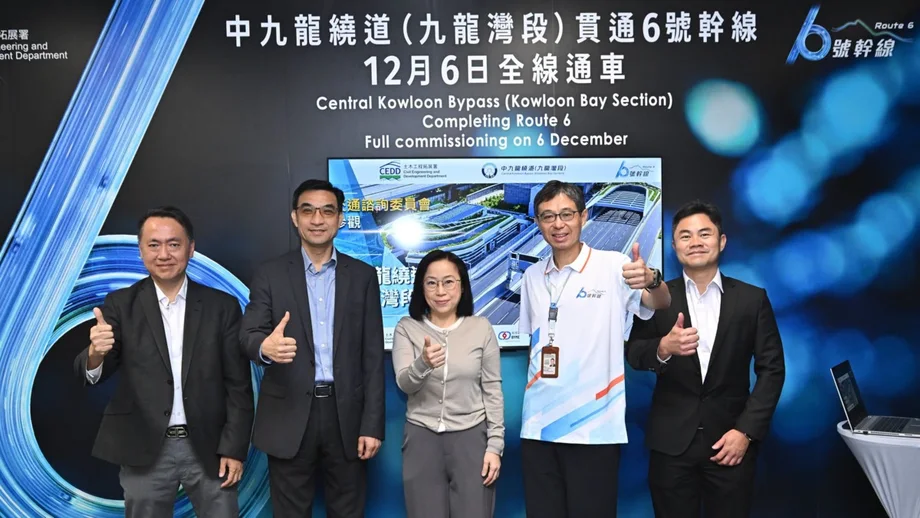
A 53 minute saving forecast for journeys across Kowloon
Hong Kong's Central Kowloon Bypass is scheduled to open fully on December 6, completing Route 6 and cutting the estimated journey between Tseung Kwan O town centre and Yau Ma Tei during busy periods from about 65 minutes to about 12 minutes.
Contents
- A 53 minute saving forecast for journeys across Kowloon
- What the final connection changes
- Which bus passengers will benefit?
- More routes and departures by the end of the year
- Six buses have tested the complete route
- Why tunnel signs are being tested overnight
- A major tunnel project with work continuing above ground
- The main dates in the rollout
- Key Points
The Transport Department plans to redirect three bus services through the new Kowloon Bay section: Citybus 795 towards West Kowloon, KMB 290E towards Tsuen Wan and Citybus A28X towards the airport. Each will use the complete Route 6 corridor, giving residents of Tseung Kwan O more direct connections across Kowloon.
The projected saving is 53 minutes, or about 82% of the journey time before Route 6 was commissioned. The Civil Engineering and Development Department uses that earlier journey as its comparison. The 12 minute estimate covers travel between Tseung Kwan O town centre and Yau Ma Tei; passengers travelling farther will also spend time reaching their stops and continuing to their destinations.
Secretary for Transport and Logistics Mable Chan announced the opening date at a meeting of the Legislative Council's Panel on Transport. She said authorities were completing system tests and fire safety inspections before the road opens.
Chan described the connection that the completed corridor will provide:
"The full opening of the Route 6 will establish a transport link connecting West Kowloon, East Kowloon and Tseung Kwan O," Chan said.
The opening follows the commissioning of the Yau Ma Tei section on December 21, 2025. The new section fills the remaining gap between that road and the Tseung Kwan O–Lam Tin Tunnel, allowing vehicles to follow the complete corridor.
What the final connection changes
The Kowloon Bay section connects to the Tseung Kwan O–Lam Tin Tunnel in the east and the Yau Ma Tei section in the west, with a connection to Cha Kwo Ling. Together, the roads form Route 6, linking Tseung Kwan O with eastern and western Kowloon.
The Civil Engineering and Development Department says the route is designed to separate longer journeys across districts from shorter local trips. Vehicles travelling between Tseung Kwan O and West Kowloon will have a direct corridor, while those making shorter journeys between Tseung Kwan O and Kai Tak can continue using existing roads.
For drivers, the practical change is a new choice of route according to their destination. For the surrounding districts, the aim is to reduce the amount of traffic making long journeys through roads that also serve local neighbourhoods.
The Highways Department identifies relief of congestion on existing roads running east to west across central Kowloon as the purpose of the Yau Ma Tei project. Completing the link extends the usefulness of that section by connecting it directly with the tunnel serving Tseung Kwan O.
Which bus passengers will benefit?
The Transport Department's three planned diversions cover different destinations. Citybus 795 will use the Kowloon Bay section towards West Kowloon, KMB 290E towards Tsuen Wan, and Citybus A28X towards the airport.
KMB says route 290E will travel between Tseung Kwan O Industrial Estate and Tsuen Wan West Station using the existing Tseung Kwan O–Lam Tin Tunnel and the entire Central Kowloon Bypass. This gives the route a continuous path through Route 6 rather than requiring it to leave the corridor at the unfinished connection.
Airport service A28X already appears on the Transport Department's Yau Ma Tei section guide, which lists its journey from Tseung Kwan O Station Public Transport Interchange to the Airport Ground Transportation Centre. The planned change brings it onto the new Kowloon Bay section as well.
KMB also plans special weekday services during busy periods on route X42C, which runs between Cheung Hang Estate in Tsing Yi and Yau Tong. Those additional journeys will use the Central Kowloon Bypass.
A new KMB route, 49E, is planned between Cheung Wang in Tsing Yi and Tseung Kwan O Industrial Estate. KMB says its route changes and new service will be introduced progressively after the Kowloon Bay section opens. Exact implementation dates, fares and detailed timetables for these changes have not been announced.
More routes and departures by the end of the year
The Transport Department says bus journeys between East Kowloon and the western New Territories have already become substantially shorter since the Yau Ma Tei section opened. Bus use of that road is also expanding.
The department expects the number of routes using the section to rise from an initial eight to 13 by the end of the year. The number of scheduled departures is expected to increase from 28 to more than 130.
Those figures represent five additional routes, an increase of 62.5%, and more than 4.6 times the initial number of departures. The much larger rise in departures means the expansion involves more journeys as well as more route numbers.
The department's existing public transport list includes 33X, 252S, 258X, 259S, 259X, 268P, 269S and A28X. These connect places including Tsuen Wan, Tuen Mun, Yuen Long, Tin Shui Wai and Tseung Kwan O with destinations across Kowloon and the airport.
The planned total of 13 routes describes the network expected by year end. Individual passengers will need the operating details for their particular service, especially where a change involves only special departures during busy periods.
Six buses have tested the complete route
The Civil Engineering and Development Department says construction of the Kowloon Bay section is substantially complete and preparations for opening have entered their final stage.
Two franchised bus operators sent a total of six double decker buses along the new road, travelling over the complete Route 6 between Yau Ma Tei and Tseung Kwan O. The department says the road tests were completed successfully.
Commissioner for Transport Angela Lee also inspected the Kowloon Bay section with members of the Transport Advisory Committee. Their visit covered the tunnel entrances and exits at both ends, Lam Tin Interchange, the control centre and the Kai Tak connecting road.
The inspection brings together several parts of the opening preparations: the physical road, the junctions where vehicles enter or leave, and the centre responsible for managing tunnel operations. Chan told lawmakers that final preparations also covered public transport facilities and road signs.
The Transport Department says it will increase publicity before and after the opening so drivers and passengers can understand the new routes. It will also closely monitor the tunnel operator's management and maintenance work.
Why tunnel signs are being tested overnight
The Tseung Kwan O–Lam Tin Tunnel is also involved in preparations for the full opening. The Transport Department has announced overnight tests of the traffic control and surveillance systems that will serve the completed Route 6.
During the testing periods, some lane control signals, tunnel closure signs and variable message signs will change their displays intermittently. Lane control signals tell drivers whether a lane is open, while variable message signs display instructions or information that can change with traffic conditions.
The announced testing window runs from 11.30pm to 3.30am the following morning on four nights. Temporary traffic signs will be placed at the site, and the department has urged motorists to drive carefully and be patient.
Fire safety inspections form another part of the final preparations described by Chan. These checks sit alongside system testing and the completed bus trials as authorities prepare to bring the connected roads into regular operation.
A major tunnel project with work continuing above ground
The Highways Department's Central Kowloon Route project page describes the Yau Ma Tei section as a road measuring 4.7 kilometres, with three lanes in each direction. About 3.9 kilometres is tunnel, roughly 83% of its length.
The section connects Yau Ma Tei Interchange in West Kowloon with the Kai Tak Development Area and Kowloon Bay in East Kowloon. Its estimated project cost is HK$42.36 billion, and construction began in December 2017.
The work included tunnels beneath the seabed of Kowloon Bay and at Ma Tau Kok, reconstruction of part of the Gascoigne Road Flyover, roads below ground level at Kai Tak, and connections to the existing street network. Separate contracts covered ventilation buildings, an administration building, and electrical and mechanical installations across the route.
The Highways Department also lists landscaping and public space work extending beyond the road opening. A contract covering landscaped decks, gardens, tree planting and improvements to part of Kai Fuk Road has an anticipated completion date in 2028.
Another contract, beginning in September 2026, covers the Ma Tau Kok landscaped deck and waterfront promenade, associated landscaping, and replacement facilities including the Kowloon City Ferry Pier Public Transport Interchange. Its anticipated completion date is 2029. Residents will therefore see some surrounding public spaces completed after traffic begins using the full bypass.
The main dates in the rollout
The road has opened in stages, while bus services and surrounding public works follow their own schedules. The key milestones are:
- December 2017: Construction began on the Yau Ma Tei section project.
- December 21, 2025: The Yau Ma Tei section opened to the public.
- Before the December 6 opening: Six double decker buses completed road tests between Yau Ma Tei and Tseung Kwan O; final system and fire safety checks continued.
- December 6: The Kowloon Bay section is scheduled to open, completing the bypass and Route 6.
- After opening: KMB plans to introduce its diversions, special services and new route progressively.
- By year end: The Transport Department expects 13 bus routes and more than 130 departures to use the Yau Ma Tei section.
- 2028 and 2029: Separate landscaping and waterfront contracts have anticipated completion dates.
For passengers, the immediate change will depend on when their bus service adopts the new road. For drivers travelling between Tseung Kwan O and West Kowloon, December 6 is the scheduled start of the complete connection.
Key Points
- The Central Kowloon Bypass is scheduled to open fully on December 6, completing Route 6.
- Authorities forecast a journey of about 12 minutes between Tseung Kwan O town centre and Yau Ma Tei during busy periods, compared with about 65 minutes before Route 6.
- Citybus 795, KMB 290E and Citybus A28X are planned to use the new Kowloon Bay section.
- KMB also plans special X42C departures and a new 49E service.
- Six double decker buses have successfully completed road tests over the full corridor.
- The Transport Department expects 13 routes and more than 130 departures to use the Yau Ma Tei section by year end.