Late night crowds put the new crossing under pressure
Hong Kong's new Huanggang crossing handled 14,760 travellers between midnight and 2 a.m. on the second weekend after its opening, prompting calls for a dedicated bus lane as private cars queued and some coach journeys from Tsim Sha Tsui stretched from 35 minutes to about 90 minutes.
Contents
- Late night crowds put the new crossing under pressure
- What happened during the busiest hours?
- Why operators want a bus lane
- Private cars and enforcement draw scrutiny
- Authorities increase staff and transport capacity
- Shenzhen Bay offers another late night route
- How the pressure developed
- What the record figures reveal
- What travellers face at the crossing
- Key Points
The Hong Kong government said passenger traffic in those two hours was 212% above the comparable period at the previous Huanggang and Lok Ma Chau facilities. About 1,200 vehicles headed towards Huanggang during the busiest hour, twice the usual weekend level, as visitors returned to Shenzhen after Halloween season activities and concerts.
The pressure continued into the Halloween weekend. Shenzhen boundary inspection authorities subsequently announced that the city processed 1.145 million passenger crossings on October 31, including a record 161,000 at Huanggang. The figures show how entertainment in Hong Kong, ordinary weekend journeys and travel associated with the Canton Fair combined to generate exceptional demand.
Transport operators and a legislator want changes on the roads approaching the crossing, alongside extra immigration counters and buses. Their concern is practical: coaches carrying returning visitors can become trapped in the same queues as private cars, delaying both the passengers aboard and the next group waiting in the city.
What happened during the busiest hours?
The government's figures put the sharpest surge between midnight and 1 a.m., when 9,375 passengers departed through the crossing, an increase of 176% from the previous comparable period. That single hour accounted for almost two thirds of the 14,760 travellers recorded between midnight and 2 a.m.
Online footage showed private cars queuing in the holding area outside the joint inspection building on Saturday night. Congestion also developed on Lok Ma Chau Road towards the crossing from San Tin, with queues reaching the San Tin Interchange.
San Tin Highway was particularly busy between 11:30 p.m. and 1:30 a.m. Police opened a vehicle holding area to manage the traffic, while authorities brought all lanes, passages and counters into operation early on the L1 vehicle departure level and the L1M inspection level for people travelling in vehicles.
At about 12:30 a.m., private cars took approximately 45 to 50 minutes to travel from the holding area through clearance. The wait later shortened to about 30 minutes. Passengers using the L1M inspection hall waited around 15 minutes, and the government said vehicle queues on the two levels had cleared by 2 a.m.
Police also described an average wait of about 25 minutes to reach the passenger drop off area and said cross boundary vehicle traffic returned to normal before 1 a.m. Their update concerned access traffic, while the government's later time covered queues inside the departure levels. Travellers therefore faced different waiting times depending on where they were in the journey.
Why operators want a bus lane
Choi Shun-kei, deputy general manager of the Cross Border Express bus management company, said passenger numbers on the Saturday night were twice those of the usual equivalent weekend period. The company increased departures from once every 15 minutes to once every five minutes, tripling the scheduled frequency.
Choi said congestion began at about 11 p.m. A queue towards Yuen Long at the San Tin Interchange reached roughly one kilometre, while a coach trip from Tsim Sha Tsui took about an hour and a half instead of 35 minutes. That made the journey more than two and a half times its usual length.
Coaches and private cars share the approach lanes. Choi said this slowed buses heading to the crossing and prevented them from returning promptly to urban boarding points. Adding departures becomes harder when the same vehicles spend longer completing each journey.
His proposed remedy is a bus lane on San Tin Highway, particularly for holiday peaks. Reserving road space for buses would give vehicles carrying many passengers a clearer route through congested approaches. The government preparations described so far focus on extra services, staffing and clearance capacity; no decision or opening date for a dedicated lane was announced.
Private cars and enforcement draw scrutiny
Choi said private cars licensed to cross at other checkpoints, including Shenzhen Bay, could switch to the new Huanggang crossing. He also suspected that some vehicles in the queues were providing unauthorised cross boundary passenger services.
These services are commonly called white plate cars in Hong Kong: private vehicles used to carry paying passengers without the required permission. No count of suspected illegal vehicles in the Huanggang queues was given.
Lawmaker Chong Ho-fung urged police to step up action against operators advertising such services on social platforms. He also called for clearer signs before the joint inspection building so private drivers could find the correct departure level without making wrong turns.
Chong argued that a bus lane would be relatively straightforward to introduce and said authorities should use the weekend experience to prepare more thoroughly for major events. His proposals address two different sources of delay: vehicles sharing limited road space and drivers navigating the new building.
Authorities increase staff and transport capacity
Chief Secretary Eric Chan inspected Huanggang and instructed the Security Bureau to open more inspection counters and vehicle lanes before peak periods. He also asked the Transport and Logistics Bureau to oversee preparations by transport operators.
The Transport Department directed cross boundary coach and franchised bus companies to strengthen services for major concerts at Kai Tak Sports Park and Halloween activities across Hong Kong. Franchised bus operators were to provide extra vehicles and staff, with changes to queues and boarding arrangements.
The Security Bureau, Immigration Department, Customs and Excise Department, police and other agencies were tasked with monitoring passenger and vehicle volumes. The Transport Department would coordinate the deployment of vehicles and staff according to demand.
Commissioner for Transport Winnie Tse Wing-yee inspected the Exhibition Centre Station Public Transport Interchange in Wan Chai, the cross boundary bus stop opposite Golden Plaza on Arran Street in Prince Edward, and the Austin Road coach terminus in Jordan. Operators prepared standby vehicles and relief drivers so they could increase services when queues grew.
Officials also checked taxi queues and encouraged taxi ambassadors to offer travel advice and help passengers line up. Chan asked visitors to plan ahead, avoid the busiest periods or stay overnight in Hong Kong after attending events.
Shenzhen Bay offers another late night route
Shenzhen Bay extended passenger clearance until 2 a.m. for two nights over the Halloween weekend, two hours later than usual. Cross boundary coaches departing from Causeway Bay, Wan Chai, Central, Tsim Sha Tsui and Mong Kok scheduled their final Shenzhen Bay services for 12:30 a.m.
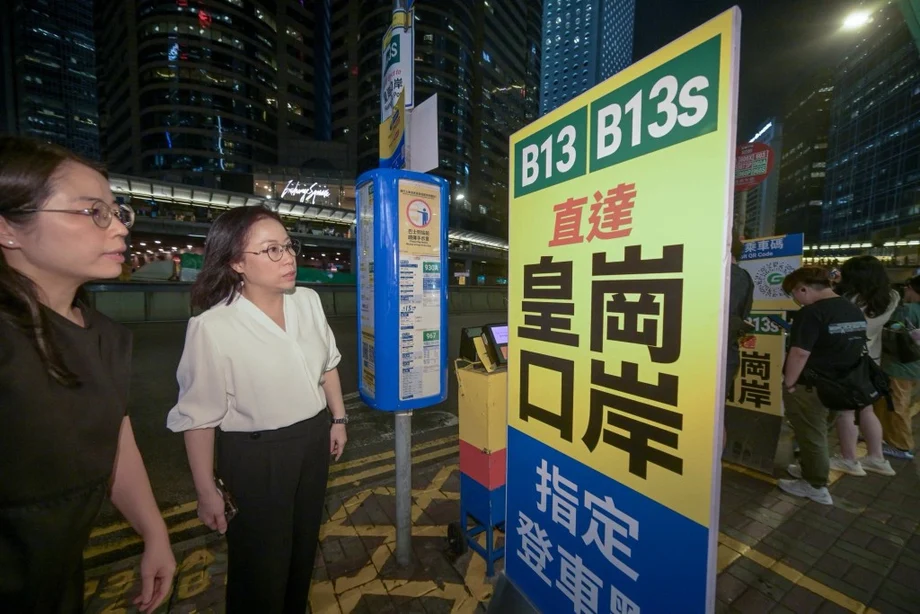
Citybus also arranged special overnight route B13S between Central and the Huanggang crossing, which operates around the clock. The service was scheduled for the early hours of Saturday and Sunday.
In Central, the operator provided signs and staff to organise boarding at designated locations on Connaught Road Central outside the Wing Lung Bank Building, near Jubilee Street and by Wing On Centre. These arrangements served people leaving nightlife venues and waterfront events after regular daytime travel patterns had ended.
The late services coincided with crowds at Lan Kwai Fong, the Wine and Dine Festival at the Central Harbourfront and Tamar Park, and concerts by Canadian singer The Weeknd at Kai Tak. With activities taking place in several districts, transport demand was spread across multiple boarding points before converging on the border.
How the pressure developed
Immigration officials expected incoming passenger traffic to peak on Saturday morning and departures to remain busy from Friday through the early hours of Sunday. That forecast matched a weekend pattern in which visitors could arrive for daytime activities, stay for evening entertainment and leave after midnight.
The main developments unfolded across the final part of October and the start of November:
- On the second weekend after the new crossing opened, 14,760 travellers passed through between midnight and 2 a.m. on Sunday, with heavy vehicle queues on the approaches.
- A police traffic update published on October 26 described waits averaging about 25 minutes to reach the passenger drop off area and the use of crowd and traffic controls.
- On October 30, Deputy Director of Immigration Ching Wo-mok inspected Huanggang and Shenzhen Bay ahead of the Halloween peak.
- On October 31, Huanggang processed 161,000 passenger crossings, while Shenzhen's total reached 1.145 million.
- On November 2, Shenzhen boundary inspection authorities announced the October 31 records.
During Ching's inspections, the Immigration Department said arrival and departure halls at both crossings were operating smoothly late at night. Officers were to remain on duty through the expected peaks, and travellers were advised to avoid the busiest periods where possible.
What the record figures reveal
Shenzhen's October 31 total comprised 599,000 inbound and 546,000 outbound passenger crossings. The 1.145 million total exceeded the previous record of 1.1377 million, set on August 22, by 7,300 crossings, or about 0.6%. It was the fourth time that year that the city's daily record had been broken.
Land crossings between Shenzhen and Hong Kong handled 1.115 million passenger movements that day, also a record. That represented about 97.4% of Shenzhen's total. Huanggang's 161,000 movements accounted for approximately 14.4% of the land crossing figure.
These are counts of crossings, so a person entering and leaving on the same day contributes two movements. Shenzhen boundary inspection authorities attributed the surge to Hong Kong festivities and large concerts, the weekend travel peak and the opening of the Canton Fair's third phase.
The Huanggang queues illustrate why daily totals tell only part of the transport story. Thousands of passengers reached the crossing in a short period after evening activities, concentrating demand on approach roads, bus fleets and inspection facilities at the same time.
What travellers face at the crossing
Passengers returning to Shenzhen need to allow time for the full journey: reaching a boarding point, waiting for transport, travelling through the approach roads and completing border checks. During the busiest period, a 15 minute queue inside an inspection hall sat alongside much longer delays for some road journeys.
Police asked travellers to leave ample time, wait patiently and follow instructions from officers and security personnel. For those using Shenzhen Bay's temporary late service, the scheduled 12:30 a.m. final coach departures were earlier than the 2 a.m. clearance closing time.
Hong Kong's response combines more transport, earlier opening of inspection facilities and closer monitoring. The proposed bus lane would address the shared road approaches, where operators said congestion kept coaches from completing trips and returning for waiting passengers.
Key Points
- Huanggang handled 14,760 travellers between midnight and 2 a.m. on the second weekend after opening, 212% above the previous comparable level.
- About 1,200 vehicles headed towards the crossing in the busiest hour, twice the usual weekend volume.
- A coach operator said Tsim Sha Tsui journeys increased from 35 minutes to about 90 minutes and called for a bus lane.
- Authorities expanded staffing, transport services and border clearance capacity for Halloween crowds.
- Shenzhen Bay extended clearance until 2 a.m. for two nights, while Citybus arranged overnight route B13S to Huanggang.
- Shenzhen recorded 1.145 million passenger crossings on October 31, including a record 161,000 at Huanggang.