A quantum fluid that forms its own stripes
A University of Warsaw team reports creating a supersolid phase in a quantum fluid of light using an optical microcavity containing liquid crystal and an organic semiconductor. The researchers describe a condensate that develops regularly spaced density stripes while retaining features associated with superfluids, bringing an unusual combination of quantum properties into a system described as operating at room temperature.
Contents
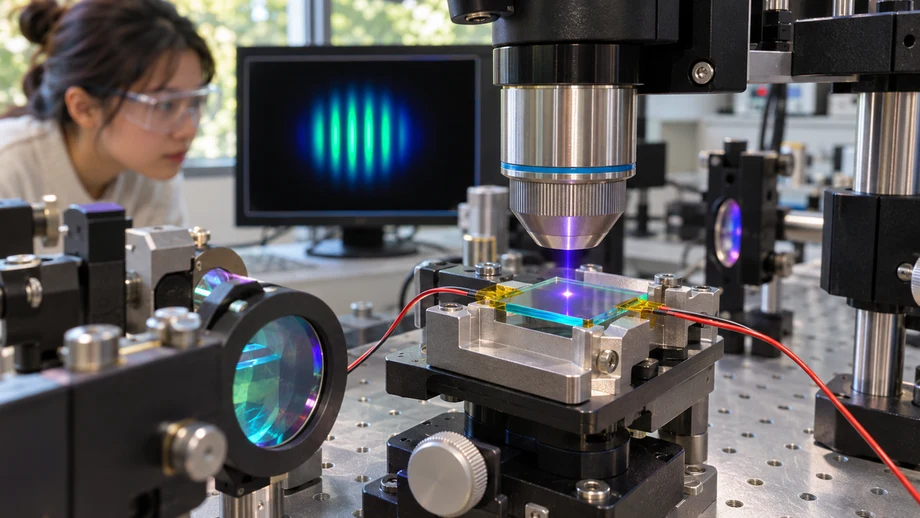
The experimental design combines a nematic liquid crystal with two layers of the polymer methyl-substituted ladder-type poly(p-phenylene), known as MeLPPP. Light and electronic excitations in the polymer couple strongly enough to form exciton polaritons, hybrid entities that can gather into a shared quantum state.
IBM Research's publication listing identifies the study as a Science Advances paper and dates it October 16, 2026. Its description reports that the stripes appear at different positions each time the condensate forms, even in the presence of a random disorder potential. The researchers also report randomly appearing vortices, another feature associated with superfluids.
The temperature needs careful wording. The research description calls the achievement room temperature supersolidity, while the accompanying account places strong light and matter coupling near 60 degrees Celsius. The exact temperature at which the supersolid observations were made is not specified in the academic summary. Both descriptions place the work far above the temperatures close to absolute zero used for ultracold atomic supersolids.
What makes a supersolid unusual?
A conventional crystal has a repeating arrangement of matter. A superfluid is a quantum fluid capable of flowing without the ordinary resistance associated with viscosity. A supersolid combines spatial order resembling that of a crystal with collective quantum behavior associated with a superfluid.
The word solid can be misleading in everyday terms. Here, the repeating structure is a pattern in the density of a quantum fluid. The experiment concerns a condensate of hybrid light and matter excitations inside an optical device, rather than a familiar rigid object.
A Bose-Einstein condensate forms when many bosonic particles or excitations occupy a shared quantum state and behave collectively. One useful picture is a crowd moving in step: the collective behavior becomes central, rather than each member acting independently. In a polariton condensate, the light emitted by the device gives researchers access to that collective state.
Ultracold atomic experiments established supersolid behavior in 2017. Those systems use extremely low temperatures to bring quantum behavior into view on a collective scale. The Warsaw approach uses exciton polaritons to explore related physics in a different temperature range and with a different kind of experimental platform.
How the liquid crystal shapes the condensate
The microcavity confines light so that it can interact strongly with excitons in the MeLPPP layers. An exciton is an electronic excitation consisting of an electron and the positively charged vacancy, or hole, it leaves behind. Strong coupling mixes the light and exciton states into exciton polaritons.
Polaritons combine a very small effective mass inherited from light with interactions inherited from their matter component. Effective mass describes how an excitation responds to changes in its motion inside a material. That small effective mass helps explain why polariton condensation can occur at much higher temperatures than condensation in atomic gases.
The nematic liquid crystal has molecules that tend to share a preferred orientation. In this device, it produces what the researchers call Rashba-Dresselhaus spin-orbit coupling. In accessible terms, the cavity links the polarization properties of light to how the polaritons move.
The resulting energy and momentum relationship has two distinct minima at the same energy. These are two equally favorable places for condensation to occur. Occupation of those states provides the setting for the spatially modulated condensate described in the study.
Why the position of the stripes matters
The emitted light shows regular bright stripes, revealing periodic changes in the condensate's density. Their spacing supplies the repeating order associated with the supersolid phase. Their changing position between successive condensates gives researchers another crucial piece of information.
The academic description says the stripes appear at random positions from one realization of the condensate to another. In each realization, the system selects a particular placement for its pattern. Physicists call this spontaneous breaking of translational symmetry: a system that allows different positions settles into one particular spatial arrangement.
A simple comparison is a repeating pattern that could slide left or right without changing its spacing. Once the condensate forms, the pattern occupies one position. When the experiment creates another condensate, the stripes can settle somewhere else.
The researchers report that this behavior persists despite a random disorder potential, meaning irregular variations in the conditions experienced by the polaritons. They interpret the observation as evidence that the stripes are resistant to that disorder and that their position is chosen spontaneously.
Vortices add another feature to the reported quantum fluid. A vortex is a circulating structure in which the quantum phase, the timing of the collective wave, winds around a central point. The study reports their random appearance alongside the striped density pattern, connecting spatial order with behavior familiar from superfluids.
A different proposal predicted larger patterns
A July 2024 theoretical preprint, titled Supersolidity of polariton condensates in photonic crystal waveguides, explored another route to a polariton supersolid. It proposed a structure that guides light along one dimension and has a periodically patterned surface.
The two research efforts concern different devices and mechanisms. The 2024 proposal uses a photonic crystal waveguide and nonlinear scattering between polariton modes. The reported liquid crystal experiment uses a microcavity in which spin-orbit coupling creates two energy minima for condensation.
The waveguide calculations predict that polaritons initially condensed at zero momentum can scatter into modes with finite momentum as the optical input rises. Momentum describes the motion associated with those modes. Their combined emission can produce a regular spatial pattern, with the position of that pattern chosen spontaneously under suitable conditions.
The predicted modulation has a wavevector of about plus or minus 0.3 inverse micrometers, corresponding to a spatial period of roughly 21 micrometers. The underlying photonic crystal period is about 0.25 micrometers. Dividing 21 by 0.25 gives about 84, so the predicted density pattern repeats on a scale roughly 84 times larger than the fabricated surface pattern.
That comparison explains an important feature of the proposal: the collective pattern has its own length scale, set by the polariton modes involved in scattering. The researchers also report calculations showing that the relevant scattering point can be controlled through the input power.
Two thresholds and 300 numerical trials
The 2024 theory identifies changes in emitted light as practical signs to seek in an experiment. Its calculations distinguish the initial condensation threshold from a further threshold associated with nonlinear scattering into additional modes. A threshold is the input level at which a new behavior begins.
When a nonzero linear coupling connects the relevant modes, emission from the additional branch can show two thresholds: one coinciding with the initial condensation and another appearing at higher input. Without that linear coupling, the additional branch instead shows a single nonlinear threshold associated with scattering.
The calculations also connect the freedom to choose the position of the stripes to the coupling conditions. In the case without linear coupling between those modes, the modulation takes different positions in different numerical realizations. The study assessed that spontaneous choice using 300 stochastic realizations, meaning simulations with different random fluctuations.
Each realization produced a periodic modulation, but the phases of those patterns spread across the full range of possible values. Averaging more realizations reduced the visible modulation because the differently positioned stripes cancelled one another. The result illustrates why studying individual condensates matters when the collective state chooses its own spatial arrangement.
The research sequence contains two distinct milestones:
- July 2024: A theoretical preprint proposes a supersolid in a photonic crystal waveguide, including emission thresholds and numerical tests of spontaneous pattern formation.
- October 16, 2026: IBM Research's listing dates a Science Advances study reporting a room temperature supersolid phase in a liquid crystal microcavity.
What this changes for quantum photonics
Polariton systems operate with particles continually entering and leaving the collective state. The accompanying account describes polariton lifetimes of only a few picoseconds, with one picosecond equal to a trillionth of a second. Optical excitation replenishes the system as particles decay and light escapes.
Physicists call this a driven-dissipative system: an external source supplies energy while the device loses energy and excitations. In the waveguide theory, the steady state results from the balance between gain, losses and interactions. The collective pattern is maintained through that continuing balance.
The combination of accessible temperatures and optical readout makes the reported microcavity a useful setting for studying ordered quantum fluids. Researchers can examine density patterns through emitted light, while the liquid crystal supplies a way to shape the polariton energy structure.
Potential applications discussed around the work include fast photonic components and neuromorphic computing accelerators, which process information using arrangements inspired by nervous systems. The relevant attraction is that interacting optical states can respond collectively and nonlinearly, producing a large change in behavior when an input crosses a threshold.
The reported achievement is the creation and observation of a quantum phase. Turning that physics into a computing component requires control over how the state forms, where its pattern sits and how it responds to an input. The random stripe positions are especially relevant: spontaneous choice is valuable evidence for the physics, while an information processing device would need a reliable way to use or control that choice.
The experimental and theoretical work together provide a more detailed picture than either alone. The microcavity study describes striped condensates and vortices at accessible temperatures. The waveguide proposal supplies calculations of a different mechanism, including pattern scales, emission thresholds and statistical tests. Together, they broaden the set of optical structures in which supersolid behavior can be investigated.
Key Points
- A University of Warsaw team reports a supersolid polariton condensate in a microcavity containing nematic liquid crystal and two MeLPPP polymer layers.
- The reported density stripes choose different positions between condensate realizations and persist despite a random disorder potential.
- The study also reports randomly appearing vortices, a feature associated with superfluids.
- The academic summary describes room temperature operation; the accompanying account places strong coupling near 60 degrees Celsius.
- A separate July 2024 theoretical proposal predicts waveguide patterns with a period of about 21 micrometers and analyzes 300 numerical realizations.
- Photonic computing is a possible application, while the central result concerns the formation and behavior of an unusual quantum state.