A fleeting signal in billions of particle decays
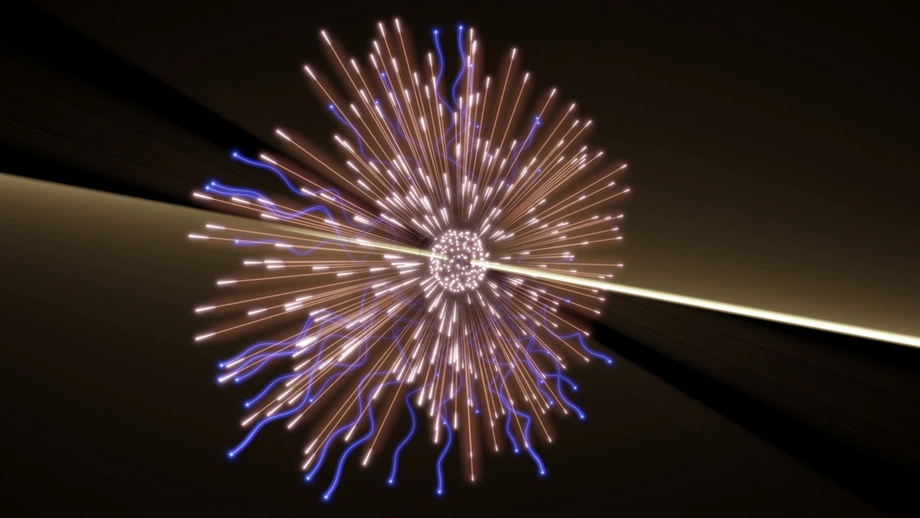
The LHCb experiment at CERN has reported the first evidence from a single experiment for an exceptionally rare decay of a neutral B meson into two muons, using collision data collected in 2024 and 2025. Combined with earlier measurements, the signal reaches a statistical significance of 3.2 standard deviations, enough to qualify as evidence but short of the threshold physicists require for an observation.
Contents
- A fleeting signal in billions of particle decays
- What exactly is disappearing?
- Why this counts as evidence
- A search stretching from 1984 to 2026
- How the detector finds the muon pairs
- What the result says about unknown particles
- Why measuring a lifetime adds another test
- What comes next for the smallest scales
- Key Points
The result, announced in the LHCb collaboration's November 3 announcement in 2026, advances a search that began in 1984. The decay is written B0 → μ+μ−, also called Bd → μ+μ−. It transforms a particle containing a bottom quark or antiquark into a muon and its antiparticle.
The Standard Model, the theory describing known elementary particles and their interactions, predicts roughly one such decay for every 10 billion B0 meson decays. That extraordinary rarity makes the process useful: an undiscovered particle could change its probability enough for a precise experiment to notice.
LHCb also reported its most precise measurements of the probability and effective lifetime of a related decay, Bs0 → μ+μ−. Both sets of results agree with the Standard Model. Together, they give researchers a sharper way to test theories proposing particles beyond those already known.
What exactly is disappearing?
B mesons are short lived particles made of a quark and an antiquark. The B0 and Bs0 belong to the same family, but their lighter quark components differ: one involves the down type and the other the strange type. Their different composition changes how often they can produce a pair of muons.
A muon is an elementary particle similar to an electron, but heavier. The two muons in these decays carry opposite electric charges. Researchers search for their tracks and use their measured properties to reconstruct the mass of the particle that produced them.
The Standard Model predicts the Bs0 decay about three times per billion decays, roughly 30 times more often than the B0 process. These probabilities, called branching fractions, describe the share of a particular kind of meson that follows a given decay route. Most B mesons disappear through other routes, leaving the desired signal buried among much larger numbers of particles.
Why this counts as evidence
LHCb found a significance of three standard deviations using the 2024 and 2025 sample alone. Adding data from Run 1 and Run 2, the earlier operating periods of the Large Hadron Collider, raised that figure to 3.2.
Statistical significance measures how strongly the data favour a signal over an explanation based on background alone. A larger number means a random fluctuation in the background would be less likely to produce a result at least as striking. Particle physicists commonly use three standard deviations as the threshold for evidence and five for an observation.
The collaboration's description is deliberately specific: this is the first evidence from a single experiment for B0 → μ+μ−. A joint LHCb and CMS analysis had already reported evidence in 2015, but later analyses did not confirm that earlier indication.
The new measurement brings the search back above the evidence threshold with a fresh dataset. The next statistical goal is five standard deviations. LHCb gave no date for reaching it.
A search stretching from 1984 to 2026
Researchers have pursued these rare decays across several generations of experiments. The more frequent Bs0 process reached the observation threshold first, providing a foundation for the harder B0 search.
- 1984: The search for B0 → μ+μ− began.
- November 2012: LHCb reported evidence for Bs0 → μ+μ− at 3.5 standard deviations.
- May 2015: A combined LHCb and CMS analysis observed the Bs0 decay at 6.2 standard deviations and reported an initial indication of the B0 decay.
- February 2017: LHCb alone observed the Bs0 decay at 7.8 standard deviations.
- Subsequent analyses using data collected through 2018 did not confirm the earlier B0 indication.
- 2024 and 2025: LHCb collected the new data used in the latest analysis.
- November 3, 2026: LHCb announced evidence for the B0 decay at three standard deviations in the new sample and 3.2 when combined with earlier runs.
The history explains why researchers distinguish carefully between evidence and observation. A promising signal needs further data, and later measurements can strengthen it or move it below the accepted threshold.
How the detector finds the muon pairs
LHCb's upgraded detector collects data at about five times the rate achieved during 2010–2018. For a process expected only once in 10 billion B0 decays, recording more usable collisions is essential.
The Vertex Locator, known as VELO, helps identify where particles were created and where they decayed. Assembled by the University of Liverpool, the detector operates just five millimetres from the LHC beam. Its precise tracking allows researchers to locate the decay points of particles that survive for only a tiny fraction of a second.
Machine learning helps separate promising muon pairs from background, the many other processes that produce similar tracks or combinations of particles. Researchers then examine the invariant mass of each pair, a quantity calculated from the muons' energies and momenta that can identify the mass of their parent particle.
The mass distribution contains a visible contribution from Bs0 decays and a smaller contribution at the lower B0 mass. LHCb fits these signals together with the background to estimate how many decays of each type are present.
B0 production provides a useful advantage. The collider produces about four B0 mesons for every Bs0 meson, according to LHCb. Although an individual B0 is about 30 times less likely to decay into two muons, its greater abundance narrows the expected difference in event numbers to roughly a factor of seven. That comparison helps explain how the rarer process becomes accessible in a sufficiently large dataset.
What the result says about unknown particles
The Standard Model gives precise predictions for both decay probabilities. Theories extending it can change those predictions by introducing particles that affect the decay process, even when those particles are not produced directly as visible objects in the detector.
LHCb identifies additional Higgs bosons, Z′ vector bosons and leptoquarks as examples. These are proposed particles in different extensions of the theory. Their possible influence makes rare decays a way to search indirectly for physics at energies beyond the direct reach of a particular collision experiment.
The LHCb collaboration, which operates the experiment and conducted the analysis, described the latest measurements this way:
The results announced today, in agreement with the SM, isolate even more precisely the parameter region in which these new models can exist
The practical effect is to narrow the combinations of proposed particle masses and interaction strengths that remain compatible with experiment. In LHCb's joint analysis of the two branching fractions, the Standard Model prediction lies inside the 68.27% confidence region, a range expressing the measurement's uncertainty.
Why measuring a lifetime adds another test
LHCb also measured the effective lifetime of Bs0 mesons that decay into muon pairs. Combining Run 1, Run 2 and Run 3 data, it obtained 1.60 ± 0.16 ± 0.01 picoseconds, in agreement with the Standard Model prediction.
A picosecond is one trillionth of a second. The first uncertainty describes the statistical limits of the measurement; the second covers systematic effects associated with how the measurement is made. The statistical uncertainty is much larger, showing why additional data can be valuable.
The effective lifetime describes the decay timing of the selected Bs0 sample. Some proposed extensions of the Standard Model can leave the total probability of producing two muons nearly unchanged while changing how those decays are distributed over time. Measuring both frequency and timing therefore tests more possibilities than counting decays alone.
The ratio of the B0 and Bs0 branching fractions supplies another comparison. A proposed theory must account for the relationship between the two processes as well as their individual rates. LHCb's latest results bring these separate checks together in one analysis.
What comes next for the smallest scales
LHCb submitted the new results for publication and presented them at a CERN seminar opening a workshop between the collaboration and theoretical physicists. The immediate experimental task is to collect enough additional evidence to move the B0 signal toward the observation threshold and measure its probability more precisely.
A further LHCb upgrade in the middle of the next decade could increase the data collection rate by another order of magnitude, meaning about ten times, according to the collaboration. That would support more demanding tests using both rare decays.
The term Zeptoverse describes the extremely small distances researchers hope to investigate through such precision measurements. A zeptometre is one thousandth of a billionth of a billionth of a metre. Rare decays provide an indirect route to investigating effects associated with very small distances and high energies.
Dark matter and the origin of the universe's excess of matter over antimatter remain broader motivations for searching beyond the Standard Model. The finding announced here is narrower and concrete: a rare decay predicted by the existing theory has reached the evidence threshold, while its measured behaviour gives researchers tighter limits on proposed alternatives.
Key Points
- LHCb reported the first evidence from a single experiment for B0 → μ+μ−, following a search begun in 1984.
- The 2024 and 2025 data reach three standard deviations; combining earlier runs raises the significance to 3.2.
- The Standard Model predicts roughly one such decay per 10 billion B0 decays.
- The new decay measurements agree with the Standard Model and narrow the allowed possibilities for additional particles.
- LHCb measured the related Bs0 decay's effective lifetime at 1.60 ± 0.16 ± 0.01 picoseconds.
- Five standard deviations remain the goal for an observation of the B0 decay.