Four generations of jets in one enormous galaxy
A galaxy stretching about 4.2 million light-years has preserved evidence of four separate episodes of activity around its central supermassive black hole, giving astronomers an unusually long record of a cosmic engine switching off and restarting.
Contents
- Four generations of jets in one enormous galaxy
- What does a black hole activity cycle mean?
- How the team reconstructed the galaxy's history
- A history measured in millions of years
- Why four episodes make this galaxy unusual
- Are the jets becoming weaker or shorter?
- Three observatories, one shared record
- Key Points
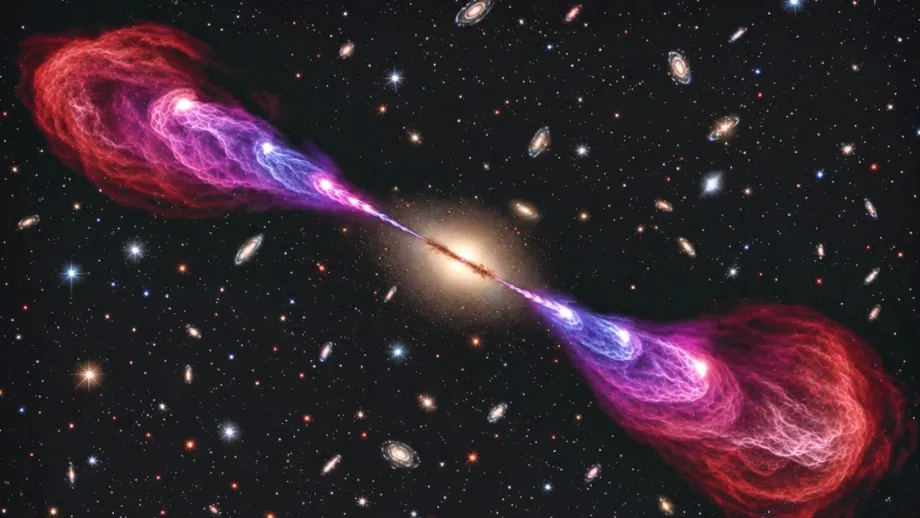
Researchers at the Indian Institute of Science Education and Research (IISER) Pune and the National Centre for Radio Astrophysics (NCRA-TIFR) identified four pairs of bright radio features in the S-shaped galaxy J023721.13-010528.5. Each pair is associated with a different generation of jets, powerful streams of energetic particles driven from the region around the black hole.
The team describes it as the first known radio galaxy showing evidence of four such episodes. Among the tens of thousands of radio galaxies astronomers have studied, most show one major period of jet activity. Only six had previously been identified with evidence of three episodes.
The study was led by Pavan Khadekar, a PhD student at IISER Pune, under the guidance of Dharam Vir Lal of NCRA-TIFR and Ramana Athreya of IISER Pune. Its findings were reported as published in The Astrophysical Journal on October 21, 2026.
What does a black hole activity cycle mean?
A supermassive black hole can have a mass millions or billions of times that of the Sun. Material gathering around it can form a hot, rotating flow. Some of the energy released in this surrounding region can power jets that travel far beyond the visible body of the host galaxy.
Astronomers call a galaxy a radio galaxy when structures associated with this activity shine strongly at radio wavelengths. Radio telescopes detect that radiation, revealing features that ordinary photographs taken in visible light may miss.
The jets can remain active for millions of years before fading. A later restart can launch a fresh pair while older structures are still detectable farther out. A galaxy can therefore retain several generations of activity at once, much as successive marks on a landscape can preserve events from different periods.
For J023721.13-010528.5, the central finding is the presence of four generations in the same system. The black hole remains in place through these episodes; what changes is the activity associated with the material around it and the jets it powers.
How the team reconstructed the galaxy's history
Khadekar and his colleagues combined observations from India's Giant Metrewave Radio Telescope (GMRT), the Very Large Array in the United States and South Africa's MeerKAT telescope. Together, those observations allowed the team to examine the galaxy's extensive radio structure and distinguish features linked to different episodes.
The crucial evidence was four pairs of hotspots. A hotspot is a bright region associated with a jet, often where the fast flow transfers energy to surrounding material. Such regions help astronomers trace how a jet has travelled and interacted with its environment.
Four pairs means eight bright regions arranged into four associated sets. Pairing matters because jets commonly emerge in opposite directions from the central region. The researchers interpreted the four sets as evidence of separate generations, rather than one continuous episode.
Athreya was initially unconvinced that the galaxy had reached a fourth phase of activity, despite Lal's insistence. He said it took time to extract convincing evidence. That scrutiny was central to the finding: identifying a fourth generation required the team to establish how the observed structures fitted together.
A history measured in millions of years
The estimated ages associated with the hotspot generations range from about six million to 21 million years. The researchers also place the beginning of the latest activity episode a few million years ago. These estimates describe a history reconstructed from the galaxy's radio emission, rather than changes watched unfold during a human lifetime.
The broad sequence is:
- About 21 million years: the older end of the estimated age range associated with the observed jet generations.
- About six million years: the younger end of that estimated range.
- A few million years ago: the approximate beginning of the fourth and most recent activity episode.
- October 21, 2026: the reported publication date of the findings in The Astrophysical Journal.
The figures span roughly 15 million years between the older and younger ends of the quoted range. That gives a sense of the depth of the record, although the researchers have not provided a complete timetable for every restart or the quiet intervals between them.
Astronomers estimate the ages of radio structures using their physical properties and models of how they evolve. Energetic particles change as they radiate and travel, leaving clues in the radio signal. The resulting ages are estimates, so the sequence is best understood on the scale of millions of years.
Why four episodes make this galaxy unusual
J023721.13-010528.5 adds a fourth chapter to a type of history that astronomers have rarely been able to trace even through three. The six previously identified galaxies with three episodes provided examples of repeated activity; this object extends that observed sequence by another generation.
The galaxy's scale makes that record especially striking. A light-year is the distance light travels in one year, so a span of 4.2 million light-years means light would need about 4.2 million years to cross that distance. Here, the quoted size describes the enormous galaxy and its radio structure.
Its S-shaped appearance is another part of the observed geometry. The study identifies the shape alongside the multiple hotspot pairs, but the cause of the curve has not been established in the account of the discovery. Explaining the shape and reconstructing the activity cycles are related tasks that require attention to the arrangement of the radio features.
The scientific value lies in having successive episodes preserved around the same central engine. Researchers can compare those generations within one galaxy, where they share a host and a surrounding environment, instead of relying entirely on comparisons between different objects.
Are the jets becoming weaker or shorter?
The researchers suggest that the jets may lose power, remain active for less time, or do both with each successive episode. Four generations offer more opportunities to examine that possibility than a galaxy with only one visible restart.
Power and duration describe different things. A less powerful jet delivers energy more slowly. A shorter episode delivers energy for less time. Either change can alter the structures left behind, while the surrounding gas can also affect how a jet expands and fades.
The suggestion therefore concerns how the black hole's output may change across repeated episodes. The discovery gives researchers a system in which to investigate that pattern, with older remnants and more recent structures available for comparison.
The reason the activity repeatedly stops and resumes is still unknown. Material reaching the central region supplies the process that powers the jets, so changes in that supply are relevant to understanding the cycle. Establishing what happened in this particular galaxy will require further study of its radio structures and environment.
Three observatories, one shared record
The discovery brought together observations from instruments on three continents. Different radio observations can help researchers examine both bright, compact features and much fainter extended emission. For a galaxy with several generations of activity, recovering those older traces is essential to reconstructing its history.
Khadekar, the IISER Pune doctoral researcher who led the study, described how access to observatory data supported the investigation:
"Many radio telescopes freely provide their data to researchers across the world. This collaborative philosophy of observatories makes for a more comprehensive investigation, and more efficient use of data different scientists can use the same observations for exploring differing ideas," Khadekar said.
The combination of GMRT, Very Large Array and MeerKAT observations illustrates that approach. A radio observation collected for one investigation can also contain evidence useful for another, including faint structures whose importance becomes apparent when examined alongside other data.
Further studies of similar galaxies could help determine how often repeated activity occurs and whether later jets commonly become weaker or shorter. For now, J023721.13-010528.5 provides a rare case with four generations to examine, extending the observed history of repeated black hole activity beyond the previously known examples.
Key Points
- Researchers at IISER Pune and NCRA-TIFR identified the first known radio galaxy with evidence of four separate black hole activity episodes.
- The S-shaped galaxy J023721.13-010528.5 spans about 4.2 million light-years.
- Four pairs of hotspots trace different generations of jets, with estimated ages ranging from six million to 21 million years.
- The latest episode appears to have begun a few million years ago.
- The team combined observations from India's GMRT, the Very Large Array in the United States and South Africa's MeerKAT telescope.
- Researchers suggest successive jets may become weaker or remain active for less time. The cause of the repeated shutdowns and restarts is still unknown.