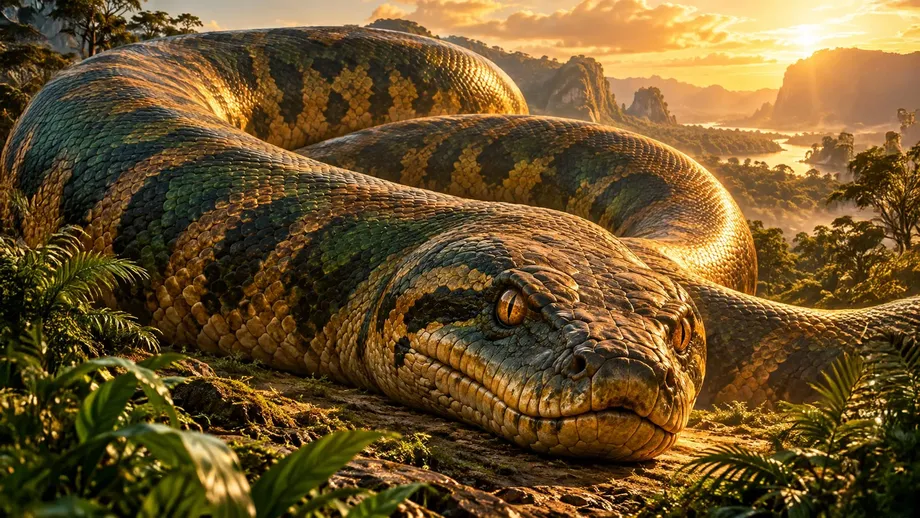
A giant hidden in 27 backbone bones
Twenty seven fossil vertebrae from the Panandhro Lignite Mine in Kutch, Gujarat, have revealed an ancient Indian snake whose estimated length ranges from 10.9 to 15.2 metres, about 36 to 50 feet. Named Vasuki indicus, it lived roughly 47 million years ago and ranks among the largest snakes ever identified.
Contents
- A giant hidden in 27 backbone bones
- What the Gujarat fossils reveal
- How scientists estimated its length
- How Vasuki compares with Titanoboa
- A probable ambush hunter in forested swamps
- Warmth helped shape its world
- A snake family linked India and Africa
- The dates behind the discovery
- Later discoveries broaden the picture
- Key Points
Paleontologists Debajit Datta and Sunil Bajpai of the Indian Institute of Technology Roorkee described the species in Scientific Reports on 18 April 2024. Their Vasuki discovery study, published as article 8054, identifies it as the largest known member of Madtsoiidae, an extinct family of snakes.
The upper estimate would put Vasuki beyond the approximately 13 metres commonly estimated for Titanoboa, the giant snake from ancient Colombia. Its actual length remains uncertain, however: two methods produced substantially different results, and parts of the backbone needed to refine the calculation are missing.
Vasuki also offers clues to a much larger story. Its bones connect a tropical wetland in western India with an ancient snake lineage that the researchers propose spread toward North Africa after India collided with Asia. Later fossil discoveries suggest that this enormous animal shared its environment with several other kinds of snakes.
What the Gujarat fossils reveal
Datta and Bajpai studied fossils from a grey shale layer in the Naredi Formation at Panandhro. The layer belongs to the early Middle Eocene, specifically the Lutetian interval, and formed about 47 million years ago. Lignite, the coal mined at the site, forms from accumulated plant material and helps place the discovery within an ancient landscape rich in vegetation.
The collection contains 27 associated vertebrae, mostly well preserved, with some still joined together. The researchers could confidently place 22 in the portion of the backbone before the cloaca, the opening through which snakes discharge waste and reproduce. Their shapes also indicate that these bones came from ahead of the rear trunk.
Closed seams in the bones suggest the animal had reached skeletal maturity. That matters because the researchers were estimating the size of a mature snake rather than trying to predict how much a young animal might eventually grow.
The specimen used to define the species, known as the holotype, is a partial backbone rather than a complete skeleton. Its scientific name combines Vasuki, the mythical serpent associated with the Hindu deity Shiva, with indicus, referring to India.
How scientists estimated its length
Vasuki's vertebrae are exceptionally large. The central part of each bone measures between 37.5 and 62.7 millimetres long, while the width across particular joint structures ranges from 62.4 to 111.4 millimetres. These measurements describe parts of individual bones, not the width of the whole animal.
Datta, the lead author and a paleontologist at IIT Roorkee, described the scale of the largest specimen:
The largest of its vertebrae is 11 cm wide,
The researchers used two published methods that relate vertebral width to total snake length. Such calculations work by comparing bones with those of snakes whose body lengths are known, then using the relationship to estimate the missing animal's size. The largest vertebrae from the middle trunk supplied the measurements.
One method produced lengths of 10.9 to 12.2 metres. The other yielded 14.5 to 15.2 metres. Together they explain why descriptions of Vasuki often give a broad range rather than a single measurement.
The authors caution that the collection lacks vertebrae from the rear portion before the cloaca and from the cloacal region itself. Scientists also have limited knowledge of how bone proportions change along the backbone in madtsoiid snakes. A more complete skeleton would help narrow the estimate.
How Vasuki compares with Titanoboa
Titanoboa lived in what is now Colombia approximately 60 million years ago, around 13 million years before Vasuki. Its estimated length of about 13 metres falls between the lower and upper sets of calculations for the Indian snake.
The comparison therefore depends on which reconstruction best captures Vasuki's proportions. Estimates of 10.9 to 12.2 metres would make it shorter than Titanoboa; estimates of 14.5 to 15.2 metres would make it longer. The secure finding is that Vasuki belongs among the largest known snakes and occupies the top size category within its own extinct family.
Its vertebrae also stand out against those of other large madtsoiids. The central portions of Gigantophis vertebrae cited in the study measure 28 to 41 millimetres long, compared with Vasuki's 37.5 to 62.7 millimetres. Width measurements reach 66 millimetres in Gigantophis and 111.4 millimetres in Vasuki.
The researchers acknowledge that fossil collections may miss the largest individuals of any species. Even with that limitation, the Gujarat bones provide a striking anatomical comparison: Vasuki's exceptional scale is visible in the preserved remains themselves.
A probable ambush hunter in forested swamps
Vasuki's broad, massive vertebrae suggest a thick, cylindrical body. Datta and Bajpai infer that the snake moved relatively slowly and probably relied on ambush rather than pursuing animals over long distances.
A concealed predator could wait for prey to approach before striking. The researchers suggest Vasuki may then have used constriction, wrapping its body around an animal and squeezing it, in a hunting strategy comparable to that of large pythons and anacondas.
Its precise diet and hunting behaviour are unknown. The surviving backbone provides clues about body structure and movement, while direct evidence of meals or a complete head would be needed to answer more detailed questions about feeding.
The researchers place Vasuki in forested swamps in Kutch, a region that is now largely arid. Its anatomy is consistent with a substantial terrestrial animal, possibly using shallow marshy settings, rather than a snake living exclusively in water.
That combination of heavy build and wetland habitat offers a plausible setting for an ambush predator. Vegetation and shallow water could provide cover, while the surrounding ecosystem would determine which prey animals were available.
Warmth helped shape its world
The 2024 study places Vasuki in a warm geological interval, with average temperatures estimated at about 28 degrees Celsius, or 82 degrees Fahrenheit. Its habitat was part of a tropical world very different from modern Kutch.
Snakes are ectothermic: they depend heavily on heat from their surroundings to regulate body temperature. External warmth affects their activity and digestion, and can help create conditions in which very large reptiles can survive.
Food supply, habitat and inherited body structure also influence size. A large snake needs enough energy to maintain its body, and its evolutionary history affects how it grows. The researchers consider warmth a possible contributor to Vasuki's size within that wider ecological picture.
Datta also addressed the difference between ancient warm conditions and the pace of warming today:
While high temperatures spur the development of large bodies in snakes and other cold-blooded organisms, current temperatures are rising too fast for these snakes to become as massive as they did in the past,
His comment places the discovery on an evolutionary timescale. Vasuki belonged to a lineage shaped over millions of years, with the climate, food resources and geography of its own period.
A snake family linked India and Africa
Madtsoiidae existed for roughly 100 million years, from the Late Cretaceous to the Late Pleistocene. Members lived in regions including India, Madagascar, Africa, South America, Europe and Australia. Vasuki belonged to this extinct lineage, separate from modern pythons and anacondas.
Datta and Bajpai compared anatomical features to reconstruct its family relationships. Their analysis placed Vasuki in a distinct branch with Madtsoia pisdurensis, known from the Late Cretaceous of India, and Gigantophis garstini, known from the Late Eocene of North Africa. A branch, or clade, groups animals inferred to share a common ancestor.
The researchers propose that this lineage originated in India, with its roots extending back approximately 88 million years, during the continent's isolation following the breakup of Gondwana. Gondwana was an ancient supercontinent whose fragments became several of today's continents.
Bajpai, a paleontologist at IIT Roorkee and coauthor of the study, explained the geographic reasoning:
Since this group was dominated by madtsoiids from India and Vasuki was the most primitive ancestor in the family tree, we inferred that this group of snakes originated in India,
The proposed movement toward Africa followed India's collision with Asia around 50 million years ago. New geographic connections offered a route through southern Eurasia, including southern Europe, during the Eocene. The researchers use the distribution and relationships of the fossils to reconstruct that possible dispersal.
The dates behind the discovery
Vasuki's story spans both geological time and recent scientific publication. The age of the animal, the proposed history of its relatives and the date scientists named it refer to different events.
The main milestones are:
- About 88 million years ago: the researchers place the proposed roots of Vasuki's broader lineage in India.
- About 60 million years ago: Titanoboa lived in what is now Colombia.
- About 50 million years ago: India collided with Asia, opening possible routes for dispersal.
- About 47 million years ago: Vasuki lived in the tropical environment recorded at Panandhro.
- During the Eocene, approximately 56 to 34 million years ago: the researchers place the broader dispersal toward North Africa through southern Eurasia, following the collision.
- 18 April 2024: Datta and Bajpai published the description of Vasuki indicus in Scientific Reports.
- 2025: further studies examined other Eocene snakes from western India and ancient anacondas from Venezuela.
The proposed Indian origin concerns an ancestral lineage extending much further back than the known Vasuki fossils. The Gujarat specimen records one giant member of that history at about 47 million years ago.
Later discoveries broaden the picture
Datta and Bajpai's 2025 research in the Journal of Paleontology described additional fossil snakes from Eocene deposits in western India. The discoveries included the aquatic snake Pterosphenus rannensis, another large madtsoiid and other extinct snake groups.
The researchers identified a madtsoiid that appears to have shared a marshy environment with Vasuki. Evidence from the deposits also points to snakes occupying tidal settings as well as swamps and marshes. Ancient western India supported a varied snake community, with different animals using different parts of the landscape.
Another 2025 study, published in the Journal of Vertebrate Paleontology, examined fossil anaconda vertebrae from Venezuela. It found that anacondas had already reached large sizes by approximately 12.4 million years ago, with estimated lengths around 5.2 metres, comparable to many living anacondas.
The anaconda findings add a useful comparison. One lineage maintained a substantial body size for millions of years through changing climates and ecosystems, while Vasuki reached much greater estimated lengths in an older tropical setting. Together, the discoveries direct attention to each lineage's history and habitat as well as temperature.
Vasuki's greatest contribution is therefore broader than a contest over the longest snake. Its bones help reconstruct a vanished Indian wetland, the evolution of giant reptiles and the possible movement of an ancient snake family between continents.
Key Points
- Vasuki indicus lived in western India about 47 million years ago.
- Datta and Bajpai described it from 27 associated vertebrae found at Panandhro Lignite Mine in Gujarat.
- Two methods estimated its length at 10.9 to 12.2 metres and 14.5 to 15.2 metres.
- The study identifies it as the largest known madtsoiid; its size relative to Titanoboa remains uncertain.
- The researchers suggest it was a slow moving ambush predator that probably used constriction.
- Its fossil relatives support a proposed Indian origin and later dispersal toward North Africa through southern Eurasia.
- Research published in 2025 adds evidence of a diverse ancient snake community in western India.