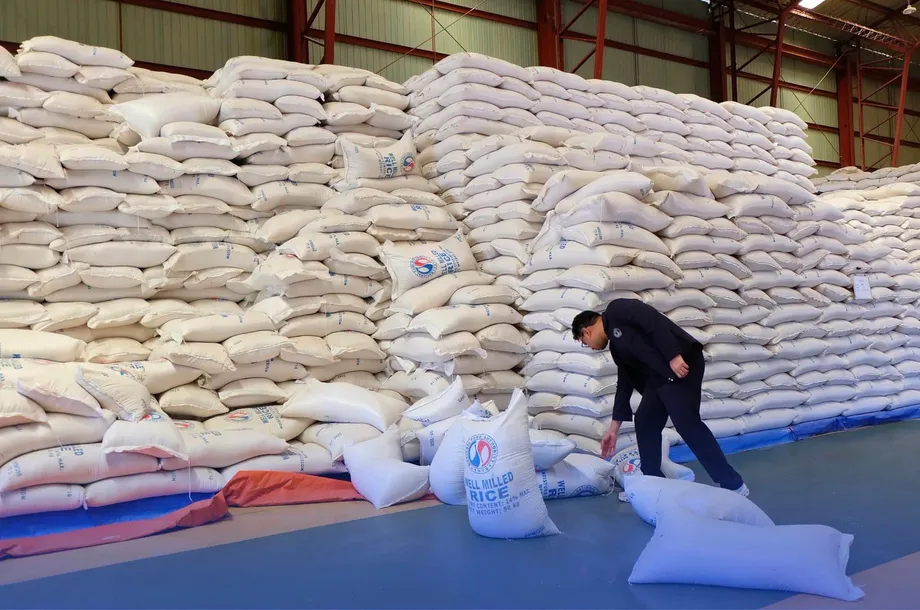
Rice is available, but much of it is outside government hands
The Philippines has about 75 days of rice supplies when stocks in homes, trading businesses and mills are counted together, according to rice industry leaders and National Food Authority Administrator Larry Lacson. The reserve the government can draw on directly is much smaller: Lacson reported seven days of stocks in NFA warehouses after releases and auctions, while industry estimates put government holdings at around nine days.
Contents
- Rice is available, but much of it is outside government hands
- What the official inventory says
- A larger legal target than the NFA has reported
- Why a higher buying price may still lose farmers
- Money, warehouses and trucks all constrain the reserve
- Imports are heading beyond the previous record
- El Niño puts harvests and livelihoods at risk
- Consumers face a separate affordability test
- US rice purchases could broaden the supply base
- Key Points
Both figures fall below the 15 days required under the revised Rice Tariffication Law. The gap matters as the Department of Agriculture prepares for El Niño, which could cut the main harvest in the second half of 2026 by about 700,000 metric tons of palay, or unhusked rice.
Leonardo Montemayor, chairperson of the Federation of Free Farmers, said a large national inventory offers less protection during a disaster when most rice belongs to private businesses and households. Emergency distribution depends on rice the government already controls, or can buy and move quickly.
Montemayor described the practical problem facing officials when a calamity interrupts supplies:
If a volcano erupts, or a flood, or something like that, where will the government get rice if they're looking for stocks?
The government could have to purchase rice from private suppliers at prevailing market prices, he said. Meanwhile, importing more rice to protect consumers can put pressure on the prices farmers receive during harvest. Securing food supplies therefore involves two connected tasks: keeping enough rice in the country and building a public reserve without weakening the farmers who replenish it.
What the official inventory says
The Philippine Statistics Authority's September rice inventory placed national stocks at 1.91 million metric tons on September 1, 2026. That was down 8.0 percent from 2.07 million metric tons a year earlier and down 12.4 percent from 2.18 million metric tons in August.
Commercial businesses held 42.8 percent of the September total, households held 42.2 percent, and NFA depositories held 15.0 percent. Together, businesses and households controlled 85 percent of the rice counted. Applying those shares to the total gives approximately 817,000 metric tons in commercial storage, 806,000 metric tons in homes and 287,000 metric tons in NFA depositories.
NFA holdings declined more sharply than the national total: they were down 36.1 percent from September 2025 and 6.6 percent from August 2026. Commercial stocks were almost unchanged from a year earlier, rising 0.1 percent, while household stocks fell 0.6 percent.
The September inventory and the 75 day estimate describe different snapshots. At the industry estimate of at least 35,000 metric tons consumed daily, 1.91 million metric tons would cover about 55 days, while 75 days would require at least 2.625 million metric tons. The Department of Agriculture also described 75 days as its goal for the end of 2026. No precise inventory date accompanied the broader 75 day estimate cited by industry leaders.
A larger legal target than the NFA has reported
The December 2024 amendment to the Rice Tariffication Law raised the NFA's required reserve from nine days to 15 days. The Department of Agriculture's April buffer stock statement, published on April 22, 2025, confirmed that all rice in this reserve must come from local farmers.
That statement put NFA stocks at the equivalent of 7.17 million bags of milled rice, each weighing 50 kilograms, enough for nine days. It described the inventory as the highest since the end of 2020. Lacson's harvest season update put stocks at seven days, equivalent to 5.5 million bags, following warehouse clearances, releases and auctions; Montemayor and other industry participants estimated around nine days.
Using the industry's consumption estimate of 35,000 metric tons daily, a 15 day reserve would require at least 525,000 metric tons of rice. A nine day reserve would contain about 315,000 metric tons, leaving a gap of roughly 210,000 metric tons. These calculations use the same daily consumption figure so readers can compare the scale of the requirement.
The NFA now builds its reserve through domestic purchases rather than imports. Its buying program therefore has to acquire palay from farmers, process it into edible rice and store it until needed. Rice arriving through private importers helps national supply, while the public reserve depends on this separate procurement process.
Why a higher buying price may still lose farmers
Orlando Manuntag, co-founder of the Philippine Rice Industry Stakeholders Movement, or PRISM, said the NFA pays about P29 to P30 per kilogram for dry palay, compared with P27 to P28 offered by private traders. Wet palay fetches about P20 to P21 because it contains more moisture and requires drying.
Lacson has described NFA prices starting at P27 for clean, dry palay and reaching P30 in some areas. In the harvest season update, he put the range at P28 to P30 after the Department of Agriculture directed the agency to raise its minimum buying price. The rates vary with location, quality and the buying period.
Farmers cannot always take advantage of the higher government price. Montemayor said NFA delivery schedules can involve weeks of waiting, quality checks can lead to rejection, and many farmers and cooperatives lack mechanical dryers. A farmer who needs money immediately may accept a lower private offer rather than wait for a government delivery slot.
Drying is a practical link between farm income and emergency reserves. Palay must lose excess moisture before it can be stored safely and milled efficiently. Without access to drying equipment, farmers may have to sell wet grain cheaply, while the NFA struggles to obtain enough grain that meets its requirements.
The agency's procurement reach is limited as well. Lacson said its present budget and operating capacity allow it to purchase only 4 percent to 5 percent of the national harvest. Most farmers consequently sell through other buyers, even when government prices are attractive.
Money, warehouses and trucks all constrain the reserve
Lacson said the NFA's annual procurement budget has stayed at P9 billion since 2023. He also identified inadequate storage, drying and milling capacity, along with staff shortages, as obstacles to meeting the 15 day requirement.
The April 2025 agriculture department statement described a larger pool of available procurement funds because it included money carried over from the previous year. Lacson explained the position at that time:
"So far this year, we've spent only P2.6 billion of the P14.6 billion available to us for palay procurement. This includes unspent funds of P5.6 billion carried over from the 2024 budget," Lacson said.
The annual P9 billion allocation and that P14.6 billion balance therefore measure different things: one is the regular yearly budget, while the other included unspent funds. In April 2025, the NFA said it could still buy about 500,000 metric tons of palay.
The agency's modernization plans include 36 new warehouses and other facilities, plus construction or refurbishment of another 133 facilities. It has procured 150 trucks and plans to expand the fleet to 600. Lacson also said additional warehouses had been rented for incoming harvest purchases.
The April statement described storage upgrades intended to accommodate 555,000 metric tons of rice, or 880,000 metric tons of palay. Those are alternative measures of capacity, since unhusked grain loses weight during processing. The same statement recorded 1.1 million bags of already milled rice as of April 11, a smaller category within the broader reserve expressed in rice equivalent.
Lacson's harvest season procurement target is 500,000 metric tons of palay, within a target of 790,000 metric tons for the year. Reaching those volumes requires money to buy the crop and enough space, equipment and transport to handle it.
Imports are heading beyond the previous record
The Bureau of Plant Industry recorded 3.98 million metric tons of rice arrivals by late September 2026, already above the 3.39 million metric tons imported throughout 2025. Agriculture Assistant Secretary and department spokesperson Arnel de Mesa said imports could exceed 5 million metric tons to protect supplies through El Niño.
Montemayor cited an end of September figure of about 4.2 million metric tons. If arrivals averaged 400,000 metric tons monthly during the final quarter, he estimated that the annual total could reach 5.4 million to 5.5 million metric tons, approaching the US Department of Agriculture projection of 5.7 million metric tons.
The earlier import record was about 4.8 million metric tons in 2024. A total of 5.4 million would be approximately 600,000 metric tons above that record, or about 12.5 percent higher. The government's immediate priority is keeping supply available as domestic production faces dry conditions.
Vietnam supplied 2.72 million metric tons, or 68.3 percent of the late September arrivals. Thailand supplied 517,528 metric tons, about 12.9 percent, and Myanmar supplied 400,360 metric tons, about 10 percent. Together, these three countries accounted for roughly 91 percent of imports.
Heavy arrivals can help keep rice available to consumers, but Montemayor warned that they can also depress local palay prices, especially when imported supplies coincide with domestic harvests. The NFA's ability to buy locally becomes particularly important during that overlap.
El Niño puts harvests and livelihoods at risk
The Department of Agriculture estimates that El Niño could reduce palay output during the main harvest in the second half of 2026 by about 700,000 metric tons. The eventual loss will depend on the severity and duration of dry conditions in affected areas.
State weather bureau PAGASA projections cited by agriculture officials put dry spell effects through March 2027, while another warning identified November through April as the period facing the strongest effects. Farmers therefore face a risk extending beyond the end of the current year.
De Mesa said the department plans to raise production in areas less affected by El Niño and in areas with irrigation. Where water becomes too scarce to plant, officials are considering alternative work, including cleaning and repairing irrigation systems and other agricultural facilities.
The department has also made advance purchases of rice, fertilizer and other farm inputs. Initial assistance under the Unified Package for Livelihoods, Industry, Food, and Transport, known as UPLIFT, covers 310,968 farmers and fisherfolk, with P2.2 billion allocated for fertilizer assistance and P1 billion for cash assistance. Aid for nearly 196,000 farmers was scheduled for October and November.
The key dates show how the reserve requirement, harvest concerns and import plans fit together:
- December 2024: The rice law amendment raised the required NFA reserve to 15 days.
- April 22, 2025: The agriculture department reported nine days of NFA stocks, the highest inventory since the end of 2020.
- September 1, 2026: The PSA measured national rice stocks at 1.91 million metric tons.
- Late September 2026: Rice imports reached 3.98 million metric tons in the Bureau of Plant Industry tally.
- End of 2026: The agriculture department aims to maintain national stocks equivalent to 75 days.
- 2027 and 2028: PRISM plans to begin and then expand purchases of rice from the United States.
Consumers face a separate affordability test
Department of Agriculture monitoring in Metro Manila on October 5 recorded local well milled rice at P50 per kilogram and local regular milled rice at P48. Imported well milled rice was P48, while imported regular milled rice was P43.
Imported regular milled rice was therefore P5 per kilogram cheaper than the local equivalent in that price snapshot. For a household buying 10 kilograms, the difference would be P50. Special varieties of both local and imported rice reached P60 per kilogram; premium local rice was P55 and premium imported rice was P50.
The NFA's role in affordability is also governed by rules on releasing stocks. The April 2025 agriculture department statement said the agency's public sales are restricted to aging stocks, defined there as milled rice stored for at least two months after processing. Agriculture Secretary Francisco P. Tiu Laurel Jr. said the department was examining ways to manage those stocks while helping disadvantaged Filipinos.
US rice purchases could broaden the supply base
PRISM and the USA Rice Federation have signed an agreement for Philippine buyers to source rice from the United States. The plan calls for 100,000 metric tons in 2027 and 200,000 metric tons annually beginning in 2028, through open tenders and cooperation with USA Rice member companies.
The Philippines has not imported US rice since the Rice Tariffication Law took effect in 2019. The United States was a major supplier from 1999 to 2007, including through cooperation with the NFA, and supplied large volumes during earlier decades.
Peter Bachmann, president and chief executive officer of USA Rice, described the agreement as a chance for buyers to add another source and for American producers to regain access to the Philippine market:
"This agreement encourages Filipino buyers to consider another reliable, high-quality source of supply as they manage their reserves, and it potentially gives U.S. growers and millers renewed access to an important market at a time when we are in dire need of viable markets," Bachmann said.
PRISM co-founder Rowena Del Rosario-Sadicon said the agreement could lead to further cooperation between the industries. The planned purchases would broaden a supply base currently dominated by Vietnam, although their initial scale is modest: 100,000 metric tons is about 2.5 percent of the 3.98 million metric tons already imported by late September 2026.
The US purchases would feed into commercial supply. Building the NFA's required reserve still depends on purchases from Filipino farmers, supported by drying, milling, storage and transport capacity. More import sources and stronger public reserves address different parts of the same food security problem.
Key Points
- Industry leaders and the NFA cite about 75 days of national rice supply, including private and household stocks.
- NFA reserve estimates of seven to nine days remain below the legal requirement of 15 days.
- The PSA recorded 1.91 million metric tons of rice on September 1, 2026, with 85 percent held by businesses and households.
- The NFA faces limits in funding, storage, drying, milling, transport and staffing.
- Rice imports could exceed 5 million metric tons in 2026 as El Niño threatens local production.
- PRISM plans purchases of 100,000 metric tons of US rice in 2027 and 200,000 annually from 2028.