Two eruptions, two very different energy stories
Two solar eruptions observed on September 14 and 16, 2025, have given scientists in Bengaluru and their international collaborators a closer look at how material escaping the Sun divides its energy between movement, heat and magnetic fields. The faster eruption travelled at about 645 kilometres per second. The slower one moved at about 145 kilometres per second, yet showed stronger early expansion and a growing share of energy held as heat.
Contents
- Two eruptions, two very different energy stories
- How the instruments share a view
- Why the earliest stages are difficult to measure
- What images and spectra each reveal
- The faster eruption carried relatively little heat
- The slower eruption expanded more strongly
- From mission launches to joint observations
- What this changes for understanding solar weather
- Key Points
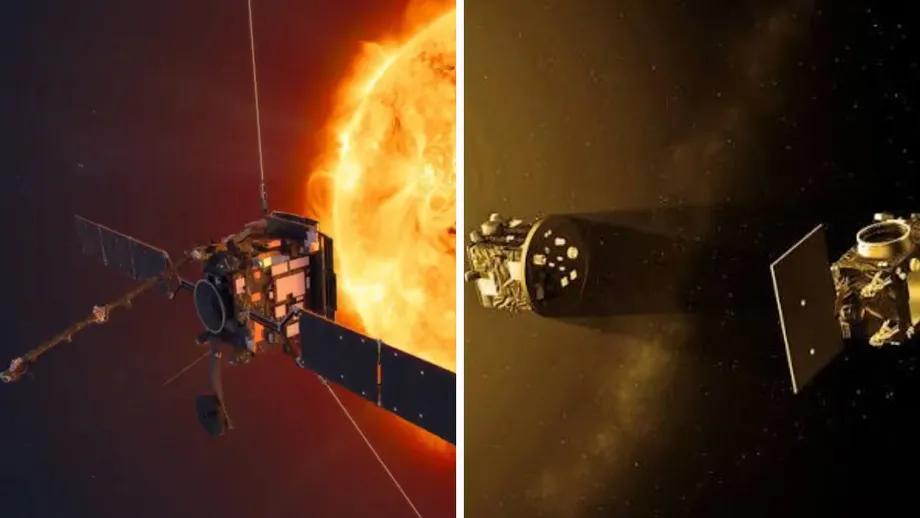
The researchers combined simultaneous observations from India's Aditya-L1 and the European Space Agency's Proba-3. Their instruments watched almost the same region close to the Sun, but collected different kinds of information: one measured the spectrum of light from hot gas, while the other produced images showing the eruption's shape and movement.
Scientists at the Indian Institute of Astrophysics (IIA), working with European and American solar physicists, used those complementary measurements to estimate the eruptions' mass, density and energy. Their coordinated coronagraphic observations study, accepted for publication in Astronomy & Astrophysics, presents the first simultaneous observations of coronal mass ejections by these two instruments.
A coronal mass ejection, or CME, is an expulsion of plasma and magnetic fields from the Sun's outer atmosphere, called the corona. Plasma is gas in which electrons have separated from atoms. Understanding what happens to this material near the Sun helps scientists explain how an eruption develops as it travels into space.
The two events offered a useful comparison: the faster CME travelled about 4.4 times as quickly as the slower one, but their differences went beyond speed. Their changing density and energy showed why images and measurements of hot gas are valuable together.
How the instruments share a view
Aditya-L1's Visible Emission Line Coronagraph, known as VELC, studies the corona between about 1.05 and 1.5 solar radii from the Sun's centre. Proba-3's Association of Spacecraft for Polarimetric and Imaging Investigation of the Corona of the Sun, or ASPIICS, observes between about 1.1 and 3 solar radii.
A solar radius is the distance from the Sun's centre to its visible surface. The instruments therefore share a viewing region between about 1.1 and 1.5 solar radii, just above that surface. This overlap allows researchers to compare measurements of the same eruption while it is still close to its origin.
Coronagraphs block the Sun's bright face so that the much fainter surrounding corona becomes visible. Proba-3 does this with two spacecraft flying about 150 metres apart. One casts a shadow on the other, creating an artificial eclipse for the observing instrument.
VELC, developed by IIA in collaboration with the Indian Space Research Organisation (ISRO), provides spectroscopic observations. Spectroscopy separates light by wavelength, allowing scientists to examine particular signals from the hot material. ASPIICS supplies images in white light and in a green emission line from the corona.
Why the earliest stages are difficult to measure
The inner corona is a difficult place to follow an eruption because faint escaping material must be observed close to the Sun's brilliant disc. Earlier instruments in space had limited success tracking the early development of faint CMEs, leaving gaps in measurements of how their energy changes.
ISRO described the value of combining the instruments in a statement issued on October 16, 2026. The agency explained that VELC supplied spectroscopy while ASPIICS supplied imaging of almost the same part of the corona:
These joint observations provide deeper insights into CME evolution than observations from a single spacecraft alone.
The researchers examined observations from July through December 2025. Within that period, they identified only two CMEs recorded simultaneously by both instruments, on September 14 and September 16. VELC captured both at an early stage, supplying measurements that complemented the ASPIICS images.
What images and spectra each reveal
ASPIICS white light observations allowed the team to estimate the mass and volume of the eruptions, along with their number density. Number density describes how many particles occupy a given volume. Following these quantities as an eruption rises helps show whether its material is spreading out and becoming more dilute.
The images also provided estimates of the CMEs' shape and motion. Those measurements fed into calculations of kinetic energy, the energy carried by moving material. Both mass and speed matter: a more massive eruption carries more kinetic energy at the same speed, while increasing speed has an especially strong effect.
VELC observed the green emission line from iron known as Fe XIV, at a wavelength of 5303 angstroms. This signal comes from gas at about two million degrees. Its spectrum allowed independent estimates of electron number density, thermal energy and the eruption's lateral extent, meaning its width across the viewing direction.
The instrument also measured emission measure, a quantity linked to the amount and density of hot material contributing to the observed light. Researchers use it, together with assumptions about the emitting region, to estimate the plasma's physical properties.
Mass and thermal energy estimates derived from ASPIICS and VELC agreed well despite differences in their observing methods, geometric assumptions and physical calculations. Agreement between independent methods gives researchers a useful check on quantities that are difficult to measure directly.
The faster eruption carried relatively little heat
The September 14 CME moved at approximately 645 kilometres per second. Its kinetic and estimated magnetic energies were comparable, while thermal energy remained much smaller. Thermal energy describes energy associated with the motion of particles within the gas, rather than the movement of the eruption as a whole.
The research paper puts thermal energy nearly two orders of magnitude below kinetic energy, or roughly one hundredth as much; public descriptions of the findings put it at about 1% of total energy. The paper's specific comparison is between heat and motion.
During the observed early development of this eruption, the relatively small thermal component indicated limited heating of the plasma. Much more energy was associated with its outward movement and magnetic field than with heat.
The slower eruption expanded more strongly
The September 16 CME travelled at about 145 kilometres per second. Its density fell more steeply with height than the density of the September 14 event, indicating stronger early expansion. As the material occupied a larger volume, the number of particles within each unit of space declined.
Expansion and outward speed describe different aspects of an eruption. A CME can move away from the Sun more slowly while spreading out more strongly. Measuring both helps explain how the cloud changes, rather than describing it with a single speed.
The slower eruption also showed a different energy pattern. Its thermal energy increased until it became comparable to its kinetic energy. In this case, heat grew into a substantial part of the measured energy balance during the period of observation.
Across both CMEs, estimated magnetic energy stayed comparable to or greater than kinetic energy over the observed heights. Magnetic energy is energy associated with the magnetic field carried by the erupting material. The researchers calculated it using observed CME properties and physically motivated assumptions constrained by those observations.
The comparison shows the value of measuring several properties together. Speed separated the two events immediately, but the density and thermal measurements revealed a further contrast: the slower eruption expanded more strongly and developed a much larger thermal component relative to its motion.
From mission launches to joint observations
Both missions reached space aboard Indian launch vehicles, although they use different arrangements to observe the Sun. Aditya-L1 is India's first dedicated solar mission. Proba-3 is a European mission using precision flight by two spacecraft to create its observing conditions.
- September 2, 2023: Aditya-L1 launched aboard PSLV-C57.
- January 6, 2024: Aditya-L1 entered a halo orbit around the Sun-Earth L1 point, providing a continuous view of the Sun.
- December 5, 2024: Proba-3 launched aboard PSLV-XL from Sriharikota.
- July to December 2025: Researchers examined the observation period in which they identified the two simultaneous CME recordings.
- September 14 and 16, 2025: VELC and ASPIICS observed the eruptions analysed in the study.
- October 16, 2026: ISRO issued its statement describing the joint findings.
The shared viewing region links the missions scientifically. VELC supplies information about hot plasma very close to the Sun, while ASPIICS images the overlapping region and extends farther into the corona.
What this changes for understanding solar weather
CMEs matter beyond solar physics because eruptions directed towards Earth can trigger geomagnetic storms. Those disturbances can affect satellites, navigation and communications. Researchers therefore need to understand how an eruption's properties develop before it reaches the wider space environment.
The study adds measurements at an early stage that has been difficult to observe. It brings mass, density, expansion and several forms of energy into the same analysis, with independent estimates from instruments using different methods. That gives scientists more information against which to test explanations of CME development.
The two events also provide concrete examples of different energy histories close to the Sun. One was fast and carried relatively little thermal energy; the other was slower, expanded more strongly and developed thermal energy comparable to its kinetic energy. Models of eruptions need to account for such differences.
The study focuses on these two CMEs and their early evolution. No operational forecast service or date for applying the results to forecasts was announced. The immediate result is a more complete set of measurements for studying how solar eruptions acquire and redistribute energy.
Key Points
- Aditya-L1 and Proba-3 recorded the same two solar eruptions on September 14 and 16, 2025.
- The eruptions travelled at about 645 and 145 kilometres per second, respectively.
- VELC spectroscopy and ASPIICS imaging provided complementary measurements of material close to the Sun.
- The faster CME had thermal energy roughly one hundredth of its kinetic energy, according to the research paper.
- The slower CME expanded more strongly, and its thermal energy grew to match its kinetic energy.
- Estimated magnetic energy was comparable to or greater than kinetic energy in both events.
- The findings provide new measurements for understanding the earliest stages of solar eruptions.