A six-year dispute ends with a sharp market reaction
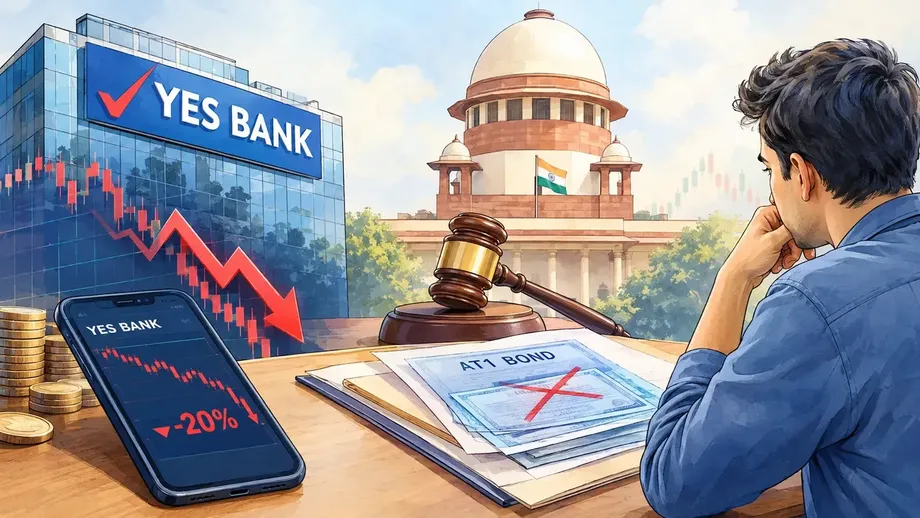
Yes Bank shares fell as much as 20% to Rs 16.96 on October 15, 2026, after the Supreme Court upheld the cancellation of the lender's decision to write off Rs 8,415 crore of Additional Tier-1 bonds during its March 2020 rescue. The ruling gives bondholders a route to recover investments that were reduced to zero, while leaving the bank facing decisions about how to account for the outcome.
Contents
- A six-year dispute ends with a sharp market reaction
- Why the administrator's authority mattered
- How the rescue became a court battle
- What made these bonds different from deposits
- Who stands to recover money?
- What the court said about annual interest
- How Yes Bank says its capital could be affected
- Why the government defended the write-off
- The rescue records also came under scrutiny
- Key Points
A bench of Justices Dipankar Datta and Augustine George Masih dismissed appeals by Yes Bank, the Reserve Bank of India (RBI) and the central government against the Bombay High Court's January 20, 2023 judgment. Bondholders were represented by Axis Trustee Services Ltd.
The Supreme Court bench announced its decision in these terms:
We see no reason to interfere with the impugned judgment.
The dispute centred on the administrator's authority to cancel the bonds after the bank's reconstruction scheme took effect. A provision allowing the write-off had appeared in the draft scheme but was omitted from the final version approved by the government.
Trading volumes exceeded 622 million shares across the National Stock Exchange and Bombay Stock Exchange. The intraday low of Rs 16.96 compared with the previous close of Rs 21.20, a fall of Rs 4.24 per share. The broader market rose about 1.5%, making the bank's decline particularly stark.
For shareholders, the immediate concern is how restoring bondholder rights could affect the bank's core capital, future accounts and cash payments. For bondholders, the judgment marks a legal victory after more than six years of litigation, with the practical recovery process still to be settled.
Why the administrator's authority mattered
The Bombay High Court found that Yes Bank had been reconstituted on March 13, 2020, before its administrator wrote down the bonds on March 14. The final reconstruction scheme contained no specific provision authorising that action.
Bondholders argued that the omission mattered because the draft scheme had expressly contemplated a write-off. Once the government approved a final scheme without that provision, they said, the administrator could not independently cancel their investments.
The Supreme Court examined whether the administrator could act without specific authority under the reconstruction scheme and whether the write-down complied with the RBI's applicable master circular and the bonds' information memorandum. A master circular brings together a regulator's rules on a subject; an information memorandum sets out an investment's terms and risks.
The court upheld the High Court's conclusion against the appellants on those questions. It also considered whether developments since the write-down made a decision on the merits unnecessary, and chose to decide the substantive legal issues.
The High Court had left the authorities free to take further action permitted by law. Its ruling therefore placed the focus on the powers available under the approved rescue arrangement and the rules governing these particular bonds.
How the rescue became a court battle
Yes Bank entered its 2020 rescue after rising bad loans, governance concerns and pressure on its ability to meet withdrawals damaged confidence. The RBI intervened, and the government approved reconstruction under the Banking Regulation Act, 1949, backed by State Bank of India (SBI) and other lenders.
The main events unfolded as follows:
- March 5, 2020: The RBI placed Yes Bank under a moratorium, restricting banking activity while a rescue was arranged.
- March 13, 2020: The bank was reconstituted under the reconstruction scheme, according to the High Court's findings.
- March 14, 2020: The administrator wrote down Rs 8,415 crore of AT1 bonds to zero.
- April 2021: The Securities and Exchange Board of India imposed a Rs 25 crore penalty on Yes Bank over alleged mis-selling of AT1 bonds in the secondary market.
- January 20, 2023: The Bombay High Court quashed the write-off.
- May 20: The Supreme Court reserved judgment after hearing the parties.
- October 15, 2026: The Supreme Court dismissed the appeals, and Yes Bank shares fell sharply.
Yes Bank had issued AT1 bonds in 2013, 2016 and 2017. The write-down covered the 2016 and 2017 tranches, meaning the groups of bonds issued in those two years.
What made these bonds different from deposits
AT1 bonds are securities that banks issue to strengthen their capital, the financial cushion available to absorb losses. They form part of the banking framework known as Basel III, developed after the 2008 global financial crisis.
Investors generally receive interest, called a coupon, in exchange for accepting risks greater than those attached to ordinary debt. AT1 bonds are unsecured, meaning holders have no specific asset pledged to repay them, and perpetual, meaning they have no fixed repayment date.
The terms can allow the bonds to be written down or converted into shares when specified financial stress conditions are met. That loss absorption feature helps explain why a bank can count them towards regulatory capital and why investors seek higher returns for holding them.
A bank deposit is money held in an account under deposit terms. Buying an AT1 bond means investing in a security whose contract allows losses under defined conditions. That difference became especially important at Yes Bank because many affected retail investors were also customers of the lender.
The legal dispute required the courts to examine how those contractual risks fitted with the reconstruction scheme, the administrator's powers and the RBI's rules. The Supreme Court's decision leaves the High Court's rejection of this write-down intact.
Who stands to recover money?
Axis Trustee Services represented debenture holders seeking to overturn the cancellation of their investments. Both institutional and retail investors were affected, including mutual funds that had marked the bonds down to zero.
Data submitted during the court proceedings identified 1,346 retail investors with about Rs 679 crore invested. Of those, 1,311 were Yes Bank customers, holding nearly Rs 663 crore.
Those figures mean roughly 97% of the identified retail investors were customers of the bank. Their Rs 663 crore accounted for about 98% of the Rs 679 crore attributed to that retail group. The concentration helps explain why the sale of complex bank securities to existing customers became a separate regulatory concern.
SEBI's Rs 25 crore penalty in April 2021 concerned alleged mis-selling in the secondary market, where investors buy securities that have already been issued. The court case concerned the later cancellation of the bonds during reconstruction.
The remaining recovery questions are whether the bonds will be restored or repaid, how any past interest will be treated and when implementation will occur. No payment timetable was given in the accounts of the decision.
What the court said about annual interest
The Supreme Court also addressed annual coupon payments, an issue of direct importance to investors who bought the bonds for income. The bench said those payments must follow the information memorandum.
Justices Datta and Masih stated:
Payment of annual coupon rate shall remain unaffected by the outcome of these appeals and must be made in terms of the Information Memorandum.
The information memorandum is central because it contains the contractual terms governing the securities. Investors seeking to understand future payments will need the court's directions to be applied alongside those terms.
The coupon direction puts annual interest alongside the principal amount in the practical work that follows the judgment. For an individual investor, both matter: restoring the value of an investment and receiving income under its terms are different parts of recovery.
How Yes Bank says its capital could be affected
Yes Bank has said any financial liability resulting from the verdict would be recognised in the relevant future reporting period. The bank has also said it did not expect a material financial impact.
After the 2023 High Court judgment, then chief executive Prashant Kumar said restoring the bonds would not affect total capital adequacy. In an extreme scenario, he said, Common Equity Tier 1 capital could fall while AT1 capital increased.
Common Equity Tier 1, usually shortened to CET1, is a bank's core capital cushion, including ordinary shareholders' equity and retained earnings. AT1 instruments form another part of its capital structure. A change between those categories can matter to shareholders even when the combined capital ratio stays unchanged.
The Rs 8,415 crore at the centre of the case is equivalent to about 14.8% of Yes Bank's reported market capitalisation of Rs 56,876 crore on October 15. That comparison helps explain the scale of investor concern, while the bank's eventual accounting treatment depends on how the judgment is implemented.
The share price decline followed an already weak period. Yes Bank shares were down about 21% over the preceding year and nearly 15% since the start of 2026. The sudden fall added pressure as investors assessed the ruling against the bank's stated expectations.
Why the government defended the write-off
The government and RBI argued that AT1 bonds were designed to absorb losses during financial stress and that the write-off supported Yes Bank's rescue. The government said SBI invested around Rs 8,000 crore against the backdrop of the proposed treatment of the bonds.
The Centre maintained that the RBI master circular and bond contracts provided a basis for the action independent of the reconstruction scheme. It also argued that the trigger associated with a bank becoming unviable could arise before reconstruction was complete.
Solicitor General Tushar Mehta, representing the Centre, finance ministry, RBI and Yes Bank, warned of consequences for the wider banking system if the loss absorption feature of AT1 bonds were weakened. He put outstanding AT1 bonds across Indian banks at around Rs 1.81 trillion, or Rs 1.81 lakh crore; another account of the Centre's submissions put the amount at nearly Rs 1 lakh crore.
Bondholders focused on the authority exercised in this rescue. Their lawyers argued that the administrator exceeded his powers and had to follow the approved scheme and applicable legal process.
The rescue records also came under scrutiny
The Supreme Court sought Cabinet records connected with reconstruction before reserving judgment. These included resolutions, meeting minutes and related documents.
The bench also sought the rules governing the relevant Cabinet meeting, quorum requirements and the names of members present. A quorum is the minimum number of participants required for a meeting to conduct valid business.
Those requests placed the formal approval process alongside the bond contracts and RBI rules in the court's examination. The dispute reached beyond the commercial purpose of the rescue to the documents and decisions through which it was carried out.
For banks arranging future rescues, the case puts the wording of reconstruction schemes and the legal authority for imposing investor losses at the centre of planning. For Yes Bank's investors, the immediate task is more concrete: translating the judgment into the treatment of the bonds, interest payments and the bank's accounts.
Key Points
- The Supreme Court dismissed appeals by Yes Bank, the RBI and the Centre against the quashing of a Rs 8,415 crore AT1 bond write-off.
- Yes Bank shares fell as much as 20% to Rs 16.96 on October 15, 2026.
- The final reconstruction scheme omitted a write-off provision that had appeared in the draft.
- The court said annual coupon payments must follow the bonds' information memorandum.
- Court proceedings identified 1,346 retail investors with about Rs 679 crore invested, most of them Yes Bank customers.
- The method and timing of bondholder recovery remain to be settled.