Reliance controls Jio, but the IPO figures need a closer look
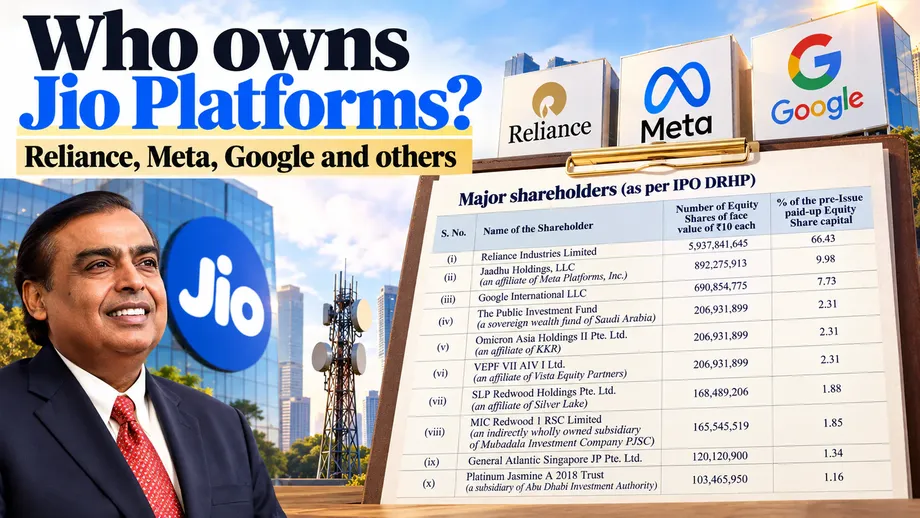
Reliance Industries owns 66.43% of Jio Platforms, while Meta affiliate Jaadhu Holdings owns 9.98% and Google International holds 7.73%, according to the company's draft prospectus. The proposed initial public offering would issue up to 270 million new shares without any existing shareholder selling shares through the offer.
Contents
- Reliance controls Jio, but the IPO figures need a closer look
- What the shareholder register actually shows
- Meta and Google bring commercial ties as well as capital
- Sovereign funds and private equity complete the investor base
- New shares will dilute ownership without changing control
- The fundraising target and price range do not align
- Debt repayment is the main planned use of proceeds
- Growing earnings support a business extending beyond mobile service
- What is scheduled, and what still needs confirmation
- Key Points
That structure makes this a fundraising exercise for Jio rather than an exit for its global investors. Up to ₹27,500 crore of the proceeds is planned for repayment or prepayment of borrowings at Reliance Jio Infocomm, the subsidiary that operates its telecom business.
There is, however, a substantial mismatch between the reported fundraising target and the reported price range. An issue of 27 crore shares priced at ₹1,065 to ₹1,119 each would raise between ₹28,755 crore and ₹30,213 crore, not the widely cited ₹37,700 crore. The final offer documents will need to establish which figures apply.
Reliance disclosed receipt of an observation letter from the Securities and Exchange Board of India (SEBI) on August 28, 2026, following the filing of draft papers on June 19. Reports describe an October subscription window and a listing by the end of that month. These dates and the price range should be treated as expectations, since the observation letter does not itself confirm the launch schedule or final pricing.
What the shareholder register actually shows
The draft prospectus identifies Reliance Industries as the promoter, the controlling shareholder behind the company. It holds 5,937,841,645 equity shares. Members of the wider promoter group hold no equity shares as of the draft document's date.
The register contains 105 shareholders: Reliance, ten additional leading shareholders and 94 other shareholders. This distinction explains why the ten investors with stakes of at least 1% are not exactly the same group as Reliance plus the document's additional top ten shareholders.
The ten holders with stakes of at least 1%, including Reliance, account for 97.3% of the company's equity using the published percentages. TPG's investment vehicle is the next largest named holder, with 0.93%.
- Reliance Industries Limited: 5,937,841,645 shares, or 66.43%.
- Jaadhu Holdings, LLC, a Meta affiliate: 892,275,913 shares, or 9.98%.
- Google International LLC: 690,854,775 shares, or 7.73%.
- Saudi Arabia's Public Investment Fund: 206,931,899 shares, or 2.31%.
- Omicron Asia Holdings II Pte. Ltd., affiliated with KKR: 206,931,899 shares, or 2.31%.
- VEPF VII AIV I Ltd., affiliated with Vista Equity Partners: 206,931,899 shares, or 2.31%.
- SLP Redwood Holdings Pte. Ltd., affiliated with Silver Lake: 168,489,206 shares, or 1.88%.
- MIC Redwood 1 RSC Limited, a Mubadala subsidiary: 165,545,519 shares, or 1.85%.
- General Atlantic Singapore JP Pte. Ltd.: 120,120,900 shares, or 1.34%.
- Platinum Jasmine A 2018 Trust, associated with the Abu Dhabi Investment Authority: 103,465,950 shares, or 1.16%.
- India Markets Pte. Ltd., managed or advised by TPG Capital: 82,772,760 shares, or 0.93%.
The remaining public shareholders collectively hold 156,868,465 shares, listed as 1.75%. The published percentages are rounded, so they do not add to exactly 100%.
Meta and Google bring commercial ties as well as capital
Meta and Google are Jio's largest minority investors, with a combined 17.71% stake before the proposed issue. Their investments are held through Jaadhu Holdings and Google International, respectively, rather than appearing under the parent companies' familiar consumer brands.
The relationship with Meta extends into digital commerce, enterprise solutions and services built around WhatsApp. Google's partnership produced JioPhone Next, a smartphone jointly developed with Jio using an Android operating system tailored for Indian users. These are specific commercial connections, although their value to Jio cannot be measured from the ownership percentages alone.
Neither investor is offering shares for sale in the proposed IPO. That means their existing share counts would remain unchanged through the offer, although their percentage ownership would fall when Jio issues new shares.
These holdings sit within a much larger fundraising history. Jio attracted more than ₹1.52 lakh crore from investors in 2020, equivalent to more than ₹152,000 crore. Intel Capital and Qualcomm also invested in the business, but individual holdings for those investors are not identified in the shareholder breakdown reproduced here.
Sovereign funds and private equity complete the investor base
Three investors associated with sovereign wealth funds hold a combined 5.32% before the issue: Saudi Arabia's Public Investment Fund at 2.31%, Mubadala's MIC Redwood 1 at 1.85%, and the Abu Dhabi Investment Authority's associated trust at 1.16%. Sovereign wealth funds invest capital on behalf of governments.
The legal entities matter. Mubadala's stake is held by an indirectly wholly owned subsidiary. The ADIA investment is held through Platinum Jasmine A 2018 Trust, acting through its trustee, Platinum Owl C 2018 RSC Limited, which is wholly owned by ADIA.
The private equity group is also substantial. KKR and Vista each have affiliated vehicles holding 2.31%, followed by Silver Lake at 1.88%, General Atlantic at 1.34% and the TPG vehicle at 0.93%. Together, these published holdings amount to 8.77%.
Vista belongs in that group even though some shorter shareholder summaries omit it. Its vehicle holds exactly the same number of shares as the Public Investment Fund and KKR's vehicle: 206,931,899. The official register therefore gives a fuller picture than a list focused only on the most familiar investor names.
New shares will dilute ownership without changing control
The draft specifies a fresh issue of up to 270,000,000 shares with a face value of ₹10 each. Face value is the nominal amount assigned to a share in the company's capital structure, not the price investors would pay in the IPO. The sale price is to be determined through book building, a process in which investor bids help establish the final issue price.
There is no offer for sale. In an offer for sale, existing shareholders sell some of their holdings and receive the proceeds. Here, the proceeds instead go to Jio, subject to issue expenses and the stated use of funds.
Adding the share counts in the draft produces approximately 8.939 billion existing shares. If Jio issues the full 270 million shares and there are no other capital changes, the total would rise to approximately 9.209 billion. The newly issued shares would represent about 2.93% of that enlarged total, consistent with the reported estimate of roughly 2.9%.
On that basis, Reliance's holding would fall from 66.43% to approximately 64.48%. Jaadhu's stake would become about 9.69%, and Google's about 7.50%. These are calculations from the draft share counts, not confirmed final ownership percentages. Reliance would still retain a clear majority.
The fundraising target and price range do not align
Reports estimate proceeds of ₹37,700 crore, also expressed as ₹377 billion, with dollar equivalents ranging from about $3.8 billion to $4 billion. Those dollar estimates vary, but they refer to the same stated rupee target.
The reported price range creates a separate problem. Multiplying the maximum 27 crore new shares by ₹1,065 gives ₹28,755 crore. At ₹1,119, the proceeds would be ₹30,213 crore. Even the upper end is ₹7,487 crore below the ₹37,700 crore estimate.
To raise ₹37,700 crore from 27 crore shares would require an average issue price of approximately ₹1,396.30 per share, before expenses. Investors should therefore avoid treating the share count, price range and fundraising target as a single settled package.
At the reported $3.8 billion to $4 billion size, Jio's IPO would exceed Hyundai Motor India's $3.3 billion offering in 2024. That potential record depends on the final proceeds. Reports also describe a $50 billion pipeline of Indian share offerings for 2026, including a National Stock Exchange issue estimated at ₹300 billion, or about $3.1 billion. SEBI sought clarification on the exchange's draft prospectus, potentially delaying that separate transaction.
Debt repayment is the main planned use of proceeds
Jio plans to direct up to ₹27,500 crore toward repayment or prepayment, in full or in part, of borrowings at Reliance Jio Infocomm. The balance is intended for general corporate purposes. The transaction therefore raises money at the platform company to reduce debt in its major operating subsidiary.
Against the reported ₹37,700 crore target, the debt allocation represents about 72.9% of gross proceeds. Subtracting ₹27,500 crore leaves ₹10,200 crore before issue expenses. That is an illustrative calculation, not a confirmed amount available for general corporate purposes.
The discrepancy in the fundraising figures matters here too. If proceeds instead matched the reported price range and maximum share count, the same debt allocation would consume about 91.0% to 95.6% of gross proceeds. The amount left before expenses would be between ₹1,255 crore and ₹2,713 crore.
Reports describe stronger cash generation and a declining net leverage ratio ahead of the IPO, but do not give a numerical leverage ratio. Net leverage generally compares debt after deducting cash with a measure of earnings. Without the actual ratio and borrowing terms, the precise effect of the planned repayments cannot be calculated.
Growing earnings support a business extending beyond mobile service
Jio reported FY26 revenue from operations of ₹146,885.30 crore, up 14.6% from ₹128,218.40 crore in FY25. A longer comparison puts revenue at approximately ₹110,000 crore in FY24 and nearly ₹147,000 crore in FY26, an increase of about one third using those rounded figures.
EBITDA rose from ₹64,170 crore to ₹76,255.40 crore, an increase of 18.8%. EBITDA measures earnings before interest, taxes, depreciation and amortisation. The EBITDA margin increased from 50.05% to 51.91%, a gain of 1.86 percentage points, indicating that this earnings measure grew faster than revenue.
Reports differ on FY26 profit. One gives profit after tax of ₹30,049.10 crore, up 15.1% from ₹26,109 crore. Another gives consolidated net profit of ₹30,064 crore. The difference is ₹14.90 crore, and the accounts do not explain whether it reflects a different reporting measure or another adjustment.
Jio's customer base increased from 488.2 million to 524.4 million, a gain of 36.2 million, or about 7.4%. Separately, it added about 27 million net active mobility customers. These are different customer measures and should not be treated as interchangeable.
Its reported wireless broadband market share was 49.95% as of March 31, compared with Bharti Airtel's 35.13%, Vodafone Idea's 12.65% and BSNL's 2.24%. Jio's lead over Airtel was 14.82 percentage points. The company also said it served about 1.4 times as many 4G and 5G subscribers as its nearest rival.
Beyond mobile connectivity, Jio is expanding home broadband, enterprise services, artificial intelligence, digital platforms, its 5G technology stack and technology activities overseas. Reliance Industries Chairman Mukesh Ambani described that technology ambition in remarks at the group's annual general meeting:
Before Jio, many believed that India could only import technology from the world. Our engineers proved otherwise. Today, Jio is not merely integrating technology. It is creating original technology
What is scheduled, and what still needs confirmation
The proposed timetable spans several regulatory and market steps. Receipt of SEBI's observation letter is a milestone in reviewing the offer documents, not confirmation that subscriptions have opened or that the reported price range is final.
- June 19, 2026: Jio Platforms filed its draft red herring prospectus with SEBI.
- August 28, 2026: Reliance disclosed that Jio received SEBI's observation letter that day.
- October 19, 2026: The reported expected date for the anchor investor round.
- October 21 to October 23, 2026: The reported expected subscription period.
- By the end of October 2026: The reported expected listing window.
Anchor investors are institutional investors allotted shares before the main subscription period. The reported allocation framework provides up to 50% for qualified institutional buyers and at least 35% for retail investors. Separate reservations are also planned for eligible Reliance shareholders and employees, but their sizes have not been disclosed.
Ambani said Reliance Jio Infocomm Chairman Akash Ambani, Reliance Retail Ventures Executive Director Isha Ambani Piramal and Reliance Industries Executive Director Anant Ambani would lead the IPO process. Their stated roles concern the transaction's leadership, not a replacement for Reliance Industries as the controlling shareholder.
The final price, confirmed offer dates, reservation sizes and reconciliation of the fundraising estimate remain the key unresolved details. The draft ownership register establishes who holds Jio today; the final offer documents will establish the terms on which public investors can join them.
Key Points
- Reliance Industries owns 66.43% of Jio Platforms before the proposed IPO; Meta's affiliate holds 9.98% and Google holds 7.73%.
- The draft identifies 105 shareholders, with the ten holders owning at least 1% accounting for 97.3% of equity.
- The proposed issue consists of up to 270 million new shares, with no sale by existing shareholders.
- A full issue would leave Reliance with approximately 64.48%, assuming no other capital changes.
- The reported ₹1,065 to ₹1,119 price range implies proceeds below the ₹37,700 crore estimate.
- Up to ₹27,500 crore is planned for repayment or prepayment of Reliance Jio Infocomm borrowings.
- FY26 revenue reached ₹146,885.30 crore, while the customer base grew to 524.4 million.
- The reported October 2026 offer timetable and pricing still require confirmation in final offer documents.