

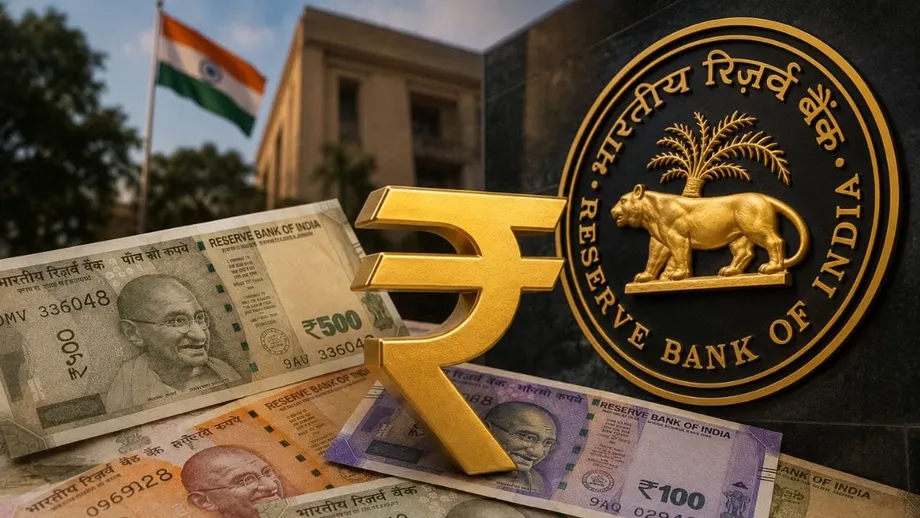
A 20% Reserve Rule Adds a New Layer to Rupee Defence
The Reserve Bank of India announced a new cash reserve requirement for specified currency derivatives above $2 million and a dedicated dollar supply window for three government oil companies on October 10, 2026, seeking to ease pressure on a rupee trading close to 97 per dollar.
Contents
- A 20% Reserve Rule Adds a New Layer to Rupee Defence
- The $5 Million Threshold Is Not a Hedging Ban
- Cancelled Contracts Cannot Be Rebooked
- How the Foreign Exchange Risk Reserve Works
- Oil Companies Account for Billions in Dollar Demand
- Cheaper Forward Dollars Could Still Mean Costlier Protection
- Reserves and Banking Liquidity Face Further Pressure
- The Measures Follow Months of Currency Pressure
- Early Relief Does Not Remove External Pressures
- Key Points
The package cuts the threshold for certain hedging transactions without proof of the underlying exposure from $100 million to $5 million. It also bars the rebooking of cancelled rupee currency derivative contracts, while allowing contracts to be rolled over at maturity under existing rules.
The oil company facility will begin on Monday, October 12, through designated banks and continue until further notice. It will meet the daily dollar requirements of Indian Oil Corporation, Hindustan Petroleum Corporation and Bharat Petroleum Corporation, moving a major source of demand away from the open currency market.
The RBI described its purpose in a statement announcing the measures:
The measures are intended to strengthen market discipline and ensure appropriate risk management in the foreign exchange market, while maintaining an orderly and transparent market environment.
The central tension is that reducing demand for dollars may support the currency, but making hedging more expensive can leave companies less protected against further depreciation. Supplying dollars to oil companies also shifts the burden from the market to the RBI's foreign exchange resources, rather than removing India's need to pay for imported energy.
Most reports put Friday's closing exchange rate at 96.73 per dollar. Reports differ on the precise closing and record levels: another account gives a Friday figure of 96.9650, while the original announcement account distinguishes a record closing low of 96.82 from an intraday low near 96.96. Those differences matter when judging whether the currency has reached a new record.
The $5 Million Threshold Is Not a Hedging Ban
The reduction from $100 million to $5 million is a 95% cut in the threshold for hedging contracted exposures without establishing the underlying exposure. An underlying exposure is an actual currency risk, such as a company's obligation to pay a foreign supplier in dollars.
The $5 million threshold is calculated across all authorised dealers, rather than being a separate allowance at each bank. A corresponding reduction applies to rupee currency derivatives across recognised stock exchanges.
This is not an absolute $5 million ceiling on genuine hedging. Transactions above the applicable threshold require documentation establishing the exposure. Companies with larger legitimate payment obligations can still seek protection, but must substantiate the risk they are covering.
Authorised dealers must also obtain and retain an undertaking confirming that the same contracted exposure has not been hedged with another dealer. That requirement targets duplicate hedges against a single obligation, which can create currency positions larger than the underlying commercial need.
Cancelled Contracts Cannot Be Rebooked
The rebooking restriction covers rupee currency derivative contracts cancelled after the directions were issued, including contracts cancelled with another bank. It applies to both deliverable contracts, which involve exchanging currencies, and non deliverable contracts, which settle the difference between an agreed exchange rate and a reference rate.
A company cannot simply cancel a covered contract and arrange a replacement elsewhere. That closes an avenue for repeatedly changing positions as the exchange rate moves.
Rollovers at maturity remain permitted under existing regulations. A rollover extends currency protection when a contract expires, making it different from cancelling a live contract and booking another one.
The distinction matters for businesses managing payment schedules. The rules preserve a route for continuing protection at maturity, while restricting the cancellation and replacement of contracts during their life.
How the Foreign Exchange Risk Reserve Works
The new Foreign Exchange Risk Reserve, or FERR, requires authorised dealers to hold cash with the RBI equal to 20% of the rupee equivalent of the notional value of each eligible contract exceeding $2 million. Notional value is the amount of currency covered by the contract, not the bank's profit or the customer's upfront payment.
The more detailed descriptions specify contracts used to hedge current account exposures where the customer buys foreign currency against rupees. This includes obligations associated with trade payments. Some reports describe the reserve more broadly as covering all rupee derivatives, but the detailed accounts identify this narrower category of eligible transactions.
The reserve must be maintained daily until the contract ends, with daily reporting through the RBI's Central Information Management System. Attempts to evade the requirement by using multiple transactions will be treated as violations.
The 20% requirement is a cash reserve obligation on the dealer, not a statement that every customer must pay a 20% fee. Its cost can nevertheless reach customers because the bank must commit funds that it cannot use elsewhere.
Ashhish Vaidya, head of treasury at DBS Bank, described the intended effect on currency demand:
The 20% levy will make it more expensive to hedge large dollar transactions and could reduce dollar/rupee premiums. This, together with taking OMC dollar demand out of the market and reducing the threshold for forex derivative contracts to $5 million, will impact dollar demand and support the rupee.
Oil Companies Account for Billions in Dollar Demand
Market participants estimate that public sector oil marketing companies generate $10 billion to $12 billion in monthly demand for dollars related to oil, or roughly $300 million to $400 million a day. Routing that demand through a dedicated RBI facility could remove a substantial buyer from the spot market, where currencies are exchanged for near immediate delivery.
The facility does not reduce the oil import bill. It changes how the three companies obtain dollars, potentially easing competition for foreign currency among other market participants.
The RBI has not disclosed a fixed dollar allocation or limits for individual transactions under the facility. Its stated duration is until further notice, so there is no announced closing date.
The arrangement recalls the August 2013 dollar and rupee swap window for the same three oil companies. The latest announcement describes dollar sales through designated banks; it should not be assumed to have identical terms to the earlier swap facility.
The immediate focus on supplying dollars also contrasts with India's earlier push for trade settlement in rupees, which sought to reduce reliance on dollar conversions. The oil window addresses immediate currency demand rather than changing the currency in which energy purchases are paid.
Cheaper Forward Dollars Could Still Mean Costlier Protection
Kotak Mahindra Bank estimates that hedging costs could rise by 1% to 1.6%, while IDFC FIRST Bank estimates an increase of around 1.5%. These are forecasts of the reserve requirement's effect, not confirmed charges applying uniformly to every company.
At the same time, both banks expect forward premiums to soften. A forward premium is the difference between today's exchange rate and the rate agreed for a future currency transaction. A lower premium does not necessarily mean a lower total hedging cost if a bank adds charges to recover the cost of maintaining the reserve.
Forward premiums had risen after the RBI used dollar and rupee sell and buy swaps to absorb excess rupee liquidity from banks. One account puts the increase in the cost of hedging dollars for a year at more than 100 basis points over two months. One hundred basis points equals one percentage point.
Some bankers warned that the new reserve could sharply restrict importer hedging and cause premiums to fall steeply. Those are warnings, not established outcomes.
Samir Lodha, founder and managing director of QuantArt Market Solutions, highlighted the risk to companies covering genuine obligations:
The concern is that regular importers who want to manage their currency risks prudently may now find hedging more difficult and expensive.
The policy therefore presents a tradeoff. Less hedging demand may ease pressure on the rupee today, while companies that decide against protection remain exposed to a more expensive dollar when their payments fall due.
Reserves and Banking Liquidity Face Further Pressure
India's foreign exchange reserves were reported to have fallen by $12.95 billion to $734.60 billion in the week ending October 2, the fourth consecutive weekly decline. Accounts put the decline over roughly a month at $51 billion or nearly $52 billion.
Those reserve movements should not be treated as a precise measure of dollars sold to defend the currency. Changes in reserve values can also reflect movements in the prices and exchange rates of assets held by the central bank.
The decline followed a diaspora deposit programme reported to have raised $133 billion and helped bring reserves close to $800 billion in early September. The oil company facility adds another channel through which the RBI may supply foreign currency.
Domestic liquidity is also part of the policy picture. IDFC FIRST Bank projects that the core banking liquidity surplus could decline from Rs 10.4 lakh crore on October 2 to around Rs 2 lakh crore by March 2027. That is a projected reduction of Rs 8.4 lakh crore, or about 81%, driven by several factors rather than the derivatives reserve alone.
Kotak estimates that the measures could withdraw around Rs 1.5 lakh crore of durable liquidity if sustained for another month. Separately, the RBI announced an October sale of government securities worth Rs 25,000 crore and increased daily maintenance of the Cash Reserve Ratio from 90% to 99%.
The latter change concerns how much of the required reserve banks maintain each day. It does not mean banks must reserve 99% of their deposits. The RBI also raised its repo rate by 25 basis points at the October meeting and moved to calibrated tightening. IDFC FIRST Bank expects the rate to reach 6% to 6.25% before further increases end, but that remains a forecast.
The Measures Follow Months of Currency Pressure
The latest intervention follows earlier restrictions, efforts to attract foreign currency deposits and interest rate action. The main dates show how the response has developed:
- August 2013: The RBI opened a dollar and rupee swap window for the same three oil companies.
- February 28, 2026: The West Asia conflict began, according to the reported chronology. The rupee subsequently weakened by around 6%.
- March 2026: The RBI capped banks' net open positions in the domestic deliverable dollar and rupee market at $100 million.
- May 20, 2026: The rupee reached a reported intraday low of about 96.96 per dollar.
- June 2026: The RBI introduced its diaspora deposit programme.
- October 10, 2026: The RBI announced the derivatives restrictions and oil company dollar window.
- October 12, 2026: The dedicated dollar facility is scheduled to open.
Reports describe depreciation of about 7% during the calendar year, more than 7% compared with a year earlier, and nearly 10% during fiscal 2026. These measurements cover different periods and should not be treated as interchangeable.
Early Relief Does Not Remove External Pressures
The one month dollar and rupee non deliverable forward contract fell about 40 paise in thin Saturday trading after the announcement. That suggests an initial improvement in sentiment, but limited weekend trading is not enough to establish a lasting currency recovery.
Kotak Mahindra Bank said a move below 95 rupees per dollar could not be ruled out. That is a forecast, not an RBI target. Likewise, the suggestion that the central bank would defend 97 per dollar came from market participants, including Abhishek Upadhyay of ICICI Securities Primary Dealership, rather than an announced exchange rate commitment.
Foreign equity outflows remain substantial. One account gives more than $30 billion for the calendar year; another gives a more precise $32.4 billion. Elevated oil prices increase India's dollar payment needs, while higher global interest rates can make investments outside India more attractive.
US Treasury yields were reported at 5.3% for the 10 year benchmark. Vivek Kumar, an economist at QuantEco Research, attributed currency pressure to commodity prices, global rates and geopolitical uncertainty, factors the domestic trading restrictions cannot directly change.
Dhiraj Nim, a foreign exchange strategist at ANZ in Mumbai, described the limits of the intervention:
It buys time but doesn’t change the picture: oil prices and capital flows will still decide the rupee’s direction.
The next tests are trading after the weekend, the opening of the oil company window on October 12 and the coming week's reserve figures. The scale of dollar supply, the duration of the facility and the actual cost passed on to hedging customers have not yet been established.
Key Points
- The RBI introduced a 20% cash reserve for eligible currency derivative contracts exceeding $2 million.
- The threshold for specified hedges without establishing the underlying exposure falls from $100 million to $5 million, not an absolute cap on genuine hedging.
- Cancelled rupee derivative contracts cannot be rebooked under the new directions; rollovers at maturity remain permitted.
- Indian Oil, Hindustan Petroleum and Bharat Petroleum will receive dollars through a dedicated facility starting October 12.
- Banks expect relief for the rupee and softer forward premiums, alongside higher costs for some hedging transactions.
- Oil prices, foreign investment flows and reserve use remain central to whether the relief lasts.