A brief rebound gives way to heavy selling
Taiwan stock index futures fell below 40,000 during night trading on November 5, losing more than 2,000 points at one stage as a sharp selloff in American chip and artificial intelligence stocks spread across the technology supply chain. The reversal followed an earlier rebound of more than 400 points that had carried the futures to 42,298.
Contents
- A brief rebound gives way to heavy selling
- How the reversal unfolded
- Why state elections matter to the AI buildout
- Chipmakers and storage suppliers take the hardest hit
- Qualcomm exposes another pressure point
- Borrowing costs deepen the cloud sector's worries
- Asia's losses were concentrated, not uniform
- Oil and defensive shares offer a different picture
- Wall Street divides over the next move
- Key Points
The swings came after Democratic victories in the 2026 US midterm elections shifted investor attention toward possible restrictions on data center construction, alongside existing concerns about the cost and returns of the AI expansion. Democrats secured control of both chambers of Congress, while victories in important state races added uncertainty over construction permits and electricity policy.
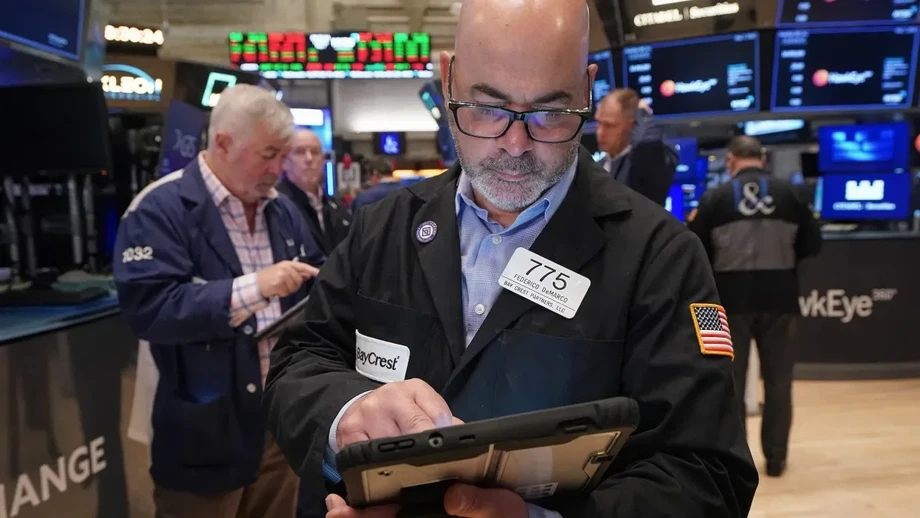
At 11:34 p.m. Taipei time on November 5, the Philadelphia Semiconductor Index was down 791 points, or 7.7%. The Nasdaq Composite had fallen 982 points, or 3.8%, while the S&P 500 lost 169 points, or 2.2%, and the Dow Jones Industrial Average dropped 595 points, or 1.1%.
Selling intensified into the early hours of November 6 in Taipei. The Nasdaq's intraday loss reached 4.9%, the S&P 500 fell 3.2%, and the Dow lost 1,136 points, or about 2.1%. The semiconductor index subsequently fell as much as 12%, leaving its gain for the year at roughly 25%.
The Nasdaq also moved more than 10% below its record high from the previous month, entering what traders call a correction. For Taiwan, the immediate pressure came through both futures and the American depositary receipts of Taiwan Semiconductor Manufacturing Co., which fell about 10% during the US session.
How the reversal unfolded
Markets initially welcomed parts of the election outcome. Investors anticipated that a Democratic Congress facing Republican President Donald Trump could limit major policy changes and increase pressure for an end to the war with Iran. Technology suppliers moved in the opposite direction as concern about AI construction grew.
- November 4, Asian trading: Japan's Nikkei fell about 3.1% while investors were still assessing election returns and neither chamber of Congress had been formally called.
- November 4, US trading: The Dow rose 3.03%, the S&P 500 gained 1.58%, and the Nasdaq added 1.44%. The Philadelphia Semiconductor Index nevertheless fell 3.1%.
- November 5, Asian trading: Taiwan's TAIEX fell 3.20% to 41,574.72, while South Korea's KOSPI dropped 5.28% to 5,383.81.
- November 5, Taiwan night trading: Index futures rebounded to 42,298 before reversing and breaking below 40,000 as American technology shares plunged.
- Early November 6, Taipei time: The Nasdaq's intraday decline widened to 4.9%, with semiconductor and AI infrastructure companies among the largest losers.
The reversal was visible even before Wall Street opened on Thursday. At 3:03 a.m. US Eastern time, Nasdaq 100 futures were down 1%, S&P 500 futures slipped 0.2%, and Dow futures rose 0.3%. By the regular session, selling had spread to all three major indexes.
Why state elections matter to the AI buildout
Texas governor elect Gina Hinojosa had advocated tighter restrictions on data center development. Democratic candidates opposing new projects also won important races in Georgia, bringing local construction decisions into the market's assessment of future AI spending.
Data centers house the computers that train and operate AI systems. Their expansion creates demand for processors, memory, storage, networking equipment and electricity. A delay in opening a facility can therefore affect expected orders across several industries.
Jonas Goltermann, chief markets economist at Capital Economics, identified state governments as the most immediate political risk because governors and legislatures can move relatively quickly to restrict construction. Macquarie Group analysts also pointed to Hinojosa's victory as a possible signal of stricter rules in Texas, where major projects are planned.
No specific new restriction or implementation date was identified in the market accounts. Democrats are due to take control of Congress in January, while Trump's presidential veto gives him a way to block federal legislation. Masahiko Loo, chief fixed income strategist at State Street Investment Management, said that power could limit sweeping changes even as uncertainty grows around AI investment, energy demand and consumer costs.
Chipmakers and storage suppliers take the hardest hit
Sandisk fell as much as 22%, extending a 7% decline in the previous session. AMD dropped as much as 17%, while Micron's intraday loss reached about 16%. Intel fell about 10%, and Nvidia and Broadcom each lost roughly 9% during the selloff.
Weakness also reached companies supplying the equipment around the processors. Seagate Technology and Western Digital lost more than 15% at points during trading. Astera Labs fell about 17%, Lumentum nearly 14%, MACOM Technology 15%, SiTime 11%, Wolfspeed 14% and Veeco Instruments 7%. The iShares Semiconductor ETF, which holds a basket of chip stocks, dropped about 11%.
Strong recent results offered limited protection. Optical technology supplier Coherent lost 13% despite reporting quarterly revenue growth of 50%, supported by demand for data center connections. Arm Holdings fell about 13% even though its results and guidance exceeded consensus forecasts, as investors had been looking for still stronger growth.
Some companies also faced individual setbacks. Micron paused plans for a plant in Taiwan because of labor disputes. Morningstar chief US strategist Dave Sekera said Intel's weaker than expected revenue projections had already contributed to concern about a less vigorous data center expansion before Thursday's selling.
Qualcomm exposes another pressure point
Qualcomm's smartphone business supplied a separate reason for caution. Revenue from its handset chip division fell 26% to $5.14 billion in the fourth quarter, below expectations of $5.25 billion. The shortfall was $110 million, or about 2.1% of the expected amount.
The company's shares fell more than 8% after hours and opened Thursday about 13% lower. A disappointing profit forecast added to the pressure, outweighing a more encouraging outlook for its data center business.
Higher memory prices connected to AI infrastructure demand have pushed up phone costs and weakened handset demand. Counterpoint Research figures showed global smartphone shipments falling by a fifth in the September quarter. Qualcomm chief executive Cristiano Amon said Android handset sales had reached a bottom and were beginning to recover.
The relationship creates a difficult balance for chip investors. Spending on AI can lift demand for memory and computing equipment while making components more expensive for other electronics manufacturers. Qualcomm's results brought that strain into focus just as markets were reassessing the pace of AI construction.
Borrowing costs deepen the cloud sector's worries
CoreWeave fell about 14%, Nebius about 17% and Iren about 19%. These companies belong to a group often called neocloud providers, businesses that supply computing capacity with a strong focus on AI workloads.
CoreWeave, Nebius and Iren had each already lost at least 30% during October. JPMorgan's James Sullivan highlighted widening borrowing spreads among neocloud companies. A borrowing spread is the extra interest a lender charges above a benchmark rate; a wider spread makes financing new facilities more expensive.
Large cloud operators have established businesses that generate cash to support investment. Companies more dependent on borrowing face a tighter calculation: they need to fund construction, open facilities and earn enough revenue to cover their financing costs. Permit delays can lengthen the wait for that revenue.
Major technology companies also declined on Thursday, though generally less sharply than the infrastructure specialists. Meta fell 4%, Amazon 3%, Microsoft 2% and Alphabet 1%. Oracle lost about 9% at one stage, while Tesla fell roughly 10%.
Jordan Watson, a portfolio manager at Tandem Investment Advisors, warned of further volatility and questioned whether the large sums committed to AI infrastructure would produce the returns investors expect. His concern connects the political debate to the financial problem: construction spending ultimately needs paying customers and profitable uses.
Asia's losses were concentrated, not uniform
South Korea's semiconductor exposure left it especially vulnerable. SK Hynix fell 8.5% and Samsung Electronics lost 6.5%. The KOSPI triggered a temporary trading halt during the decline, while the technology focused Kosdaq fell 5.11%.
Taiwan's TAIEX fell 3.20% to 41,574.72 and was heading toward a weekly loss of approximately 8%. Foxconn dropped more than 3%, while TSMC's locally traded shares fell 0.88% during the Asian session, before the much steeper decline in its American receipts.
Japan's Nikkei finished Thursday down 1.79% at 61,077.90, while the broader Topix gained 1.16% to 3,940.39. The 2.95 percentage point gap reflected their different mixes of companies. Toyota's 16.7% rise after stronger earnings and an improved outlook helped support the Topix.
Japanese AI suppliers had already suffered heavy selling during Wednesday's session. Advantest fell 6.4%, Tokyo Electron 5%, SoftBank Group about 7% and Kioxia 10%. Fiber cable suppliers Fujikura and Furukawa Electric lost 8.2% and 9%, respectively. Of the Nikkei's 225 members, 130 fell and 95 rose.
Other markets advanced on Thursday. Hong Kong's Hang Seng gained 3.67%, Australia's ASX 200 rose 2.61%, and China's CSI 300 added 0.29%. Chinese chip companies also gained, including Moore Threads, Biren Technology and SMIC. In Europe, the STOXX 600 rose about 0.47% around midday even as ASML, Soitec and Infineon declined.
Oil and defensive shares offer a different picture
US consumer staples stocks rose more than 1% during Thursday's technology selloff, while energy and utilities also advanced. Chevron and Johnson & Johnson helped cushion the Dow, although their gains were insufficient to offset broader selling.
Oil moved sharply in both directions. On Wednesday, Brent fell $8.98, or 8.7%, to $94.62 a barrel, while West Texas Intermediate dropped $7.97, or 8.3%, to $88.12. Prices fell further during Asian trading before rebounding later Thursday, with WTI rising more than 2% above $90 and Brent gaining more than 2% to about $97.
Investors had anticipated that Democratic control of Congress could increase pressure on Trump to negotiate an end to the Iran war. Lower fuel costs helped airline shares in Asia: Singapore Airlines rose 3.2%, Cathay Pacific 2.2% and Japan Airlines 6.2%. Energy and shipping companies weakened during that earlier oil decline.
Government bonds also attracted buyers. The US Treasury yield for debt maturing in 10 years fell to about 4.85%, while the equivalent Japanese yield declined 5.8 basis points to 2.76%. A basis point is one hundredth of a percentage point.
Britain supplied a contrasting interest rate development. The Bank of England raised its Bank Rate by a quarter of a percentage point to 4%, with eight policymakers supporting that increase and Catherine Mann preferring a larger rise. British inflation had reached 3.5% in September, above the bank's 2% target, amid pressure from energy costs.
Wall Street divides over the next move
JPMorgan's US market intelligence team, led by Andrew Tyler, maintained a positive view on the prospect of a near term rebound. The team favored combining technology stocks with cyclical companies, whose earnings tend to rise and fall with economic activity, while increasing the cyclical share of that combination.
JPMorgan argued that concern about Texas could be excessive because developers can build in other states and tighter rules would still leave room for construction. The team was nevertheless waiting for selling pressure to clear, large cloud operators to confirm spending plans, stronger semiconductor and memory results, and a recovery in capital market activity.
Barclays global head of equities analysis Alex Altmann placed more weight on AI financing and future revenue growth than on the election. Citadel Securities strategist Scott Rubner saw conditions for a rally toward year end, citing resilient corporate earnings and room for investors to rebuild positions. JPMorgan's Craig Cohen also pointed to historical gains averaging about 15% in the year after midterm elections since 1950.
Rosenblatt Securities analyst Kevin Cassidy described the immediate market reaction to uncertain policy decisions:
investors don't like uncertainty.
Yorkville Ives analyst Daniel Ives said he had become more selective, favoring businesses able to demonstrate practical AI applications and investment returns. OpenAI, meanwhile, defended data center development in its Thursday policy blueprint, arguing that facilities should support broader industrial development and economic benefits.
For Taiwan's manufacturers and investors, the next concrete tests are cloud spending commitments, chip company earnings and actual decisions on construction permits. Thursday's trading showed how quickly expectations about those decisions can travel from American state elections to Asian factories, stock markets and futures contracts.
Key Points
- Taiwan night futures fell below 40,000 after an earlier rebound to 42,298.
- The Nasdaq's intraday loss reached 4.9%, taking it more than 10% below its recent peak.
- The Philadelphia Semiconductor Index fell as much as 12%; Sandisk and AMD suffered especially steep losses.
- Democratic election victories increased concern about data center permits, while financing costs and company forecasts added pressure.
- Taiwan's TAIEX fell 3.20%, South Korea's KOSPI lost 5.28%, and several other Asian markets advanced.
- Investors are watching cloud investment plans, semiconductor earnings and construction policy for the next signals.