A giant animal identified from two teeth
A lower molar about 1.1 centimetres long and a lower incisor recovered from a former coal mine in southern Thailand have led researchers to identify a new genus and species of giant rodent. Named Yakamys sirindhornae, the animal lived about 33 million to 35 million years ago and is estimated to have weighed roughly 30 kilogrammes.
Contents
- A giant animal identified from two teeth
- What the teeth revealed
- How scientists estimated 30 kilogrammes
- Why its age changes the story
- A coal basin with a rich fossil record
- From a 2004 discovery to a new scientific name
- A collaboration across three countries
- Why the species bears Sirindhorn's name
- What further discoveries could explain
- Key Points
The teeth were discovered in 2004 at the Bang Mak coal mine in Krabi province by geologist Phannipha Sae Tian. They came from a layer of clay between major coal seams. Their location and characteristics led researchers to suggest that both teeth belonged to the same animal.
Thailand's Ministry of Natural Resources and Environment describes the species as the largest known rodent from the Paleogene period. Researchers say it places the emergence of giant body sizes among rodents some 15 million to 20 million years earlier than previously understood.
The discovery joins a collection of ancient mammals from the Krabi Basin, including early primates and several groups of hoofed animals. It also shows why fossils collected during mining can retain scientific value long after the machinery stops.
What the teeth revealed
Dr Yaowalak Chaimanee, a specialist in fossil mammals at the French National Centre for Scientific Research, led the study. The team examined the teeth in detail and compared their structure with those of other rodents.
The lower molar was especially useful. Its arrangement of cusps, the raised surfaces that help an animal process food, differed from those described in related animals. Researchers judged those differences sufficient to identify both a new genus and a new species.
A genus is a group used to organise closely related species. Giving the animal a new genus means the researchers found enough distinctive features to place it in a separate named group, rather than adding another species to an existing one.
The team assigned Yakamys sirindhornae to Ischyromyidae, an extinct family of ancient rodents. Although the animal is also called Sirindhorn's giant rat, its scientific classification places it within that ancient family.
How scientists estimated 30 kilogrammes
The estimate of about 30 kilogrammes comes from biological equations applied to the fossil evidence. Researchers use relationships between the dimensions of preserved parts and body mass to estimate how heavy an extinct animal might have been.
Teeth are valuable for this work because they preserve measurable features even when much of a skeleton is missing. The Krabi study combines those measurements with the distinctive tooth anatomy used to identify the species.
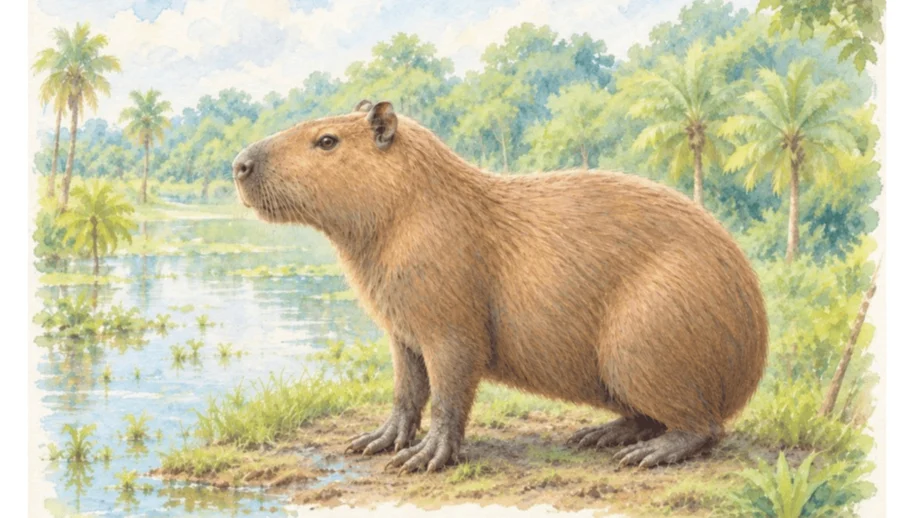
A capybara, the largest living rodent, provides a useful comparison. At around 60 kilogrammes in the comparison given with the discovery, it would weigh about twice the estimated mass of Yakamys sirindhornae. The Krabi animal would therefore have been roughly half that weight, still an imposing size for a rodent of its time.
The two animals belong to different families. Capybaras are members of Caviidae, the family that also includes guinea pigs, while Yakamys belongs to Ischyromyidae. Their classification shows that large body size appeared in different branches of the rodent family tree.
Why its age changes the story
The fossil bearing sediments date to the late Eocene, about 35 million to 33 million years ago. The Eocene is an epoch within the longer Paleogene period, the interval used for the claim that Yakamys was the largest known rodent of its time.
Researchers say the discovery moves evidence of rodent gigantism back by 15 million to 20 million years. Gigantism simply means the evolution of a very large body compared with related animals. In this case, the striking combination is a substantial estimated weight and an unusually early place in rodent history.
Natural Resources and Environment Minister Suchart Chomklin described the importance of the find for understanding how mammals changed over time:
This discovery is significant for the study of mammalian evolution and offers new insights into the historical changes in body size among rodents.
The study adds a specific example to that history: an ancient rodent family had already produced an animal estimated at 30 kilogrammes in what is now southern Thailand. Large rodents therefore have a longer evolutionary record than researchers had previously recognised.
A coal basin with a rich fossil record
The Krabi Basin covers much of Nuea Khlong district and contains sediments laid down on land during the late Eocene. Thick coal seams later made the basin a source of fuel for electricity generation, with mining and power generation beginning in 1964.
The mining area included three pits: Wai Lek, Bang Mak and Bang Pu Dam. Excavation exposed layers containing numerous fossils, giving teams access to evidence of the animals and plants that once occupied the basin.
Krabi has yielded the ancient primate Siamopithecus and a large variety of anthracotheres, an extinct group of hoofed mammals. Other finds include carnivorous mammals, animals with even or odd numbers of toes, colugos, bats and rodents.
Reptiles, fish, invertebrates and plants also occur in the fossil record there. Together, these discoveries make the basin one of Thailand's oldest important sites for fossil mammals and give researchers a broader picture of the community in which the giant rodent lived.
From a 2004 discovery to a new scientific name
The teeth were collected during a period when Thai and French palaeontology teams surveyed the exposed mining deposits and gathered specimens for study. Mining has since ended, but research on the collected fossils has continued.
The sequence stretches from industrial excavation to scientific description:
- 1964: Coal mining and electricity generation began in the Krabi Basin.
- 2004: Geologist Phannipha Sae Tian discovered the lower molar and lower incisor at Bang Mak.
- After collection: Researchers examined the teeth and compared them with other ancient rodents.
- 4 November 2026: The research was published in Scientific Reports.
The paper is titled A giant Eocene ischyromyid from Southeast Asia reveals the early evolution of rodent gigantism. Its authors are Y. Chaimanee, L. Marivaux, V. Millien, C. Yamee, P. Tian and J.-J. Jaeger.
The long interval between collection and publication illustrates the lasting value of a fossil collection. A specimen can remain available for detailed comparison and eventually contribute to the recognition of an animal previously unknown to science.
A collaboration across three countries
Thailand's Department of Mineral Resources worked with researchers from France and Canada on the discovery. The participating institutions included the University of Poitiers and the University of Montpellier in France, and McGill University in Canada.
Chaimanee led the investigation as a researcher specialising in ancient mammals. The work brought together the fossils collected in Thailand and the comparative study needed to determine their place among other rodents.
The two specimens are housed at the Department of Mineral Resources. Keeping the physical teeth in a scientific collection allows researchers to return to the evidence, check measurements and compare it with future discoveries.
For Krabi, the result gives a former industrial site another lasting role: a place whose fossils help explain the early history of mammals in Southeast Asia. The value lies both in the unusual rodent and in the wider collection of animals preserved in the basin.
Why the species bears Sirindhorn's name
Her Royal Highness Princess Maha Chakri Sirindhorn granted permission for the species to bear her name. The naming honours her support for science, geology and palaeontology in Thailand, according to the ministry.
The genus name Yakamys refers to the animal's large size. The species name sirindhornae carries the royal dedication. Together, the two words form the scientific name used to distinguish this animal from every other named species.
Yakamys is the fifth fossil animal named in her honour. The earlier four are the dinosaur Phuwiangosaurus sirindhornae, published in 1994; the primate Tarsius sirindhornae, published in 2011; the dinosaur Sirindhorna khoratensis, published in 2015; and the trilobite Tsinania sirindhornae, published in 2023.
The new rodent adds an ancient mammal from southern Thailand to a group of names spanning very different animals and periods of Earth's history.
What further discoveries could explain
The main unanswered questions concern the animal's full anatomy, precise body size, way of life and the reason it grew so large. The evidence currently consists of two teeth, and the estimated 30 kilogrammes remains a calculation based on those remains.
Additional skull or skeletal material would give researchers more measurements and anatomical features to study. It could help refine the weight estimate and reveal more about how the animal moved and lived.
Food availability, environmental conditions and habitat are possible subjects for further investigation into its size. The diverse fossils already recovered from Krabi give researchers a setting in which to explore those questions, while new remains would provide more direct evidence about Yakamys itself.
The Ministry of Natural Resources and Environment says it will continue supporting geological and palaeontological research, conservation and public knowledge of Thailand's geological heritage. Protecting specimens and their collection records will preserve the information needed for that work.
Key Points
- Yakamys sirindhornae is a newly identified genus and species of giant rodent from Krabi, southern Thailand.
- The evidence consists of a lower molar and lower incisor discovered at Bang Mak in 2004.
- The animal lived about 33 million to 35 million years ago and is estimated to have weighed around 30 kilogrammes.
- Researchers identify it as the largest known Paleogene rodent and say it brings evidence of rodent gigantism forward by 15 million to 20 million years.
- The study involved researchers from Thailand, France and Canada, with the specimens housed at the Department of Mineral Resources.
- The species is the fifth fossil animal named in honour of Princess Maha Chakri Sirindhorn.