A million more tonnes from almost the same land
Uzbekistan harvested 5.002 million tonnes of raw cotton in 2026, according to Ministry of Agriculture figures, exceeding its contractual production target of 4.5 million tonnes by 502,000 tonnes. The crop was the largest since independence in 1991, with most of the increase coming from higher yields rather than more land.
Contents
- A million more tonnes from almost the same land
- How the harvest reached this point
- More plants in each hectare
- New varieties and a wider use of Xinjiang methods
- Preparing the crop for a faster harvest
- Machines collected 85% of the crop
- Mentors and financing supported weaker farms
- Where yields and production were highest
- Water savings and the end of mass mobilisation
- More cotton for factories, and a higher target for 2027
- Key Points
Cotton covered 890,000 hectares, compared with 876,000 hectares in 2025. Production rose by 1.016 million tonnes from 3.986 million tonnes, an increase of about 25.5%, while the planted area grew by just 1.6%. Average yield climbed from 45.5 to 56.2 centners per hectare.
A centner equals 100 kilograms, so the new average means farmers collected 5.62 tonnes from each hectare, up from 4.55 tonnes a year earlier. Raw cotton is the harvested material containing both fibre and seeds. It must be processed to separate the fibre before it can become yarn or fabric.
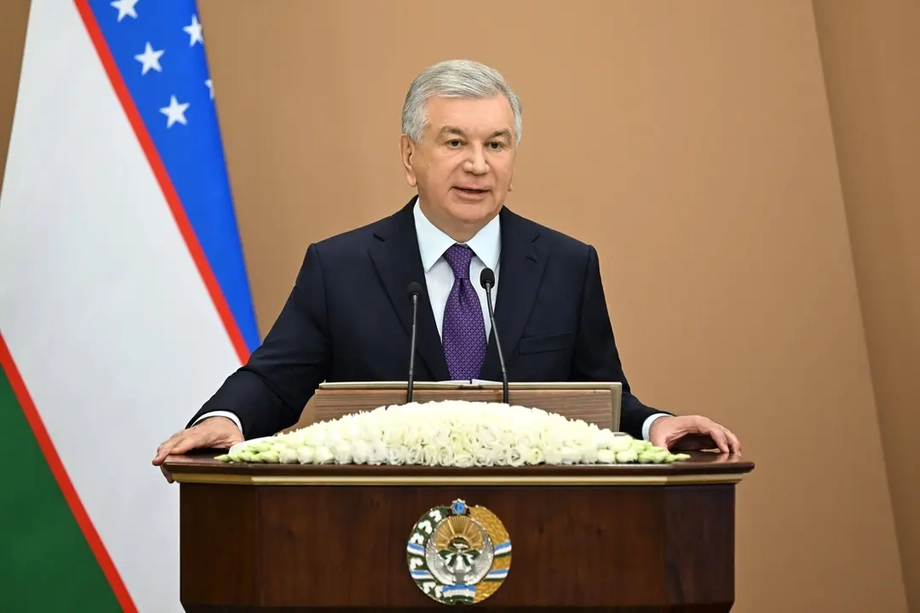
President Shavkat Mirziyoyev congratulated agricultural workers in a message dated November 4; the announcement was also dated November 5 in coverage of the record. He credited changes in planting, seeds, machinery and agricultural support, while the ministry identified eight practical factors behind the increase.
The historical comparison gives the achievement a precise boundary. Uzbekistan produced 5.058 million tonnes in 1990, before independence, from 1.83 million hectares. The 2026 crop was only 56,000 tonnes smaller, grown on less than half that area. Yield had more than doubled from the 27.6 centners per hectare recorded in 1990.
How the harvest reached this point
Uzbekistan's recent production figures show a sharp acceleration after a long period of much lower yields. Between 1990 and 2018, yields ranged from 20.6 to 27.6 centners per hectare. By 2023, they had reached 36.6 centners.
The main production and policy milestones show how the current harvest fits into that change:
- 1990: Uzbekistan harvested 5.058 million tonnes from 1.83 million hectares.
- 2018: Production fell to 2.31 million tonnes from 1.071 million hectares, with yield at 21.6 centners per hectare.
- March 2020: Mirziyoyev signed the decision abolishing the state order for raw cotton, starting with that year's crop.
- 2024: Farmers harvested 3.181 million tonnes from 1.004 million hectares, yielding 31.7 centners per hectare.
- 2025: Production reached 3.986 million tonnes from 876,000 hectares.
- 2026: Production rose to 5.002 million tonnes from 890,000 hectares, yielding 56.2 centners per hectare.
More plants in each hectare
The Ministry of Agriculture put changes in planting patterns first among the eight factors behind the result. Farmers moved fully away from the previous arrangements using 90 centimetres and 60 centimetres toward single and twin rows based on 76 centimetres.
The twin row arrangement, described as 76 by 10 centimetres, supported 220,000 to 240,000 plants per hectare. The single row arrangement supported 160,000 to 180,000 plants, compared with 80,000 to 110,000 under earlier practices. Farmers were therefore growing many more cotton plants within the same field boundaries.
Twin rows covered 670,700 hectares, about 75% of the area detailed in the planting breakdown. Single rows covered 218,800 hectares, about 25%. Together, those figures total 889,500 hectares, consistent with the rounded national figure of 890,000 hectares.
Denser planting puts more potential cotton bolls, the pods containing seeds and fibre, within each hectare. Managing that density requires attention to water, nutrition and the condition of the crop. The ministry paired its planting changes with recommendations covering plant density, crop management, fertilisation, ripening, protection zones, field management, compliance with regulations and keeping fields ecologically clean.
New varieties and a wider use of Xinjiang methods
Foreign cotton varieties resistant to bollworm and herbicides were planted on 603,800 hectares, accounting for 68% of the area. Early ripening local varieties producing fibre of high quality occupied another 285,700 hectares, or 32%, according to the ministry.
Bollworm is an insect pest that damages cotton bolls. Resistance helps plants withstand that threat, while herbicide resistance allows a variety to tolerate particular chemicals used to control weeds. Early ripening varieties can bring the crop to maturity sooner, helping farmers organise harvesting before weather deteriorates.
Farmers used the Xinjiang sowing method on 305,200 hectares, an increase of 124,000 hectares from the previous year. That puts the earlier area at 181,200 hectares, meaning use of the method expanded by about 68%.
Researchers are also developing and testing varieties suited to desert conditions, extreme heat, and saline or sandy soils. Work in Alat district of Bukhara region is intended to support cultivation in difficult growing conditions. Cotton plants being kept for next year's planting material must reach full natural maturity so their seeds develop properly.
Preparing the crop for a faster harvest
The ministry said farmers applied boric acid, aspirin, yeast and silicon fertiliser as part of efforts to help cotton cope with heat, water shortages and pests. It also described a coordinated programme to bring the crop to maturity and prepare fields for machinery.
Defoliation and desiccation took place in three stages. Defoliation removes leaves, making cotton easier to collect with less leafy material mixed into it. Desiccation dries plant tissue, helping prepare the field for harvesting.
Ethephon was used first to accelerate boll opening. Mild defoliants followed in the second stage, with stronger products and desiccants, including diquat, used in the third stage to support boll opening and speed collection.
The practical aim was to make more of the crop ready at the same time. The ministry said this helped machines harvest in one pass and shortened the picking period from two months to one. Mirziyoyev said the main crop was collected before rainfall and bad weather, despite challenges associated with climate change. Collection continued in some areas, including cotton being retained to prepare seeds for the next planting season.
Machines collected 85% of the crop
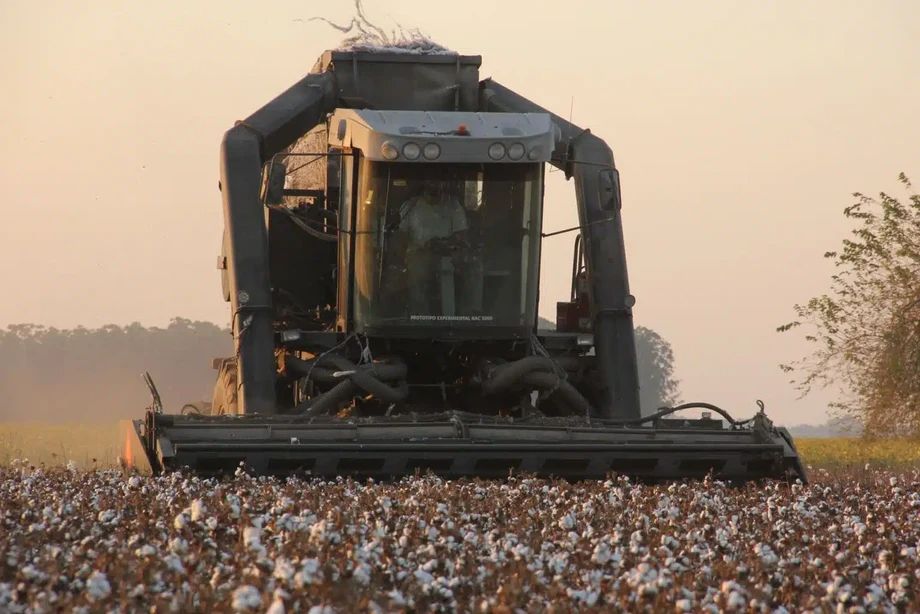
Mirziyoyev said more than 3,000 cotton picking machines collected 85% of the harvest in 30 to 35 days. The Ministry of Agriculture's account of its eight contributing factors listed 2,800 machines. Neither account explained the difference in equipment totals.
Jizzakh and Syrdarya reached 100% mechanisation of harvesting, according to the president. Nationally, an 85% share of a crop of about 5 million tonnes means machines collected roughly 4.25 million tonnes of raw cotton.
Uzbekistan's president praised farmers and agricultural workers for the result:
This is a truly historic victory, won through your hard work, courage and perseverance,
Mirziyoyev also credited digital systems, drones and other technologies with helping halve harvesting costs. Faster collection reduced the time needed to bring in the crop and the demand for large numbers of seasonal pickers. For farms managing a much larger harvest, the machinery programme linked higher field output with the ability to collect it promptly.
Mentors and financing supported weaker farms
Experienced farmers and agricultural clusters producing 50 to 60 centners per hectare mentored 4,658 farmers whose yields had averaged below 30 centners in 2025. Agricultural clusters connect cotton growing with processing and textile production.
The programme assigned one mentor for every five farmers. Advice and field work were tracked through the Digital Agriculture platform, while a special Mentor's Log recorded practical skills, field conditions, assignments and results. The approach gave farms with lower yields a structured way to learn from producers already achieving much better results.
The ministry said timely financing supported agricultural work, including 12 trillion soums in concessional loans for the 2026 cotton crop. Such loans offer more favourable terms than ordinary commercial borrowing, helping farmers pay for inputs and field operations when they are needed.
Farmers also received a subsidy of 1 million soums for each tonne of cotton sold through exchange trading. The total subsidy allocation reached 2.4 trillion soums, up by 600 billion soums from 1.8 trillion, an increase of about one third.
Mirziyoyev linked the harvest to the establishment of a Cotton Council, better payment discipline, changes to subsidies and the creation of an insurance system. He expected cotton growers to earn a combined net profit of 13 trillion to 14 trillion soums in 2026. That remained a forecast for earnings after costs.
Where yields and production were highest
Nearly 400,000 hectares averaged 70 centners per hectare, according to the presidential message. Around 70,000 hectares yielded 100 to 110 centners, equivalent to 10 to 11 tonnes per hectare. About 1,000 farms and clusters achieved average yields of at least 100 centners.
Anorboy Eshmatov of Pakhtakor district and Ulugbek Supiyev of Jarkurgan district each achieved 110 centners per hectare. Average yields exceeded 60 centners in Jizzakh, Khorezm, Bukhara, Navoi and Syrdarya regions.
Koson led districts by total production, harvesting 110,000 tonnes. Mirishkor followed with 105,000 tonnes, Kasbi with 95,000, Nishan with 90,000 and Mirzachul with 85,000. These totals measure the size of each district's harvest, while yield measures how much cotton came from each hectare.
Karakalpakstan produced more than 400,000 tonnes despite water shortages and salty soils associated with the retreat of the Aral Sea. Mirziyoyev said yields there rose by 10 to 15 centners per hectare compared with previous years, equivalent to an additional 1 to 1.5 tonnes from each hectare.
Water savings and the end of mass mobilisation
Mirziyoyev said cotton production now uses half as much water as in the 1990s, crediting technologies that save water. His address did not explain the calculation behind that comparison. Cotton irrigation historically diverted water from rivers feeding the Aral Sea, contributing to its severe shrinkage.
The president also said cotton acreage had fallen by 38% in recent years. That longer comparison sits alongside the small increase between 2025 and 2026. In 2000, about 1.4 million hectares produced roughly 3 million tonnes, compared with 890,000 hectares and just over 5 million tonnes in 2026.
Labour arrangements have changed alongside land use. The abolition of the state cotton order in 2020 replaced the old procurement structure with contractual relationships involving cotton and textile clusters and opportunities to sell through exchanges. Forecast and contractual production targets continued, including the 4.5 million tonne target for 2026.
On March 1, 2022, the International Labour Organization announced that organised child labour and forced labour had ended in the 2021 cotton production cycle. Monitoring based on about 11,000 interviews found that 99% of pickers worked voluntarily.
The Cotton Campaign lifted its call for a global boycott on March 10, 2022. Before that decision, 331 brands and companies had pledged not to use Uzbek cotton. Labour rights concerns remain, including isolated cases of coercion, while mechanisation has further reduced the need to recruit large numbers of people for picking.
More cotton for factories, and a higher target for 2027
The Ministry of Agriculture said the larger harvest could support expanded domestic production of yarn, fabrics and finished garments. Processing cotton within Uzbekistan connects the agricultural crop to industrial jobs that continue beyond the picking season.
Textile exports totalled $2.1 billion in the first eight months of 2026, representing 9.4% of national exports, according to the National Statistics Committee. The US Department of Agriculture puts the wider textile and garment industry's contribution at about 3% of gross domestic product, with roughly 600,000 people employed.
World Bank figures show textile employment rising from 188,000 in 2018 to about 600,000 in 2024, more than tripling. A larger domestic cotton supply gives those factories more raw material to process.
For 2027, Mirziyoyev set a national yield target of 65 to 70 centners per hectare, or 6.5 to 7 tonnes. Reaching that range would require another increase of about 16% to 25% from the 2026 average of 56.2 centners. Planned measures include productive seed varieties, agricultural drones, technology that saves water and energy, and artificial intelligence.
Scientists and specialists from more than 30 countries also proposed creating a World Cotton Centre in Uzbekistan at a forum in Tashkent marking World Cotton Day. The proposal accompanied a harvest whose central achievement was already measurable: substantially more cotton from almost the same area as the previous year.
Key Points
- Uzbekistan harvested 5.002 million tonnes of raw cotton in 2026, its largest crop since independence in 1991.
- Production rose about 25.5% from 2025, while planted area increased by only 1.6%.
- Average yield reached 56.2 centners per hectare, equivalent to 5.62 tonnes.
- Denser planting, new varieties, coordinated crop preparation, mentoring and financing contributed to the increase, according to the Agriculture Ministry.
- Mirziyoyev said machines harvested 85% of the crop in 30 to 35 days.
- The 2027 yield target is 65 to 70 centners per hectare, with wider use of drones and technology that saves water and energy planned.