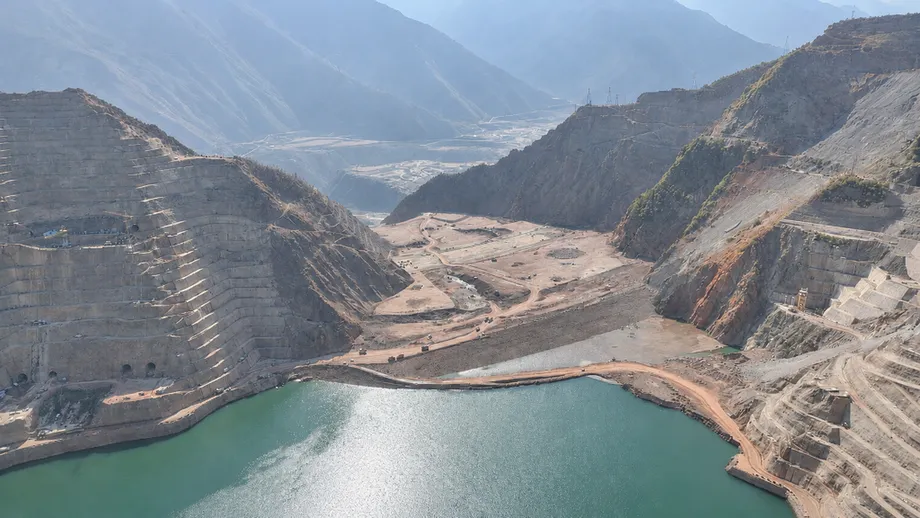
A vast construction site is already producing electricity
More than 20,000 people are working around the clock at Tajikistan's Rogun hydropower plant, where two generating units have already produced more than 11 billion kilowatt-hours of electricity. The next major milestone is September 2027, when a third unit is scheduled to begin operating, even as construction of the giant dam continues toward an expected completion in 2035.
Contents
- A vast construction site is already producing electricity
- What the next generating unit will change
- Building the dam one layer at a time
- Why so much of Rogun is underground
- A village lives inside the perimeter
- Compensation faces the pressure of rising prices
- The dispute over the dam's height
- Billions are still needed to finish Rogun
- Safety and the workforce behind the schedule
- The milestones from early design to completion
- Key Points
During a visit by journalists on October 29, 2026, Deputy Technical Director Murod Sa'dulloev said the reservoir had reached 1,140 metres above sea level that year. The plan is to raise it to 1,165 metres in 2027, a further 25 metres, to support increased electricity production.
Rogun is taking shape in a steep gorge on the Vakhsh River, about 100 kilometres east of Dushanbe. Its planned height of 335 metres would make it the world's tallest rockfill dam. Trucks carrying as much as 80 cubic metres of material per trip move along mountain roads, while workers build and reinforce an extensive network of underground structures.
The project promises more reliable electricity for a country troubled by winter shortages, with additional power intended for neighbouring countries. Its reservoir is also expected to displace more than 50,000 people. Some families still live inside the construction perimeter, earning money from the workforce while preparing for the eventual loss of their homes.
Those two realities are advancing together: Rogun is supplying electricity before it is finished, while its growing reservoir brings relocation closer for communities upstream. Financing, construction safety and compensation will help determine how the benefits and costs are shared.
What the next generating unit will change
Sa'dulloev described a completed station with six generating units rated at 630 megawatts each, giving Rogun a total capacity of 3,780 megawatts. The projected average annual generation is 14.4 billion kilowatt-hours.
Megawatts measure how much power a station can produce at a particular moment. Kilowatt-hours measure the electricity it generates over time. The more than 11 billion kilowatt-hours produced by the first two units is a cumulative total since they began operating; the 14.4 billion figure is the expected output in an average year after completion.
Engineering company Studio Pietrangeli's Rogun project page, which lists work undertaken in 2018 and 2019, gives an earlier configuration of six turbines rated at 600 megawatts, or 3,600 megawatts in total. Sa'dulloev's figures are 180 megawatts, or 5%, higher.
Raising the reservoir increases the height through which water can fall toward the turbines. That height helps determine how much energy the water can deliver. The planned rise in 2027 is therefore part of the electricity schedule, alongside the installation and commissioning of the third unit.
Building the dam one layer at a time
Engineer Jahongir Sultonzoda said dump trucks at Rogun carry between 40 and 80 cubic metres per journey. Excavators, bulldozers and trucks operate across different levels of the site, where rain can leave deep ruts and mud on the roads.
The dam is an embankment built from rock and earth, with a core designed to stop water passing through it. Material is placed in layers, compacted and checked against the design before the next layer is added. The work depends on the quality of both the materials and their placement.
Studio Pietrangeli lists a final dam crest length of 650 metres and a rockfill volume of 70 million cubic metres. Its design description sets out several construction stages, ending with a main dam crest at 1,300 metres above sea level. That elevation refers to the top of the finished dam, while the 1,140 metre figure given by plant management refers to the reservoir's water surface in 2026.
Why so much of Rogun is underground
The Vakhsh now passes through underground waterways associated with the project. Water directed through pressure conduits drives turbines connected to generators, then returns to the river downstream. Other tunnels carry water around construction areas or provide routes for releasing excess flows.
Studio Pietrangeli describes three diversion tunnels with a combined discharge capacity of 5,600 cubic metres per second. Its project specifications also list five spillway tunnels with a total length of 10 kilometres. Spillways give water a controlled route past the dam when it needs to be released.
The engineering company identifies flood protection as a major design challenge because water flowing over the top could threaten the rockfill dam. It also says the site lies in a seismically active area, with important faults crossing tunnel routes. Tunnel linings must be designed for those conditions.
Construction extends high onto the surrounding mountains. Terraces and access roads have been cut into slopes, and metal anchors up to 70 metres long are installed in drilled holes to reinforce the rock. Transport tunnels, service passages and underground galleries connect parts of a site far larger than the area covered during the October visit.
A village lives inside the perimeter
Pasi Murakho remains a functioning village within Rogun's fenced construction area. Houses, orchards, livestock and household buildings sit alongside the activity of a national infrastructure project.
Residents are known to security staff, but relatives and other visitors must show a passport and obtain an entry permit. A visit to a family home therefore involves a checkpoint as well as the usual journey to the village.
Construction has brought customers to local shops, canteens and other services. Some residents work in nearby Rogun rather than at the plant, and the town is close enough to reach on foot. The village economy combines farming, household work, employment and trade with the construction workforce.
Residents will eventually have to relocate. For families earning money from the site, moving means finding a new home and rebuilding the routines and customer relationships that support them. Their present income is tied to a place they are expected to leave.
Compensation faces the pressure of rising prices
More than 50,000 people are expected to be displaced by the reservoir. The practical challenge reaches beyond allocating plots: families must be able to replace homes, obtain services and restore the work that supports them.
Mukim Khasanov, a farmer aged 75 awaiting resettlement from a village near Rogun, said his family had received a plot elsewhere. He described how higher prices had reduced the buying power of compensation calculated years earlier.
Khasanov explained the difficulty of purchasing building materials with that compensation:
When our homes and property were valued, prices were completely different – even for building materials – whereas now everything is extremely expensive.
His example was a wooden panel that had risen from 50 somoni to 150 somoni, three times its earlier price. At those prices, the same amount of money buys only one panel instead of three.
Some residents of Rogunion, a settlement near Dushanbe whose name recalls the home area of people displaced by the reservoir, say promised agricultural land has never been allocated. Housing compensation and access to farmland address different needs: a replacement house provides shelter, while land can provide food and income.
The dispute over the dam's height
Rivers Without Borders, an environmental coalition, argues that lowering the planned dam by 35 metres could spare around 32,000 people from displacement. Its alternative would bring the height from 335 metres to 300 metres.
Evgenij Simonov, the coalition's coordinator, describes the record height as a matter of national prestige. The authorities argue that the taller design provides better economic and environmental results than lower alternatives, an assessment described as supported by World Bank studies.
The disagreement links an engineering choice directly to the number of people who must move. A higher dam allows a higher reservoir, affecting both electricity production and the extent of land covered by water. Residents facing relocation experience that choice through the future of their houses, farms and communities.
The construction schedule presented by plant management continues to follow the 335 metre design. Debate over a lower alternative is taking place while the dam rises and the reservoir expands.
Billions are still needed to finish Rogun
The estimated cost to complete Rogun is around $5.8 billion, with financing expected to come mainly from Tajikistan's state budget. International lenders are becoming more involved, adding external funding to a project with years of construction still ahead.
Tajikistan ratified a $300 million World Bank loan agreement in early October 2026. The Asian Development Bank's proposed contribution is a further $500 million, comprising a $200 million grant and a $300 million concessional loan, according to the finance ministry's account of financing discussions.
The proposed split was detailed during October financing talks involving Finance Minister Faiziddin Sattor Qahhorzoda and representatives of both banks. A grant does not have to be repaid. A concessional loan does, but on more favourable terms than ordinary commercial borrowing. No final approval or payment date was given for the proposed ADB package.
The banks also discussed a Full Mutual Reliance Framework, an approach intended to let them use common procedures for assessing the project, awarding contracts and monitoring construction. That coordination matters when several lenders are financing different parts of the same large undertaking.
Filippo Menga, an associate professor at the University of Bergamo who studies geography, described how the commitment of major financial institutions increases the pressure to continue:
stopping the project, both financially and politically, is now extremely difficult
The financing decisions connect Rogun's construction programme to future public spending and repayment commitments. The proposed ADB package would provide substantial help, while the estimated completion cost remains several billion dollars.
Safety and the workforce behind the schedule
Tajik specialists carry out most of the work at Rogun, alongside more than 2,000 foreign workers. People from China, India, Italy and Pakistan are among those working across the project. The workforce includes drivers, engineers, tunnel miners and workers whose relatives also have jobs there.
An incident on October 21, 2026, involved the failure of a tank collecting process water in a tunnel. Supervisory authorities said no workers were seriously injured. Workers received first aid and returned to work, while Sultonzoda said the incident caused no damage. Construction continued.
The October 29 visit, organised by the Union of Journalists of Tajikistan with support from plant management, included safety instructions about operating machinery, barriers and possible rockfalls. Visitors were given hard hats and reflective vests. The trip covered only part of the construction area.
The milestones from early design to completion
Rogun began as a Soviet project in the 1960s, according to Studio Pietrangeli. Its present programme combines electricity generation, further reservoir filling and construction of the remaining units over several years.
- 1960s: The Rogun project began during the Soviet era.
- Early October 2026: Tajikistan ratified a $300 million World Bank loan agreement.
- October 21, 2026: A process water collection tank failed in a tunnel; authorities said no workers were seriously injured.
- October 29, 2026: Plant management outlined progress and the next generating milestones during a visit by journalists.
- 2027: The reservoir is planned to reach 1,165 metres above sea level.
- September 2027: The third generating unit is scheduled to begin operating.
- 2035: Construction is scheduled for completion.
The next concrete tests are the planned reservoir rise and the third unit's launch. For households awaiting relocation, progress also means securing replacement homes and the means to earn a living as water levels climb.
Key Points
- More than 20,000 people work at Rogun, including more than 2,000 foreign workers.
- Two units have generated more than 11 billion kilowatt-hours; a third is scheduled for September 2027.
- Plant management gives a final capacity of 3,780 megawatts and average annual generation of 14.4 billion kilowatt-hours.
- The planned dam height is 335 metres, and the reservoir is expected to displace more than 50,000 people.
- Residents describe compensation weakened by inflation and delays in receiving promised farmland.
- Completion is scheduled for 2035, with an estimated $5.8 billion still required.
- A $300 million World Bank loan agreement has been ratified; a further $500 million ADB package is proposed.