A growing economy still depends on earnings abroad
Tajikistan needs about 1.4 million jobs over the next decade, while money sent home by citizens working abroad was equivalent to roughly 46% of its gross domestic product in 2025, according to World Bank estimates. The challenge is to build businesses that can pay enough for more people to choose work at home.
Contents
- A growing economy still depends on earnings abroad
- What migrant money does for families
- Poverty has fallen under two different measures
- The warning dates back to 2019
- Projects delivered gains, while business barriers persisted
- Why faster growth can produce too few jobs
- Pay matters as much as vacancies
- Energy and a $100 million reform program
- A migration bill addresses protection and return
- Key Points
The World Bank Group's Board of Directors discussed a new framework for fiscal years 2026–2032 on June 3, 2026. Its three priorities are secure and affordable clean energy, a healthy workforce with better skills, and private investment that creates more and better jobs.
The Country Partnership Framework backs Tajikistan's National Development Strategy 2030. It combines support from the International Development Association, which finances development in poorer countries, the International Finance Corporation, which supports private businesses, and the Multilateral Investment Guarantee Agency, which provides investment guarantees.
Gael Raballand, the World Bank Group Country Manager for Tajikistan, described the purpose of the renewed partnership:
Tajikistan has made important progress over the past two decades. To preserve and build on these achievements, our renewed partnership aims to help the country's transition to a more sustainable economic model driven by clean energy, stronger human capital, and increased private investment for more and better jobs for people,
Tajikistan has recorded average annual economic growth above 7% over the past decade, according to official figures. Yet the continued importance of migrant earnings shows why the new framework focuses on the income people can earn within the country, alongside growth in total output.
What migrant money does for families
Remittances, the money migrants send home, pay for food, education, housing and other household needs. They also support shops, construction companies and services by giving families more money to spend.
The World Bank estimates these transfers were equivalent to 39% of GDP in 2023, 49% in 2024 and 46% in 2025. GDP measures the value of goods and services produced inside a country. Comparing transfers with GDP shows the scale of the money arriving from abroad relative to domestic production.
Some of that spending reaches local producers, while some buys imported goods. A family can become more financially secure through a relative's work abroad even as the country continues to rely on foreign production for many of the things that family purchases.
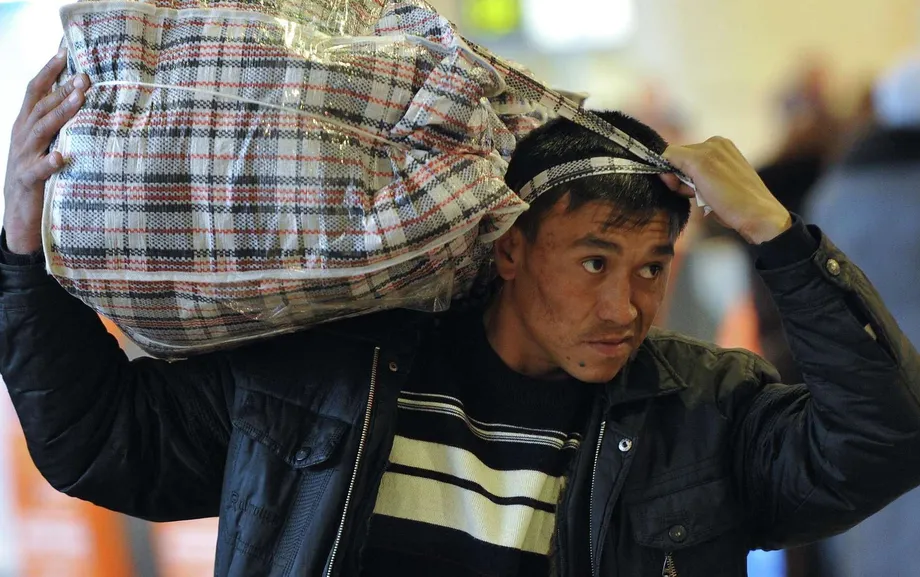
Russia remains a major destination for Tajik workers. Changes in Russian employment, wages or migration rules can therefore reach households in Tajikistan through smaller transfers and reduced spending. Russian authorities tightened migration controls and introduced additional restrictions on foreigners after the March 2024 attack at Crocus City Hall.
Tajik citizens also seek employment in Kazakhstan, Belarus, the United Arab Emirates, Qatar, Kuwait, South Korea, Japan and the United Kingdom. Expanding domestic opportunities would give workers another choice while preserving the income that migration currently brings.
Poverty has fallen under two different measures
The World Bank Group's announcement says Tajikistan's national poverty rate fell from 56% in 2010 to below 20% in recent years. Figures using the international poverty threshold of $4.20 a day show a decline from 55% in 2010 to 14.8% in 2025.
The national measure uses the country's own poverty standard. The international measure uses purchasing power parity, a method that adjusts for differences in what money can buy across countries. Each tracks poverty against its own threshold, which explains why the percentages differ.
Remittances have helped families raise their living standards. The challenge for economic policy is to make that progress more secure by expanding income from domestic employment, alongside migrant earnings.
Attiya Waris, the United Nations Independent Expert on foreign debt and human rights, addressed that challenge after an official visit to Tajikistan in 2026. She recognized progress in poverty reduction, economic growth and infrastructure, while calling for decent and productive employment at home.
Waris identified agriculture and food processing, sustainable tourism, mineral processing and the digital economy as areas deserving investment. She also called for education, vocational training, internet access and financing for small and medium businesses, with particular attention to women and young people facing low wages, limited employment options and shortages of social services.
The warning dates back to 2019
The World Bank's May 2019 Country Economic Memorandum, report number 130045-TJ, had already urged Tajikistan to move toward growth driven by private businesses and exports. It recommended directing more remittance income into private investment.
The memorandum recorded remittances at 38% of GDP in 2017, with about 90% originating in Russia. Transfers had fallen by a cumulative 45% during 2014–2016 as the Russian economy slowed, creating a sudden financing shortfall for Tajikistan.
Private firms then accounted for about 15% of investment, 30% of industrial output and 13% of formal employment. Public enterprises dominated industrial production, while the business environment constrained private activity.
The employment figures were especially revealing. Average annual economic growth of 6.8% during 2007–2017 accompanied net job growth of just 1.1% a year, or about 23,364 jobs annually. The population of working age was increasing by roughly 3% each year.
The sequence of policy efforts now stretches across several periods:
- May 2019: The World Bank's economic memorandum called for stronger private investment, exports and job creation.
- 2019–2023: The previous partnership strategy prioritized human capital, public institutions and private sector development. Its duration was later extended through 2024.
- June 3, 2026: The World Bank Group Board discussed the partnership framework for fiscal years 2026–2032.
- July 2026: The World Bank approved a $100 million grant supporting economic reforms.
- 2030: Supported reforms are projected to help generate more than 92,000 additional jobs with better pay.
The continuity is striking: seven years after the earlier diagnosis, private investment and productive employment remain central priorities. The new framework concentrates resources on problems that earlier projects helped address but left unresolved.
Projects delivered gains, while business barriers persisted
The previous partnership period produced progress in healthcare, education, social protection and energy. Programs also supported rural enterprise, improved parts of the business environment and simplified some administrative procedures.
An agricultural commercialization project recorded improved commercial activity among nearly 21,000 beneficiaries, against an initial target of 12,500. It supported 1,458 agricultural enterprises against a target of 1,500, reaching about 97% of that enterprise target.
Those results show a practical route toward domestic production: helping farms and agricultural businesses turn their output into stronger commercial activity. Food processing can extend that chain by creating demand for crops, processing facilities, packaging and transport.
Businesses still face uncertainty over the application of tax laws, risks to property rights, limited access to finance and substantial state involvement in the economy, according to World Bank assessments. A company considering new equipment or a larger workforce needs predictable rules and financing it can afford.
The COVID-19 pandemic, regional instability and changes in economic ties with Russia also affected implementation. Some resources moved into crisis response, and some projects slowed. Remittances nevertheless averaged nearly half of GDP during 2022–2025, according to the bank's estimates, keeping foreign earnings at the center of household finances.
Why faster growth can produce too few jobs
Around 130,000 young people enter Tajikistan's labor market each year, according to World Bank estimates cited in its earlier assessments. The projected need for 1.4 million jobs over the coming decade reflects both new entrants and the need for more opportunities among people already of working age.
Investment in mining can raise output substantially while employing relatively few workers. Mines require expensive machinery, equipment and infrastructure, so a large increase in investment can produce a smaller increase in employment.
The World Bank has identified a concentration of private investment in extractive industries and a slow movement of workers from agriculture into more productive industrial and service jobs. Agriculture provides substantial employment, but low output per worker limits the incomes it can support.
Productivity means how much a worker produces in a given amount of time. Better equipment, reliable electricity, useful skills and access to customers can help a business produce more. That gives it a stronger basis for paying higher wages.
Large infrastructure projects can support this process when businesses use the new capacity to expand. Their lasting employment contribution depends partly on the factories, farms and service companies that develop around them. The World Bank estimates that roughly a quarter of Tajikistan's workforce goes abroad for employment, illustrating the scale of the domestic opportunity needed.
Pay matters as much as vacancies
Tajikistan's average nominal monthly wage reached 3,507.67 somoni in July 2026, up 21.6% from a year earlier, according to the Agency for Statistics under the President. A nominal wage is the amount paid before adjusting for changes in prices.
Average monthly pay varied considerably by sector: 2,365 somoni in healthcare and social services, 2,812 somoni in public administration, defense and social insurance, and 3,739 somoni in education. A growing number of vacancies will have limited appeal to some workers if the available pay falls short of their household needs.
A study conducted in autumn 2023 with participation from the Moscow Human Rights Ombudsman's office surveyed 900 migrants from Tajikistan, Uzbekistan and Kyrgyzstan, including 300 Tajik citizens. The Tajik participants reported average monthly earnings of 49,691 rubles, with 56,083 rubles for men and 40,297 rubles for women.
Those figures describe a Moscow sample in 2023, while the domestic figures cover workers across Tajikistan in July 2026. Migration also brings expenses for housing, documents and living away from family. The World Bank's diagnostic assessment provides a comparison of similar work: some Tajik migrants in Russian construction, trade and services earn at least three times what comparable jobs pay at home.
For workers weighing their options, the decision therefore involves both access to a job and the income left after expenses. Better domestic wages require businesses capable of sustaining higher pay through stronger production and sales.
Energy and a $100 million reform program
The new partnership framework includes support for the Rogun Hydropower Plant, alongside education, health, water, sanitation and climate adaptation. More reliable electricity can reduce seasonal shortages and help businesses keep equipment running.
Private investment remains another part of that process. Producers need finance, skills, transport, digital connections and access to customers to turn additional electricity into goods and services they can sell competitively.
The $100 million grant approved in July 2026 supports reforms in the digital, aviation and energy sectors. Planned measures address competition, regulation, transparency in state support and conditions for investors.
The World Bank estimates that the supported reforms could help generate more than 92,000 additional jobs with better pay by 2030. These are projected results of reform. Businesses will need to invest, expand and hire for that employment to materialize.
The financing sits within a larger development relationship. At the framework's announcement, the International Development Association was financing 25 projects in Tajikistan totaling $1.93 billion. The International Finance Corporation had a $69 million portfolio supporting seven private sector clients.
A migration bill addresses protection and return
Tajikistan's lower house of parliament, the Majlisi Namoyandagon, unanimously adopted a new draft Law on Migration presented by Labor, Migration and Employment Minister Soleha Kholmahmadzoda. It is intended to replace the law dated December 11, 1999.
The bill provides for a unified migration information system, regulation of private companies arranging employment abroad, protection for migrants and their families, and measures supporting return and reintegration. It also covers internal and environmental migration, resettlement and vulnerable groups.
The legislation still requires approval by the Majlisi Milli, the president's signature and official publication before replacing the existing law. No dates for those remaining steps were given, and the full bill text was unavailable for examination.
The proposed law addresses how migration is managed and how people are protected. The economic framework addresses the opportunities available before they leave and after they return. Together, the initiatives place attention on a concrete goal: making domestic employment a financially workable choice while safeguarding citizens who continue to work abroad.
Key Points
- Remittances were equivalent to an estimated 46% of Tajikistan's GDP in 2025, compared with 49% in 2024.
- The World Bank Group's framework for fiscal years 2026–2032 prioritizes clean energy, workforce health and skills, and private investment.
- Tajikistan needs about 1.4 million jobs over the next decade, according to World Bank estimates.
- Average monthly domestic pay reached 3,507.67 somoni in July 2026, with substantial differences between sectors.
- A $100 million reform grant supports changes projected to help generate more than 92,000 additional jobs with better pay by 2030.
- A migration bill approved by the lower house still requires further approval, signature and publication.