Samut Prakan hub to produce 170,000 tonnes a year
Nestlé has begun construction of a 23 billion baht coffee manufacturing complex in Thailand, combining a NESCAFÉ factory, a distribution centre with storage for more than 100,000 pallets, and a centre for developing new coffee products. The project is expected to buy about 4.3 billion baht of ingredients and materials from Thai suppliers each year.
Contents
- Samut Prakan hub to produce 170,000 tonnes a year
- From joint venture exit to a new factory
- A factory serving several coffee markets
- How the technology will handle coffee and orders
- Thai suppliers stand to gain recurring purchases
- Coffee research reaches farms and new recipes
- Renewable electricity and resource reuse are design goals
- Skilled jobs are central to the employment plan
- A large commitment within Thailand's investment drive
- Key Points
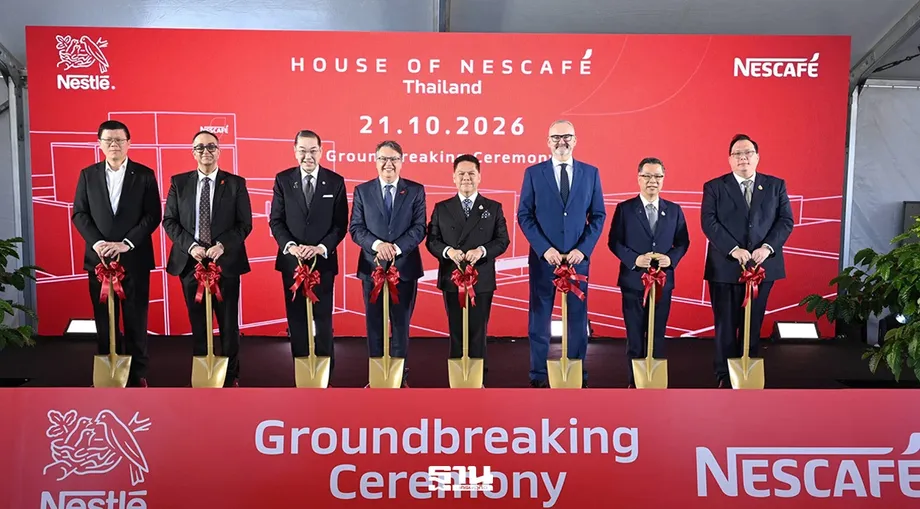
The House of NESCAFÉ Thailand development, at Araya Industrial Estate in Samut Prakan province, held its groundbreaking ceremony on October 21, 2026. Thailand's Board of Investment (BOI) puts planned annual production capacity at about 170,000 tonnes, covering instant coffee, coffee mixes and beverages ready to drink.
Production is scheduled to begin in the fourth quarter of 2028, according to the BOI timetable. Nestlé describes its expected opening more broadly as the second half of that year. The investment will serve Thai consumers and support exports, expanding the company's coffee manufacturing capacity in Southeast Asia.
The BOI expects more than 520 jobs, particularly for Thai engineers, technology specialists and workers with specialist skills. Nestlé's construction announcement describes employment of more than 500 people, alongside training to help employees operate the new technology.
For Thailand, the project connects several parts of the economy in one development: agricultural purchasing, food processing, product research, warehousing and exports. For Nestlé, it establishes a new production base following the end of its former coffee manufacturing joint venture in the country.
From joint venture exit to a new factory
Nestlé's partnership with Quality Coffee Products Co Ltd (QCP), a venture owned equally by Nestlé and the Mahagitsiri family, ended on December 31, 2024. QCP consequently lost the right to continue manufacturing NESCAFÉ products.
The new factory follows that change in the company's manufacturing arrangements. Nestlé has operated in Thailand for more than 130 years, while NESCAFÉ, established internationally in 1938, entered the Thai market in 1973.
The project's main milestones span almost four years:
- December 31, 2024: Nestlé's QCP joint venture with the Mahagitsiri family ended.
- July 8, 2026: The BOI approved the investment application at a meeting chaired by Deputy Prime Minister and Finance Minister Ekniti Nitithanprapas.
- October 21, 2026: Nestlé held the groundbreaking ceremony at Araya Industrial Estate in Samut Prakan.
- Fourth quarter of 2028: Production is scheduled to begin under the BOI timetable.
The approval followed discussions between Thai government representatives and Nestlé executives at the World Economic Forum in Davos earlier in 2026. The BOI then worked with the company to advance the investment.
A factory serving several coffee markets
The Samut Prakan plant will manufacture soluble coffee, coffee mixes and canned coffee ready to drink. Soluble coffee is instant coffee that dissolves in water. Coffee mixes combine coffee with other ingredients, allowing consumers to prepare a drink with fewer separate steps.
Producing these categories at one location gives Nestlé capacity to supply different drinking occasions, from coffee prepared at home to cans bought for consumption while travelling or working. The distribution centre will also handle a wider range of Nestlé products.
Remy Ejel, Nestlé's chief executive for Asia, Oceania and Africa, said the investment would help meet rising consumer demand and expand production capacity in Southeast Asia. He described Thailand as one of the company's largest and most active coffee markets, and NESCAFÉ as the country's leading coffee brand.
Nikhil Chand, chairman and chief executive of Nestlé Indochina, said the facility would support exports as well as the domestic business. Export destinations and the division of production between Thailand and overseas markets have not been announced.
How the technology will handle coffee and orders
Nestlé plans to install its proprietary coffee extraction and aroma retention technologies. Extraction draws soluble coffee substances from the beans, while aroma retention systems are designed to preserve the compounds that give coffee its smell and flavour.
Artificial intelligence, robotics and advanced automation will coordinate manufacturing processes. Nestlé says the aim is to improve product consistency, quality and operating efficiency across the production chain.
Chand described the scope of the development when outlining the investment:
"This investment project comprises a high-technology coffee manufacturing facility and a distribution centre capable of handling a wide range of Nestlé products," Chand said.
The distribution centre will connect production, automated storage, order preparation and dispatch through information updated in real time. This allows the warehouse to coordinate what has been made, where goods are stored and what needs to leave for customers.
An Automated Storage and Retrieval System, known as ASRS, will provide capacity for more than 100,000 pallets. Pallets are platforms used to hold and move stacks of goods. The automated system will place products into storage and retrieve them for orders, linking a large warehouse directly with factory output.
Thai suppliers stand to gain recurring purchases
Nestlé expects the new facility to source approximately 4.3 billion baht of ingredients and materials domestically each year. Purchases will include coffee beans, sugar and fresh milk, extending the project's commercial reach beyond coffee growers alone.
The 23 billion baht construction investment and the annual purchasing plan will affect suppliers in different ways. Building the facility creates demand during development, while purchases of ingredients and materials would continue as the plant operates.
At the projected annual rate, five years of local purchasing would amount to about 21.5 billion baht, close to the value of the factory investment itself. That calculation shows the scale of the planned recurring spending; actual purchases will depend on operations and production needs.
BOI Secretary General Narit Therdsteerasukdi described the investment as connecting agricultural production with manufacturing and the movement of finished goods:
"This investment strengthens the entire coffee value chain, from farming and processing to logistics and export," Narit said.
For farmers and other suppliers, access to this spending will depend on providing the ingredients and materials the factory needs. Nestlé's purchasing plan therefore sits alongside programmes intended to improve agricultural quality and expand domestic coffee production.
Coffee research reaches farms and new recipes
Nestlé has bought Thai robusta beans for more than four decades. Its support for growers includes training, quality seedlings and efforts to extend cultivation into more parts of Thailand. Recent work has included support for robusta cultivation in Mae Sot district, Tak province.
The company also plans research into coffee varieties suited to Thailand's climate, including varieties better able to cope with changing climate conditions. Seedling distribution and training in sustainable cultivation are intended to help farmers improve the quality and reliability of their crops.
Nestlé has supported the expansion of cultivation to help meet rising consumption and narrow the gap between domestic coffee output and industrial demand. Expanding the supply of suitable beans would connect those farming efforts with the needs of the new manufacturing plant.
A Coffee Innovation Center at the Samut Prakan site will focus on ingredients, new recipes and other coffee developments. The farm programmes and the innovation centre address different stages of the same business: growing suitable raw materials and turning them into products consumers want to buy.
Renewable electricity and resource reuse are design goals
Nestlé says the facility aims to use 100% renewable electricity, alongside biomass fuel and systems that recover heat for reuse. Biomass is fuel made from organic material. Heat recovery captures heat from a process so it can be used again rather than released unused.
The renewable electricity target covers the plant's electricity supply. Biomass and heat recovery form additional parts of the energy plan, reflecting the need for heat as well as electrical power in manufacturing.
Water reuse systems are also planned. The development includes waste management measures aimed at sending no waste to landfill, making resource use part of the factory's operating design.
These are targets for the future facility. Nestlé has not published quantified reductions in greenhouse gas emissions or water consumption for the project. The BOI has linked the investment to Thailand's Bio-Circular-Green Economy approach, which combines agricultural resources, reuse of materials and more efficient production.
Skilled jobs are central to the employment plan
The BOI's forecast of more than 520 jobs focuses on engineering, technology and specialist positions. Nestlé also expects roles for workers with intermediate and advanced skills, with opportunities to learn how to use the facility's manufacturing systems.
Automation changes the type of work required at the plant. Robotics, process controls and automated storage create a need for people who can operate, maintain and coordinate those systems. Nestlé says employee training will form part of the development.
Industry Minister Warawut Silpa-archa said the government was ready to support responsible investors bringing advanced technology, workforce development and environmental initiatives to Thailand. He attended the groundbreaking alongside Swiss Ambassador Fabrice Filliez, Narit and representatives of the Industrial Estate Authority of Thailand, Nestlé and Frasers Property.
Chand said the site would create lasting value for Thailand's economy and society through local employment and purchases from Thai farmers and suppliers. Those benefits are expected to develop as construction gives way to production and regular procurement.
A large commitment within Thailand's investment drive
Nestlé invested more than 27.8 billion baht in Thailand between 2018 and 2025, expanding capacity in categories including beverages and pet food. The new 23 billion baht coffee development alone is roughly four fifths of that stated investment total for the earlier eight years.
The project was also the largest named investment in a package of nine projects worth 66.3 billion baht approved by the BOI. Nestlé's share amounts to about 35% of the package, showing the weight of food manufacturing within approvals that also covered technology, aviation and energy.
Other approved projects included 7.8 billion baht for GPU server infrastructure, 14.3 billion baht for Thai Airways aircraft leasing and 5.6 billion baht for wind power, alongside electronics investments. For the coffee project, the government's stated goal is to strengthen Thailand's position as a regional food and beverage manufacturing base.
The practical test will come when the factory starts operating in late 2028: producing coffee at the planned scale, coordinating the automated warehouse and converting the annual local purchasing plan into business for Thai suppliers.
Key Points
- Nestlé has begun building the 23 billion baht House of NESCAFÉ Thailand at Araya Industrial Estate in Samut Prakan.
- The development includes a coffee factory, a distribution centre and a Coffee Innovation Center.
- The BOI puts planned annual production capacity at about 170,000 tonnes, with operations scheduled for the fourth quarter of 2028.
- More than 520 jobs are expected, with a focus on engineering, technology and specialist skills.
- Nestlé plans to purchase about 4.3 billion baht of Thai ingredients and materials annually.
- The facility targets 100% renewable electricity, heat recovery, water reuse and no waste sent to landfill.