Office workers face the sharpest pressure
About 8.7 million workers in Thailand, or 21.8% of a workforce of 40.1 million, hold jobs that generative artificial intelligence could reshape, according to the National Economic and Social Development Council (NESDC). Within that group, 2.2 million face the possibility that AI will replace some tasks or entire positions, while 6.5 million are more likely to use it as an assistant.
Contents
- Office workers face the sharpest pressure
- Who makes up the 2.2 million most at risk?
- Why AI is more likely to assist 6.5 million others
- Thai job advertisements show a changing skills market
- Graduates face an experience barrier
- ASEAN exposure is widespread, adoption is uneven
- Higher wages can coexist with fewer openings
- Thailand's response moves toward employment pathways
- Exports, smaller businesses and worker protection
- Key Points
The assessment draws on Thailand's Labour Force Survey for the fourth quarter of 2025 and an occupational assessment framework developed by International Labour Organization (ILO) researchers. Its central warning concerns people working at computers: clerks, customer service staff, financial professionals and software developers, alongside graduates seeking their first jobs.
Generative AI produces material such as text, images and computer code. Its ability to complete routine office tasks is changing which skills employers want and how much experience they expect from applicants.
Thailand's recruitment data already show that shift. The Thailand Development Research Institute (TDRI) counted 580,505 online job advertisements during the second through fourth quarters of 2025, down from 642,216 in the same months of 2024. That is a decline of 61,711 advertisements, or 9.6%, even as demand for AI skills rose across several professions.
The regional picture contains both pressure and opportunity. The ILO finds employment in highly exposed occupations across Southeast Asia still expanding, while International Monetary Fund (IMF) research identifies weaker recruitment demand in exposed occupations across Asia. Existing jobs and opportunities for new applicants can move differently, leaving young workers facing a tighter entrance into careers even while established employees remain at work.
Who makes up the 2.2 million most at risk?
NESDC places about 1.9 million workers with intermediate skills in the group facing task replacement. Clerical, secretarial and office support occupations account for 52.5% of that group, customer relations for 28.4%, and accounting, finance and statistics for 13.7%.
Those occupations include approximately 750,000 clerks and 310,000 contact centre employees. Their work often follows established procedures, making parts of it easier to automate, such as processing standard requests or preparing routine documents.
Another 330,000 workers in occupations requiring advanced skills fall into the replacement group. They include advertising and marketing specialists, financial analysts, investment advisers and information technology professionals.
University education offers limited shelter from this particular change. Among workers in the replacement group, 55.8% have at least a bachelor's degree. Their average age is 36.5, average monthly income is 27,820 baht, and 53% work in Bangkok and surrounding provinces. Business administration accounts for the largest field of study identified, at 41.8%.
NESDC also flags a risk it calls downshifting: workers moving into jobs below their qualifications after losing work that uses their existing skills. A professional taking driving or delivery work through an application may retain an income while losing access to the career progression associated with the previous occupation.
Why AI is more likely to assist 6.5 million others
Salespeople, shop owners and drivers feature prominently among the 6.5 million workers whose jobs NESDC expects AI mainly to support. Their central responsibilities still involve negotiation, reading customer needs, managing people or carrying out work in the physical world.
About 5.9 million workers in this group have intermediate skills. Salespeople account for 47.2% of that subgroup, shop owners for 20.1%, and car, taxi and van drivers for 17.2%. AI can help recommend products, manage inventory, forecast demand or plan routes while people handle the broader job.
Roughly 600,000 workers with advanced skills also fall into the assistance category, including managers and administrators. Across the full group, 72.7% have less than a bachelor's degree, average age is 42.3, and average monthly income is 21,506 baht.
Workers in the replacement group therefore earn an average of 6,314 baht more each month and are 5.8 years younger than those in the assistance group. The comparison shows why this transition reaches into relatively well paid office careers rather than following a simple divide between highly educated and less educated workers.
Thai job advertisements show a changing skills market
TDRI's job market analysis, published on February 10, 2026, examined advertisements collected from more than 23 recruitment websites through a workforce analytics project supported by Thailand's Programme Management Unit for Human Resources and Institutional Development, Research and Innovation.
Software engineering advertisements fell 5.3% between the second through fourth quarters of 2024 and the corresponding period of 2025. Within that occupation, however, advertisements requesting AI skills rose 94.6%, reaching 3,345, or 22.2% of its 15,097 advertisements in 2025.
Graphic design followed a sharper contraction. Total advertisements fell 13%, while those seeking AI skills rose 98.7%. AI appeared in 445 advertisements, representing 5.1% of recruitment demand for the occupation.
Accountancy moved differently: advertisements grew 7.1% to 43,032. Posts requesting AI skills more than doubled, increasing 103.6%, but represented just 1.3% of the total. Civil engineering advertisements fell 14.4%, while AI requirements appeared in only 51 advertisements, or 0.7%, despite growth of 168.4% from a small base.
These figures describe employers' advertised recruitment needs. They capture a market in which AI requirements can spread while demand for an occupation falls, grows or remains concentrated in work requiring professional judgment and responsibility.
Graduates face an experience barrier
TDRI found that advertisements requiring AI skills were more likely than general advertisements to request at least three years of experience across all four occupations examined. Employers increasingly want someone who can supervise AI output immediately, including checking accuracy and handling unusual cases.
Software development illustrates the challenge. AI can produce code, but experienced engineers still need to assess security, check whether the code works within a larger system and decide how that system should develop. A graduate may know how to operate the tool while still needing supervised practice to acquire those responsibilities.
NESDC secretary general Danucha Pichayanan has warned that technological change could reduce opportunities in repetitive work and basic data analysis, tasks often assigned to newcomers. TDRI identifies a longer term consequence: fewer starting positions mean fewer opportunities to develop the experienced workers companies will later need.
The institute recommends changing education assessments to reward reasoning and verification, alongside the final result. It also calls for employers to redesign starting roles and maintain routes into professions, supported by government incentives or requirements.
Thailand's wider labour market was already under pressure in 2026. NESDC recorded unemployment of 0.94%, or around 390,000 people, in the first quarter, when unemployment lasting more than a year rose 27%. Second quarter figures put unemployment at 0.95%, or about 400,000 people, up 9.7% from a year earlier, while prolonged unemployment increased 11.3%. Businesses were also facing energy cost pressures linked to conflict in the Middle East and disruption from the transition to electric vehicles.
ASEAN exposure is widespread, adoption is uneven
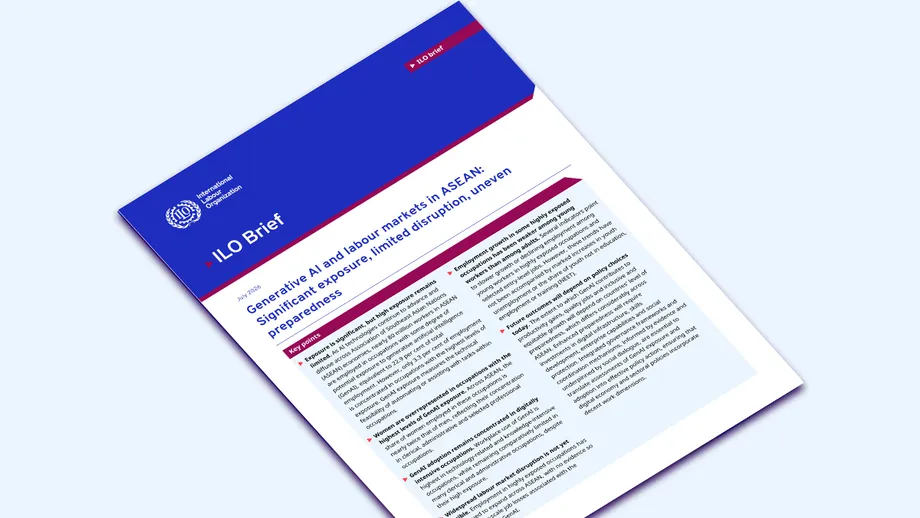
The ILO's ASEAN labour brief, dated July 8, 2026, estimates that nearly 80 million people, or 22.9% of regional employment in 2025, worked in occupations with more than minimal exposure to generative AI. About 11.7 million, or 3.3%, were in its highest exposure category, while around 67% had no identified exposure.
The organisation's regional findings put Thailand's share with more than minimal exposure at 20.6%, compared with 21.8% in NESDC's assessment. The two assessments use different occupational groupings and statistical bases. Singapore's share was 42.2%, followed by the Philippines at 28.1%, Indonesia at 21.7% and Viet Nam at 20.8%.
Women across ASEAN were more than twice as likely as men to work in occupations with high exposure, reflecting their concentration in clerical, administrative and professional work. Workers aged 15 to 24 had broadly similar exposure to adults, although the brief identified emerging weakness in selected jobs at the start of careers.
AI adoption remained concentrated in technology intensive occupations, with comparatively limited use in office administration despite its exposure. The ILO called for investment in infrastructure, business capabilities, governance and dialogue between governments, employers and workers.
Christian Viegelahn, an ILO economist and the report's lead author, connected those investments to the benefits workers might receive:
Productivity gains depend on investments in human capital and social protection.
Higher wages can coexist with fewer openings
IMF Managing Director Kristalina Georgieva's January skills analysis reports that one in 10 job advertisements in advanced economies and one in 20 in emerging market economies require at least one new skill.
Advertisements requiring a new skill tend to offer about 3% more pay in the United States and United Kingdom. For roles requesting four or more new skills, the premium reaches up to 15% in the United Kingdom and 8.5% in the United States.
The IMF found that broader adoption of new skills was associated with stronger employment in American regions over the past decade. Each increase of one percentage point in the share of advertisements requiring new skills was associated with employment growth of 1.3%.
AI skills showed a less favourable employment pattern. They attracted higher wages, but had not produced the same employment gains. After five years, employment in occupations vulnerable to AI was 3.6% lower in regions with strong demand for AI skills than in regions with weaker demand. Workers with advanced skills and those in less skilled roles tended to benefit most from broader skills changes, while routine office occupations faced pressure.
The IMF's October 2026 Regional Economic Outlook: Asia and Pacific adds evidence from roughly 40 million online advertisements across 19 Asian economies. Since ChatGPT's launch in November 2022, recruitment demand in occupations more exposed to AI fell nearly 10% relative to less exposed occupations, before stabilising.
About 6% of Asian firms explicitly sought AI skills in advertisements. Those businesses recorded stronger growth in recruitment demand, including for exposed occupations. Emerging requirements included writing effective AI instructions, connecting models to an organisation's information through retrieval augmented generation, and building AI agents that carry out sequences of tasks.
Thailand's response moves toward employment pathways
Thailand's national AI action plan for 2022 to 2027 includes a target to develop 30,000 people with AI capabilities within three years, spanning researchers, applied engineers and professional users. Reaching workers across the much larger exposed population also requires accessible training for clerks, contact centre staff and employees of smaller businesses.
Microsoft and the Thai government announced a national employment coalition on October 15, 2026, connecting training with employers and recruitment services. Thailand became the first of 19 countries to implement the Microsoft Elevate AI and Jobs model.
The company's education research found that 77% of students surveyed reported receiving no formal AI training from their school, while 66% of educators wanted monthly or quarterly institutional training. Microsoft also said its digital and AI skills programmes had reached more than 2.7 million Thai people during the previous two years.
Partners include the higher education ministry, vocational education authorities, the departments responsible for skills development and employment, industry organisations, NESDC, JobsDB by SEEK, Generation Thailand and Thai Fund Foundation. JobsDB reported a 13% rise in applications alongside increasing requests for AI skills in advertisements.
The first phase runs from October 2026 through June 2027. Plans include a Workforce Transformation Framework, credentials aligned with the European Union's DigComp 2.2 digital competence framework, practical competitions and connections to employment. The announcement gave no numerical job placement target.
The sequence of assessments and initiatives shows how the response developed:
- Fourth quarter of 2025: Labour Force Survey data provide the basis for NESDC's assessment of 8.7 million exposed workers.
- February 10, 2026: TDRI publishes its analysis of declining advertisements and rising AI requirements.
- July 8, 2026: The ILO publishes its ASEAN assessment, finding continued employment growth in highly exposed occupations.
- October 15, 2026: Microsoft and government partners announce the employment coalition.
- June 2027: The coalition's first phase is scheduled to finish.
Exports, smaller businesses and worker protection
Thailand faces another connection to AI through trade. The World Bank's October 2026 East Asia and Pacific economic report says AI related goods accounted for more than 70% of export growth in Thailand, Malaysia, the Philippines and Viet Nam, while other trade was weak or contracting. A reversal in global AI investment would therefore threaten an important source of growth.
The bank projected Thai economic growth of 2% in 2026, raised from 1.3% in April. Its Building Thailand's Future Today report also describes rapidly growing demand for AI skills since 2022, from a low starting point, concentrated in occupations with advanced skills and high incomes. Information and communications technology professionals accounted for 42%.
The World Bank places some sales occupations among intermediate skill jobs susceptible to replacement, whereas NESDC places sales mainly in its assistance group. The practical outcome depends on the tasks involved: processing a standard transaction differs from negotiating with a customer whose needs are uncertain.
World Bank chief knowledge officer Paschal Donohoe has also promoted smaller, specialised AI models adapted to local languages and limited connectivity. He cited Indian farmers using the bank's AgriConnect initiative who need soil information in their own language. Such applications offer a route for AI use beyond large companies and office professions.
NESDC's recommendations combine wider adoption and computing infrastructure with a shift toward workers supervising AI. Agentic AI can plan and execute linked tasks, while physical AI applies intelligence to machines operating in the real world, potentially extending changes into production, logistics and services.
Worker protections must develop alongside those capabilities. NESDC calls for legal and digital governance frameworks addressing labour rights and accountability. The World Bank recommends wider social protection, formal employment and continued access to learning. Together, those measures would help workers move into new roles while preserving income and opportunities to develop their skills.
Key Points
- NESDC estimates that generative AI could reshape work for 8.7 million people in Thailand, or 21.8% of the assessed workforce.
- About 2.2 million face task replacement risks, while 6.5 million are more likely to receive assistance from AI.
- TDRI recorded a 9.6% decline in online job advertisements alongside rising demand for AI skills in four examined professions.
- Advertisements requesting AI skills more often sought at least three years of experience, creating pressure on graduates.
- The ILO finds employment in highly exposed ASEAN occupations still growing, with adoption at an early and uneven stage.
- Thailand's new employment coalition plans training, credentials and employment pathways through June 2027.