

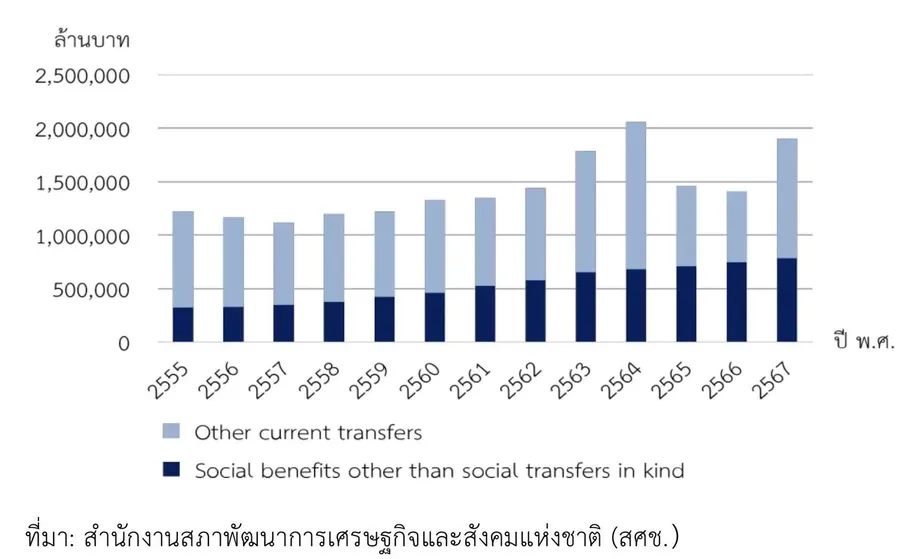
A narrow revenue base meets expanding obligations
Thailand's social protection spending rose from THB610 billion in 2012 to THB1.40 trillion in 2024, while a separate government revenue assessment puts the country's structural tax gap at around 5.6% of gross domestic product. Together, those figures expose the central fiscal problem: public obligations are growing faster than the revenue base needed to support them.
Contents
- A narrow revenue base meets expanding obligations
- What the national accounts reveal
- How much revenue could Thailand raise?
- Support measures have added lasting costs
- Welfare spending is growing faster than its funding
- Pensions, healthcare and service quality
- Debt forecasts differ in scope and timing
- Tax proposals are not yet collected revenue
- The dates and decisions that matter
- Key Points
The National Economic and Social Development Council (NESDC) examined the government's economic role through seven national accounts covering 2012 to 2024. Its findings identify low tax collection, rising transfers and subsidies, and increasing interest costs as pressures that leave government savings insufficient to finance investment, requiring further borrowing.
A separate NESDC welfare projection places the start of a social protection deficit in 2031 under its baseline assumptions. Meanwhile, its second quarter 2025 economic outlook warned that interest payments could exceed 12% of government revenue by 2027, increasing the risk of a credit rating downgrade.
These warnings concern different parts of public finance. A welfare funding gap, a government budget deficit and the public debt ratio are not interchangeable measures. They nevertheless point toward the same policy challenge: how to fund pensions, healthcare, assistance and investment without steadily increasing the burden of debt.
The World Bank's Public Spending and Revenue Assessment, published on May 29, 2023, offers a practical benchmark. It estimates that substantial tax reform could increase revenue collection by 3.5 percentage points of GDP, helping finance unmet needs while containing debt. That is a potential gain from reform, not revenue already collected.
What the national accounts reveal
NESDC's study finds that government production accounts for approximately 7% to 8% of GDP and grows relatively steadily, with a larger role during economic disruption or weak growth. Government production means the value of services and other output produced by government institutions. It is not the same as total public spending, which also includes transfers, subsidies and interest.
Taxes on production and imports, along with income, wealth and other taxes, contribute less than in many other countries. NESDC connects this weakness to a limited tax base and a large informal economy. Informal businesses and workers can remain outside parts of the tax system while also lacking full access to public protection and benefits.
On the spending side, subsidies to producers and transfers to households increased, particularly during crises and economic support programmes. Employee compensation, benefits for insured people, assistance to vulnerable groups and interest payments also create continuing obligations.
The resulting government saving deficit means current income does not adequately cover current expenditure, leaving insufficient savings for investment. Borrowing can bridge that gap, but repeated borrowing adds to debt and future interest costs.
NESDC also cautions against treating transaction totals as a verdict on policy success. National accounts show the value of economic activity, not directly whether a school improves learning, a hospital provides effective treatment or a subsidy reaches the intended household. Distribution, demographics, institutions and competition require separate examination.
How much revenue could Thailand raise?
The 2025 fiscal warning puts government revenue below 16% of GDP, against cited averages of 24.8% for OECD countries and 18.6% for Asia Pacific economies. On those figures, Thailand's gap exceeds 8.8 percentage points against the OECD average and 2.6 points against the regional average. Differences in coverage and reference periods mean these comparisons should not be treated as precise tax targets.
The World Bank uses a different benchmark: how much Thailand collects relative to its estimated capacity, based on economies at similar income levels. Its structural tax gap of approximately 5.6% of GDP is therefore an estimate of unused collection potential, not a measure of unpaid tax bills or tax evasion alone.
The World Bank states its central finding directly:
Even after accounting for efficiency gains, a key finding of this report is that an increase in revenue will be necessary to meet these spending needs while maintaining fiscal sustainability over the longer term.
NESDC's recommendations focus on connecting income, employment, asset and transaction records to widen coverage and reduce avoidance. It also proposes reviewing tax deductions and exemptions that do not justify their cost, assessing informal economic activity, and making entry into the tax system easier.
The 2025 fiscal warning also identifies reliance on consumption taxes rather than income and asset taxes as a weakness. Expanding revenue therefore involves choices about who pays, alongside improvements in collection. Raising receipts without examining the distribution of the burden could leave vulnerable households worse off.
Support measures have added lasting costs
The OECD's macroeconomic stability assessment, published on December 8, 2025, quantifies several decisions that reduced fiscal room. Lower oil excise taxes cost revenue equivalent to 0.6% of GDP in 2022 and 0.2% in 2023. Discretionary cash transfers added approximately 0.7% of GDP to the fiscal 2024 deficit and around 1% in 2025.
In June 2025, the government approved THB115.38 billion across 481 stimulus projects. Allocations included THB85 billion for infrastructure, THB11.12 billion for productivity and responses to United States tariffs, THB10.05 billion for tourism, and THB9.20 billion for local economic development.
Infrastructure represented roughly 74% of the package, calculated from THB85 billion divided by THB115.38 billion. The OECD assessment puts the expected contribution to output growth at 0.4 percentage points. Financing came from reallocating the Digital Wallet programme budget, rather than treating the full package as spending outside the existing budget.
Contracts or procurement procedures were required by September 2025, with full disbursement due by September 2026. Those deadlines describe the programme's rules; they do not establish that every project was completed or paid for on schedule.
The October 2025 Khon La Khrueng Plus scheme allocated another THB44 billion to subsidise household purchases at participating businesses. The OECD put its value at slightly under 0.25% of GDP.
NESDC recommends limiting subsidies to demonstrated needs and assessing beneficiaries, leakage, value and economic effects before and after implementation. The OECD similarly favours narrowing price controls and using social benefits to protect poorer households, rather than relying broadly on controls and reduced consumption taxes.
Welfare spending is growing faster than its funding
NESDC's social protection figures show revenue increasing from THB730 billion in 2012 to THB1.57 trillion in 2024, while spending rose from THB610 billion to THB1.40 trillion. Annual compound growth was reported at 6.6% for revenue and 7.3% for expenditure.
The system still recorded revenue above spending in 2024. Its vulnerability lies in the trend and funding structure, not a claim that it was already in deficit. Spending rose from 4.96% to 7.50% of GDP between 2012 and 2024, an increase of 2.54 percentage points.
Government subsidies supplied 72.8% of welfare revenue. Including government contributions to funds increased the state's share to 78.6%, compared with 13.6% from insured members and employers. This leaves welfare provision heavily dependent on the same public revenue base that must finance other services.
Retirement and death benefits accounted for 41.29% of spending, with healthcare accounting for 32.64%. Together, these categories represented 73.93%, showing how strongly the system is exposed to population ageing.
Under the baseline projection, a deficit begins in 2031. By 2040, projected revenue is THB1.92 trillion, against expenditure of THB2.37 trillion to THB2.76 trillion across scenarios. That implies a gap of THB450 billion to THB840 billion. The calculations depend partly on a 1% limit on government subsidy growth applied in the projections, so they are conditional forecasts rather than inevitable outcomes.
Pensions, healthcare and service quality
Thailand's share of people aged 60 or older rose from 13.18% in 2010 to 20.17% in 2023. NESDC expects that share to reach 28.09% in 2034, when the country would meet its projected threshold for a super aged society. The share aged 15 to 59 is projected to fall to 55.83% by 2040.
Public sector pensions accounted for 66.2% of pension and lump sum retirement payments in 2024. NESDC identifies the 2015 Government Pension Fund Undo policy as adding more than THB76 billion to expenditure. It also points to the Social Security Fund's first full retirement benefit payments in 2014, when the earliest eligible members had completed 180 months of contributions and reached age 55.
Healthcare costs rise rapidly after age 60, especially for chronic conditions such as diabetes, hypertension and cancer. The National Health Security Fund covers more than 47 million people and uses fixed payments per person to control costs. NESDC contrasts that with reimbursement of actual expenses for many items under the Civil Servant Medical Benefit Scheme, which it associates with unnecessary service use and higher spending per person.
The World Bank's assessment also links future healthcare costs to ageing, chronic disease and new medical technologies. In education, it finds that increased spending per student has not translated into stronger learning results, pointing to numerous small primary schools with insufficient resources and relatively low spending at preschool and secondary levels.
These findings support a distinction between reducing waste and reducing necessary services. NESDC proposes reorganising overlapping government functions, using digital technology and allocating staff according to demand in education, healthcare, security and justice. Its welfare proposals include basic state protection, supplementary pensions tied to employment, voluntary savings and broader contributory coverage for informal and gig workers.
Debt forecasts differ in scope and timing
The World Bank described public debt at around 60% of GDP in its 2023 assessment and judged associated risks relatively contained because much of the debt was denominated in baht and held by Thai residents. That structure reduces some exposure to foreign currency shocks, but does not remove interest costs or refinancing needs.
The OECD's December 2025 projections show government net lending deficits of 5.6% of GDP in 2025 and 5.2% in 2026, with gross financial liabilities reaching 68.0% in 2026. Its discussion separately cites fiscal year deficits of 4% in 2024 and an expected 4.5% in 2025. The measures and periods differ, so the figures should not be substituted for one another.
The welfare assessment reports public debt of THB12.9 trillion, or 66.8% of GDP, in May 2026, and projects 68.2% in 2030. The earlier fiscal warning says debt could reach the 70% ceiling sooner than expected, without specifying a date.
A separate account dated September 18, 2026 describes Fitch retaining Thailand's BBB+ rating and changing its outlook from negative to stable. It forecasts government debt below 63% of GDP in fiscal 2028, compared with 59.3% in fiscal 2025, using Government Finance Statistics figures.
That account differs from the 2025 description of Fitch's outlook as stable and gives a lower debt trajectory than the broader public debt projections. Different dates, debt definitions and assumptions prevent a direct reconciliation. An outlook change also differs from a rating upgrade. The earlier account puts Moody's at Baa1 with a negative outlook and S&P at BBB+ with a stable outlook.
Tax proposals are not yet collected revenue
The fiscal 2027 to 2030 plan described in the September 2026 account targets THB263 billion in additional revenue. Proposed measures include increasing VAT from 7% to 8.5% in fiscal 2028 and to 10% in fiscal 2030, and raising petrol and diesel excise taxes by THB1 per litre from fiscal 2027.
Other measures listed include carbon taxation, a 15% global minimum corporate tax, import duties on goods valued below THB1,500, reviews of personal income tax deductions, higher state enterprise remittances, better returns from state assets, linked taxpayer data and a single tobacco excise rate. The account says none of the listed measures had begun taking effect at that point. Their projected proceeds should therefore not be treated as secured income.
During Senate consideration of the fiscal 2025 government financial report, Comptroller General's Department accounting adviser Sudthai Chaichantuk presented revenue of THB2.9 trillion, up 0.46%, and expenses of THB3.6 trillion, up 8.23%. The reported net shortfall was THB760 billion. Rounded revenue and expense totals do not reproduce that figure exactly.
Reported assets were THB8.7 trillion and liabilities THB11 trillion. Their rounded difference is THB2.3 trillion, rather than the THB3 trillion also cited in the discussion. These accounting totals should not be confused with the debt ratio governed by the 70% ceiling.
Senator Nirat Yu Phakdi proposed raising VAT by three percentage points and returning money to registered poorer households, estimating THB450 billion in additional revenue. His reported supporting calculations contain inconsistencies, so that estimate is not a verified fiscal costing. Senator Khwanchai Saenhirun separately urged broader taxation of informal activity and better digital collection.
Nirat also proposed using roughly THB4 trillion held outside the annual budget to reduce borrowing. Sudthai explained that most such money belongs to revolving funds and other funds with specified purposes. Excess accumulated balances may be transferred to the Treasury after individual review, but the full amount is not automatically available.
The dates and decisions that matter
The central policy choice is how quickly Thailand can strengthen revenue while protecting essential services. The World Bank supports a measured fiscal adjustment that preserves public investment. The OECD stresses stronger collection and spending efficiency, forecasting GDP growth of 2.0% in 2025, 1.5% in 2026 and 2.6% in 2027 in its December 2025 assessment.
The main milestones span historical observations, spending deadlines and conditional projections:
- 2012 to 2024: NESDC tracks government activity and the expansion of social protection spending.
- May 29, 2023: The World Bank publishes its spending and revenue assessment.
- June and October 2025: Thailand approves the project stimulus package and launches Khon La Khrueng Plus.
- September 2026: The June 2025 package's full disbursement deadline falls due.
- 2027: Interest payments could exceed 12% of government revenue under the earlier NESDC warning.
- Fiscal 2028 and 2030: The described revenue plan schedules proposed VAT increases.
- 2031: The welfare baseline projects its first deficit.
- 2034 to 2040: Ageing and projected welfare funding gaps place further pressure on public finances.
Whether those pressures become manageable depends on implementation and results, not announcements alone. The assessments do not establish that the proposed taxes have been enacted, that all stimulus money was disbursed on time, or that welfare reforms will deliver their intended savings. NESDC's call for linked public databases and budgets tied to service outcomes would make those questions easier to answer.
Key Points
- NESDC identifies a narrow tax base and rising recurring spending as pressures on Thailand's finances.
- The World Bank estimates a structural tax gap of 5.6% of GDP and potential revenue gains of 3.5 percentage points through reform.
- Social protection spending reached THB1.40 trillion in 2024, with government funding supplying 78.6% of revenue.
- A conditional welfare baseline projects deficits beginning in 2031.
- Debt estimates differ by date and statistical coverage and cannot be compared directly.
- Proposed tax increases and better spending controls remain central to financing services without further debt pressure.