
A narrow margin for Thailand's next borrowing round
Thailand's Cabinet approved 1.26 trillion baht in new public borrowing on September 29, 2026, as competing government projections pointed to public debt approaching, or briefly crossing, the country's 70% limit. A Finance Ministry estimate puts debt at 69.7% of gross domestic product by September 2027, leaving just 0.3 percentage points below the ceiling.
Contents
- A narrow margin for Thailand's next borrowing round
- What the 1.26 trillion baht plan finances
- Why the debt forecasts differ
- Lower borrowing costs now, refinancing later
- Energy borrowing has defined uses and deadlines
- Rail projects share the borrowing allocation
- Travel taxes could raise revenue, but estimates vary
- Other tax changes reach beyond travellers
- Revenue weakness meets rising spending commitments
- Welfare costs extend the pressure into the next decade
- Key Points
The Public Debt Management Office (PDMO) expects the debt ratio to peak within the limit in fiscal 2028. A separate study by the Office of the National Economic and Social Development Council (NESDC), however, projects a peak of 70.05% that year. That small numerical difference matters because it separates compliance with the current fiscal framework from a projected breach.
The pressure is bringing several revenue proposals into focus: changes to automobile excise taxes, a 1,000 baht departure tax, and a possible shift away from dedicated tax funding for four public bodies. A separate 450 baht fee for foreign tourists is also under consideration. None of the proposed travel charges has begun being collected.
The borrowing plan arrives after reported improvements in Thailand's credit rating outlooks from negative to stable, with Fitch Ratings making its announcement in September. An outlook improvement is not a rating upgrade, and it does not remove the challenge of financing persistent deficits.
The central issue is broader than the debt ceiling. Revenue has declined relative to the size of the economy, legally required spending absorbs more of the budget, and welfare costs are projected to outgrow their funding. New taxes could provide some relief, but their scale, design and approval status differ considerably.
What the 1.26 trillion baht plan finances
The fiscal 2027 plan includes approximately 1.18 trillion baht in government borrowing, 81.465 billion baht for state enterprises and 850 million baht for other public agencies. Fiscal 2027 runs from October 1, 2026, to September 30, 2027.
The largest government item is 788 billion baht to finance the fiscal 2027 budget deficit. Another 60 billion baht covers fiscal 2026 deficit financing associated with spending carried into the following year, while 12.359 billion baht is allocated to economic and social development projects. Together, these direct government uses total about 860.359 billion baht.
The government also plans to borrow 63.038 billion baht for onward lending, principally to rail agencies, alongside 200 billion baht under the emergency energy borrowing decree and 56.820 billion baht for Treasury liquidity management. The detailed government allocations total about 1.180 trillion baht, consistent with the rounded headline figure.
New borrowing is only one part of the debt management programme. The plan also includes approximately 1.9 trillion baht in management or restructuring of existing debt, with one account giving the more precise figure of 1.91 trillion baht, and 580 billion baht in repayments. Of those repayments, 462 billion baht is to come from the fiscal 2027 expenditure budget and 118 billion baht from other sources.
These amounts should not simply be added together and described as new debt. Restructuring can replace existing obligations, while repayments reduce them. The approved borrowing amount is a financing plan, not a direct measure of how much the outstanding debt stock will increase.
Why the debt forecasts differ
PDMO director general Jindarat Viriyataveekul put debt at approximately 68% of GDP at the end of fiscal 2026 and slightly above 69% at the end of fiscal 2027. She described a peak in fiscal 2028 followed by a gradual decline.
By the end of fiscal 2027, the public debt ratio is expected to reach just over 69%, before peaking in fiscal 2028.
The fiscal framework for 2027 to 2030 gives more precise estimates of 68.17% at the end of fiscal 2026 and a peak of 69.78% at the end of fiscal 2028. That peak would leave only 0.22 percentage points below the ceiling.
NESDC's study, Thailand's fiscal risk landscape from a debt dynamics perspective, projects 67.97% in fiscal 2026, 69.34% in 2027 and 70.05% in 2028, before a decline to 65.74% in 2032. Its 2028 forecast is 0.27 percentage points above the fiscal framework estimate and 0.05 points above the ceiling.
The Finance Ministry estimate of 69.7% for September 2027 is also higher than NESDC's 69.34%. These are forecasts rather than observed outcomes, and they should not be treated as interchangeable. A separate NESDC welfare assessment projects debt at 68.2% in 2030, rather than supplying the same annual path as the debt dynamics study.
Lower borrowing costs now, refinancing later
The PDMO is adjusting how it raises money as bond markets become more expensive. Its preferred instruments include Treasury bills, promissory notes and term loans, allowing it to postpone some longer maturity bond issuance until conditions improve.
Jindarat said approximately 89% of the existing debt portfolio consists of borrowing with long maturities, while the government's average borrowing cost is around 2.6%. That structure limits how quickly changing market rates affect the cost of existing debt. It does not guarantee that new borrowing will remain equally cheap.
Thai Bond Market Association figures for September 29, 2026, put the three year government bond yield at 1.53% and the ten year yield at 2.41%, a difference of 0.88 percentage points. The ten year yield was reported to be at its highest level in four months. The PDMO also cited pressure from rising yields on ten year US Treasury bonds.
Shorter funding can avoid locking in current costs for a long period, but it brings repayment or refinancing dates closer. The strategy therefore depends partly on the ability to replace that borrowing on acceptable terms later. The reported term loans have maturities of approximately three to five years, shorter than longer dated bonds even though they are not all immediate obligations.
A separate financing transaction shows that longer borrowing has not stopped entirely. The PDMO arranged a 1 billion baht social bond for the Neighbouring Countries Economic Development Cooperation Agency, with a ten year maturity and a fixed annual interest rate of 3.13%. Sold fully to institutional investors through Government Savings Bank, it supports debt restructuring associated with Laos's Route 11 and the fifth Thai Lao Friendship Bridge between Bueng Kan and Bolikhamxay.
Energy borrowing has defined uses and deadlines
The 200 billion baht energy allocation in fiscal 2027 is the second half of a 400 billion baht emergency borrowing programme. The first half, assigned to fiscal 2026, has been almost fully used, with only several billion baht remaining.
The PDMO described a recent financing round of approximately 30 billion to 40 billion baht for the Thai Chuai Thai Plus assistance programme. An additional phase of that programme was scheduled to begin on October 1, 2026.
The second 200 billion baht allocation is intended for energy transition projects, including household solar installations, electric public transport, electric motorcycles and workforce training. Screening criteria had been considered, but individual projects still awaited consideration at the next screening committee meeting.
Project proposals were required before September 30, 2026, with approved projects allowed to draw funds through December 31, 2027. Borrowing is to proceed according to project progress and actual disbursement needs, rather than automatically drawing the entire allocation at once.
The decree sets out purposes and an attached project schedule approved by Parliament. Jindarat said this prevents the money from simply being transferred to unrelated tasks, including proposed flood responses. Further borrowing or guarantees for the Oil Fuel Fund, if higher oil prices require them, would create additional pressure beyond the present plan.
Rail projects share the borrowing allocation
Of the government's 63.038 billion baht in onward lending, approximately 10.653 billion baht is allocated to the Mass Rapid Transit Authority of Thailand and 52.385 billion baht to the State Railway of Thailand.
The metro allocation is dominated by 10.5 billion baht for the Purple Line from Tao Poon to Rat Burana and the Kanchanaphisek ring road. Smaller amounts cover the Orange Line between Thailand Cultural Centre and Min Buri, the Green Line extension to Khu Khot, and existing Blue and Purple Line sections.
The State Railway allocation covers continuing projects, including 6.5 billion baht for the first phase of the Bangkok to Nakhon Ratchasima high speed railway, 12 billion baht for the Den Chai to Chiang Rai and Chiang Khong route, and 3.31 billion baht for double tracking between Nakhon Pathom and Chumphon. Red Line extensions are also included.
The detailed project account contains an apparent inconsistency: it gives the Ban Phai to Nakhon Phanom railway allocation as only 16,000 baht and does not provide a complete set of amounts for all eight stated State Railway projects. That figure cannot safely be treated as a usable project allocation without clarification. The agency total of 52.385 billion baht is the clearer financing figure.
Travel taxes could raise revenue, but estimates vary
The Revenue Department's departure tax proposal would initially charge 1,000 baht per departure by air, covering eligible travellers of all nationalities. Airlines or ticket agents would collect the tax with the fare. Land and sea departures would initially be exempt, while the proposed legal ceiling is 5,000 baht per departure.
Public consultation runs until October 29, 2026. The proposed law would take effect 180 days after publication in the Royal Gazette, with tickets purchased before the effective date exempt even if travel occurs later. Other proposed exemptions cover children aged two or younger, transit passengers, transport personnel and specified official activities.
Revenue estimates differ sharply. One estimate puts annual proceeds at 12 billion baht. A separate illustrative calculation produces approximately 46 billion baht by adding 13.06 million Thai outbound trips to 32.97 million foreign tourist arrivals in 2025, assuming similar foreign departure numbers, and multiplying by 1,000 baht.
The larger figure is not an estimate of actual collections. It does not adjust for air travel alone, exemptions or changes in travel behaviour. The two numbers should therefore not be presented as equally developed forecasts.
The Tourism and Sports Ministry's separate 450 baht foreign visitor fee would initially apply to eligible air arrivals. It targets approximately 8 billion baht annually for tourism development after collection and insurance costs. Its proposed first quarter 2027 start remains a target, pending decisions on collection, exemptions, insurance and Cabinet approval.
A foreign visitor subject to both measures would pay an additional 1,450 baht for one arrival and departure. The visitor fee would finance insurance and tourism improvements, while the departure tax would raise government revenue. The two proceeds cannot be assumed to be freely interchangeable.
Other tax changes reach beyond travellers
Deputy Prime Minister and Finance Minister Ekniti Nitithanpraphat said conclusions on automobile excise taxes were expected within one to two weeks of his remarks. The discussions include protecting domestic vehicle producers, but no final rates or detailed revenue estimate have been established in the reported proposals.
Another proposal would end dedicated tax allocations for Thai PBS, the Thai Health Promotion Foundation, the National Sports Development Fund and the Older Persons Fund. These earmarked taxes direct revenue to specified bodies rather than the general Treasury.
Replacing that arrangement with annual budget allocations could redirect at least 10 billion baht a year to the Treasury, according to the estimate attached to the proposal. This is not necessarily an equivalent improvement in the government's fiscal balance: if the bodies continue receiving budget support, some or all of that expenditure would still have to be financed.
For scale, the 12 billion baht departure tax estimate and the 10 billion baht earmarked revenue estimate together amount to 22 billion baht, approximately 2.8% of the planned 788 billion baht deficit borrowing. The comparison uses the stated figures and does not establish net savings, particularly because replacement funding for the four bodies has not been specified.
Korn Chatikavanij, a Democrat Party deputy leader, member of Parliament and former finance minister, warned that rising expenditure combined with slow tax revenue growth could leave Thailand constrained by fiscal discipline rules and its debt ceiling. The NESDC assessment identifies a wider revenue issue: the fiscal framework anticipates a value added tax increase, but its implementation remains highly uncertain.
Revenue weakness meets rising spending commitments
NESDC found that net government revenue averaged 15% of GDP in fiscal 2023 to 2025, down from 16.5% in fiscal 2011 to 2016. That is a decline of 1.5 percentage points. Revenue has fallen short of expenditure by an average equivalent to approximately 4% of GDP over the past ten fiscal years.
Recent cash collections have risen: net revenue reached approximately 2.61 trillion baht in the first eleven months of fiscal 2026, up 4%. Growth in baht terms, however, does not by itself reverse a longer decline in revenue relative to the economy.
Required spending commitments accounted for 76.2% of the fiscal 2026 budget, compared with 71.7% in fiscal 2016. The increase of 4.5 percentage points leaves less room to redirect spending. Pensions, personnel costs, healthcare and welfare are difficult to reduce quickly because many arise from legal entitlements.
Obligations outside the main budget also matter. Pending government reimbursements under Section 28 of the State Fiscal and Financial Disciplines Act of 2018 rose from 839.462 billion baht in fiscal 2018 to 1.134 trillion baht in fiscal 2025, an increase of approximately 294.289 billion baht, or 35.1%.
NESDC cautioned that debt alone does not establish whether public finances are sustainable. Revenue capacity, repayment obligations, borrowing costs and growth also determine the government's ability to absorb shocks. Its baseline assumes economic growth exceeds real borrowing costs, helping reduce the debt ratio, while continuing fiscal deficits add to debt.
Welfare costs extend the pressure into the next decade
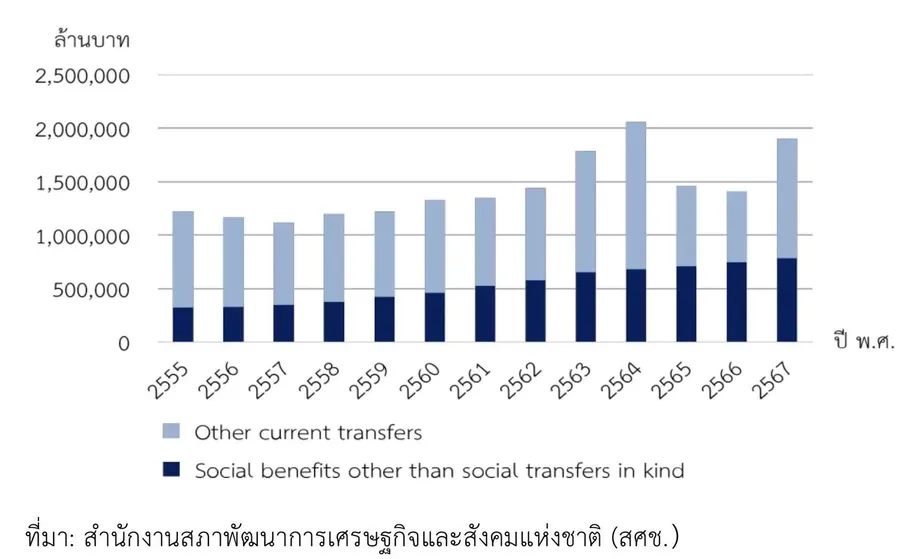
NESDC's separate social budget assessment projects welfare spending exceeding revenue from 2031 under its baseline scenario. Social protection expenditure rose from 610 billion baht in 2012 to 1.40 trillion baht in 2024, growing at an average annual compounded rate of 7.3%. Revenue grew more slowly, at 6.6%, reaching 1.57 trillion baht.
Government subsidies supplied 72.8% of welfare revenue. Including government contributions to funds raises the state share to 78.6%, while insured members and employers contributed 13.6%. Retirement and death benefits accounted for 41.29% of spending, and healthcare for 32.64%, together 73.93%.
Population ageing adds to those costs. People aged 60 or older represented 20.17% of the population in 2023 and are projected to reach 28.09% in 2034. The working population aged 15 to 59 is projected to decline from 67% to 55.83% by 2040.
For 2040, the assessment projects baseline revenue of 1.92 trillion baht and spending across scenarios of 2.37 trillion to 2.76 trillion baht. Its modelling applies a 1% limit on government subsidy growth. The figures therefore describe outcomes under specified assumptions, not a settled funding decision.
NESDC recommends expanding contributory protection to informal workers, gig workers and people working for themselves, reviewing tax bases, controlling healthcare costs and linking welfare records with income and tax information. These measures address a different scale of pressure from individual travel charges.
The immediate timetable separates decisions already taken from proposals still pending:
- September 29, 2026: Cabinet approved the fiscal 2027 debt management plan.
- Before September 30, 2026: Energy transition projects were required to be submitted for screening.
- October 1, 2026: Fiscal 2027 begins, alongside the scheduled additional Thai Chuai Thai Plus phase.
- October 29, 2026: Departure tax consultation closes.
- First quarter 2027: Target start for the foreign visitor fee, subject to approval.
- December 31, 2027: Disbursement deadline for approved energy projects.
- Fiscal 2028: Both debt assessments project a peak, but disagree on whether it exceeds 70%.
Key Points
- Thailand approved approximately 1.26 trillion baht in new public borrowing for fiscal 2027.
- The fiscal framework projects a 69.78% debt peak in 2028; NESDC projects 70.05%.
- The PDMO is favouring shorter funding while average existing borrowing costs remain around 2.6%.
- The 1,000 baht departure tax and 450 baht visitor fee remain proposals, not active charges.
- Ending dedicated tax allocations could redirect Treasury revenue, but net savings depend on replacement budgets.
- Declining revenue relative to GDP and rising welfare commitments make the fiscal challenge larger than any single tax proposal.