New cooking pots add lead to everyday meals
Locally made aluminium pots in Bangladesh released lead into rice and khichuri in laboratory tests, with the highest concentrations during their first uses. Researchers from icddr,b and Stanford University tested 20 new pots and seven used pots, finding a route through which an ordinary household purchase can expose families to a metal that damages children's developing brains.
Contents
- New cooking pots add lead to everyday meals
- How researchers tested the pots
- Why scrubbing and acidic food matter
- What the figures mean for children
- A kitchen risk within a national health problem
- Warnings about cookware go back years
- What tests elsewhere add to the picture
- Scrap metal and the price of safer cookware
- What regulators are doing
- Key Points
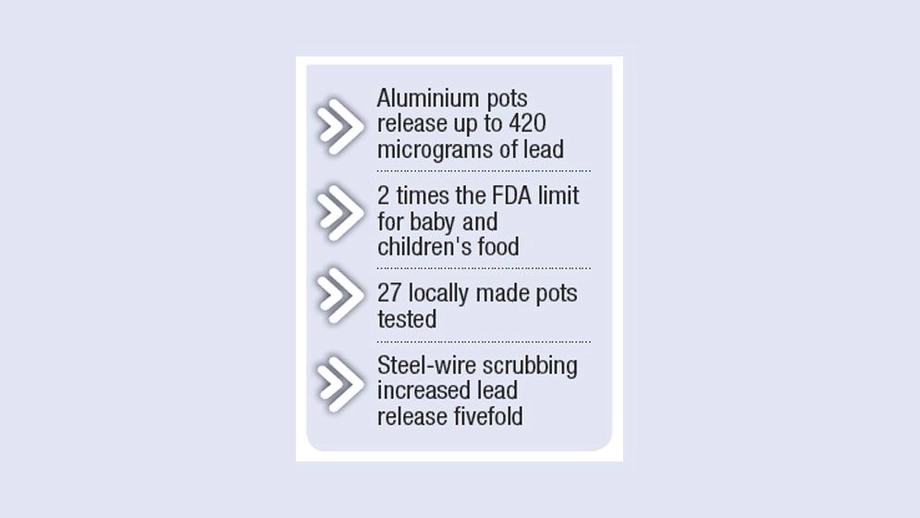
The study, published on October 25, 2026, in the Journal of Exposure Science & Environmental Epidemiology, recorded first use concentrations of 305 micrograms of lead per kilogram of rice and 420 micrograms per kilogram of khichuri, a dish made with rice and lentils. The academic abstract describes these figures as mean concentrations; public statements describe them as levels reaching those amounts.
Those concentrations are about 30 and 42 times the 10 micrograms per kilogram benchmark for foods intended for babies and young children cited by the researchers. Lead continued to enter food after repeated cooking, including during the third use. Rice cooked in six of the seven pots collected from households also contained detectable lead.
Dr Jenna Forsyth, director of Project Unleaded at Stanford University's Human and Planetary Health initiative, explained why the team examined both cookware and meals:
We measured lead in both the pots and the food cooked in them, so we could see how an everyday cooking pot becomes a source of exposure.
The findings put the focus on manufacturing and food safety oversight, as well as kitchen habits. A shiny replacement pot may release more lead initially than an older one, while abrasive cleaning can increase the amount that escapes from its surface.
How researchers tested the pots
The team's cookware exposure study used two approaches: cooking plain rice and khichuri, and testing metal release with a solution containing 4% acetic acid. Acetic acid is the acid found in vinegar. The solution allowed researchers to examine how acidity and everyday handling affect the transfer of lead from metal into liquid.
The 20 new pots came from a supplier in Bangladesh, while local households provided the seven used pots. Researchers measured lead in the cookware and examined its transfer into food and liquid under different conditions, including repeated use, scrubbing and stirring.
Lead release was highest during the early uses of new pots and then declined. The authors suggest that lead near the surface is more easily released and gradually depleted through use. Concentrations in cooked food nevertheless remained above the cited benchmark for young children's food in the experiments described in the abstract.
The research was supported by Stanford University's King Center on Global Development. It was a laboratory investigation involving 27 pots, with children's intake estimated from food consumption patterns. Broader testing is needed across manufacturers, cookware types and cooking routines. The national share of lead exposure attributable to pots, and the original scrap sources used in these particular pots, remain unknown.
Why scrubbing and acidic food matter
Abrasive cleaning produced some of the clearest changes in the tests. New pots scrubbed before testing released around five times as much lead on their first use as pots used without scrubbing. On the second use, the difference was nearly threefold.
These comparisons came from the acetic acid experiments. Acidity helps draw metals out of contaminated cookware, while rough cleaning can damage the surface and expose more material. Stirring with a metal spatula also increased lead release in similar tests.
Families using steel wire cleaning pads may therefore increase exposure while trying to keep their cookware clean. Avoiding abrasive pads and acidic dishes can reduce some of the conditions that promote lead release, although contamination can persist during ordinary cooking.
Dr Jesmin Sultana, assistant scientist in Environmental Health and WASH at icddr,b, described the concern for households:
Families prepare rice and khichuri with great care, and they should not have to worry that the pot is adding lead.
Sultana advised using cookware tested for food safety when preparing meals for young children. Where households continue using locally made aluminium pots, she recommended avoiding wire scrubbers and sour or acidic foods. Appearance offers little guidance: lead has no visible colour, smell or taste that allows a family to judge a finished pot's safety.
What the figures mean for children
Researchers combined the cooking results with earlier measurements of rice consumption among children in rural Bangladesh. They estimated that children eating rice prepared in the tested pots after three uses could ingest about 13 to 19 micrograms of lead each day, roughly six to nine times the US Food and Drug Administration's interim reference level for children's daily lead intake.
A microgram is one millionth of a gram. Such tiny quantities matter because lead is a neurotoxin, a substance that can injure the brain and nervous system. Children's brains are still developing, making exposure especially concerning for learning, attention and behaviour.
The food concentration benchmark and the daily intake reference answer different questions. Micrograms per kilogram describe how much lead is in a quantity of food. Micrograms per day describe the total swallowed over a day, which depends on how much a child eats. The intake estimates came from calculations using rice consumption, rather than blood tests of children eating from these pots.
The World Health Organization says there is no known safe level of lead in blood. It recommends identifying and reducing exposure sources when blood lead reaches five micrograms per decilitre, a unit equal to one tenth of a litre. That intervention threshold helps health services decide when to act; prevention is needed at lower levels too.
A kitchen risk within a national health problem
Bangladesh's Multiple Indicator Cluster Survey 2025 found elevated blood lead in about 38.4% of children aged 12 to 59 months and 7.5% of pregnant women. Conducted by the Bangladesh Bureau of Statistics with UNICEF support, the survey shows why identifying routine sources of exposure has become a national concern.
Lead can reach families through contaminated food, paint, dust, household products and unsafe battery recycling. The cookware findings identify another exposure route requiring attention alongside those sources. Prolonged exposure also affects adults, including through an increased risk of heart disease.
Bangladesh's national lead reduction targets call for halving the proportion of young children with elevated blood lead by 2030 and reducing that proportion by 95% by 2035. The Cabinet approved the draft National Strategy and Multi-Year Action Plan for a Lead-Free Bangladesh for 2026 to 2035 on August 17, 2026.
Cookware testing gives those ambitions a concrete task: identify contaminated products before they reach kitchens. Blood testing can identify people needing attention, while checking raw materials and finished pots can prevent repeated exposure through daily meals.
Warnings about cookware go back years
The Environment and Social Development Organization, or ESDO, raised concerns about locally sold aluminium cookware in 2018. Its cookware contamination report described tests of four samples from Bangladesh in a San Francisco laboratory.
ESDO reported average exposure per serving of 216 milligrams of aluminium, six micrograms of arsenic, 7.5 micrograms of cadmium and two micrograms of lead. It said lower grade pots released more lead, while higher grade pots released more copper. The small sample identified concerns about several metals and supported further investigation of materials used in production.
Several developments now connect those earlier warnings to current research and regulation:
- February 2017: Research covering 42 cookware items from ten developing countries documented the release of lead and other metals during acid testing.
- April 28, 2018: ESDO announced its findings from four cookware samples sold in Bangladesh.
- January 2026: According to BSTI, certification became mandatory for aluminium cooking utensils under BDS 1110:2025.
- August 17, 2026: Bangladesh approved its draft national strategy and action plan to reduce lead exposure through 2035.
- October 25, 2026: The icddr,b and Stanford cookware study was published.
- November 6, 2026: Public accounts detailed the new findings and responses from food safety and standards officials.
The years between the first warnings and the latest experiments show the need to connect research with routine checks on products sold in markets.
What tests elsewhere add to the picture
The research published in February 2017 tested 42 aluminium cookware items from ten developing countries by boiling dilute acetic acid for two hours. Fifteen items released at least one microgram of lead per serving of 250 millilitres, about 36% of the sample.
Ten items released more than one microgram of cadmium per serving, and 15 released more than one microgram of arsenic. One pot from Viet Nam released 33, 1,126 and 1,426 micrograms of lead per serving in successive tests. Its increasing release contrasts with the decline observed during repeated use in the newer Bangladesh experiments, showing why testing must cover different products and repeated cooking.
Preliminary experiments in that earlier research found that coating cookware reduced aluminium exposure per serving by more than 98%, with similar reductions for other metals. Protective surfaces offer a possible manufacturing approach requiring checks for safety, durability and performance during use.
Bangladesh's newer study adds direct measurements from rice and khichuri to this wider evidence. Its practical contribution is to examine meals people eat regularly, alongside controlled tests of acidity, cleaning and stirring.
Scrap metal and the price of safer cookware
Aluminium cookware is popular because it is affordable, widely available and conducts heat well. Small manufacturers often melt scrap metal to make pots. Potential inputs include discarded engine parts, radiators, computer components and cans, whose metal composition may vary considerably.
Lead in unsuitable scrap can remain in the finished product. Testing raw materials therefore matters before casting begins, while testing finished cookware reveals how much contamination can migrate into food during cooking.
Mahbubur Rahman, a researcher at icddr,b and a study author, said replacing inexpensive cookware would be difficult for many households. He called for preventing contaminated scrap from entering production and giving small manufacturers access to safer materials and quality testing.
Researchers have discussed the findings with cookware manufacturers and BSTI, including at a workshop. They encountered difficulties accessing manufacturers and tracing their materials. The team has since collected additional cookware samples from Dhaka and other parts of Bangladesh for further testing.
Bangladesh has already reduced another food exposure route. In markets examined by a study published in 2023, turmeric samples with detectable lead fell from 47% in 2019 to none in 2021. Researchers linked that improvement to public awareness, work with traders and enforcement against colouring containing lead. Cookware requires a similar connection between production checks, market oversight and affordable safer products.
What regulators are doing
BSTI says mandatory certification under BDS 1110:2025 requires aluminium utensils to meet limits for lead and other toxic metals. The agency says it is collecting factory and market samples, bringing manufacturers into its licensing system and preparing legal action against products that fail requirements.
BSTI cited a maximum limit of 0.05%, without identifying which metals that figure covered. Its response also left unspecified whether certification includes measurements of lead transferred into food during cooking. Researchers want both the composition of cookware and its performance in the kitchen addressed.
Dr Md. Mahbubur Rahman, of Environmental Health and WASH at icddr,b, set out the requested division of responsibility:
We urge the Bangladesh Food Safety Authority to establish clear safety requirements for lead leaching from cookware into food and Bangladesh Standards and Testing Institution (BSTI) to set and enforce clear lead safety requirements for cookware.
Md Safiqul Islam, chairman of the Bangladesh Food Safety Authority, said the authority was using training, workshops and awareness campaigns to warn about contamination. He advised households to avoid aluminium cooking utensils as much as possible.
For families, the immediate priorities are cookware tested for food safety, especially for children's meals, and avoiding abrasive scrubbing and acidic cooking when using the pots of concern. For regulators and producers, the larger task is ensuring that an affordable pot is made from suitable materials and tested for what it releases into food.
Key Points
- Researchers tested 20 new aluminium pots and seven used pots from Bangladesh, finding lead transfer during cooking and laboratory experiments.
- First use food concentrations reached 305 micrograms per kilogram in rice and 420 in khichuri.
- Abrasive scrubbing increased lead release about fivefold during the first acid test of new pots.
- Estimated intake from rice cooked after three uses was 13 to 19 micrograms of lead daily for children.
- Bangladesh's 2025 national survey found elevated blood lead in about 38.4% of young children and 7.5% of pregnant women.
- Researchers want safer scrap materials, stronger manufacturing oversight and clear requirements for lead released from cookware into food.