Two districts report deaths as daily case counts rise
Two more children died with suspected measles in Bangladesh during the 24 hours ending at 8am on October 12, 2026, bringing the combined number of confirmed and suspected measles deaths since March 15 to 1,164. The latest deaths occurred in Kishoreganj and Habiganj districts, one in each, according to the daily figures attributed to the Directorate General of Health Services (DGHS).
Contents
- Two districts report deaths as daily case counts rise
- What changed in the latest 24 hours?
- Hospital figures show a continuing burden
- How the outbreak and response unfolded
- WHO documented widespread transmission in April
- Young children faced the greatest danger
- Why the vaccination target needed correction
- Protection requires more than campaign totals
- Accountability questions remain unresolved
- Key Points
Both deaths were classified as suspected measles. No new death from confirmed measles was recorded during the reporting period, which began at 8am on October 11. The cumulative death count now comprises 1,060 suspected deaths and 104 confirmed deaths.
The DGHS Control Room update also recorded 1,269 new suspected cases and 152 confirmed infections. Together, those two reported categories total 1,421 for the day. That figure should not be described as 1,421 newly confirmed infections: most were recorded on the basis of symptoms, rather than laboratory confirmation.
The geography is consistent across the district and divisional accounts. Kishoreganj is in Dhaka division, while Habiganj is in Sylhet division. Reports describing one death in each of those divisions therefore do not conflict with the more specific district figures.
The latest tally shows transmission continuing nearly seven months after the national reporting period began. It also comes as the government seeks to vaccinate 3.4 million children missed during an earlier campaign, with the special vaccination effort scheduled to continue until October 31. The immediate challenge is to reach those children while protecting patients and their contacts from further infection.
What changed in the latest 24 hours?
Suspected cases rose from 205,028 on October 11 to 206,297 on October 12. Confirmed infections increased from 22,421 to 22,573. Suspected deaths rose from 1,058 to 1,060, while confirmed deaths remained at 104.
The preceding daily update had recorded seven additional suspected deaths, 1,180 suspected cases and 93 confirmed infections. Compared with that period, the latest suspected case count increased by 89, about 7.5%, while confirmed infections increased by 59, about 63.4%.
Those changes describe reporting over two successive days, not a settled trend in transmission. Confirmation can follow testing and reporting schedules, and a single daily increase cannot establish whether the outbreak is accelerating. Likewise, the fall from seven suspected deaths to two does not by itself show a sustained reduction in deaths.
Across the two reporting periods, nine suspected deaths, 2,449 suspected cases and 245 confirmed infections were added. The unchanged confirmed death count is encouraging only in the narrow sense that no additional confirmed fatalities were recorded. Children continued to die in the suspected category.
Hospital figures show a continuing burden
Since March 15, 183,226 patients with suspected measles have been admitted to hospitals nationwide. Of those, 175,655 recovered and were discharged, according to the October 12 update. Recorded discharges amount to approximately 95.9% of cumulative admissions.
The previous update listed 182,047 admissions and 174,469 recovered patients. The cumulative totals therefore increased by 1,179 admissions and 1,186 discharges in the latest reporting interval. Discharges can exceed admissions on a particular day because patients admitted earlier may leave hospital during that period.
Subtracting cumulative discharges from admissions leaves 7,571. That is an accounting difference, not a verified count of people currently occupying hospital beds. Deaths, transfers and other outcomes would need to be accounted for before treating it as the number still receiving inpatient care.
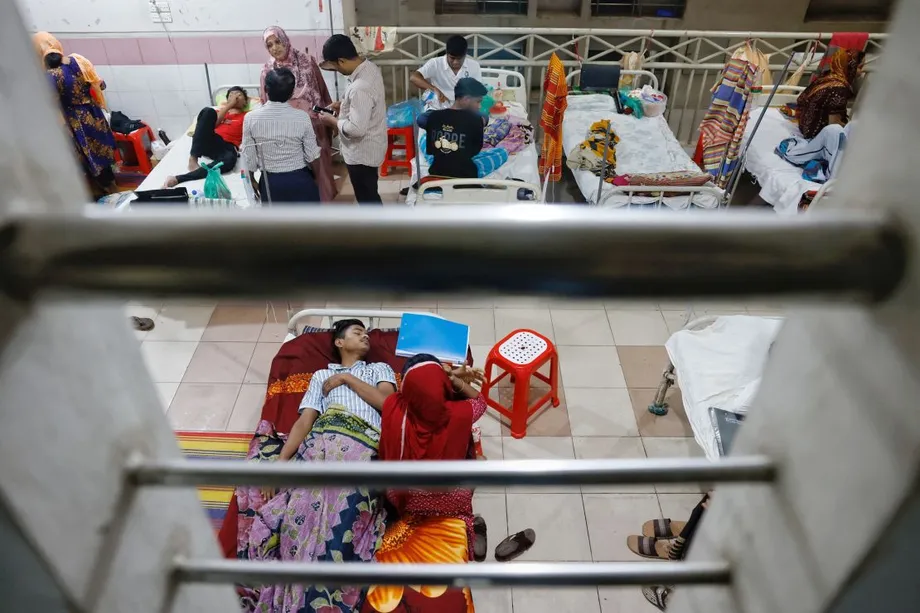
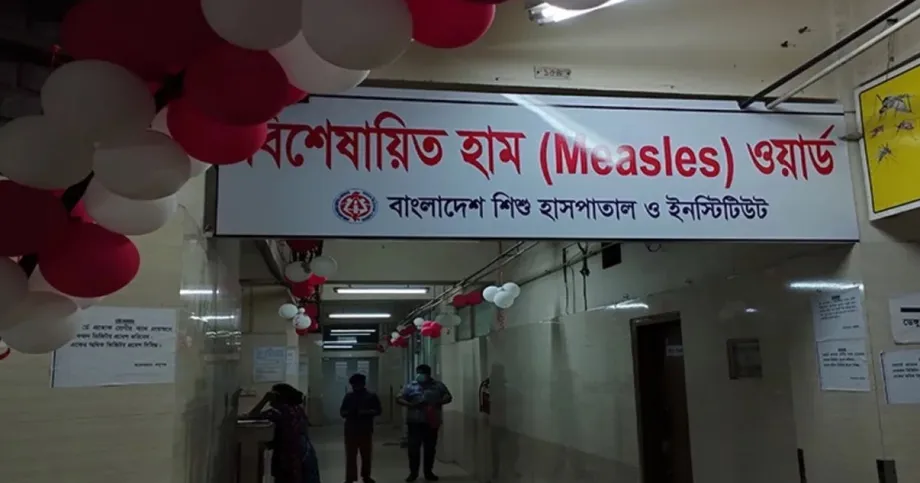
Hospital pressure had already become evident during the July outbreak surge, when nearly 130 measles patients were being treated in 32 rooms at Medical College Hospital in Mymensingh, more than twice the intended ward capacity. The October national totals do not establish the present conditions at that hospital, but they show that admissions have continued long after the initial emergency response.
How the outbreak and response unfolded
The reporting period begins on March 15, although the World Health Organization described an increase in measles cases from January 2026. Bangladesh notified WHO of the nationwide rise on April 4. Vaccination then expanded in stages before the current effort to reach children who had been missed.
- March 15: The starting date for the cumulative DGHS outbreak figures.
- March 30: The National Immunization Technical Advisory Group approved a nationwide measles and rubella vaccination campaign.
- April 4: Bangladesh notified WHO of increasing cases across 58 of its 64 districts.
- April 5: Targeted vaccination began in 30 subdistricts in 18 priority districts.
- April 12: The campaign expanded to Dhaka North, Dhaka South, Mymensingh and Barishal city corporations.
- April 20: Nationwide vaccination began, according to WHO.
- May 20: The main campaign ended, although vaccination of missed children continued.
- May 23: The government disclosed an informal request for an independent WHO inquiry into the crisis.
- October 12: Combined suspected and confirmed deaths reached 1,164.
- October 31: The stated end date for the special campaign targeting 3.4 million missed children.
This sequence matters because emergency vaccination did not end the outbreak. The latest figures show that cases and deaths continued months after the main campaign, making both the reach of vaccination and the quality of infection control central to the response.
WHO documented widespread transmission in April
The World Health Organization's April outbreak report, published on April 23, recorded cases in all eight divisions and 58 of 64 districts, about 91% of districts. Its detailed figures through April 14 listed 19,161 suspected cases, 2,973 confirmed infections, 166 suspected deaths and 30 confirmed deaths.
WHO's document contains an internal discrepancy: its opening summary gives 2,897 confirmed cases, while the detailed description gives 2,973. The summary also presents 166 deaths without the same category breakdown used later. Comparisons here use the detailed description, which separates suspected and confirmed deaths.
Against those detailed April figures, the October suspected case total is about 10.8 times as large, while confirmed infections are about 7.6 times as large. Combined deaths increased from 196 to 1,164, nearly sixfold. These are comparisons of cumulative reported totals, not measurements of the current rate of spread.
Dhaka had the largest suspected case burden in April, with 8,263 cases, followed by Rajshahi with 3,747, Chattogram with 2,514 and Khulna with 1,568. Together, those four divisions accounted for 16,092 cases, approximately 84% of the national suspected total at that point.
Within Dhaka, WHO identified concentrations in densely populated settlements, including Demra, Jatrabari, Kamrangirchar, Korail, Mirpur and Tejgaon industrial and slum clusters. The October update does not provide a comparable district or divisional breakdown of infections, so those April concentrations cannot be assumed to describe the present distribution.
Young children faced the greatest danger
WHO reported that 79% of cases in its April assessment involved children younger than five. Children younger than two accounted for 66%, and infants younger than nine months for 33%. These age categories overlap and should not be added together. Suspected deaths were mainly among unvaccinated children younger than two.
The report also contains a separate statement that 91% of cases occurred among children aged one to 14, without explaining how that figure fits the earlier age breakdown. The precise age distribution therefore needs clarification. The October daily update does not provide new age percentages.
Bangladesh ordinarily gives measles and rubella vaccine doses at nine and 15 months. Infants infected before nine months may therefore become ill before their first routine dose. The outbreak campaign lowered eligibility to six months, but infants younger than that still depend heavily on reduced exposure and protection among people around them.
Measles spreads through the air or droplets from an infected person's nose, mouth or throat. WHO lists fever, cough, runny nose, bloodshot eyes and white spots inside the mouth among early symptoms, followed by a rash. A person can be infectious from four days before the rash appears until four days afterward.
That infectious period makes separation of suspected patients important even before a diagnosis is confirmed. Complications can include pneumonia, diarrhoea, ear infection, blindness and inflammation of the brain. WHO identifies malnourished children, especially those with vitamin A deficiency, and people with weakened immune systems as groups at greater risk of severe illness.
Why the vaccination target needed correction
The special campaign aims to vaccinate 3.4 million children aged six to 59 months who missed the main April and May campaign. The health ministry announced an opening event at the T&T playground in Dhaka, to be attended by Health Minister Sardar Md Sakhawat Hossain and State Minister M A Muhit. The announcement set October 31 as the closing date, but did not provide an explicit calendar date for the opening Saturday.
The original campaign target was 18,015,064 children. A later calculation found that the eligible population was approximately 4.4 million larger. On those figures, the original target omitted roughly one fifth of the revised eligible population of about 22.4 million.
By the time the special campaign was announced, 19,861,530 children had reportedly been vaccinated. That exceeded the original target by about 1.85 million. Exceeding an underestimated target, however, does not prove that all eligible children were reached.
Some areas recorded vaccination above 100% of their targets. Immunization officials said children older than 59 months had also received doses in some places. Surveys by WHO and UNICEF subsequently identified unvaccinated children in urban and rural communities, showing why a high administrative percentage can coexist with gaps in protection.
The revised eligible population, the reported vaccination count and the 3.4 million campaign target do not reconcile exactly. The figures do not establish how many vaccinations were given outside the intended age range or how many eligible children remained unvaccinated at the announcement date. Local counts and verification will be needed to establish the campaign's actual reach.
Protection requires more than campaign totals
DGHS Director General Professor Prabhat Chandra Biswas said vaccination was the main response and that authorities wanted to reach all children aged six to 59 months while continuing routine immunization. Additional Director General Professor Fowara Tasmim acknowledged possible errors in estimating the child population and in vaccination work in the field.
Public health specialist Mushtaq Hossain, a former chief scientific officer at the Institute of Epidemiology, Disease Control and Research, advocated a wider vaccination range, from six months to 15 years. He also urged authorities to identify areas of intense transmission and ensure no child there was missed. The announced government campaign remains focused on children younger than five.
WHO's April assessment linked the outbreak to vaccine shortages during 2024 and 2025, routine immunization gaps and the absence of regular nationwide supplementary measles and rubella campaigns since 2020. It recommended at least 95% coverage with both vaccine doses in every municipality, rather than relying solely on a national average.
WHO described the conditions needed for protection in its April risk assessment:
Continued spread is likely unless urgent measures are implemented to strengthen surveillance, rapidly detect and respond to cases, and close immunity gaps through high-quality vaccination activities.
The response documented by WHO included district rapid response teams, faster vaccine procurement, vitamin A for suspected and confirmed patients, hospital preparedness, isolation capacity and infection prevention. Prabhat Chandra Biswas also acknowledged that isolation is difficult in poor households where several people share a small room.
WHO assessed national and regional risk as high in April and global risk as moderate. It cited population movement across the borders with India and Myanmar, along with major travel hubs. Those are dated assessments, not a new October evaluation. WHO did not recommend restrictions on travel or trade.
Accountability questions remain unresolved
On May 23, the reported death tally stood at 426 suspected deaths and 86 confirmed deaths, a combined 512. Prime Minister's health special assistant S M Ziauddin Haider said the government had informally asked WHO to conduct an independent inquiry and that the organization had expressed interest.
The dispute concerned vaccine procurement, delays in decisions and missed vaccination campaigns. UNICEF said it had warned the interim government through at least five letters and on at least 10 occasions in meetings. Former health special assistant Professor Sayedur Rahman rejected the criticism, saying vaccines had been procured through UNICEF, including in September 2025.
Other accounts described approval of an open tender approach and delays in procurement decisions. These are competing explanations, not established findings assigning responsibility. Health Minister Sardar Sakhawat Hossain blamed the previous government, while public health specialist Benazir Ahmed also criticized the response after the outbreak began and called for reviews of individual deaths.
The High Court issued a rule asking why a commission should not be formed to investigate the child deaths. A rule seeks a response; it is not itself a final finding or an order establishing the proposed commission. The government separately said it had begun examining vaccine shortages and deaths.
No completed independent WHO inquiry, final court determination or next hearing date is identified in these announcements. The clearest scheduled next step is the vaccination campaign deadline of October 31. An account published with the campaign announcement carried a lower death tally of 1,084, but without an explicit date it cannot be placed precisely alongside the October 12 update.
Key Points
- Two children died with suspected measles in Kishoreganj and Habiganj during the 24 hours ending at 8am on October 12, 2026.
- Combined deaths since March 15 reached 1,164: 1,060 suspected and 104 confirmed.
- The latest daily update recorded 1,269 suspected cases and 152 confirmed infections.
- Cumulative suspected cases reached 206,297, while confirmed infections reached 22,573.
- Hospitals recorded 183,226 admissions and 175,655 recovered patients discharged during the reporting period.
- A special campaign aims to vaccinate 3.4 million missed children aged six to 59 months by October 31.
- Procurement disputes and requests for investigations have not produced a final finding identified in the announcements.