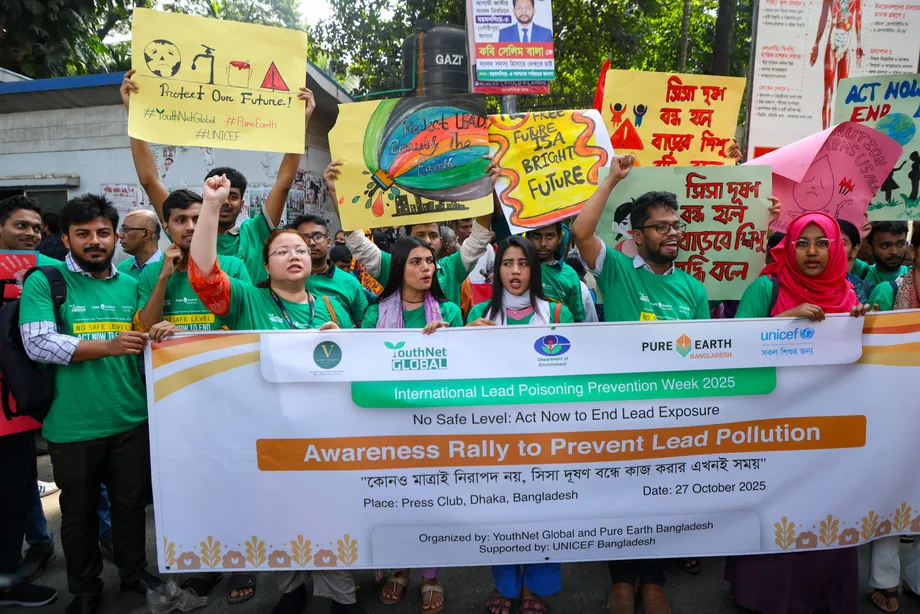
A national health warning becomes a test of action
Bangladesh aims to halve the proportion of young children with elevated blood lead by 2030, after a national survey found that 38.34% of children aged 12 to 59 months had levels at or above the threshold for public health intervention. The same survey found elevated levels in 7.54% of pregnant women.
Contents
- A national health warning becomes a test of action
- What the national blood tests show
- Why harm can begin before symptoms appear
- What the 2030 and 2035 targets mean
- Why unsafe battery recycling persists
- What cleanups in Savar and Khulna reveal
- Turmeric and paint show other routes to prevention
- The economic cost reaches beyond hospital bills
- Enforcement gets new tools and local pressure
- Key Points
The Cabinet approved the draft National Strategy and Multi-Year Action Plan for a Lead-Free Bangladesh (2026–2035) on August 17, 2026, at a meeting chaired by Prime Minister Tarique Rahman. Its longer target is a 95% reduction in the affected proportion of young children by 2035.
At an October 14 seminar in Dhaka, Environment, Forest and Climate Change Minister Abdul Awal Mintoo said those ambitions must become funded work plans, capable institutions and measurable results. The meeting brought together more than 100 participants from government, research, industry, development organisations and youth groups.
Bangladesh already has examples of progress: contaminated soil has been cleaned, lead adulteration in turmeric has fallen sharply in tested samples, and illegal smelting factories have been closed. Yet unsafe battery recycling continues to supply a market serving millions of electric three-wheelers, while contaminated products and old industrial sites create other routes into homes.
The immediate challenge is to connect those efforts. Blood testing identifies people who need help; environmental investigations locate the pollution; enforcement and safer collection systems prevent the next exposure. Cleaning a site also matters after its furnace has stopped operating, because lead can remain in soil for years.
What the national blood tests show
The Bangladesh Bureau of Statistics conducted the Multiple Indicator Cluster Survey (MICS) 2025 with UNICEF support. Its final report, Progotir Pothe, includes the country's first nationally representative assessment of blood lead among young children and pregnant women. Pure Earth's national response review says the assessment involved 13,707 participants.
The survey used 5 micrograms of lead per decilitre of blood as its intervention threshold. A decilitre is one tenth of a litre. Lead can damage health at lower concentrations too, so prevention must reach beyond people whose results cross that line.
Dhaka district recorded a much higher affected proportion, approximately 65.2% of children. A study by icddr,b also found concerning blood lead levels in 98% of 500 children aged two to four in Dhaka. The national survey provides the broad picture; these local findings identify places requiring particularly close investigation.
Dr Priscilla Wobil, a health specialist at UNICEF Bangladesh, said identifying the routes of exposure is the next task. The national assessment has not yet pinpointed the exact sources responsible for each child's exposure.
For families, that means a blood test needs to be followed by practical investigation of the places where children live, play and eat. Possible sources include industrial emissions, contaminated dust and soil, food, paint, cookware and other consumer products.
Why harm can begin before symptoms appear
Lead is a neurotoxin, a substance that can damage the brain and nervous system. Children are especially vulnerable while their brains are developing. Exposure can affect attention, memory, behaviour and learning, with consequences that continue into school and working life.
Dr Quazi Ahmed Zaki, director of the Institute of Epidemiology, Disease Control and Research, warned at the seminar that physical damage can occur before clinical symptoms become apparent. A child may therefore need protection even when parents see no obvious illness.
Pregnancy creates another route of exposure. Bangladesh's clinical management guideline explains that lead stored in bones can return to the bloodstream during pregnancy and reach the developing baby. Iron and calcium deficiencies can increase vulnerability.
Wobil said removing the source should be the priority, alongside nutrition and monitoring children's development. She also identified a major testing gap: Bangladesh lacks a national reference laboratory for routine blood lead testing. Expanding reliable testing is therefore part of the response, alongside preventing pollution at its source.
What the 2030 and 2035 targets mean
The national strategy measures success through the proportion of children aged 12 to 59 months whose blood lead reaches or exceeds 5 micrograms per decilitre. Using the MICS baseline of 38.34%, a reduction of 50% would bring that proportion to about 19.17% by 2030. A reduction of 95% would bring it to about 1.92% by 2035.
Those calculations show the scale of the task: Bangladesh must bring the affected share from nearly four in 10 young children to roughly one in five by 2030, then to about two in 100 by 2035. The targets concern how many children cross the threshold, rather than a uniform reduction in every child's blood lead concentration.
The strategy assigns responsibilities across ministries, agencies and other organisations. Its programmes cover surveillance, institutional capacity, regulation, enforcement, business participation, public education, research and coordination. At the Dhaka seminar, Mintoo described the investment required:
This requires sustained investment in testing facilities and laboratories, environmental monitoring, site remediation, safer industrial practices and public health responses.
The milestones leading to implementation stretch back well before Cabinet approval:
- 2011: Pure Earth and the University of Dhaka began mapping toxic sites.
- 2017: A cleanup in Kathgora, Savar, tested ways to reduce exposure in a residential community.
- 2018: Bangladesh introduced a mandatory lead limit of 90 parts per million for decorative paint.
- 2022: Health surveillance tested 980 children across four districts.
- August 17, 2026: The Cabinet approved the draft national strategy and action plan.
- September 2026: Follow-up testing at SSR School in Khulna recorded lower median blood lead.
- October 14, 2026: The Dhaka seminar called for financing, stronger institutions and coordinated implementation.
Why unsafe battery recycling persists
Used lead-acid batteries sit at the centre of Bangladesh's exposure problem. Pure Earth's mapping programme documented more than 350 contaminated hotspots, including 290 associated with battery recycling. A World Bank estimate put the number of informal recycling sites at more than 1,100 in 2022.
Electric three-wheelers account for roughly 60% to 65% of domestic demand for lead-acid batteries. Pure Earth's review estimates that around 70% to 80% of used batteries enter informal recycling networks, where workers may break them apart by hand, drain contaminated acid onto the ground and melt lead in basic furnaces.
Informal businesses can offer more money for discarded batteries because they avoid taxes and the cost of pollution controls and worker protection. Formal recyclers must compete against those lower operating costs. Batteries that wear out quickly keep the supply of discarded units flowing.
Dr Amrita Kundu of Georgetown University, whose research examined the economics of this market, explained why enforcement needs support from financial changes:
Good regulations are important, but without effective implementation they have limited impact. We need to change the economic incentives so that responsible formal businesses become more competitive than the informal sector.
Pure Earth Bangladesh country director Mitali Das said the organisation is advancing a proposed Extended Producer Responsibility directive with the government. This approach would give producers responsibility for organising or financing collection and safer handling after batteries are used. The proposal seeks better collection, traceability and environmentally sound recycling.
Other recommendations include digital battery registration, minimum durability standards, incentives for compliant recyclers and deposit refund schemes. Traceability means keeping a record of where a battery goes, making it easier to follow it from sale to collection and recycling.
What cleanups in Savar and Khulna reveal
Kathgora shows why closing a polluting business is only part of the job. Recycling operations there were abandoned in 2016 after complaints from residents, but contaminated soil remained in a neighbourhood where women and children spent time working and playing.
A Kathgora remediation study enrolled 69 children living within 200 metres of the abandoned sites. Researchers combined soil capping, household cleaning and awareness activities. Median soil lead fell from 1,400 milligrams per kilogram to 55, a reduction of about 96%.
Among 47 children measured before the intervention and seven months afterwards, median blood lead fell from 21.3 to 17.0 micrograms per decilitre. Among the 25 children measured at all three visits, it fell from 22.6 at baseline to 14.8 after 14 months, a reduction of about 35%. The number followed declined as the study progressed, and the final median remained well above the national intervention threshold.
Children living within 50 metres of the abandoned sites had baseline blood lead levels 31% higher than children living farther away. The findings connect the location of contaminated ground with the exposure experienced by nearby families.
At SSR School in Labanchora, Khulna, preliminary September 2026 testing found a 17.5% reduction in median blood lead among 111 participants tested before and after remediation. Aftab Uz Zaman Khan, Pure Earth Bangladesh's senior programme manager, said the median fell from 5.32 micrograms per decilitre in 2025 to 4.39. Pure Earth's institutional review also records a fall in median surface lead concentrations at Labanchora from 98,476 parts per million to 99.
Turmeric and paint show other routes to prevention
Bangladesh's turmeric intervention offers a different example: stopping lead from entering a widely used product. Researchers from Stanford University and icddr,b investigated the use of lead chromate to make turmeric look brighter yellow. Laboratory analysis linked lead in the spice to lead found in people's blood.
The response combined public information, engagement with major processors, rapid product screening and food safety enforcement. Lead chromate contamination fell from 47% of tested turmeric samples to zero within two years, while mill workers' median blood lead fell by 30%, according to Pure Earth's review.
Decorative paint became another regulatory focus. Evidence gathered by the Environment and Social Development Organization helped lead to the mandatory 90 parts per million limit introduced in 2018. Product standards give manufacturers a measurable rule and inspectors a basis for action.
Consumer goods still require attention. Pure Earth's 2023 rapid screening found that 24% of 197 samples exceeded reference lead levels, including metal and ceramic foodware, paint and children's plastic toys. Another investigation found lead in 96 of 367 product samples. Families cannot reliably identify contaminated items by appearance, which makes testing and market oversight essential.
The economic cost reaches beyond hospital bills
Global research estimates that lead exposure caused about US$28.6 billion in health related economic losses in Bangladesh in 2019. Das cited a range equivalent to 6% to 9% of gross domestic product when discussing the burden at the seminar.
The estimate reflects costs that reach beyond immediate medical treatment. Damage to children's learning can affect education and later earnings, while adult illness reduces health and productive working life. A 2023 study by Bjorn Larsen and Ernesto Sánchez-Triana estimated approximately 138,000 deaths from cardiovascular disease associated with lead exposure annually among Bangladeshi adults aged 25 or older.
The researchers also estimated that young children in Bangladesh lose about 20 million IQ points collectively each year, averaging 6.9 points per child over the first five years of life. IQ is a measure used in research to assess aspects of thinking and reasoning; the practical concern is children's ability to learn and develop their potential.
Bangladesh's expanding energy and transport systems make safer disposal increasingly urgent. Lead-acid batteries serve three-wheelers, solar installations and backup power. A Jahangirnagar University study with the Christian Commission for Development in Bangladesh estimated that existing solar installations could generate more than 33,000 tonnes of electronic waste. Collection and disposal systems need to grow alongside the equipment they serve.
Enforcement gets new tools and local pressure
The Department of Environment closed 57 illegal lead smelting factories and filed cases against 77 factories between September 2024 and May 2026, according to figures cited in Pure Earth's review. Fines totalled approximately 5.79 million taka.
Mohammed Solaiman Haider, the department's additional director general, said officials are preparing standard operating procedures and technical documents for battery industry inspections, monitoring and pollution control. A technical working group has also been formed to establish permissible soil lead limits. District administrations have been asked to identify and monitor informal recycling and smelting facilities.
Pure Earth handed the department two portable X-ray fluorescence analysers at the seminar. These handheld instruments use X-rays to measure lead and other metals in solid materials, giving inspectors rapid screening results that can help locate contamination.
Youth groups are contributing local evidence. During the 2025 International Lead Poisoning Prevention Week campaign, youth activities reached all 64 districts, engaged more than 17,000 people and trained over 300 youth leaders. Fariha Alif received a Lead Champion Award after community advocacy helped close a recycling factory beside her sister's school in Narayanganj, protecting more than 1,000 students from exposure to fumes.
The October seminar launched the National Youth Alliance for a Lead-Free Bangladesh to support prevention, advocacy and awareness. It also featured Sheikh Sajidul Islam of the Islamic University of Technology, whose Surjo Garage proposal addressed discarded electric rickshaw batteries. These efforts now meet a concrete policy timetable: the first major national reduction target falls in 2030.
Key Points
- MICS 2025 found blood lead at or above 5 micrograms per decilitre in 38.34% of young children and 7.54% of pregnant women.
- The national strategy targets reductions of 50% in the affected proportion of children by 2030 and 95% by 2035.
- Unsafe battery recycling, contaminated consumer products and polluted soil require different but coordinated responses.
- Cleanups in Kathgora and Khulna recorded lower blood lead among participants measured before and after intervention.
- A proposed producer responsibility directive would strengthen battery collection, tracking and safer recycling.
- Implementation priorities include financing, laboratory capacity, industry oversight, soil standards and local enforcement.