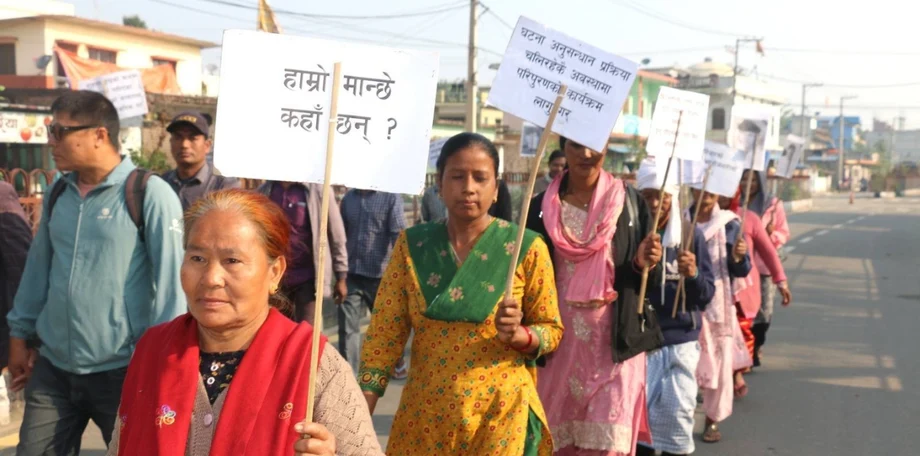
Thousands of complaints, no commissioners to act
Nepal's Truth and Reconciliation Commission has received 78,909 complaints about abuses committed during the country's armed conflict, yet vacancies at the two bodies responsible for transitional justice have left their work stalled. A parliamentary review identifies political division, limited institutional independence and poorly motivated staff as central obstacles to delivering justice nearly two decades after the November 21, 2006 peace agreement.
Contents
- Thousands of complaints, no commissioners to act
- What the parliamentary review found
- How the peace promise became a prolonged wait
- The complaint total has grown by almost a quarter
- Families of disappeared people face a separate backlog
- Why the legal disputes have mattered
- Victims want appointments they can trust
- A new government's promise faces scrutiny
- Reparation needs money and a route to appeal
- Key Points
The latest paralysis followed the government's May 5, 2026 ordinance removing public office holders, including officials at the Truth and Reconciliation Commission and the Commission of Investigation on Enforced Disappeared Persons. Their positions remain unfilled. The officials had been appointed on May 14, 2025, less than a year before their removal.
A subcommittee led by Dr Anjan Shakya, under the National Assembly's Legislative Management Committee, examined the implementation of six laws. Formed on July 20, it submitted its findings to the parent committee on October 30. Its review of the Enforced Disappearances Enquiry, Truth and Reconciliation Commission Act, 2014 describes a process with extensive legal machinery but insufficient political and administrative support.
For families seeking the whereabouts of disappeared relatives, recognition of sexual violence or compensation for losses, the immediate consequence is another wait. Khamm Khati, a member of the parliamentary subcommittee, said filling the commissions must come first.
The commissions are without office-bearers. Work needs to begin there first," he said. "The commissions need to be formed, and the complaints they have received need to be examined and taken forward.
What the parliamentary review found
The subcommittee identified five issues affecting implementation: treating transitional justice mainly as conventional criminal justice; inadequate political initiative and agreement; the provision allowing victims to appeal over reparation recommendations; weak staff motivation; and limited financial and administrative autonomy at the commissions.
Transitional justice combines several tasks after a period of conflict or widespread abuse. In Nepal, those tasks include establishing what happened, investigating responsibility, providing justice and reparation, and creating conditions for reconciliation. Reparation means measures to address the harm victims suffered, including compensation and other support.
The review says the commissions need independence, resources and administrative authority to investigate sensitive cases effectively. It also identifies 17 regulations, directives and procedures introduced to support the Act. The gap it describes is between having rules and having institutions capable of carrying them out.
Khati said the law minister had committed to implementing the transitional justice provisions, but government action had not matched that promise. He described justice, truth, reparation and lasting reconciliation as the process's core purposes.
Along with making laws and procedures, the task now is to ensure political consensus, strengthen the institutional capacity of the commissions and guarantee justice for victims," he said. "But once again, the government does not appear to have given this issue priority.
How the peace promise became a prolonged wait
Nepal's armed conflict began on February 13, 1996 and formally ended when the government and the Communist Party of Nepal (Maoist) signed the Comprehensive Peace Accord on November 21, 2006. The parliamentary review recalls a commitment to establish a truth and reconciliation commission within six months.
The two commissions were eventually formed on February 10, 2015, more than eight years after the peace agreement. Political disputes and legal uncertainty delayed their establishment, while later appointments failed to produce the results victims sought.
- November 21, 2006: The government and Maoist rebels signed the Comprehensive Peace Accord.
- 2014: The transitional justice Act created the legal basis for the two commissions.
- February 10, 2015: Both commissions were formed.
- 2024: Amendments to the Act opened the way for additional complaints.
- May 14, 2025: A third set of commission officials was appointed.
- May 5, 2026: An ordinance removed those officials, leaving vacancies that remain unfilled.
Arms management and the integration of Maoist combatants into the Nepali Army advanced through the peace process. Other needs, including those of some discharged combatants and people seriously injured during the conflict, also remain unresolved. Justice for civilian victims is among the largest unfinished commitments.
The complaint total has grown by almost a quarter
The Truth and Reconciliation Commission initially registered 63,718 complaints. Its current total of 78,909 represents an increase of 15,191, or about 24 percent. The expanded filing period following the 2024 amendments allowed people who had previously missed the opportunity to register to come forward.
Women who experienced rape and other sexual violence were a particular focus of that extension. During earlier parliamentary debate on amendments, only 314 of the original 63,718 complaints concerned rape and sexual violence, about 0.5 percent. Advocates for survivors had said the number of people affected was much larger.
The commission's annual report for 2024/25 recorded detailed investigations into 173 complaints. Compared with the original intake of 63,718, that was about 0.27 percent, fewer than three detailed investigations for every 1,000 complaints registered.
The same annual report recorded identity cards for 618 people, compensation recommendations for 538 and 2,268 archived complaints. Those figures show different kinds of administrative activity, while the number of detailed investigations illustrates how slowly examination of alleged abuses had progressed.
Families of disappeared people face a separate backlog
The Commission of Investigation on Enforced Disappeared Persons registered 3,288 complaints. Its reported work included investigations into 746 complaints and the transfer of 277 to the Truth and Reconciliation Commission. It also recorded 137 duplicates, 332 archived complaints and 2,542 retained for detailed investigation.
Enforced disappearance involves a person being taken into custody or otherwise deprived of liberty, followed by concealment of their fate or whereabouts. For families, finding out whether a relative is alive, where they were taken and who was responsible is a central part of justice.
The parliamentary review says stronger commissions could help establish the whereabouts of disappeared people and determine the truth about serious violations. Its recommendations therefore connect institutional reform to concrete answers that families have sought for years.
Both commissions depend on appointments to resume their work. No date has been given for filling the vacant positions.
Why the legal disputes have mattered
The 2014 Act attempted to address weaknesses in an earlier ordinance issued in 2013. An academic analysis of the Act, available through the University of Reading's research repository, describes provisions for two commissions, a Special Court to try past abuses and arrangements allowing vulnerable witnesses to participate in truth seeking.
The paper also identifies concerns in the original law, including possible amnesty for international crimes and serious human rights violations, unclear connections between truth seeking, amnesty and prosecution, and inadequate safeguards for individual rights. Amnesty is a legal measure that can protect a person from prosecution or punishment.
In 2015, Nepal's Supreme Court struck down around a dozen amnesty provisions and directed the government to revise the Act in line with international standards. Subsequent parliamentary negotiations revealed how difficult agreement on accountability remained.
An earlier House of Representatives subcommittee, formed on May 19 with a deadline of 21 days, spent five months discussing an amendment bill with 27 registered amendments. Four disputes remained: which killings should count as serious violations, what should happen when victims refused reconciliation, how to address people harmed without directly participating in the conflict, and how far sentences could be reduced for cooperating perpetrators.
Those discussions preceded the 2024 amendments. They help explain why passing legislation took years: lawmakers were deciding who could face prosecution, whose injuries the process would address and how much control victims would have over reconciliation.
Victims want appointments they can trust
Suman Adhikari, founding chairperson of the Conflict Victims Common Platform, has called for independent commissioners with experience in transitional justice who can command victims' trust. He has accused major political parties of using the commissions to provide positions for party supporters and conduct political bargaining.
Adhikari's father, teacher Muktinath Adhikari, was taken from his school and killed in Duradanda, Lamjung, on January 16, 2002. His advocacy connects a personal demand for accountability with the wider campaign for justice for conflict victims.
Suman Adhikari called for a recommendation committee to begin selecting new officials.
"We want a swift solution. Officials should be appointed to the commission by forming a recommendation committee," he says.
The parliamentary review and victims' demands converge on the need for capable institutions. Filling positions, giving investigators sufficient resources and protecting the commissions' independence are linked tasks. The review also identifies staff motivation as a problem affecting the sensitive work of investigation and truth finding.
A new government's promise faces scrutiny
The Rastriya Swatantra Party formed a government on March 27, 2026 after winning a near two thirds majority. Its election commitments promised immediate work to conclude the remaining transitional justice tasks, creating fresh expectations among victims who had spent years seeking action from earlier governments.
Forty victim organisations sent Prime Minister Balendra Shah an open letter on April 23 seeking truth, justice and reparation. They criticised the absence of their concerns from the government's reform agenda of 100 points and its national commitment.
The removal of commissioners in May was welcomed by some victims who had challenged the appointments as political power sharing. Their demand now is for a replacement process that produces trusted officials and functioning commissions.
The National Human Rights Commission's priorities issued on May 8 called for consultation with victims, their participation in the process, and documentation and registration of all victims. It also supported approaches outside court proceedings alongside unconditional action against perpetrators of serious violations.
Those priorities place victim support and criminal accountability within the same programme. People may need recognition, assistance and answers about missing relatives while investigations into serious crimes proceed.
Reparation needs money and a route to appeal
The parliamentary subcommittee says a separate transitional justice trust or fund has been established with contributions from Nepal's government, the international community and other sources. It calls for consistent political commitment to mobilise that fund for victims' justice and reparation.
The review also urges coordination with donor countries and support from local, provincial and federal governments. Its recommendations include technical and administrative assistance, protection for victims and employment opportunities. For people whose livelihoods were damaged by the conflict, such measures would connect the justice process with daily needs.
Victims can appeal if dissatisfied with commission recommendations on reparation, according to the study. Earlier amendment discussions also proposed appeals over reparation to a Special Court, with Supreme Court review of that court's rulings. Keeping remedies accessible matters when victims believe a recommendation fails to address the harm they experienced.
Nepal's immediate tasks are concrete: appoint commissioners, give the institutions financial and administrative authority, support their staff and begin examining complaints. The parliamentary review places responsibility for those steps with political leaders and the government, while victims continue to wait for decisions that turn legal promises into action.
Key Points
- The Truth and Reconciliation Commission has received 78,909 complaints, about 24 percent more than its original intake.
- Both transitional justice commissions remain without office holders after removals under a May 5, 2026 ordinance.
- A parliamentary review identifies political disagreement, limited autonomy and weak staff motivation as major obstacles.
- The Truth and Reconciliation Commission's 2024/25 report recorded 173 detailed investigations.
- Victim organisations want independent appointments, participation, truth, accountability and reparation.
- No date has been given for filling the vacant commission positions.