A business network reaches Nepal's highest offices
A transfer of Rs545 million from a steel company to a businessman's personal bank account sits at the centre of an investigation reaching into Nepal's politics, financial markets and courts. Prosecutors allege that Deepak Bhatta moved the money through his company and into insurance shares, then repaid the steel company largely with funds originating from businesses and people connected to the same corporate group.
Contents
- A business network reaches Nepal's highest offices
- Family connections and an early procurement case
- Connections across rival political parties
- The weapons purchases that police resisted
- Business approvals became another pressure point
- Following Rs545 million through several accounts
- Share trading adds billions to the allegations
- From arrest to an expanding court controversy
- What the Sapkota messages reveal
- Political leaders disagree over the response
- Key Points
Bhatta, arrested on April 2, 2026, faces several criminal cases, with the largest financial claim against him approaching Rs27 billion. He and other defendants deny wrongdoing. By October, investigators were also examining whether intermediaries had sought to influence judicial proceedings involving him.
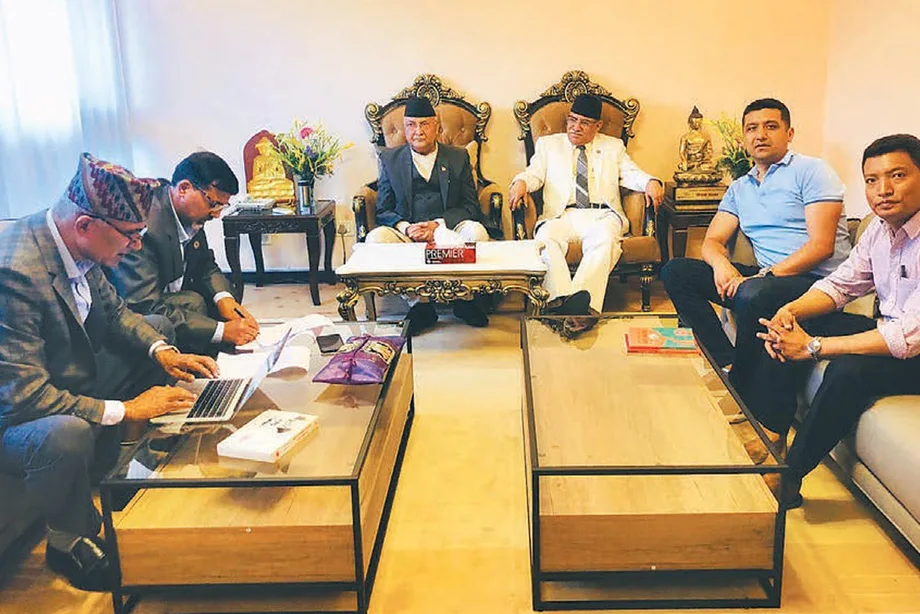
His access to political leaders had become familiar long before his arrest. Former home secretary Ek Narayan Aryal recalled an April 2024 meeting with then Prime Minister Pushpa Kamal Dahal about administrative matters and procurement, including weapons. After the meeting ran past 11 p.m., Aryal was directed through another door into a room where Bhatta was waiting.
Aryal also recalled ministers and senior officials waiting outside while Bhatta met the prime minister. Several former ministers described similar experiences. Bhatta held no elected office or formal government position explaining that access.
Over roughly two decades, he developed relationships with leaders of the Nepali Congress, CPN-UML and Maoist Centre, alongside officials responsible for security purchases, business approvals and financial regulation. His business interests expanded across those same areas.
The criminal proceedings now bring together two parts of that history: specific allegations about the movement of money, and accounts of an informal network that could reach people authorised to approve contracts, appoint officials or decide cases. The financial allegations remain before the courts, while the investigation into alleged judicial intermediaries has widened the controversy.
Family connections and an early procurement case
Bhatta was born in 1981 in Dadeldhura, into a family with political and administrative connections. His uncle, Ganesh Prasad Bhatta, served in the Rastriya Panchayat and became an assistant forest minister in 1986. His father, Chaturbhuj Bhatta, rose through the civil service and became general manager of Krishi Samagri Sansthan in 2001-02.
During his father's tenure, official records identified Deepak Bhatta as an agent for an Israeli company bidding for a government fertiliser contract. In 2005, the Commission for the Investigation of Abuse of Authority brought a corruption case alleging irregularities exceeding Rs120 million. It alleged that the company was fictitious and that Chaturbhuj had misused his position to secure its tender.
The Special Court acquitted both father and son. Deepak Bhatta was 24 at the time. A former deputy inspector general described his early business work as arranging weapons and equipment for government agencies.
By around 2007, Bhatta was executive chairman of Gorkha Travels, which brought China Southern Airlines to Nepal. A launch trip taking Nepali journalists to China helped broaden his contacts. In 2008, he registered Infinity Holdings in Sanepa, Lalitpur, building interests spanning hydropower, arms, helicopters, tourism, hotels, property, consultancy and insurance.
Connections across rival political parties
Sher Bahadur Deuba's family had a traditional kinship relationship with Bhatta's family, giving the businessman an entry into an influential political circle. Bhatta addressed Deuba as dai, an expression meaning elder brother. His relationships later extended well beyond the Nepali Congress.
UML figures Ganesh Singh Thagunna and Hari Parajuli reportedly helped introduce him to Bamdev Gautam through Gautam's son. Gautam provided a route to KP Sharma Oli. A former minister recalled Bhatta accompanying Gautam through Singha Durbar around 2009 for discussions involving security equipment, weapons and public land.
Bhatta cultivated Deuba, Oli and Dahal rather than attaching himself exclusively to one party. Frequent government changes made access across rival camps commercially useful: a business proposal could survive even when its political sponsors lost office.
During the struggle between Oli and Dahal after the Nepal Communist Party formed in 2018, a party leader described discussions involving Bhatta, Bishnu Poudel and Janardan Sharma about bringing the leaders together. Poudel communicated with Oli, while Sharma communicated with Dahal. Bhatta was also said to claim a role in the UML-Maoist unification.
Former officials described his interest in appointments, transfers and promotions at agencies connected to his businesses. Former secretary Yadav Koirala recalled him working through more powerful people and drawing influence from political protection. A former Maoist leader said Bhatta also took part in efforts to form or bring down governments after the 2022 election produced a parliament without a majority party.
The weapons purchases that police resisted
In 2013, Nepal Police was preparing a modernisation programme when, according to officials, the Home Ministry pressed for a large weapons and ammunition allocation outside the force's own priorities. The Finance Ministry approved Rs1.45 billion. Firms associated with Bhatta or his employees were among the shortlisted suppliers.
Senior police officers challenged the priorities and approached the anti-corruption commission. People familiar with a subsequent meeting said then commission chief Lok Man Singh Karki stated that Bhatta had repeatedly pressed for the purchases and discussed funding with Finance Minister Shankar Koirala.
When the process resumed the following year, Deputy Inspector General Rajendra Singh Bhandari said Bhatta approached him claiming he could manage parliamentary committees, government parties, the opposition and concerns from India and China. Bhandari alleged that Bhatta suggested favours for those helping the deal, including a party ticket or school admission for a child.
Bhandari refused, and the procurement was cancelled. Former Inspector General Upendra Kant Aryal said officers considered some proposed weapons substantially overpriced and feared another procurement scandal. Bhandari said he was subsequently transferred and assigned to a National Security Council Secretariat position that did not match his rank.
Bhatta later appeared as a local agent in purchases involving Russian helicopters, Israeli Galil rifles and a police communications project. The communications contract with Hong Kong company Eris Technology, represented locally by his company, was cancelled after work missed its deadline.
Business approvals became another pressure point
Insurance and securities regulation offered another route through which official decisions could affect Bhatta's businesses. People familiar with his activities and those of Shanker Group's Sulav Agrawal alleged that the pair gained influence over the Nepal Insurance Authority and the Securities Board of Nepal, including leadership appointments.
A senior Securities Board official said files connected to the group generally received priority. A hydropower entrepreneur alleged that his application for an initial public offering stalled until he was taken to Agrawal, who negotiated a payment. The entrepreneur said he could not meet the demand and his application remained stalled. An initial public offering is a company's first sale of shares to the public.
The proposed establishment of a privately funded stock exchange also generated political pressure. People familiar with the process said Oli pushed for approval, while Finance Minister Bishnu Poudel struggled to resolve the dispute. Chief Secretary Ek Narayan Aryal eventually wrote that the Securities Board's board could decide the matter.
Former finance minister Barshman Pun later described the exchange proposal as one factor behind the government's collapse. The proposal stalled after some board members walked out of a meeting and remained unresolved after the Gen Z protest movement.
Following Rs545 million through several accounts
Charge sheets filed in June 2026 describe a September 2022 transfer of Rs545 million from Jagdamba Steels, a Shanker Group subsidiary, to Bhatta's personal account at Siddhartha Bank. Bhatta said it was an advance for a plot measuring 54 aana in Sanepa.
The money subsequently went to Infinity Holdings, which Bhatta wholly owns, and into Himalayan Insurance as share capital. Investigators questioned the land transaction, citing the absence of a registered agreement and the lack of an ownership transfer. Prosecutors also said a proposed development in Lubhu, called Mega City, never materialised.
Bhatta later returned Rs752.6 million to Jagdamba Steels, saying the company had abandoned the purchase because of financial difficulties and that he refunded the advance with interest. The repayment exceeded the original transfer by Rs207.6 million, or about 38 percent.
A bank inspection report cited in the investigation traced Rs679 million of the repayment to entities linked to Shanker Group and the Agrawal family. That represents roughly 90 percent of the Rs752.6 million repaid. Contributors included Sahil, Sulav and Shanker Lal Agrawal, while Bhatta's wife and Infinity Holdings also supplied funds.
Investigators describe possible round-tripping: money leaves a company, passes through other accounts and eventually returns to the company. Prosecutors allege that this sequence concealed the movement of funds behind the appearance of settling a cancelled property deal. Bhatta maintains that the transfers concerned a genuine advance and refund.
Share trading adds billions to the allegations
The charge sheets also allege that Bhatta bought Rs3.8 billion in shares through Bhrikuti Stock Broking between July 2025 and March 2026 without depositing the required advance margin of at least 25 percent. A margin is the portion a buyer must pay upfront. On Rs3.8 billion in purchases, 25 percent would amount to Rs950 million.
He sold Rs930.5 million in shares during the same period, according to investigators, who alleged that about Rs2.89 billion remained outstanding for purchases made on credit. Prosecutors say the trading helped create artificial demand for Nepal Reinsurance Company shares.
The share price rose from Rs1,461 on July 21, 2025, to Rs1,686 on August 26, an increase of approximately 15.4 percent. Prosecutors allege coordinated manipulation. Their account connects transactions involving several businesses, including Himalayan Reinsurance, Himalayan Capital and Nepal Micro Insurance Company, in which Bhatta holds a 15 percent stake.
Shekhar Golchha, then chairman of Himalayan Reinsurance, acknowledged transferring Rs525 million to Bhrikuti Stock Broking on several occasions. He said he had no personal relationship with its chairman and no trading account there. He declined to discuss his relationship with Bhatta, saying they had met only twice.
From arrest to an expanding court controversy
Nepal Police's Central Investigation Bureau arrested Bhatta on April 2, 2026. Police said he had gone into hiding and was located near Gairidhara after surveillance of his residence and other locations. A family member said Bhatta had called police and offered to appear after hearing rumours of his impending arrest.
The Department of Money Laundering Investigation filed four separate criminal cases involving allegations of money laundering, banking offences, securities fraud and insurance violations. In October, prosecutors filed a sixth insurance case, alleging that Rs423 million reached his account through two transfers and seeking recovery of about Rs450.7 million.
Bhatta has described the proceedings as revenge and said he expected release by the court. During a visit while detained, he greeted visitors with a question:
So, what's the news?
His father filed a habeas corpus petition in September. Such a petition asks a court to examine whether a person's detention is lawful. Bhatta was later transferred from Nakkhu Prison to Sindhupalchok because, investigating officials said, they feared he was trying to exert influence from prison.
The main developments span several years:
- September 2022: Jagdamba Steels transferred Rs545 million to Bhatta's personal account.
- July 2025 to March 2026: Investigators allege purchases of Rs3.8 billion in shares through Bhrikuti Stock Broking.
- April 2, 2026: The Central Investigation Bureau arrested Bhatta.
- June 2026: Charge sheets detailed alleged financial transactions and securities offences.
- September and October 2026: Investigations into alleged intermediaries widened the controversy to the judiciary, police and political leadership.
What the Sapkota messages reveal
Inam Sapkota, 30, came under scrutiny after investigators found repeated contacts with former chief justice Cholendra Shumsher Rana. Authorities took Rana to a police facility around midnight on September 26, initially describing an arrest before saying the move was for his security. Police detained Sapkota at Tribhuvan International Airport on September 27 as he prepared to travel to India.
Investigators examining Sapkota's devices reportedly found communications with judges, politicians, police officers and lawyers. Justice Hari Prasad Phuyal acknowledged exchanging messages and meeting him at Hotel Himalaya. Phuyal said Sapkota invoked Prime Minister Balendra Shah's name, initially offering reassurance amid rumours of impeachment proceedings against justices, then raising pending cases, including those involving Bhatta.
One exchange concerned businessman Rohit Gupta's habeas corpus petition. Sapkota reportedly asked Phuyal to dismiss it, invoking the prime minister's interest. Phuyal replied that grounds existed for release and that the court had ordered Rs20 million in bail. Phuyal says the ruling rested on the case's merits and denies financial dealings or an improper arrangement.
Phuyal said he and other justices became suspicious and alerted the prime minister's secretariat, police chief and army chief. On October 9, he and Justice Sunil Pokharel rejected a habeas corpus petition filed by Sapkota's wife challenging his detention.
Documents reportedly recovered from Sapkota's phone refer to deposits totalling 198,333 over three months, with no currency specified, and a request for another $7,500. Screenshots also refer to collections in the names of Chief Justice Manoj Kumar Sharma and RSP lawmaker Bishwaraj Pokharel, and accounts held by Sapkota's relatives in Nepal and the United States. Their authenticity and the purposes of the alleged payments remain unverified.
Sharma and Pokharel deny knowing Sapkota or having financial dealings with him. Senior police officer Banshiraj Dahal was dismissed following an investigation into his communications with Sapkota and a late visit to Rana after police took the former chief justice into custody. The Nepal Bar Association called for an impartial investigation based on evidence.
Political leaders disagree over the response
Prime Minister Shah and Rastriya Swatantra Party chair Rabi Lamichhane reportedly disagree over how quickly to act against officials connected to the controversy. Shah is said to favour investigating everyone linked to Bhatta, while Lamichhane has argued that action requires sufficient evidence and legal grounds.
Inspector General of Police Dan Bahadur Karki faces scrutiny over alleged irregularities in election police uniform purchases, which a parliamentary subcommittee is investigating. Lamichhane reportedly opposed an immediate change in police leadership, and Home Minister Sudan Gurung was also said to oppose interference.
Police Headquarters denied reports that the government was pressuring Karki to resign. His secretariat warned that such claims could disrupt police operations and public security. Meanwhile, police expanded their investigation of Sapkota from an initial indecent behaviour allegation to possible offences under the Nepal Rastra Bank Act and money laundering laws.
The Supreme Court called a full court meeting for the Friday following publication of the latest allegations. No date for a final ruling in Bhatta's criminal cases was given. For businesses awaiting approvals, officers facing procurement scrutiny and defendants seeking court decisions, the immediate issue is who exercised authority, how money moved and whether the evidence supports criminal charges.
Key Points
- Deepak Bhatta built business interests and political access across Nepal's major parties without holding elected office.
- Prosecutors allege money laundering and other financial offences; the largest claim against him approaches Rs27 billion.
- Investigators are examining a Rs545 million corporate transfer and Rs3.8 billion in share purchases.
- Bhatta and other defendants deny wrongdoing, and the criminal cases remain before the courts.
- The Sapkota investigation has expanded scrutiny to alleged attempts to influence judges and senior officials.
- Named judicial and political figures have issued denials, while the Nepal Bar Association has sought an impartial investigation based on evidence.
- Police deny government pressure for their chief's resignation, and a parliamentary inquiry into uniform procurement continues.