A clean power test for Singapore's computing boom
Singapore is giving its data centre regulator powers to enforce clean energy commitments, with penalties reaching S$1 million or 10% of an operator's annual Singapore turnover, whichever is higher. The change puts a financial consequence behind promises to power new computing facilities with cleaner energy in a country that gets roughly 95% of its electricity from natural gas.
Contents
- A clean power test for Singapore's computing boom
- What the new law changes
- From a development pause to selective expansion
- How much expansion is planned?
- What an efficiency score of 1.25 means
- Cleaner energy must reach the facilities
- Imports and biomethane carry much of the burden
- Cooling changes can reduce the electricity bill
- Malaysia offers another route for investment
- Key Points
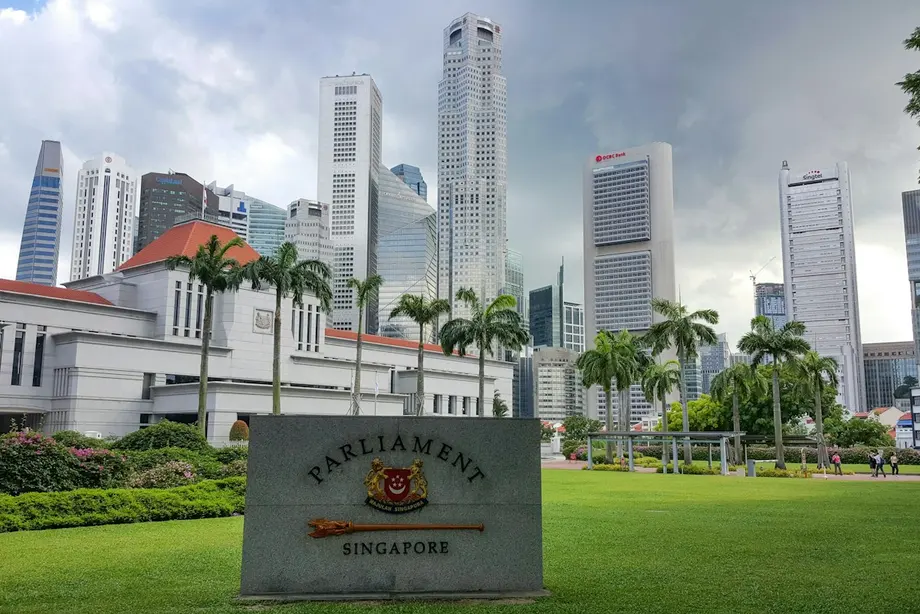
Parliament passed the Digital Infrastructure Bill on 7 October. It establishes licensing for data centres with a critical information technology load of at least 3 megawatts, covering the electricity needed by servers and other computing equipment. Efficiency requirements will extend across qualifying facilities, while clean energy obligations will apply to operators whose capacity approvals carry those commitments.
Four operators allocated 200 MW on Jurong Island, Digital Realty, Equinix, Keppel Data Centres and ST Telemedia Global Data Centres, have committed to sourcing at least half their energy through eligible green pathways. At full operation, the facilities could require about 1.1 terawatt hours of clean energy annually.
The pressure behind the policy is measurable. Singapore's data centres consumed about 6.5 TWh of electricity in 2024, slightly more than a tenth of national consumption. Their share was about 7% in 2020. A terawatt hour measures energy consumed over time; megawatts describe capacity or the rate at which electricity is used.
Singapore wants the computing investment, jobs and services that these facilities bring. Its government also wants their growth to help create a market for cleaner power rather than deepen dependence on gas. Developers must now work out how to secure that energy while competing with nearby locations offering more space and fewer restrictions.
What the new law changes
The Infocomm Media Development Authority, known as IMDA, will license qualifying facilities and set efficiency requirements. The framework covers cloud facilities, centres renting space to customers and facilities operated by businesses for their own computing needs. Centres of 10 MW or more will also require a separate licence addressing security and resilience.
IMDA can write commitments made during capacity applications into licence conditions. An operator that obtained permission partly by promising cleaner energy can therefore face a penalty for breaking that promise. The 50% requirement attaches to particular approvals, while the broader licensing framework brings existing facilities under efficiency regulation.
The law leaves numerical efficiency thresholds and implementation deadlines to subsequent regulations. Existing operators will have six months to apply for a licence once it takes effect. IMDA is drafting the detailed rules, with consultation expected within the following year, although no exact consultation date has been given.
Tan Kiat How, senior minister of state at the Ministry of Digital Development and Information, described a selective approach during the parliamentary debate:
We are not seeking to attract every megawatt of [data centre] capacity we can,
For operators, that means access to Singapore's market increasingly depends on how efficiently they use resources and how credibly they can secure cleaner energy.
From a development pause to selective expansion
Singapore began restricting growth before introducing the new licensing powers. A pause in new developments in 2019 gave the government time to reconsider how much land, electricity and water the sector could consume. Applications resumed in phases from 2022, with capacity awarded through competitive selection.
- 2019: Singapore paused new data centre developments and the release of land for them.
- 2022: A pilot application round reopened access to capacity, initially targeting about 60 MW.
- 2023: Four successful groups received about 80 MW between them.
- 30 May 2024: Singapore launched its Green Data Centre Roadmap.
- 1 December 2025: The second application round opened, offering at least 200 MW, with applications due by 31 March 2026.
- August 2026: A reported allocation assigned 200 MW on Jurong Island to four operators.
- 7 October: Parliament passed the Digital Infrastructure Bill, enabling enforcement of licence conditions.
The first pilot drew more than 20 proposals. Its successful applicants included Equinix, GDS, Microsoft and a consortium involving AirTrunk and ByteDance. The government has allocated about 280 MW through the two rounds, alongside capacity approved individually for strategic investors.
How much expansion is planned?
The Economic Development Board's Green Data Centre Roadmap account describes at least 300 MW of additional capacity, with another 200 MW reserved for operators using green energy options. At the roadmap's launch in May 2024, Singapore had 1.4 gigawatts across more than 70 data centres.
Against that baseline, 500 MW would represent an increase of about 36%, explaining the ambition to expand capacity by more than one third. A later sector estimate puts existing capacity at about 1.6 GW. These figures describe the market at different stages of its expansion.
Jurong Island is central to the next phase. Plans call for a park covering 20 hectares with potential capacity of 700 MW. The island already houses energy and petrochemical infrastructure, making it a practical location for facilities that need large electricity supplies and access to emerging fuel systems.
The 700 MW park is a longer term development plan, while the 200 MW allocation concerns specific operators. Readers and investors need to keep those scales separate when judging how much capacity has actually been approved and how much could eventually be developed.
What an efficiency score of 1.25 means
The second application round requires power usage effectiveness, or PUE, of 1.25 or better at full computing load. PUE divides all the electricity used by a facility by the electricity used by its computing equipment. A lower score means less additional power goes into cooling, power conversion and other supporting systems.
At a PUE of 1.25, equipment using 100 units of electricity would require a facility total of 125 units. At 1.3, the total would be 130 units. For the same computing workload, moving from 1.3 to 1.25 reduces total electricity demand by about 3.8%.
Applicants must also achieve BCA-IMDA Green Mark Platinum certification and use equipment exceeding requirements in Singapore's standard for data centre IT equipment, SS 715:2025. The roadmap's wider ambition is to bring facilities to PUE of 1.3 or better, with binding sector requirements to be set through regulation.
Water use will also fall within IMDA's regulatory powers. Facilities consuming more than 60,000 cubic metres annually already face mandatory efficiency practices under national water agency PUB. The new framework allows additional requirements tailored to data centres.
Cleaner energy must reach the facilities
The approved energy pathways include biomethane, low carbon ammonia, low carbon hydrogen, fuel cells combined with carbon capture, and solar installations integrated into buildings or using advanced designs. These options involve different fuels and technologies, with different infrastructure needs.
Biomethane is methane produced from biological material, such as organic waste, and processed for use as fuel. Hydrogen and ammonia can also serve as energy carriers, but the emissions associated with producing and transporting them matter. Carbon capture collects carbon dioxide for subsequent handling and storage rather than allowing it to enter the atmosphere.
The application rules exclude unbundled renewable energy certificates, which can be purchased separately from the electricity a facility receives. Operators instead need an eligible energy supply arrangement. This makes procurement a substantial part of developing a project, alongside acquiring land, servers and cooling equipment.
The estimated 1.1 TWh of annual clean energy demand from the four new facilities would equal roughly 17% of the electricity consumed by Singapore's entire data centre sector in 2024. The comparison shows how a relatively small group of approvals could create a sizeable new market for cleaner energy.
Tan described the government's objective during consideration of the law:
We are using data centers as pathfinders and early demand drivers to green the energy system,
Imports and biomethane carry much of the burden
Singapore's limited land makes large domestic renewable energy projects difficult. Imported electricity and imported fuels therefore have a major role in meeting new demand. The country aims to import about 6 GW of electricity with low carbon emissions by 2035, around a third of its expected electricity needs then, compared with about 200 MW currently.
Singapore has signed cross border clean electricity trade agreements with Indonesia and conditionally approved imports from Malaysia. It has also announced a programme to import 300 MW of biomethane supply for data centres and other industrial users. Biomethane is already an eligible pathway under the 50% requirement.
Lim Wey-Len, executive vice president of the Singapore Economic Development Board, explained the purpose of testing the fuel under a regulatory sandbox, a controlled programme for trying new arrangements:
This biomethane regulatory sandbox is an important pilot to help Singapore discover new decarbonization pathways for our manufacturing and data center sectors,
A consortium led by Keppel has also studied a power plant of 55 to 65 MW on Jurong Island using imported low carbon ammonia. As of October 2025, it had yet to commit to construction. The amount of qualifying energy developers will secure, its price and the delivery schedule remain unresolved.
Cooling changes can reduce the electricity bill
Singapore's roadmap also targets the energy used before any fuel is replaced. It encourages operators to raise operating temperatures safely to 26 degrees Celsius, upgrade equipment and consider cooling methods suited to powerful computing racks.
Digital Realty plans to increase the temperature of one data hall gradually to 26 degrees Celsius. Jon Curry, its vice president of operations in Asia Pacific, has said customers would benefit from lower electricity bills. Less intensive cooling can reduce operating costs while leaving servers within their permitted temperature range.
ST Telemedia Global Data Centres is among the early adopters of immersion cooling at scale in Singapore. This places servers in a liquid that carries heat away without conducting electricity. The roadmap describes immersion cooling as the most energy efficient cooling approach because it removes the need for air cooling, although conversion can require dedicated facilities and substantial equipment changes.
Government support is part of the transition. At the roadmap launch, then senior minister of state Janil Puthucheary said grants and capacity approvals would support operators meeting the standards. Relevant schemes could cover around 30% or more of operating costs in some cases.
Efficiency work extends inside the computing equipment. GlobalFoundries' acquisition of AMF expanded Singapore's role in silicon photonics, which uses light to move information. Such connections can reduce electricity use and heat as AI systems exchange increasing volumes of data.
Malaysia offers another route for investment
Malaysia has about 3.9 GW of data centre capacity under development, giving investors a nearby alternative as Singapore tightens access. Singaporean companies Aolani and Bitdeer have announced plans for Malaysian facilities, while Malaysia's prime minister has said SoftBank is planning $50 billion in data centres and other projects.
Lam Pham, an energy analyst at Ember, linked the movement of investment to Singapore's policy choices:
The government is tightening standards and regulations on data center investment, and as a result, a lot of investment is going to Malaysia, which also has quite good digital infrastructure,
Malaysia's national data centre efficiency guidelines are voluntary. Johor, however, requires projects to meet a water usage effectiveness threshold of 1.8 and demonstrate that water supply is available before approval. The neighbouring market has its own resource conditions even as it offers more room for development.
Singapore can retain a role in managing regional technology businesses while some computing facilities are built elsewhere. OpenAI's Singapore hub expansion accompanied a broader search across Asia Pacific for data centre locations. A business headquarters and the physical facilities serving its customers can occupy different countries.
Regional electricity supply remains a constraint. Mark Hutchinson, chief strategy officer at the Future Energy Storage & System Integration Alliance, said renewable construction was struggling to keep pace:
No country in Asia, except maybe Australia and China, is building enough renewables to even meet current demand growth, much less the accelerated growth that will be imposed by data centers,
Singapore's approach makes new computing capacity a buyer for cleaner energy. Its practical test will be whether fuel suppliers, electricity import projects and efficient facility designs can arrive together at a cost operators can sustain.
Key Points
- The Digital Infrastructure Bill establishes licensing for data centres with at least 3 MW of critical IT load.
- Breaching enforceable commitments can bring penalties of up to S$1 million or 10% of annual Singapore turnover, whichever is higher.
- Four operators allocated 200 MW on Jurong Island committed to at least 50% eligible green energy and PUE of 1.25 or better.
- Data centres consumed about 6.5 TWh in 2024, slightly more than a tenth of Singapore's electricity.
- Imported electricity, biomethane and other qualifying fuels are central to meeting new clean energy demand.
- IMDA will set detailed efficiency requirements and deadlines through regulations.
- Malaysia's expanding development pipeline offers investors an alternative as Singapore pursues selective growth.