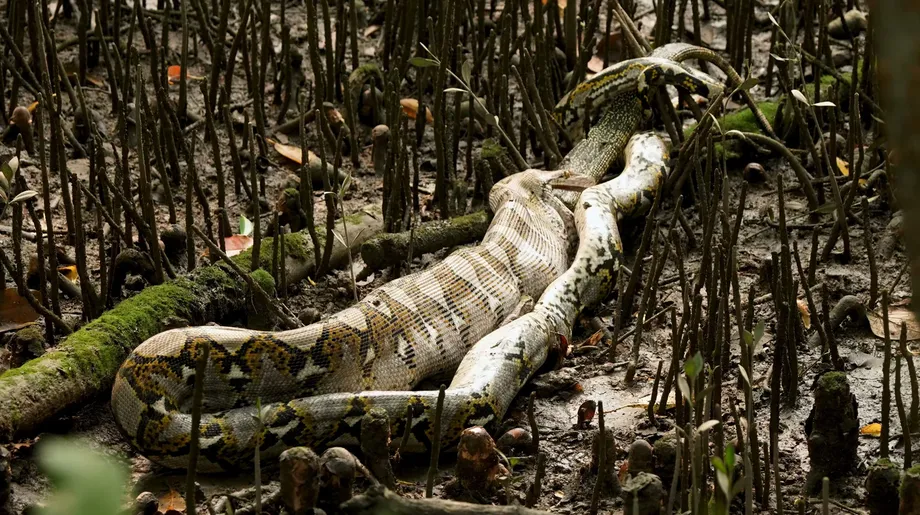
A large meal beside the water
A reticulated python estimated to be three to four metres long took more than an hour to swallow a large monitor lizard at Singapore's Sungei Buloh Wetland Reserve, in an encounter photographed by wildlife enthusiast Kelvin Leong on 17 October.
Contents
A birdwatching friend alerted Leong at about 9.30am. By the time he arrived, the python had tightly wrapped its body around the lizard and was already swallowing its head. Leong stayed to watch as the snake gradually took in the rest of its prey, finishing with the long tail before moving into the water.
The prey was identified as a Malayan water monitor, a native reptile that Singapore's National Parks Board (NParks) lists as common. Its Malayan water monitor record gives the species' size as up to three metres and names Sungei Buloh among the reserves where it occurs. The length of the lizard in this encounter was not recorded.
Leong, who was 51 at the time of the report and is the photographer behind Wilderness.sg, shared photographs and video of the encounter on Facebook. The video attracted more than 390,000 views, bringing a prolonged feeding event in the reserve to a much wider audience.
For Leong and his friend Ryan, who often visit Sungei Buloh, the sighting was a first. Their familiarity with the reserve made the encounter especially memorable: a place they regularly explored had presented a scene neither had witnessed there before.
From a morning alert to the final swallow
The python was already well into its encounter with the lizard when Leong reached it. His account begins with the snake coiled around its prey, rather than with the initial capture. The lizard's head was entering the mouth while much of its body remained outside.
Leong watched the snake slowly draw the lizard farther in. As more of the prey disappeared, the python's body became visibly swollen. The process ended with the tail passing into its mouth, after which the snake moved into the water.
The sequence unfolded over several stages:
- At about 9.30am on 17 October, a birdwatching friend alerted Leong to the encounter at Sungei Buloh Wetland Reserve.
- When Leong arrived, the python was tightly coiled around the monitor and had begun swallowing its head.
- Over the following hour or more, the snake gradually swallowed the lizard's body and tail.
- After finishing, the visibly swollen python moved into the water.
- Leong later shared photographs and footage through the Wilderness SG Facebook page.
The duration helps explain why the footage was striking. Swallowing such a large animal was a slow, continuous process, with the snake's changing shape making its progress visible to the people watching.
How a python takes in prey wider than its mouth
Leong was particularly struck by the python's ability to swallow an animal that appeared larger than its mouth. A snake's mouth at rest gives little sense of how far it can stretch during feeding.
Pythons have flexible connections between parts of the skull and lower jaw, allowing the mouth to open widely and the two sides of the jaw to move with considerable independence. Stretchy tissues also help accommodate bulky prey. Small movements of the jaws gradually draw a meal inward, which helps explain the slow progress Leong observed.
The python swallowed the monitor head first. With the head already inside its mouth when Leong arrived, he could follow the gradual passage of the lizard's body until only its tail remained visible. The snake became greatly distended as the meal passed inside.
Leong believed the lizard had already been suffocated by the python's coils. Constriction, the method pythons use to subdue prey, involves tightening the body around an animal and can stop blood from circulating effectively. Leong's description of the tightly wrapped coils captures the visible part of that process.
Reticulated pythons can reach about seven metres, although those in Singapore tend to be smaller, with large mammal prey relatively scarce. Leong's estimate placed this snake at three to four metres, a substantial animal even within that smaller local size range.
Why a water monitor belongs in this setting
NParks describes the Malayan water monitor, Varanus salvator, as a reptile that tends to stay close to water. It spends much of its time on land, but can also climb trees and is a good swimmer and diver. Those habits make the waterways and mangroves of Sungei Buloh a fitting setting for the encounter.
The species is widespread across Singapore. NParks lists forests, mangroves, parks and gardens among its habitats, and records it at locations including Kranji Mangrove, Pulau Ubin and Pulau Tekong, as well as Sungei Buloh Wetland Reserve.
Water monitors are active during the day and feed on small animals and fish. In this encounter, an animal that normally hunts smaller creatures became prey itself. The scene showed two large native reptiles occupying the same habitat, with one able to overpower and swallow the other.
The monitor's appearance also changes with age. NParks describes juveniles as dark, with bands formed by rows of yellow spots along their backs and tails. Those patterns fade as the animals mature, and large adults are often plain greyish brown. Their thick, leathery skin and long tails contribute to the substantial appearance that made this meal so arresting to watch.
A familiar reserve produces an unfamiliar sight
Leong shared the encounter in three posts on the Wilderness SG Facebook page. The photographs and video documented different stages of the feeding, allowing viewers to follow an event that had required more than an hour of observation in person.
Leong, a wildlife photographer, described his reaction in a post. In an English translation of his remarks, he said:
To witness a scene like this in the wild was truly incredible!
Ryan, Leong's friend and a regular visitor to the reserve, also described the experience as memorable. Although the pair often spend time at Sungei Buloh, this was their first opportunity to watch a python swallow a monitor lizard.
The video's more than 390,000 views reflect how widely the encounter travelled after Leong posted it. At the centre of that attention was a specific sequence: a snake already coiled around a large reptile, a gradual swallow that continued to the tip of the tail, and a visibly enlarged python moving back into the water.
Key Points
- Kelvin Leong photographed a reticulated python swallowing a large monitor lizard at Sungei Buloh Wetland Reserve on 17 October.
- A friend alerted him at about 9.30am, when the python had already begun swallowing the lizard head first.
- Leong estimated the snake's length at three to four metres. The feeding took more than an hour.
- NParks lists the Malayan water monitor as native and common, and records it at Sungei Buloh.
- The python swallowed the tail last before moving into the water.
- Leong shared three Facebook posts about the encounter, and the video received more than 390,000 views.