Five routes face a 2030 deadline and tighter financial controls
Hanoi has approved a five year pilot framework for building metro lines 1, 2, 8, 10 and 14, setting an average contract price ceiling of $120 million per kilometre for underground sections and allowing contract prices to be reduced after a state audit. The five routes require about VND900 trillion in investment during 2026 to 2030, according to Hanoi People's Committee Chairman Vu Dai Thang.
Contents
- Five routes face a 2030 deadline and tighter financial controls
- What the $120 million ceiling covers
- How Hanoi chose its cost benchmark
- Where the five lines would run
- Where VND900 trillion would come from
- Who can build the lines, and how advances are protected
- How the programme reached the November vote
- Construction quality and disruption remain contractor duties
- Technology transfer must continue beyond train assembly
- Key Points
The Hanoi People's Council passed the resolution on November 4, 2026, after extending its meeting to allow further scrutiny of rules covering contractor selection, advance payments, construction quality and technology transfer. The pilot will run for five years from the resolution's effective date, which was not specified in the announcement.
City officials put the combined length of the five lines at about 253 kilometres and aim to complete them in 2030. Hanoi's June metro programme launch used a larger figure of 303.5 kilometres and preliminary investment of VND1,315.256 trillion. The latest announcement gives no explanation for the changed route length or how the earlier investment estimate relates to the VND900 trillion required during 2026 to 2030.
The resolution ties an accelerated construction model to detailed controls over public money. Contractors must demonstrate access to finance, keep advances in dedicated bank accounts, accept inspections throughout construction and prepare to hand over the technical knowledge needed to operate and repair the railway.
For passengers, the intended result is a connected network linking the airport, central railway station and growing urban areas. For the city, the immediate task is to turn the council's decision into contracts, funding arrangements and construction oversight capable of meeting the 2030 target.
What the $120 million ceiling covers
The $120 million limit applies to the average value of turnkey contracts for underground sections. A turnkey contract places a broad package of work under a main contractor, which must deliver a completed system meeting agreed requirements. Hanoi is using this model to reduce the number of separate responsibilities it must coordinate across the five routes.
The ceiling leaves several expenses outside its scope: facilities serving both civilian and defence purposes, value added tax, compensation, support and resettlement, relocation of existing infrastructure, and consulting and project management costs assigned to the project owner. Land acquisition and moving utilities can therefore add to the city's spending beyond the capped underground contract work.
Vu Dai Thang, chairman of the Hanoi People's Committee, described $120 million per kilometre as the maximum and gave a firm commitment on the contract price:
There will be no price increases or additional costs.
The resolution also makes the signed price subject to the State Audit Office's findings. If the audit determines a lower value, the contract must be reduced accordingly. If the audited value equals or exceeds the signed price, the original contract price stays unchanged.
The audit rule gives the city a mechanism to recover savings while keeping the agreed price fixed when the audit produces a higher valuation. Its practical force will depend on clearly defined contract scope, cost records and the work accepted for payment.
How Hanoi chose its cost benchmark
Hanoi People's Committee Vice Chairman Truong Viet Dung said the benchmark drew on years of research into urban railway systems in major cities, with reviews and updates reflecting experience in Vietnam and abroad.
The comparisons presented during the discussion included approximately $141.3 million per kilometre for underground construction on Hanoi Line 3, including value added tax. Other figures were $136.5 million per kilometre for Guangzhou Line 1, $208 million for Shanghai Line 14 and $131 million for Mumbai Line 3.
Ho Chi Minh City Metro Line 2 was cited at about $188 million per kilometre across the entire route. Its planned 11.3 kilometres include roughly 9.3 kilometres underground, with total investment of about $2.2 billion. Each comparison has its own cost coverage: Hanoi Line 3 includes tax, while the new ceiling excludes tax and several other expenses. Readers therefore need those boundaries alongside the headline figures to understand what Hanoi is budgeting.
Where the five lines would run
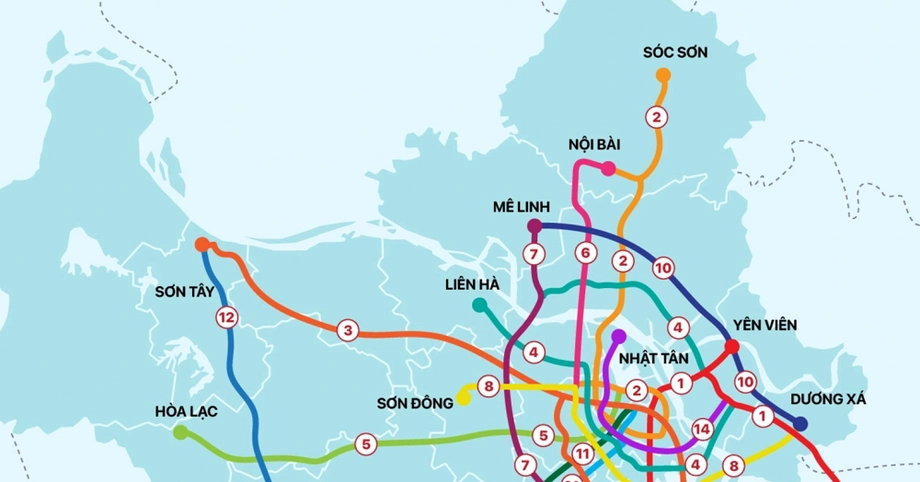
The pilot covers routes connecting Hanoi's central transport hubs with airport corridors, western development areas and districts across the Red River. The resolution describes their broad paths as follows:
- Line 1: Thuong Phuc, Ngoc Hoi, Hanoi railway station, Yen Vien and Noi Bai International Airport.
- Line 2: Noi Bai airport, Nam Thang Long, Tran Hung Dao, Thuong Dinh and Hung Vuong Stadium.
- Line 8: Hoa Lac, Son Dong, Mai Dich, Ring Road 3, Linh Nam and Thuan An.
- Line 10: Vo Chi Cong, Ring Road 2.5, Vinh Tuy and Dong Anh.
- Line 14: Thang Long Bridge, Hong Ha and Gia Lam.
The Hanoi People's Committee will approve the precise project names, alignments and locations of works through plans drawn at a scale of 1:500. On such a map, one centimetre represents five metres on the ground, allowing planners to locate infrastructure much more precisely than a general route description.
Noi Bai airport appears on both lines 1 and 2, while Line 1 also serves Hanoi railway station and Ngoc Hoi. Line 8 links the Hoa Lac area in the west with corridors farther east. The final approved alignments will determine exactly which neighbourhoods receive stations and where construction affects properties and existing infrastructure.
Where VND900 trillion would come from
Vu Dai Thang said Hanoi's total urban railway investment requirement for 2026 to 2030 is expected to exceed VND1,000 trillion. The five pilot lines alone account for about VND900 trillion, making them the dominant demand on the city's rail investment plans during that period.
The proposed financing mix includes Hanoi's budget, support from the central government, official development assistance loans, bonds and revenue from land associated with transit oriented development, commonly called TOD. City officials are working with central ministries to complete support and funding arrangements.
ODA loans are development loans arranged through international public partners. Bonds raise money from investors that the issuer must repay under agreed terms. Both provide funding for construction while creating repayment obligations extending beyond the immediate building programme.
TOD connects transport investment with development around stations. Hanoi intends to use revenue from land in these areas to help finance the railway. This links part of the funding plan to the city's ability to prepare land, organise development and collect revenue as the projects advance.
The city plans to update capital requirements and disbursement capacity for each project. Contractors need money when equipment orders and construction bills fall due, so the timing of funds matters alongside the total amount raised.
Who can build the lines, and how advances are protected
The resolution allows strategic contractors to be selected for turnkey contracts. Eligible contractors must be domestic enterprises, acting alone or in a consortium, with sufficient financial capacity or demonstrated ability to arrange lawful financing for the work.
Truong Viet Dung said the revised draft removed a proposed minimum financial resource requirement of VND60 trillion. The replacement asks contractors to demonstrate their capacity and ability to arrange funding. This changes the selection test from a fixed financial threshold to evidence that a bidder can support the package it undertakes.
Advance payments must enter a newly opened contractor account at a commercial bank headquartered in Hanoi. The money may be used only for the corresponding contractual work. Contractors are barred from transferring it to other projects, spending it for unrelated purposes or using the account balance as security for obligations outside the project.
If misuse is detected, the project owner can suspend disbursements, demand repayment or recover the advance through a guarantee. The owner must also report the matter to the investment decision maker for consideration of contract termination. A guarantee provides a route to recover money if the contractor fails to meet the covered obligation.
The resolution states that payment may take place only after the investment project has been approved. These controls are central to a model in which large advances may be needed to order equipment, secure materials and begin work on several routes at once.
How the programme reached the November vote
The council's approval followed months of construction announcements, contract preparations and legal review. Standing Vice Chairman Duong Duc Tuan presented the proposal on October 28, explaining the city's case for special rules to support the new delivery model.
- June 22, 2026: Hanoi announced the start of construction on the five metro lines.
- August 30, 2026: The People's Committee sought approval to prepare the pilot resolution.
- October 5, 2026: City Party Committee Resolution No. 30-NQ/TU backed simultaneous implementation and further consideration of the Vinhomes and SGC consortium.
- October 15, 2026: The Hanoi Metropolitan Railway Management Board and the Vinhomes and SGC consortium signed a turnkey general contractor agreement for the five lines.
- October 28, 2026: The People's Council heard the proposal and appraisal at its seventh meeting.
- November 3 and 4, 2026: A supplementary appraisal preceded the council's approval of the pilot framework.
Urban Affairs Committee head Tran Hop Dung sought clearer definitions of the pilot's scope, assessment criteria and risk management. The committee's supplementary appraisal, No. 276/BC-BDT dated November 3, addressed revisions covering cost management, responsibility, technology transfer and preparation of operating staff.
Council Chairwoman Phung Thi Hong Ha said the measures involved major projects with lasting effects on Hanoi. After the vote, she called for implementation plans assigning tasks, deadlines and responsibility, alongside continued council supervision.
Construction quality and disruption remain contractor duties
Strategic contractors carry comprehensive responsibility for construction quality, safety, security and environmental hygiene. They must also minimise disruption to daily life. That requirement matters along routes where surveys, excavation, utility relocation and equipment installation will take place near homes and businesses.
Project owners may hire qualified organisations or individuals to conduct scheduled or surprise inspections. Their authority extends across surveys, design, construction, equipment installation and trial running, giving the city opportunities to check work before a completed railway is presented for acceptance.
If a contractor fails to correct problems or demonstrate compliance with the contract, the project owner can refuse acceptance. Acceptance is the formal decision that work meets the agreed requirements, so withholding it gives the owner a direct means of demanding corrections.
Vu Dai Thang also called for compatibility and connections between lines to be considered from the design and equipment selection stages. Hanoi's 2030 target requires civil works, trains, control systems and operating preparations to progress together, with testing included before passengers can use the network.
Technology transfer must continue beyond train assembly
The resolution requires contractors to prepare a roadmap for technology transfer, local production and the development of domestic technical capabilities. The purpose is to give Hanoi the skills and information needed to operate, maintain, repair and replace railway equipment.
Contracts with subcontractors and technology suppliers must specify the transfer of data, technical documents and necessary components so that the system can operate without dependence on a single supplier. This puts maintenance access and future replacement needs into the purchasing process from the beginning.
The requirements follow the October 6 Vingroup and Alstom agreement covering a planned 200 metro trains, including 117 to be assembled in Vietnam under a technology licence. Those 117 trains represent 58.5% of the proposed fleet. Alstom described supply of up to 83 trains from France and said it expected to record the order at financial close.
The fleet arrangement gives local teams a proposed manufacturing role, while the council's rules extend across the wider railway system. Engineers and operating staff will need training alongside construction so that technical knowledge is ready when the infrastructure is handed over.
The project proposal also described a track gauge of 1,435 millimetres, communications based train control, or CBTC, and automation at Grade of Automation 4, known as GoA4. Gauge is the distance between the rails; CBTC uses communications to manage train movements; GoA4 describes operation without a driver aboard. These choices require coordinated design, testing and staff preparation across the network.
Key Points
- Hanoi approved a five year pilot framework for metro lines 1, 2, 8, 10 and 14 on November 4, 2026.
- The city targets completion in 2030 and estimates that the five routes need about VND900 trillion during 2026 to 2030.
- Underground turnkey contracts face an average ceiling of $120 million per kilometre, excluding tax, land costs and several other expenses.
- State audits can reduce signed contract prices; an equal or higher audit valuation leaves the signed price unchanged.
- Contractors must protect advance payments, accept inspections and transfer the knowledge needed for future operations and repairs.
- Officials now describe about 253 kilometres of routes, compared with 303.5 kilometres in the June programme announcement. Precise alignments require city approval.