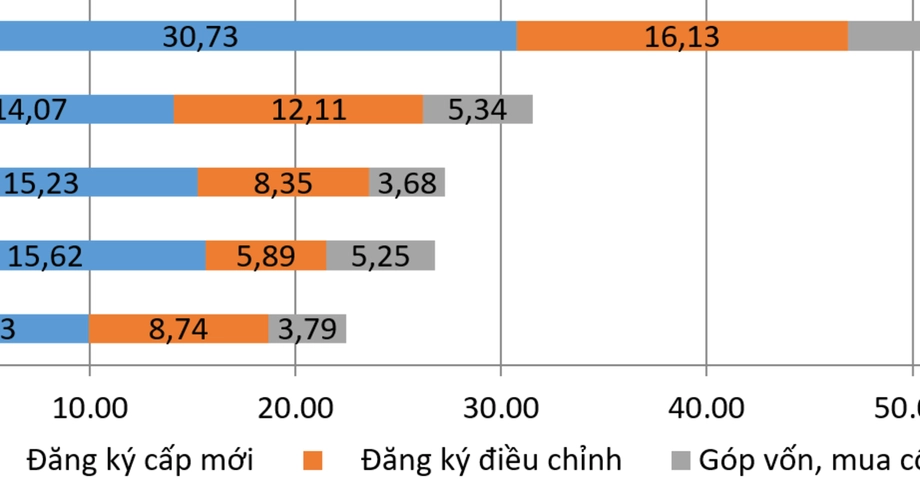
Investment commitments surge while deployed capital grows more slowly
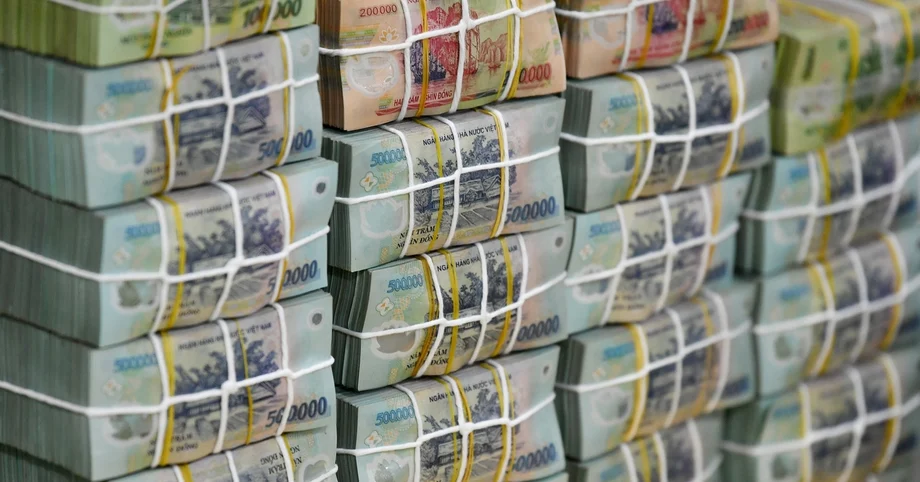
Vietnam registered $54.85 billion in foreign direct investment in the first ten months of 2026, up 74% from a year earlier and the highest level since 2009. Capital actually deployed reached an estimated $24.08 billion, with manufacturing and processing accounting for $19.96 billion, or 82.9%, of that spending.
Contents
- Investment commitments surge while deployed capital grows more slowly
- Larger capital commitments drive new project growth
- Manufacturing leads, with transport and property also attracting capital
- Singapore leads investors from 80 countries and territories
- Share purchases direct investment toward services
- Factories account for more than four fifths of deployed investment
- October extends a surge already visible in September
- Recruitment and weaker export orders test factory expansion
- Vietnamese investment abroad reaches $3.41 billion
- Laos leads overseas destinations
- Key Points
The Ministry of Finance's National Statistics Office released the figures on November 3, covering investment through October 31. New projects attracted $30.73 billion, existing projects registered another $16.13 billion, and capital contributions and share purchases totaled $7.99 billion.
Foreign direct investment, usually called FDI, includes investment in business operations in another country, such as establishing a factory, expanding an existing operation or buying a stake in a company. Vietnam's headline registration figure combines several ways foreign investors enter or expand in its economy.
Registered capital records investment commitments. Disbursement measures money actually put into projects, including projects approved in earlier periods. The two totals therefore describe different stages of investment: plans entering the system and spending reaching businesses.
Vietnam recorded growth in both measures, although commitments increased much faster. Disbursement rose 13.1% from the same period of 2025, reaching its highest level for the first ten months of any year in the past five years.
Larger capital commitments drive new project growth
Vietnam licensed 3,478 new foreign investment projects during January through October, an increase of 4.7% in project numbers. Their combined registered capital reached 2.2 times the amount recorded a year earlier.
Those figures show that capital commitments grew mainly through a larger average investment per project. Dividing $30.73 billion by 3,478 projects gives an average of about $8.8 million per newly licensed project. Using the reported growth rates, the average was roughly twice its level a year earlier.
Existing investors also increased their commitments. There were 1,079 capital adjustment registrations for previously licensed projects, adding $16.13 billion, up 33.2% from the same period in 2025.
New projects and additions to existing projects together accounted for $46.86 billion, or about 85.4% of total registered foreign investment. Within that project capital, expansions represented roughly one third. Vietnam's investment pipeline therefore includes substantial commitments from businesses already operating in the country, alongside new arrivals.
Manufacturing leads, with transport and property also attracting capital
Manufacturing and processing received $14.61 billion in newly registered capital, representing 47.5% of the new project total. Transport and storage followed with $5.15 billion, or 16.7%.
The two sectors together attracted $19.76 billion, approximately 64.3% of newly registered capital. Their prominence puts production and the movement and storage of goods at the center of Vietnam's new investment commitments.
Adding capital increases at existing projects makes manufacturing's lead larger. The sector received $24.19 billion in combined new and adjusted capital, equivalent to 51.6% of the $46.86 billion project total.
Subtracting manufacturing's $14.61 billion in new registrations from its $24.19 billion combined figure indicates about $9.58 billion in additional commitments at existing manufacturing projects. That is roughly 59.4% of all adjusted capital, showing how strongly factory expansions contributed to investment growth.
Real estate received $7.08 billion, or 15.1%, of combined new and adjusted project capital. Other sectors together received $15.59 billion. These sector totals describe project registrations, while capital contributions and share purchases have their own breakdown.
Singapore leads investors from 80 countries and territories
Singapore was the largest source of capital for newly licensed projects, registering $9.52 billion, or 31% of the total. South Korea followed with $5.81 billion, representing 18.9%, while Luxembourg ranked third with $4.99 billion, or 16.2%.
Those three origins together accounted for $20.32 billion, approximately two thirds of newly registered capital. Singapore and South Korea alone supplied $15.33 billion, almost half of the total.
Hong Kong registered $3.57 billion, or 11.6%, followed by mainland China with $2.77 billion, or 9%. Japan contributed $1.58 billion, representing 5.1%, and the Netherlands registered $438.5 million, or 1.4%.
The rankings cover investors from 80 countries and territories with newly licensed projects. Their scope is the $30.73 billion in new registrations; the broader $54.85 billion headline also includes expansions and transactions involving company ownership.
Share purchases direct investment toward services
Foreign investors carried out 2,616 capital contribution and share purchase transactions worth $7.99 billion, an increase of 49.6% from a year earlier. This category accounted for about 14.6% of total registered foreign investment.
Of those transactions, 828 increased company charter capital by a combined $3.28 billion. Charter capital is the capital that owners formally contribute or commit to a company under its registration.
Another 1,788 purchases, worth $4.71 billion, involved acquiring existing shares without increasing charter capital. In those transactions, ownership stakes changed hands while the company's registered capital stayed the same. Such purchases represented about 59% of the value of this investment category.
Professional, scientific and technological activities attracted the largest amount through capital contributions and share purchases: $2.78 billion, or 34.8%. Wholesale and retail trade, together with automobile and motorcycle repair, received $2.17 billion, or 27.1%.
Together, those two groups attracted $4.95 billion, about 62% of transaction value. Services therefore occupied a much larger place in ownership transactions than in the project registration figures, where manufacturing led.
Factories account for more than four fifths of deployed investment
Manufacturing and processing received $19.96 billion of the estimated $24.08 billion in disbursed FDI. Its 82.9% share means that more than four dollars in every five actually deployed went into the sector.
Real estate received $1.76 billion, or 7.3%. Production and distribution of electricity, gas, hot water, steam and air conditioning received $785.2 million, representing 3.3%.
Manufacturing's share of disbursement was 35.4 percentage points above its 47.5% share of newly registered capital. Vietnam's current investment spending is more concentrated in factories than its newest commitments, which include a broader mix of transport, property and other activities.
For businesses, disbursement is the stage at which investment plans become spending on construction, equipment and other project needs. The statistics do not give a timetable for deploying the newly registered capital or identify how many jobs the projects will create.
October extends a surge already visible in September
Vietnam had recorded $50.36 billion in registered FDI during the first nine months of 2026. The October total therefore represents a further $4.49 billion, calculated by subtracting that earlier cumulative figure from $54.85 billion.
Disbursement increased from $21.07 billion through September to $24.08 billion through October, a difference of $3.01 billion. The earlier industrial park earnings decline showed that rising investment was occurring alongside weaker profits among developers covered by SSI Research, whose combined net profit fell 40% in the first half.
The main milestones show how commitments and spending developed:
- January through October 2025: Registered foreign investment totaled $31.52 billion.
- January through September 2026: Registrations reached $50.36 billion and disbursement reached $21.07 billion.
- October 31, 2026: Registrations reached $54.85 billion and estimated disbursement reached $24.08 billion.
- November 3, 2026: The National Statistics Office released the October and ten month figures.
The $54.85 billion total was $23.33 billion above the same period of 2025. Earlier ten month totals included $29.11 billion in 2019, $26.76 billion in 2023 and $27.26 billion in 2024. Vietnam's 2026 registrations were therefore slightly more than twice the 2024 amount.
Recruitment and weaker export orders test factory expansion
Vietnam's manufacturing investment is growing while employers face practical constraints. The shortage of technical workers described in January included a battery manufacturer in Bac Ninh seeking 150 technical employees but attracting only 60 applicants after more than a month.
Ko Tae Yeon, chairman of the Korean Chamber of Commerce in Vietnam, described the pressure that rising investment would put on recruitment:
"Competition for human resources will become more intense as foreign investment continues to grow," said Ko Tae Yeon, chairman of KOCHAM.
October's factory survey also showed a mixed operating picture. Vietnam's October manufacturing survey recorded a Purchasing Managers' Index of 52.3, up from 51.9 in September. A reading above 50 signals improving business conditions compared with the previous month.
Production and total new orders continued to rise, but their growth slowed, while export orders fell. Manufacturers also faced longer supplier delivery times and higher input costs. For factories receiving new capital, staffing, materials and customer demand will shape how quickly additional capacity becomes productive.
Vietnamese investment abroad reaches $3.41 billion
Vietnam's outward investment also increased sharply. Newly licensed projects and additions to existing projects totaled $3.41 billion, reaching 3.1 times the amount recorded in the same period of 2025.
There were 132 newly licensed overseas projects with $1.87 billion in Vietnamese capital, 2.5 times the earlier level. Another 34 capital adjustment registrations added $1.54 billion, reaching 4.3 times the corresponding amount a year earlier.
Professional, scientific and technological activities led outward investment with $684.8 million, or 20.1%. Transport and storage received $639.4 million, representing 18.8%, while electricity, gas, hot water, steam and air conditioning production and distribution received $585.8 million, or 17.2%.
Those three groups together accounted for $1.91 billion, about 56% of outward investment. Their prominence gives Vietnam's international investment a different sector mix from foreign capital deployed inside the country, where manufacturing dominated.
Laos leads overseas destinations
Vietnamese investors registered capital in 37 countries and territories. Laos ranked first with $670.9 million, or 19.7% of the outward total. Cambodia received $487 million, or 14.3%.
Together, those two neighboring countries attracted $1.16 billion, approximately 34% of Vietnam's overseas investment. India received $361.7 million, representing 10.6%, and Indonesia attracted $340.2 million, or 10%.
The detailed statistical breakdown identifies the second largest destination, receiving $560 million, as the Dominican Republic, while another description names Dominica. The country identification needs clarification because these are two different Caribbean countries.
Other destinations included the Philippines with $193.6 million, Kazakhstan with $149.9 million and the United States with nearly $100 million. The breadth of destinations shows Vietnamese companies committing capital beyond their immediate neighbors, even as Laos remained the largest recipient.
Key Points
- Vietnam registered $54.85 billion in foreign investment through October 31, 2026, up 74% and the highest level since 2009.
- New projects accounted for $30.73 billion, existing project expansions for $16.13 billion, and capital contributions and share purchases for $7.99 billion.
- Estimated disbursement reached $24.08 billion, up 13.1%, with manufacturing receiving 82.9%.
- Singapore led newly registered investment with $9.52 billion, followed by South Korea and Luxembourg.
- Vietnamese investment abroad reached $3.41 billion, with Laos the largest destination.
- Recruitment difficulties, slower order growth and supply delays remain practical pressures on manufacturers expanding production.