Investment Accelerates While Developer Earnings Retreat
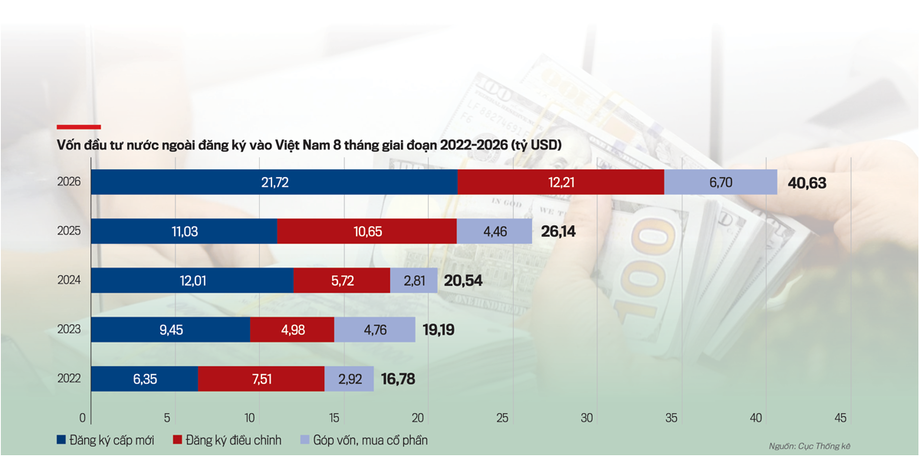
Vietnam attracted $50.36 billion in registered foreign direct investment in the first nine months of 2026, an increase of 76.4% from a year earlier. Yet industrial park developers covered by SSI Research recorded a 40% fall in net profit in the first half, to approximately VND4 trillion, even as demand for industrial land recovered.
Contents
- Investment Accelerates While Developer Earnings Retreat
- What the Investment Numbers Measure
- Manufacturing Drives Capital Deployment
- Land Take Up Recovers in Both Regions
- Why Profits Fell Despite Stronger Leasing
- New Parks Face a Tougher Cost Equation
- More Supply Meets Cautious Tenant Decisions
- The Recovery Follows an Earlier Leasing Slowdown
- Winners Differ, and Compensation Is a Separate Earnings Stream
- Key Points
The contrast reflects more than a delay between investment announcements and factory construction. Developers are contending with the absence of large land transactions booked a year earlier, higher interest expenses, changes in revenue accounting and rising development costs. Existing parks can still achieve margins above 50%, according to SSI, while new projects may earn only 30% to 35%.
SSI Research's October sector update, dated October 9, 2026, nevertheless maintains a positive investment view on selected operators and rubber companies converting plantation land. Its preferences include Viglacera and IDICO, whose earnings increased despite the decline across the developers it covers.
The central distinction is between demand for space and the timing and profitability of delivering that space. Foreign investment, signed leases, land handovers and reported earnings measure different stages of the investment cycle. Their movements need not match within the same reporting period.
What the Investment Numbers Measure
The National Statistics Office said on October 3 that disbursed foreign investment reached $21.07 billion during January through September, up 12.1% and the highest amount for that period in five years. The $21.1 billion figure cited in the sector analysis is the rounded version of that total.
Registered investment grew much faster than disbursement. Registration records investment commitments, while disbursement measures capital actually deployed. The difference helps explain why a surge in headline FDI does not immediately produce an equivalent increase in industrial park earnings.
Newly registered capital totaled $29.24 billion across 3,108 projects. Project numbers increased 6.2%, while their registered capital reached 2.4 times the amount recorded a year earlier. Another 948 existing projects registered $14.15 billion in additional capital, up 25.1%. Capital contributions and share purchases accounted for $6.97 billion across 2,335 transactions, an increase of 44% by value.
These categories also have different consequences for property demand. A new manufacturing project may need a factory site, while a share purchase can change ownership without requiring additional land. The total registered FDI figure therefore cannot be treated as a direct measure of new industrial space requirements.
Manufacturing Drives Capital Deployment
Manufacturing and processing received $17.4 billion in disbursed investment, representing 82.6% of the total. Real estate received $1.59 billion, or 7.5%, while electricity, gas, steam and air conditioning production and distribution received $723.4 million.
The composition of new commitments was less concentrated. Manufacturing and processing accounted for $13.38 billion, or 45.8% of newly registered capital, while transport and storage attracted $5.14 billion, or 17.6%. Manufacturing's share of disbursement was therefore 36.8 percentage points higher than its share of new registrations, although the two measures cover different investment stages.
Singapore was the largest source of newly registered investment, providing $9.26 billion, followed by South Korea with $5.70 billion and Luxembourg with $4.99 billion. Singapore and South Korea represented 31.7% and 19.5% respectively, together accounting for 51.2% of new registrations. These are origins of investment flowing into Vietnam, rather than destinations receiving Vietnamese FDI.
The dominance of manufacturing in capital actually deployed supports demand for industrial facilities. It does not establish when particular park operators will receive tenants, complete handovers or recognize revenue.
Land Take Up Recovers in Both Regions
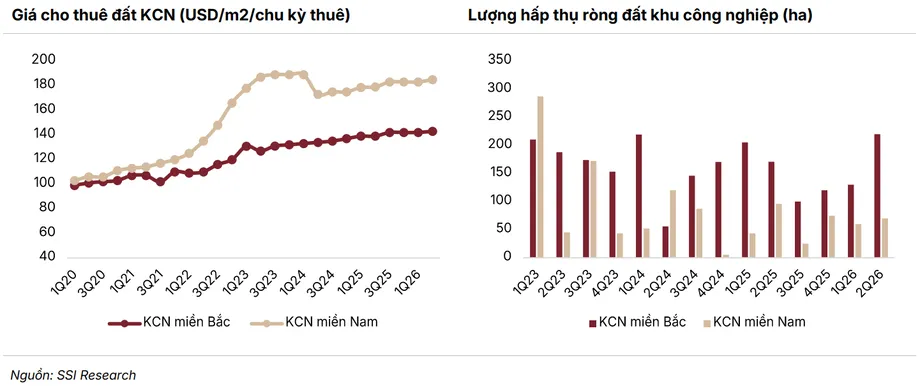
Northern Vietnam recorded approximately 217 hectares of net industrial land absorption in the second quarter of 2026, compared with 134 hectares in the first quarter. That was an increase of 83 hectares, or about 62%, and the strongest quarterly result since the 218 hectares recorded in the first quarter of 2024.
Net absorption measures the increase in occupied industrial land over a period. It provides a closer indication of property market activity than investment registrations, although it still does not determine how much revenue each developer can book.
Southern absorption reached 67 hectares in the second quarter, up from 57 hectares in the preceding quarter and 10 hectares a year earlier. The annual increase was 57 hectares, with take up reaching 6.7 times the earlier level. The quarterly increase was more modest, at approximately 17.5%.
Average asking rents also rose. Northern industrial land was offered at $143 per square meter per lease term, up 2.9% from a year earlier, while southern rents reached $185, up 3.7%. These quotations cover a lease term, not one year. Southern asking rents were $42 per square meter higher, approximately 29% above the northern average, though the figures do not establish that individual sites have comparable lease lengths or specifications.
Why Profits Fell Despite Stronger Leasing
Combined first half net revenue among the industrial park developers covered by SSI fell 20.2% to roughly VND38 trillion. Net profit declined more sharply, by 40%, to about VND4 trillion. The coverage group should not be confused with every industrial park business operating in Vietnam.
Becamex, traded under BCM, reported revenue of VND1.66 trillion, down 65%, and net profit of VND320 billion, down 82.7%. Kinh Bac City, or KBC, recorded revenue of VND1.93 trillion, down 46%, while profit after tax fell 79.2% to VND260 billion.
Sonadezi Chau Duc, or SZC, reported revenue of VND234 billion, down 63%, and net profit of VND36 billion, down 83.7%. SSI attributed much of the weakness at BCM, KBC and D2D to the absence of large land transactions comparable to those recorded a year earlier, alongside increased interest costs.
SZC and Sonadezi, or SNZ, were also affected by recognizing revenue evenly over the lease term. Under that approach, lease revenue is spread across multiple reporting periods rather than concentrated at the outset. Lower profit in a particular half year can therefore reflect accounting timing as well as commercial performance.
These explanations do not make the earnings decline irrelevant. Higher financing costs and fewer large recognized transactions still affect reported returns. They do, however, show why the decline cannot be read simply as evidence that manufacturers have stopped seeking industrial land.
New Parks Face a Tougher Cost Equation
SSI estimates that new industrial parks may achieve margins of 30% to 35%, compared with more than 50% at established parks. At a 50% reference point, the gap is already 15 to 20 percentage points, and it is wider where an existing park exceeds that level.
Land compensation, site clearance and infrastructure construction are the main pressures. SSI says administrative boundary adjustments and provincial consolidation have added to compensation costs. Prices for key building materials, including sand, stone, cement and fill, have risen by about 20% from a year earlier.
Those increases are much larger than the reported annual growth in asking rents of 2.9% in the north and 3.7% in the south. The figures apply to different cost and revenue bases, so they cannot be subtracted to calculate a margin. They nevertheless show why modest rent increases may be insufficient to protect returns on newly developed land.
SSI expects industrial park rents to be broadly flat in 2027 as new projects compete for tenants. Established operators with land and infrastructure already in place have an advantage: they can lease existing capacity without incurring the full development expense facing a new project.
More Supply Meets Cautious Tenant Decisions
CBRE estimates that approximately 1,347 hectares of industrial land will enter the market from the fourth quarter of 2026 through 2027. Northern additions are projected at 664 hectares and southern additions at 683 hectares, a nearly even split.
Expected northern supply locations include Bac Ninh, Thai Nguyen, Hai Phong and Hung Yen. Southern additions are expected in locations identified as Dong Nai, Binh Duong, Long An, Tay Ninh and Ba Ria Vung Tau. More capacity gives expanding manufacturers additional choices, while increasing competition among developers seeking to fill new parks.
SSI forecasts that new lease contracts and memoranda of understanding among its covered companies will total around 1,000 hectares in 2027, an increase of 18.6%. A memorandum of understanding records an intended agreement and should not be treated as equivalent to a completed land handover or recognized revenue.
Tenants from China, Taiwan and Hong Kong are expected to remain important, particularly in secondary industrial locations. Expansion and relocation by foreign invested manufacturers, diversification of production locations and infrastructure improvements support the leasing outlook.
Uncertainty about United States tariffs is still affecting how tenants commit capital. Some investors are choosing factories that are already built rather than immediately launching larger projects. That allows them to begin with a smaller commitment, but SSI says the shift can delay revenue and profit recognition for industrial land developers.
The Recovery Follows an Earlier Leasing Slowdown
The contrast between earnings and leasing was already visible in SSI Research's December 2025 report, dated December 23. Listed industrial park developers recorded third quarter revenue of VND21.8 trillion, up 19%, and net profit of VND5.2 trillion, up 59%, even though memoranda of understanding and new leases fell 27%.
That report attributed strong earnings partly to lower costs of goods sold at IDC, NTC and KBC, and gains at rubber related companies GVR, PHR and DPR. It also warned of sluggish leasing decisions, smaller projects and a preference for factories already built.
The December assessment cited a potential 40% tariff on Vietnamese exports in discussing transshipment risks, alongside rates of about 25% for India and 19% for ASEAN peers. Those figures describe the report's assessment at that time, not confirmation of the tariff treatment applicable to every shipment in 2026.
SSI also identified expressways, ring roads, Circular 33/2025 and the amended Investment Law as support for the longer term investment outlook. The sequence shows how leasing weakness can precede an earnings slowdown, just as recovering demand can precede stronger recognized profit:
- Third quarter 2025: listed developers recorded higher earnings while new leases and memoranda of understanding fell 27%.
- December 23, 2025: SSI warned that slower lease recognition could soften 2026 earnings at BCM, IDC, VGC and SZC.
- Second quarter 2026: industrial land absorption recovered to 217 hectares in the north and 67 hectares in the south.
- October 3, 2026: the National Statistics Office reported $21.07 billion in investment disbursement for the first nine months.
- Fourth quarter 2026 through 2027: approximately 1,347 hectares of additional industrial land are projected to enter the market.
Winners Differ, and Compensation Is a Separate Earnings Stream
IDICO's first half net profit rose 20.2% to VND1 trillion, while Viglacera's increased 37.5% to VND1.15 trillion. Stronger land leasing and recovering demand for construction materials supported their results. Their gains show that the sector average conceals substantial differences between companies.
SSI prefers VGC and IDC for attractive valuations and strong operating cash flow, which it says supports sustainable cash dividends. That assessment differs from its December 2025 preference for KBC, PHR and GVR, and from its earlier warning that IDC and VGC could experience softer earnings in 2026.
For 2027, SSI projects Viglacera's earnings will increase 29%, supported by Song Cong II and Tran Yen, alongside Phu Ha, Thuan Thanh and Yen Phong IIC. This is a forecast dependent on project activity, not a result already delivered.
Rubber companies have a different earnings driver. First half profit rose 72.8% at GVR and 232.5% at Phuoc Hoa Rubber, or PHR. SSI expects compensation from converting plantation land to continue supporting GVR, PHR and DPR, and describes PHR and DPR as offering cash dividend yields of 8% to 11%.
Compensation income is distinct from recurring industrial land leasing income. It depends on land conversion and payment timing, while dividend yields depend on share prices and distributions. Neither should be treated as a guaranteed annual return.
SSI forecasts combined 2027 net profit of VND22.3 trillion for the industrial park and rubber companies in its coverage involved in land conversion, up 12.4%. That broader forecast is not directly comparable with the VND4 trillion first half 2026 profit figure for industrial park developers. The unresolved issues are how quickly agreements become handovers, whether new supply holds rents flat, and how much rising development costs reduce the profit earned from recovering demand.
Key Points
- Vietnam registered $50.36 billion in FDI in the first nine months of 2026, up 76.4%, while disbursement rose 12.1% to $21.07 billion.
- Industrial park developers covered by SSI recorded a 40% fall in first half net profit to approximately VND4 trillion.
- Second quarter land absorption recovered in both regions, reaching 217 hectares in the north and 67 hectares in the south.
- New park margins are estimated at 30% to 35%, compared with more than 50% at established parks.
- Approximately 1,347 hectares of new supply are projected from late 2026 through 2027, while SSI expects broadly flat rents in 2027.
- IDICO and Viglacera increased first half earnings; rubber land conversion compensation provides a separate source of profit for GVR, PHR and DPR.
- SSI forecasts VND22.3 trillion in combined 2027 profit for its covered industrial park and rubber land conversion companies, up 12.4%.