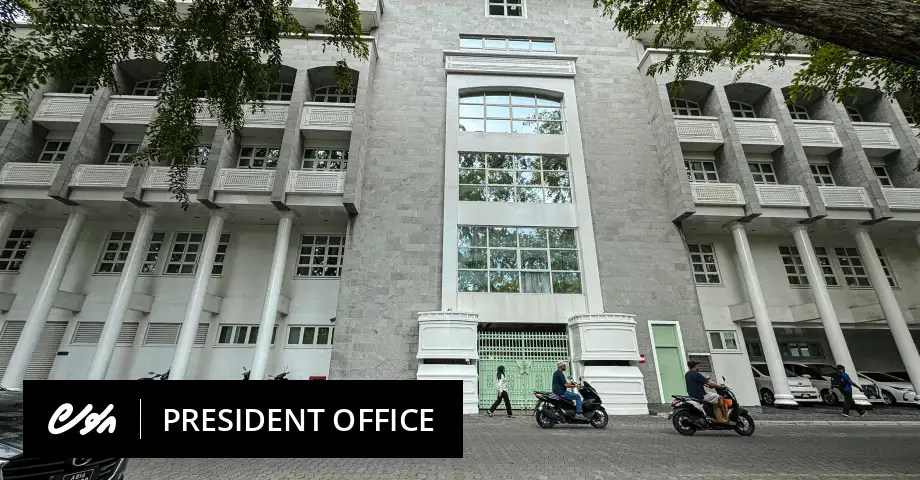
Seven members to examine decisions behind the sea boundary ruling
President Dr Mohamed Muizzu has established a seven member commission to investigate how the Maldives handled ITLOS Case No. 28, the maritime boundary dispute in which an international tribunal allocated 47,232 square kilometres of overlapping waters to the Maldives and 45,331 square kilometres to Mauritius in April 2023.
Contents
- Seven members to examine decisions behind the sea boundary ruling
- What the presidential decree requires
- Who will conduct the investigation?
- What the tribunal divided in 2023
- Why Blenheim Reef mattered
- How Chagos shaped the legal dispute
- From tribunal proceedings to a diplomatic rupture
- Seabed claims add another layer
- Key Points
Created on 1 November 2026 through Presidential Decree No. 2026/17, the commission will examine decisions by state employees, advisers and officials before and during the proceedings. Its tasks include assessing legal negligence, checking how documents were preserved and recommending measures against anyone it finds accountable.
The President's Office says international experts reviewing the case concluded that actions taken by the Maldives caused significant and irrecoverable losses involving maritime territory, fisheries, marine resources and seabed assets. Those are the government's stated grounds for the investigation. The commission must now examine the conduct of the people and institutions involved.
Ahmed Shakir chairs the inquiry, which has no fixed completion date. It will remain operational until Muizzu declares its assigned work complete.
The decision brings together two parts of a dispute that has grown since the judgment: a domestic investigation into the previous administration's actions and the current government's effort to recover waters it considers lost. Relations with Mauritius have also deteriorated, with Mauritius suspending diplomatic relations with the Maldives in February 2026.
What the presidential decree requires
The President's Office, in its commission announcement, identifies Article 115(o) of the Constitution as the authority for establishing the inquiry. Muizzu had announced his intention to create it during his presidential address on 5 February.
The decree gives the commission a broad remit. It covers the Maldives' actions leading up to the submission of the case, its conduct during proceedings, its response to the dispute and related matters. Officials who participated indirectly, as well as those who dealt directly with the proceedings, fall within its scope.
The commission must determine whether legal negligence occurred and, if so, identify its scope. In simple terms, it must examine whether people responsible for protecting the state's legal interests failed to carry out duties required of them.
Document preservation is a separate part of the mandate. The inquiry will examine how records concerning the case and related matters were maintained and protected. That task will help it reconstruct what decisions were made, who made them and what advice was available.
The President's Office attributes the decision to findings by international experts appointed to examine the dispute and identify possible next steps. Its announcement names the case as Dispute concerning delimitation of the maritime boundary between Mauritius and Maldives in the Indian Ocean (Mauritius/Maldives).
Who will conduct the investigation?
Ahmed Shakir will lead a commission whose other members are Abdul Azeez Yoosuf, Dr Aminath Shafiya Adam, Dr Abdul Muhsin Mohamed, retired Deputy Commissioner of Police Mohamed Sadiq, Ahmed Ali Maniku and Fathimath Minhath Izzath. The presidential announcement lists Shakir with the designation ODRDD.
The seven members have two linked responsibilities: examining past conduct and proposing changes for future cases. Alongside recommendations concerning accountable parties, they must suggest ways to organise state affairs so that similar problems do not recur.
The decree leaves the inquiry's duration tied to a presidential decision rather than a calendar deadline. Its work therefore extends beyond reviewing the tribunal's final allocation: it must also examine the administrative and legal process that produced the Maldives' position.
What the tribunal divided in 2023
The disputed waters lie between Addu City in the southern Maldives and the Chagos Archipelago farther south. The two countries agreed in 2019 to submit their maritime delimitation dispute to a special chamber of the International Tribunal for the Law of the Sea, known as ITLOS.
Maritime delimitation means drawing a boundary where countries' claims at sea overlap. The case concerned rights over waters and the continental shelf, the seabed and the ground beneath it. Those rights matter for activities such as fishing and exploring seabed resources.
The April 2023 allocation gave the Maldives 1,901 square kilometres more than Mauritius. Using the two stated allocations, the Maldives received about 51 percent of their combined 92,563 square kilometres, while Mauritius received about 49 percent. Mauritius's share was approximately 0.960 square kilometres for every square kilometre allocated to the Maldives.
The overlapping area was also described as 95,000 square kilometres. That description is 2,437 square kilometres greater than the sum of the two allocations, so the comparison here uses the stated awards to each country.
Muizzu's administration is now examining why the Maldives accepted or advanced particular legal positions during the case. Its argument focuses on rights it says the country should have retained, even though the Maldives received the larger of the two shares in the final division.
Why Blenheim Reef mattered
Blenheim Reef was a central point of disagreement over how to draw the boundary. Mauritius proposed using the reef as a base point for an equidistance line. Such a line is constructed by finding points equally distant from selected points on the two sides' coasts.
The Maldives challenged the use of the reef, presenting scientific evidence and satellite images in support of its position. The special chamber excluded Blenheim Reef as a base point when drawing the equidistance line.
Mauritius's proposed use of the reef would have added 4,687 square kilometres to its share. The decision to exclude it therefore had a concrete effect on the proposed boundary and was an important result for the Maldives during the proceedings.
The reef dispute helps explain why assessments of the case can focus on different decisions. The Maldives succeeded on a boundary calculation involving Blenheim Reef, while the current administration is pursuing a wider inquiry into the country's handling of the litigation and the maritime rights it claims were lost.
How Chagos shaped the legal dispute
The Maldives initially challenged whether the tribunal could hear the case while sovereignty over Chagos was disputed between Mauritius and the United Kingdom. A preliminary objection is an argument about whether a court or tribunal can proceed before it examines the main dispute.
On 28 January 2021, the ITLOS special chamber rejected the Maldives' preliminary objections. Thomas Burri and Jamie Trinidad describe that decision in their legal case commentary, published online on 9 June 2021. The ruling allowed the boundary proceedings to continue.
Chagos had been separated from Mauritius by Britain in 1965, three years before Mauritian independence. Between 1967 and 1973, inhabitants were displaced as Britain and the United States developed the military base on Diego Garcia.
On 25 February 2019, the International Court of Justice issued an advisory opinion finding that Mauritius's decolonisation had not been lawfully completed and that Britain should end its administration of Chagos as rapidly as possible. The status of the islands formed part of the setting for the later maritime case.
The Maldives voted against the United Nations resolution on Chagos on 22 May 2019. The resolution received 119 votes in favour, while the Maldives, Britain, the United States, Hungary, Australia and Israel voted against it. The Maldivian Foreign Ministry said it could not support proposals diminishing national territory under the 2008 Constitution and domestic law.
From tribunal proceedings to a diplomatic rupture
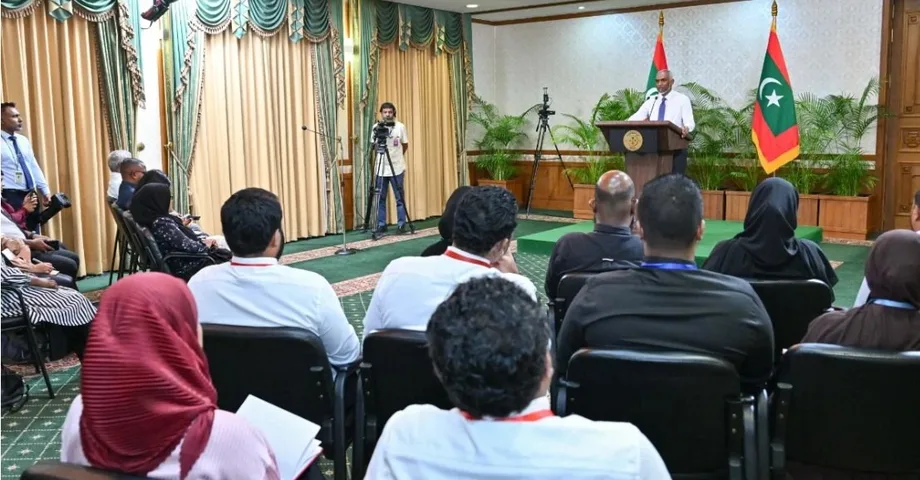
Muizzu has withdrawn the previous administration's position and said the government withdrew a letter sent by former President Ibrahim Mohamed Solih to the prime minister of Mauritius concerning the dispute. He has also announced legal steps aimed at recovering the maritime area his administration considers lost.
The main developments span several years:
- 2019: The Maldives and Mauritius agreed to submit their maritime boundary dispute to an ITLOS special chamber.
- 28 January 2021: The chamber rejected the Maldives' preliminary objections.
- April 2023: The tribunal delivered its final boundary judgment.
- 5 February 2026: Muizzu announced plans for a commission in his presidential address.
- February 2026: Mauritius suspended diplomatic relations with the Maldives.
- 1 November 2026: Muizzu established the commission through Decree No. 2026/17.
Muizzu has declared that the area relinquished under the previous administration would be included in the Maldives' economic zone. An exclusive economic zone is an area where a coastal state has particular rights over natural resources, including fish, while other countries retain navigation rights under international law.
The commission's immediate task is to investigate Maldivian decision making and recommend action. The government's effort to change the maritime outcome involves its legal and diplomatic dealings beyond that domestic inquiry.
Seabed claims add another layer
The boundary dispute also concerns the continental shelf. Rights over the shelf relate to the seabed and what lies beneath it, while fishing rights concern resources in the waters above. This helps explain why the President's Office lists fisheries, marine wealth and seabed resources separately when describing the losses it alleges.
Both countries approached the Commission on the Limits of the Continental Shelf in 2010 over claims extending beyond 200 nautical miles. That body examines scientific and technical information concerning the outer limits of continental shelves. Those claims formed another part of the countries' competing interests at sea.
The Maldives has earlier experience of negotiating maritime boundaries with its northern neighbours. It signed an agreement with Sri Lanka on 31 July 1976 and an agreement with India on 28 December 1976; both entered into effect on 8 June 1978. Those agreements used equidistance to divide overlapping areas.
The new inquiry focuses on how the Maldives managed its southern boundary case. For the state, the practical questions concern responsibility for legal decisions, preservation of records and the organisation of future maritime litigation. For fishing and resource management, the stakes concern which country exercises rights in the contested area.
Key Points
- Muizzu established a seven member commission on 1 November 2026 through Presidential Decree No. 2026/17.
- Ahmed Shakir will chair the inquiry into the Maldives' handling of ITLOS Case No. 28.
- The commission will assess possible legal negligence, document preservation, accountability and reforms.
- The April 2023 judgment allocated 47,232 square kilometres to the Maldives and 45,331 square kilometres to Mauritius.
- The tribunal excluded Blenheim Reef as a base point for drawing the equidistance line.
- Mauritius suspended diplomatic relations with the Maldives in February 2026.
- The commission will continue until the president declares its mandate complete.