Detention dispute moves between Geneva and Colombo
Sri Lanka has defended the detention of former intelligence chief Major General Suresh Sallay in a diplomatic response dated 20 September 2026, telling the United Nations that his arrest was lawful and supported by evidence. On 22 October, the Court of Appeal rejected petitions seeking permission to intervene in his challenge to that arrest and continued detention.
Contents
- Detention dispute moves between Geneva and Colombo
- What the October court decision covered
- How the investigation reached Sallay
- Different explanations for the arrest require clarification
- What prompted the UN intervention
- Lawyer and family access remain contested
- Abuse allegations and the government's response
- Hospital treatment becomes central to the case
- The dates and decisions shaping the dispute
- Key Points
Sallay, a retired officer who previously headed both the State Intelligence Service and Military Intelligence, was arrested on 25 February 2026 during an investigation connected to the Easter Sunday attacks of 21 April 2019. His detention under the Prevention of Terrorism Act (PTA) has prompted competing accounts about the grounds for arrest, access to lawyers, treatment in custody and a serious decline in his health.
The government says judicial oversight, regular family contact and specialist medical care have protected his rights. Four UN human rights mandates raised allegations of torture, restrictions on confidential legal consultations and risks to his life in an urgent communication dated 20 July.
The dispute now involves three connected issues: the evidence supporting the criminal investigation, the legality and conditions of detention, and the medical safeguards required before any return from hospital to custody. The government's response addresses each, while leaving the specific evidence underlying the arrest undescribed.
What the October court decision covered
The Court of Appeal's 22 October decision concerned applications by outside parties seeking permission to make submissions in Sallay's writ petition. A writ petition asks a court to review whether public authorities have acted lawfully.
The applications came from Buddhist clergy, including Venerable Bengamuwe Nalaka Thero, Cardinal Malcolm Ranjith and civil society organisations. The matter was before Court of Appeal President Justice Rohantha Abeysuriya and Justice Priyantha Fernando.
Accounts of the decision describe the dismissal of several intervention applications, with one specifying petitions from Buddhist monks. The reasons for the dismissals and a final decision on Sallay's challenge were not given. An earlier court update said delivery of the intervention ruling had been postponed from 14 October to 22 October; a later account described 14 October as the date of the hearing.
How the investigation reached Sallay
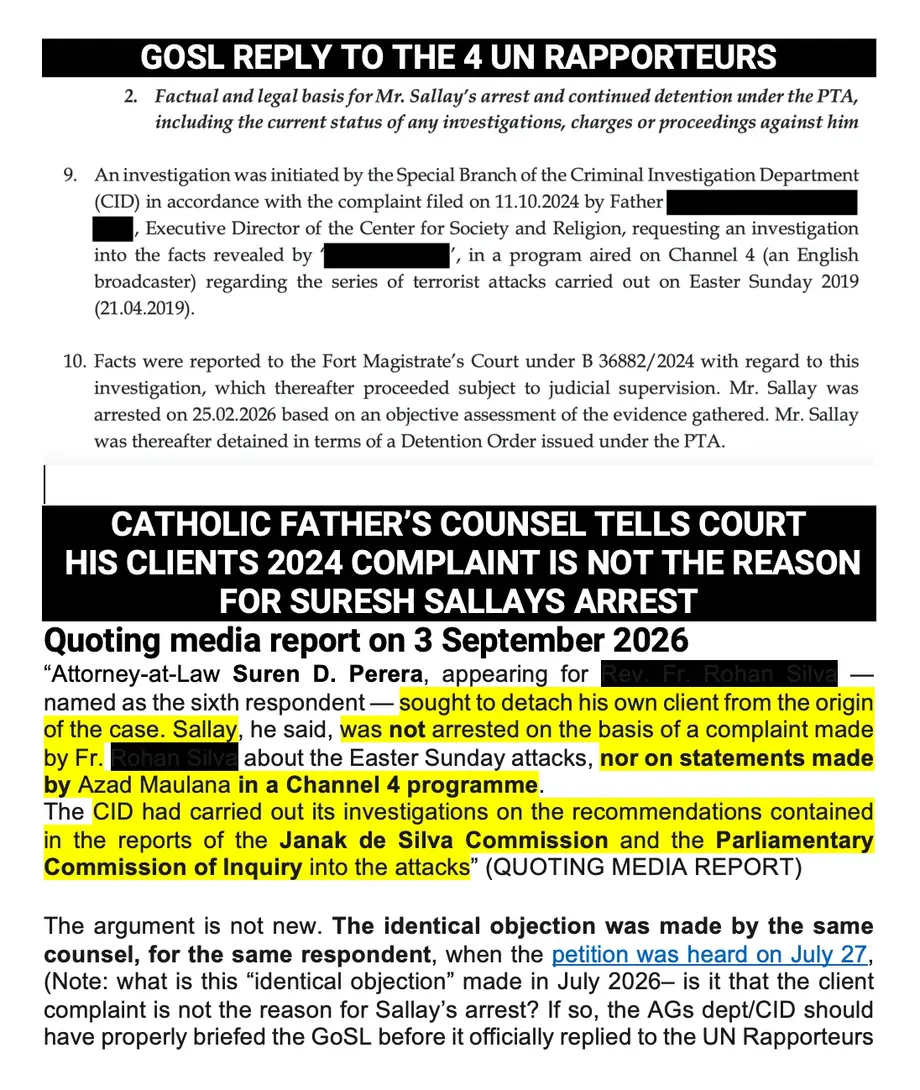
Sri Lanka's Permanent Mission in Geneva transmitted the government's response to the Office of the UN High Commissioner for Human Rights. It says the Criminal Investigation Department's Special Branch began investigating after a complaint filed on 11 October 2024 by a Catholic priest serving as executive director of the Centre for Society and Religion.
The complaint sought an inquiry into information presented in a Channel 4 programme about the Easter Sunday attacks. According to the government, investigators reported the matter to the Fort Magistrate's Court and continued under judicial supervision before arresting Sallay in February 2026.
The government rejects suggestions that political opinions, ethnicity, religion or Sallay's former positions motivated his detention. Its response says the arrest followed an objective assessment of evidence gathered during the investigation.
In its written response, the Sri Lankan government stated its position on accountability for the attacks:
The Government reiterates its commitment to ensuring accountability for the Easter Sunday attacks of 21 April 2019,
The submission also says investigations must proceed impartially and independently, with recognition of the suffering of victims, survivors and their families. Its central argument is that former rank or office cannot place someone beyond lawful investigation.
Different explanations for the arrest require clarification
Counsel representing the priest reportedly told the Court of Appeal on 3 September that Sallay's arrest followed a CID investigation based on the Janak de Silva Commission report and recommendations of a parliamentary inquiry. Counsel reportedly said the arrest was not based on the priest's October 2024 complaint or statements made by Azad Maulana in the documentary.
The government's account identifies the complaint as the investigation's starting point, while the court submission identifies commission findings and recommendations as the basis for the arrest. Readers therefore need a clear account of what evidence investigators obtained between the complaint and the decision to detain Sallay.
A further procedural issue concerns his designation as a suspect. CID officers reportedly told the Magistrate's Court on 4 March that facts concerning his detention had not yet been formally reported. On 5 March, investigators reportedly named him as the third suspect, referring to evidence that had emerged.
Case references also vary. The government response reportedly uses both B 36882/2024 and B 35882/2024, while the domestic record is identified as B/35882/24. Sallay's Court of Appeal application is identified consistently as CA/Writ/232/2026.
A June 2024 report by the Imam Committee is described as accepting Sallay's alibi and rejecting an alleged meeting account. The UN communication also records allegations that investigators ignored evidence placing him abroad at relevant times. How investigators assessed that material is part of the wider dispute over the basis for detention.
What prompted the UN intervention
The 20 July urgent communication came from Ben Saul, the UN Special Rapporteur on human rights and counterterrorism; Ganna Yudkivska, Vice Chair on Communications of the Working Group on Arbitrary Detention; Tlaleng Mofokeng, the Special Rapporteur on the right to health; and Margaret Satterthwaite, the Special Rapporteur on the independence of judges and lawyers.
These mandates examine alleged human rights violations and seek explanations from governments. Their communication asked Sri Lanka for answers across eight areas, including the legal grounds for detention, treatment in custody, medical care, access to lawyers and investigations into alleged abuse.
According to the account set out in the communication, the Ministry of Defence issued a detention order three days after Sallay's arrest. The order authorised detention for 90 days and was subsequently extended for another 90 days.
The order allegedly accused Sallay of knowing about the Easter attacks in advance and deliberately withholding that information, thereby conspiring in, aiding and abetting the crimes and concealing the identities of perpetrators. The communication also relayed allegations that questioning occurred only a few times during approximately 103 days after his arrest.
The four mandates renewed their call for an immediate moratorium on use of the PTA pending amendments. Their concerns drew on Sri Lanka's obligations under international treaties covering liberty, protection from torture and the right to health, as well as the Nelson Mandela Rules governing treatment of prisoners.
Lawyer and family access remain contested
The government says Sallay was told why he was being arrested, allowed to consult counsel and taken to his residence, where close relatives, including his wife, saw him. It says a receipt was issued, relatives were informed of the detention order and the Human Rights Commission of Sri Lanka received written notification.
The response gives a detailed weekly contact schedule: lawyer visits on Wednesdays, telephone calls with his wife and mother on Fridays, and family visits on Saturdays. Relatives could bring food, beverages and clothing.
The government also says the Fort Magistrate regularly visited the CID facility and observed Sallay in his cell. It describes the facility as an authorised detention location subject to oversight by the magistrate and the Human Rights Commission.
The UN communication presents allegations of restricted contact during particular periods. It says officers were initially present during meetings with lawyers and allegedly recorded conversations. The Magistrate's Court ordered consultations without interference on 26 March, according to the communication.
On 8 July, while Sallay was in hospital, his lawyer was allegedly told that a meeting could take place only under CID supervision. The government maintains that consultations are confidential and that communications with legal counsel cannot be used as evidence. Confidentiality allows a detained person to discuss the case and possible complaints with a lawyer privately.
Abuse allegations and the government's response
The UN communication describes allegations that Sallay was held in a cell measuring approximately 6.5 feet by 4.4 feet, with continuous lighting, pests and very limited opportunities to leave. It says the lighting allegedly caused sleep deprivation and migraines, and that access to case documents and note taking was restricted.
The communication also relays allegations that officers stripped him naked in front of officers and other detainees, handcuffed him, subjected him to degrading treatment and pressured him to confess. A subsequent account of a Human Rights Commission inquiry says CID acknowledged a strip search on 8 March in the presence of other detainees.
The government says no torture allegations had been substantiated as of its response. It cites Article 11 of Sri Lanka's Constitution and Act No. 22 of 1994, which addresses torture and other cruel, inhuman or degrading treatment or punishment.
Sri Lanka says credible evidence of abuse would be handled through investigative and judicial mechanisms. It also states that a statement obtained through torture is inadmissible and cannot justify arrest or continued detention.
The UN mandates raised additional allegations about the investigation's independence, including claims of ignored evidence, interference with CCTV material and conflicts involving officials directing the inquiry. They also expressed concern about the transfer of a magistrate who had ordered safeguards for Sallay. The government says related matters concerning investigative officers are before the Court of Appeal.
Hospital treatment becomes central to the case
Sallay's health occupies a substantial part of both the UN communication and Sri Lanka's response. The government says he received a medical examination after arrest, further assessment on 29 April and referrals for specialist care.
Its account describes treatment or referrals covering skin conditions, nutrition, neurological problems, eyesight, dental and ear problems. It also describes laboratory tests, prescribed supplements and vitamins, an MRI scan at Colombo National Hospital and a referral to the National Institute of Mental Health in Angoda.
The UN communication says a medical report received by his lawyers on 20 May recorded post traumatic stress disorder and findings described as consistent with torture and ill treatment. It also relays allegations that recommendations from a consultant nutritionist were not implemented.
Sallay began refusing food and water on 6 June and was admitted to hospital after his condition deteriorated, according to the communication. On 27 June, severe chest pain led to his transfer to the hospital's Cardiac Coronary Care Unit. He ended the hunger strike on 1 July.
The communication says cardiologists considered him a patient at high cardiac risk and told his family that surgery and an implanted cardiac device might be necessary. A later account describes a medical panel of nine members identifying a cardiac condition requiring a device.
As of 20 September, the government said Sallay remained an inpatient in Colombo National Hospital's cardiology unit. It said no statement had been recorded from him after his hospital admission and that treatment decisions rested with medical professionals. Any transfer back to detention would take account of his condition and medical advice, it said.
The dates and decisions shaping the dispute
The sequence stretches from a complaint in 2024 to court proceedings in October 2026. The main dates show how the investigation, detention challenge and medical concerns developed:
- 11 October 2024: A priest filed the complaint that the government identifies as the starting point of the CID investigation.
- 25 February 2026: CID arrested Sallay. According to the UN communication, a PTA detention order followed three days later.
- 26 March 2026: The Magistrate's Court reportedly ordered confidential consultations with lawyers without interference.
- 6 June to 1 July 2026: Sallay undertook a hunger strike and received hospital treatment after his health deteriorated.
- 20 July 2026: Four UN human rights mandates issued their urgent communication.
- 20 September 2026: Sri Lanka submitted its response defending the arrest, detention safeguards and medical care.
- 22 October 2026: The Court of Appeal rejected several applications to intervene in his writ proceedings.
The legal debate has also required care in courtroom language. Additional Solicitor General Dileepa Peiris reportedly described Sallay as the perpetrator of the attacks before the Fort Magistrate on 22 September. The magistrate corrected him, and the prosecutor apologised. Sallay's role remains a matter for investigation and judicial determination.
Sri Lanka has promised continued medical monitoring and measures to prevent torture, intimidation or reprisals. It says restrictions on family access will be governed by law, security needs and judicial directions, and that reforms to counterterrorism legislation will proceed through the legislative process. For Sallay, the immediate practical issues are continued medical care, confidential access to counsel and judicial review of the grounds for keeping him detained.
Key Points
- Sri Lanka's response dated 20 September 2026 defends Sallay's arrest and detention under the PTA.
- Four UN mandates raised allegations concerning arbitrary detention, abuse, legal access and serious health risks on 20 July.
- The government says regular lawyer and family contact, court oversight and specialist treatment were provided.
- The response leaves the specific evidence underlying the arrest undescribed, while accounts of court submissions identify different starting points for the case.
- Sallay was receiving treatment in a cardiology unit when the government submitted its response.
- The Court of Appeal rejected several intervention applications on 22 October; no final ruling on his detention challenge was described.