Repeal could leave old powers in place
Sri Lanka's proposed Protection of the State from Terrorism (PSTA) Bill would repeal the Prevention of Terrorism Act, yet preserve pending cases and significant parts of its framework through a separate transitional provision, the United Nations human rights office has warned. Its legal assessment, dated 13 October 2026, calls for substantial changes before the new legislation becomes law.
Contents
- Repeal could leave old powers in place
- A replacement promise meets renewed opposition
- What has improved since the earlier draft?
- Why the definition of terrorism matters
- Reporting a raid could carry risks
- Military custody creates an extra period of vulnerability
- Appearing before a judge is not enough
- Protection against torture needs to begin immediately
- Domestic institutions and protesters demand changes
- Trade commitments add pressure for a rewrite
- Key Points
The 19-page assessment examines the bill gazetted on 22 September and presented to Parliament by Justice Minister Harshana Nanayakkara on 6 October. The Office of the High Commissioner for Human Rights (OHCHR) acknowledges improvements, including recorded police interviews and the removal of police confessions as admissible evidence. It nevertheless finds continuing risks of arbitrary detention, torture, enforced disappearance and restrictions on peaceful civic activity.
The central problem reaches beyond the wording of terrorism offences. The bill would allow the defence secretary to order detention initially for two months, limit a magistrate's authority to reject that order, and give military personnel and the coast guard substantial arrest and search powers.
OHCHR's October legal assessment identifies the issue connecting repeal with continuing detention and prosecution:
Although section 72 would repeal the PTA upon the new Act's commencement, section 73 would preserve pending PTA cases and significant elements of the PTA framework.
For people already held or prosecuted under the PTA, the treatment of those existing cases is therefore a central part of the proposed reform. OHCHR wants transitional arrangements reviewed so that proceedings, detention, evidence rules and restrictions carried forward comply with international human rights law.
A replacement promise meets renewed opposition
The Prevention of Terrorism (Temporary Provisions) Act No. 48 of 1979 began as a temporary measure. It has since been used against Tamil and Muslim communities, journalists, human rights defenders and government critics, with a long record of arbitrary detention and torture.
President Anura Kumara Dissanayake's National People's Power alliance promised in its 2024 election manifesto to campaign for the PTA's abolition and protect civil rights throughout Sri Lanka. His government has continued using the law while pursuing a replacement.
Sangeethan Ganeshkumar, a Tamil hip-hop artist aged 24, was arrested under the PTA in June 2026 in connection with a music video. Information supplied to the UN by the Human Rights Commission of Sri Lanka (HRCSL) recorded 46 detention cases related to the PTA in 2025 and 12 during the first three months of 2026.
The debate has moved through several drafts and public challenges:
- 13 December 2025: An earlier PSTA draft was published.
- 24 February 2026: OHCHR issued an assessment calling for substantial redrafting.
- 22 September 2026: The revised bill was gazetted.
- 6 October 2026: Nanayakkara presented the bill in Parliament.
- 9 October 2026: Demonstrators in Jaffna and Batticaloa demanded its withdrawal.
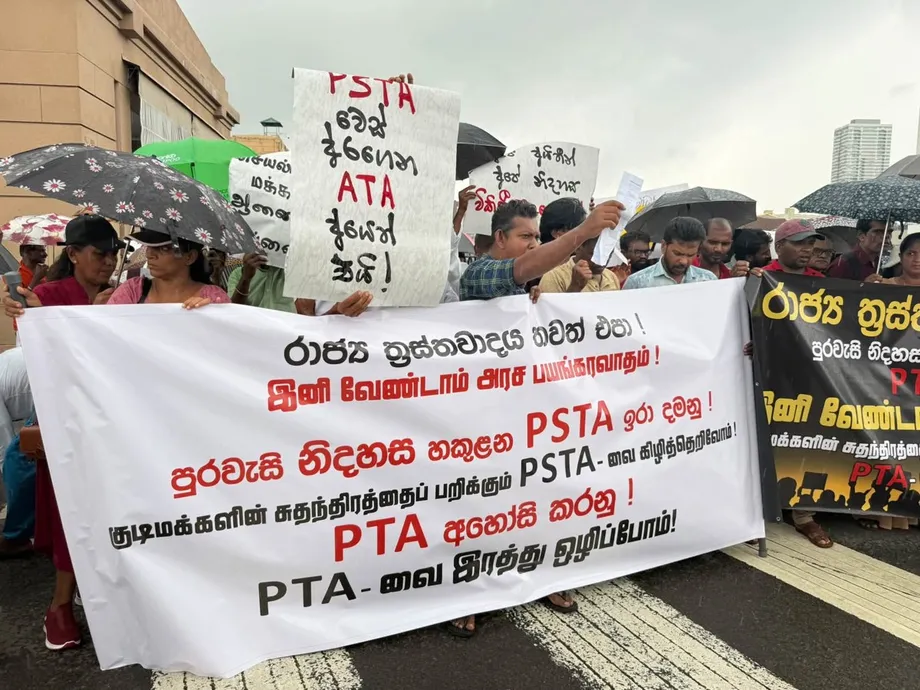
- 13 October 2026: OHCHR issued its latest assessment, while protesters gathered outside the Presidential Secretariat in Colombo.
What has improved since the earlier draft?
OHCHR's February legal assessment criticised the December draft for expansive offences, weak judicial control and incomplete protection against abuse in custody. The September version addresses some of those objections.
The revised bill removes several ordinary crimes from the listed consequences of terrorism and drops a purpose linked to sovereignty and territorial integrity. It removes recklessness from the inducement and publication offences, deletes a separate statutory curfew power, and adds requirements that several restrictive orders be necessary and proportionate. Those requirements mean restrictions should serve a legitimate need and go no further than that need requires.
Police confessions would no longer be admissible as evidence. Police interviews and statements before a magistrate would require audio and video recording, subject to a limited exception requiring written reasons and magistrate approval. The bill also introduces a central database covering arrests, detention, remand, bail, discharge, prosecution and case outcomes.
The deadline for notifying the HRCSL of arrest and detention falls from 72 hours in the earlier draft to 48 hours, a reduction of 24 hours. OHCHR welcomes the change but wants notification as soon as possible, rather than allowing the maximum period to become routine. For families and lawyers trying to locate someone in custody, an accessible record and prompt notification are practical safeguards.
Why the definition of terrorism matters
Section 3 still defines terrorism too broadly, OHCHR concludes. The wording includes "unduly compelling a government or an international organization" without further defining that phrase. The office warns that it could reach peaceful protest or civil disobedience.
The assessment also challenges references to property, environmental, electronic, cultural and communications harms. Terms including "substantial economic loss" and "likelihood of danger to life" lack sufficient definition, it says, and should be dealt with through ordinary criminal law rather than included in a terrorism definition.
Criminal laws must let people understand what behaviour is prohibited and what punishment may follow. That requirement, known as the principle of legality, is especially important when an offence carries severe penalties and permits exceptional detention powers.
Section 3(4) provides protections concerning protest, advocacy, dissent, strikes, other industrial action, and humanitarian or medical assistance. OHCHR says the latest wording treats those activities as insufficient "by itself" to infer the required mental elements, rather than expressly excluding protected conduct from the offence. It wants a firm exclusion that investigators and courts must apply.
The office also objects to allowing knowledge as an alternative to specific intention in the main offence. Its concern is that the lower threshold could widen the group of people exposed to terrorism prosecution and increase arbitrary or discriminatory enforcement.
Reporting a raid could carry risks
Section 74 defines confidential information to include information about the functions, movements or whereabouts of specified people, along with information likely to adversely affect national security and defence. OHCHR considers that definition excessively broad and imprecise.
A journalist recording an arrest, a resident posting about a raid, or a human rights monitor documenting a public checkpoint could come within its reach, according to the assessment. Those examples make the stakes concrete: information about how security personnel act in public can also be information people need to seek accountability.
The revised bill adds safeguards for lawful journalism, research, civil society activity, human rights work and dissent. OHCHR welcomes those protections while calling for the underlying offences and confidential information definition to be narrowed.
The concern extends to publication offences involving the distribution or circulation of material, or services that allow others to access it. When the underlying definition of terrorism is expansive, rules about sharing related material can affect a wide range of expression.
Military custody creates an extra period of vulnerability
Section 24 allows the armed forces and coast guard to hold a suspect before transferring that person to police as soon as possible and within 24 hours, excluding travel time. OHCHR says this adds a further period of custody compared with an arrest by police.
A suspect arrested by police may be brought before a magistrate up to 48 hours after arrest. For someone arrested by the armed forces, the permitted transfer period can push that point to 72 hours. OHCHR wants the clock to start at arrest and apply consistently, whichever authority makes it.
The military custody provision lacks express guarantees of immediate access to a lawyer, a private medical examination, recorded questioning or direct judicial oversight. OHCHR warns of risks including coercion, torture and enforced disappearance, when authorities conceal a person's fate or whereabouts after taking them into custody.
Digital privacy is also at stake. The office warns that the period before transfer to police could enable officials to compel access to phones and other devices and extract their data.
Although military arrest powers are framed as exceptional, they extend to deployments for public order or counterterrorism operations under lawful authority. OHCHR says those circumstances can go beyond isolated emergencies. It calls for civilian police primacy, clear civilian command, strict time limits and accountability for any military involvement.
Appearing before a judge is not enough
Sections 27 and 28 allow the secretary to the Ministry of Defence to authorise detention for two months at a time, up to an aggregate year. Extensions beyond the initial two months require High Court approval, and suspects must appear before a magistrate at least every 14 days.
OHCHR's objection concerns what the magistrate can do at the beginning. Under section 26(3)(a), the magistrate must give effect to an initial detention order. The court cannot independently reject it after assessing whether detention is lawful, necessary and proportionate. Section 26(3)(b) also requires remand in specified circumstances when no detention order is presented.
OHCHR identifies a one year maximum for executive detention and a separate one year maximum for remand under section 29(2); Human Rights Watch says different provisions could together allow up to two years without charge. Remand is custody while a criminal case proceeds, whereas executive detention begins through an administrative order. Each route requires effective judicial control, OHCHR says.
The proposed Independent Review Committee would examine a detention order within 30 days, but the defence minister appoints it and makes the final decision on its recommendations. OHCHR questions its independence and its inability to make binding decisions. The office also criticises restrictive bail rules and section 54, which permits detention after indictment on broad grounds without expressly requiring periodic individual review.
Protection against torture needs to begin immediately
The revised bill recognises access to a lawyer and removes an earlier requirement for prior permission. However, visits remain subject to undefined "necessary supervision", while another provision makes communication and visits subject to conditions established by written law.
OHCHR wants prompt, confidential access from the first contact with authorities, including before questioning. A lawyer must be able to advise a suspect privately, while independent medical access and timely family notification provide further protection against coercion.
The bill strengthens responses to suspected torture through medical examinations, changes of detention location where warranted, and investigations aimed at prosecution. OHCHR also wants evidence obtained through torture, coercion, unlawful detention or serious procedural violations excluded, and says immunity provisions must leave officials accountable for serious abuses.
Medical safeguards raise another concern. Section 48(2) permits compulsory examination in specified investigative circumstances despite a suspect's refusal. OHCHR warns that the provision engages bodily and mental integrity, informed consent and medical ethics.
Sections 52 and 53 add protections for agreements to defer or suspend prosecution, including High Court approval, free and informed consent, and protection against coercion. Such arrangements could still last up to 20 years, leaving a person subject to conditions for a substantial part of their life.
Domestic institutions and protesters demand changes
The HRCSL takes a more fundamental position: repeal the PTA and address terrorism offences through general law. Its recommendations to the ministry call for narrower offences, meaningful judicial oversight, genuine discretion to grant bail, and legal representation before statements are made to a magistrate.
Commission chairman Laxman T. B. Dehideniya, a retired Supreme Court judge, sent recommendations to Nanayakkara and copied Dissanayake. The commission says legislative change should be accompanied by institutional and security sector reforms, with greater independence for the proposed review committee.
Public opposition has also spread across several locations. The North-East Coordinating Committee organised demonstrations outside the Governor's Secretariat in Jaffna and at Gandhi Park in Batticaloa on 9 October. Participants read a memorandum urging the government not to pass the bill.
Protesters outside the Presidential Secretariat in Colombo on 13 October demanded both abolition of the PTA and withdrawal of its proposed replacement. Transparency International Sri Lanka has also called for the bill's withdrawal.
Trade commitments add pressure for a rewrite
Presidential powers remain another point of dispute. Section 59 allows the president to proscribe, or ban, an organisation on reasonable grounds connected to an offence under the bill. OHCHR calls for independent review and time limits. Other provisions permit restrictions on an individual's movement and communications for up to three months.
Human Rights Watch connects these powers to Sri Lanka's commitments under the European Union's Generalized System of Preferences Plus, known as GSP+. The scheme grants trade benefits linked to human rights conditions. Sri Lanka committed to repeal the PTA in 2017 as a condition for restoration of that status.
Elaine Pearson, Asia director at Human Rights Watch, warned in the organisation's October bill assessment that the proposal puts those commitments at risk:
The proposed law will allow similar abuses, breaching Sri Lanka's obligations under international law and jeopardizing its EU trade benefits.
No date for a final parliamentary vote or enactment is identified. OHCHR urges a comprehensive review before passage, involving affected communities, independent institutions, civil society and legal professionals. Its proposed changes include narrower offences, judicial warrants as the rule for intrusive searches, effective court approval of detention, and remedies for people subjected to abuse.
Key Points
- OHCHR's assessment dated 13 October 2026 calls for substantial redrafting before enactment.
- The bill adds recorded interviews and other safeguards, but retains broad offences and executive detention powers.
- Military and coast guard custody could delay a suspect's first appearance before a magistrate.
- Pending PTA cases and significant parts of its framework would survive through transitional provisions.
- Sri Lanka's Human Rights Commission recommends handling terrorism offences through general law.
- Protests in Jaffna, Batticaloa and Colombo have demanded withdrawal of the bill.