A small Chinese AI computer takes aim at a costly rival
Sipeed is targeting a price of about $3,999 for a MaixStation computer with 128 GB of memory, built around Chinese chipmaker Axera's AX8860P. The proposed machine measures just 11 by 11 by 3 cm and promises to run large AI models locally at a typical power draw of 40 watts. Its intended rival is Nvidia's DGX Spark, a compact AI system priced at about $6,950 for 128 GB.
Contents
- A small Chinese AI computer takes aim at a costly rival
- What Axera has put inside the AX8860P
- Why 128 GB matters more than a headline TOPS figure
- The official benchmark page gives a narrower picture
- Why the earlier speed claims need careful comparison
- A pocket sized box with standard storage
- More chips promise capacity, with scaling still a claim
- The software promise is central to everyday use
- Price and delivery are now tied to a campaign
- Key Points
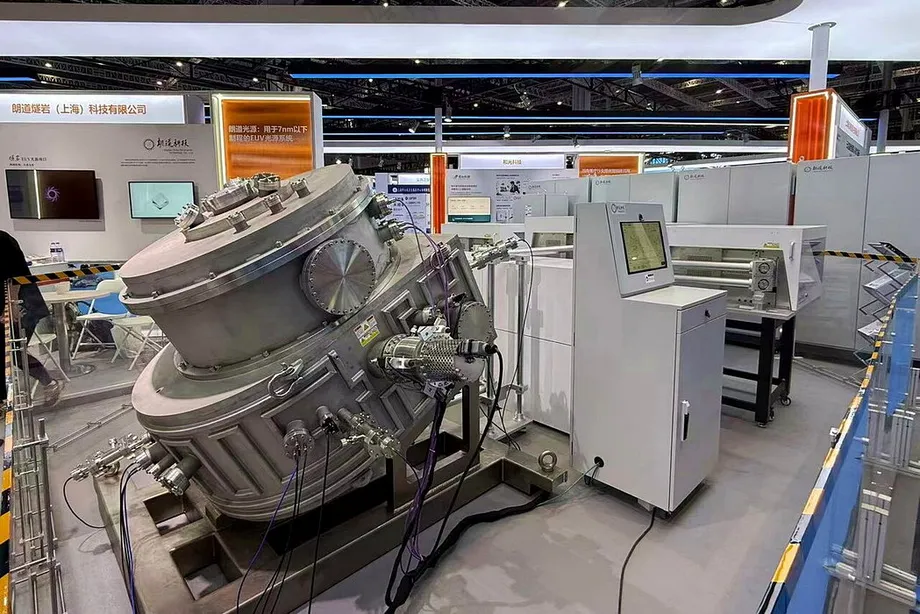
Axera introduced the chip at an industrial exhibition in Shanghai on October 13, 2026, when Sipeed also presented MaixStation. The initial pitch was striking: 25% faster processing of prompts and 30% faster generation of answers than DGX Spark when running a Qwen model with 27 billion parameters, at roughly half the price.
Sipeed's MaixStation product page now gives a more detailed picture. It lists 592 to 677 tokens per second for processing prompts on Qwen3.8-27B and 6 to 7 tokens per second for generating answers. Those figures are lower than the ranges circulated around the announcement, while the official launch plan puts a Kickstarter campaign at the end of 2026.
The attraction is concrete: a large pool of memory in a small computer could let developers, offices and individual users run capable models without renting cloud computing or buying several graphics cards. The buying decision, however, depends on the final software, measured performance and delivery schedule as much as the chip specifications.
What Axera has put inside the AX8860P
The AX8860 family uses a manufacturing process of 6 nanometres and combines 16 Arm Cortex-A55 CPU cores with a dedicated neural processing unit, or NPU. An NPU is a processor designed to perform the repeated calculations used by AI models. Axera and Sipeed rate it at up to 256 trillion operations per second, commonly shortened to 256 TOPS, using FP4.
FP4 stores numerical values with four bits of precision. Using fewer bits reduces the memory needed for a model and can speed up calculations, although the model and software must support that format. Axera's figure is for dense computation, rather than a calculation that assumes some values can be skipped through a technique called sparsity.
The chip supports PCIe 5.0 and a memory interface with a width of 256 bits. Sipeed specifies LPDDR5X-8533 memory, up to 128 GB per module, and bandwidth of 273 GB per second. Its Maix-V module measures 78 by 78 mm and uses an LPCAMM2 connector.
The Cortex-A55 cores handle the operating system and supporting work, while the NPU is intended to carry the main AI workload. Nvidia's DGX Spark has 20 Arm cores, including more powerful Cortex-X925 cores, while competing AMD Ryzen AI Halo machines use Zen 5 CPUs. Users planning to combine AI inference with substantial conventional computing therefore have more to compare than the accelerator alone.
Why 128 GB matters more than a headline TOPS figure
A language model needs memory for its numerical weights, which encode what it learned during training, and for working data created while it answers a request. A fast accelerator with too little memory can require the model to be divided across devices or moved through slower storage.
MaixStation's proposed 128 GB configuration puts it in the same memory capacity class as the larger DGX Spark. Both list bandwidth of 273 GB per second. AMD's Ryzen AI Halo range includes a configuration with 128 GB at about 256 GB per second and a more expensive version with 192 GB at 273 GB per second.
Capacity determines how much can fit. Bandwidth determines how quickly information can move to the processor. During ordinary generation by a dense language model, producing each new token requires reading large amounts of model data. A token is a small unit of text, sometimes a word and sometimes only part of one.
Sipeed consequently argues that effective use of memory can let its 256 TOPS processor compete with Nvidia's larger advertised computing figure. DGX Spark's roughly 1,000 TOPS FP4 rating uses sparsity; its dense FP4 figure is about 500 trillion operations per second. Actual application speed also depends on how efficiently the software keeps the hardware working.
The official benchmark page gives a narrower picture
Sipeed separates its tests into prefill, when a model processes the user's prompt, and decode, when it generates an answer. Faster prefill can shorten the wait before an answer begins, especially with long documents. Faster decode makes the answer appear more quickly once generation starts.
For Qwen3.8-27B in dense FP4, the official page lists MaixStation at 592 to 677 tokens per second for prefill against 550 for DGX Spark. That works out to a lead of about 8% to 23%. MaixStation's listed decode speed is 6 to 7 tokens per second, but the supplied text of the official chart gives no numerical DGX Spark decode baseline for that model.
For Qwen3.6-35B-A3B, a mixture of experts model, Sipeed lists prefill of 2,664 to 3,256 tokens per second against DGX Spark's 2,368. The calculated lead is about 13% to 38%. Decode is 34 to 37 tokens per second against 34, ranging from a tie to a lead of about 9%.
A mixture of experts model activates only part of its network for each token. That helps explain why its generation rate can be much higher than a dense model with a similar total parameter count. The two model types involve different amounts of work per token.
Sipeed describes the displayed results as conservative current measurements and says the AX8860P is still being tuned. Its chart specifies FP4 with multi token prediction, or MTP, disabled. MTP is a technique for proposing several future tokens together to speed generation.
Why the earlier speed claims need careful comparison
Sipeed's earlier published benchmark ranges were higher: 1,400 to 1,600 tokens per second for Qwen3.8-27B prefill and 15 to 17 for decode, against DGX Spark baselines of 1,300 and 13. For the mixture of experts model, those ranges were 6,300 to 7,700 for prefill and 80 to 88 for decode, against 5,600 and 80. Sipeed also gave a later comparison putting MaixStation about 10% ahead in both stages, saying newer runs showing a wider lead were not official.
The official page's lower absolute figures make the test conditions especially relevant. Prompt length, the number of requests processed together, numerical formats, runtime software and driver versions can all change the result. Independent DGX Spark runs cited in the reporting reached about 11.5 to 11.6 tokens per second for Qwen3.8-27B without speculative decoding, while prefill ranged from 840 to 1,900 depending on the software.
A simple memory calculation explains the attention given to the earlier 17 tokens per second claim. If the running model occupies roughly 16 GB, dividing 273 GB per second by 16 GB gives about 17 tokens per second before accounting for other memory traffic. Reaching that rate would require exceptionally high use of the advertised bandwidth.
The model's actual memory footprint matters here. Four bits multiplied by 27 billion parameters gives about 13.5 GB for weights alone, while numerical scaling data and other storage can increase the working size. Detailed, repeatable tests would let buyers connect the speed figures to a specific model configuration.
A pocket sized box with standard storage
MaixStation's advertised dimensions give it a volume of 363 cubic centimetres. Sipeed compares that with 1,125 cubic centimetres for DGX Spark, making its proposed enclosure roughly one third the volume. The company says the machine can draw power through USB-C from a suitable power bank rated at 65 watts.
The official page gives typical consumption of 40 watts for MaixStation and 120 watts for DGX Spark. Those are Sipeed's stated typical loads. The initial AX8860 coverage also specified 40 watts for the dedicated module, making the scope of power measurements another useful detail for eventual testing.
Connections include 10G SFP+ networking, USB-C, an MCIO 8i connector and a standard M.2 2280 slot for an SSD. The storage format gives buyers a familiar route to adding space for model files, which can quickly consume hundreds of gigabytes.
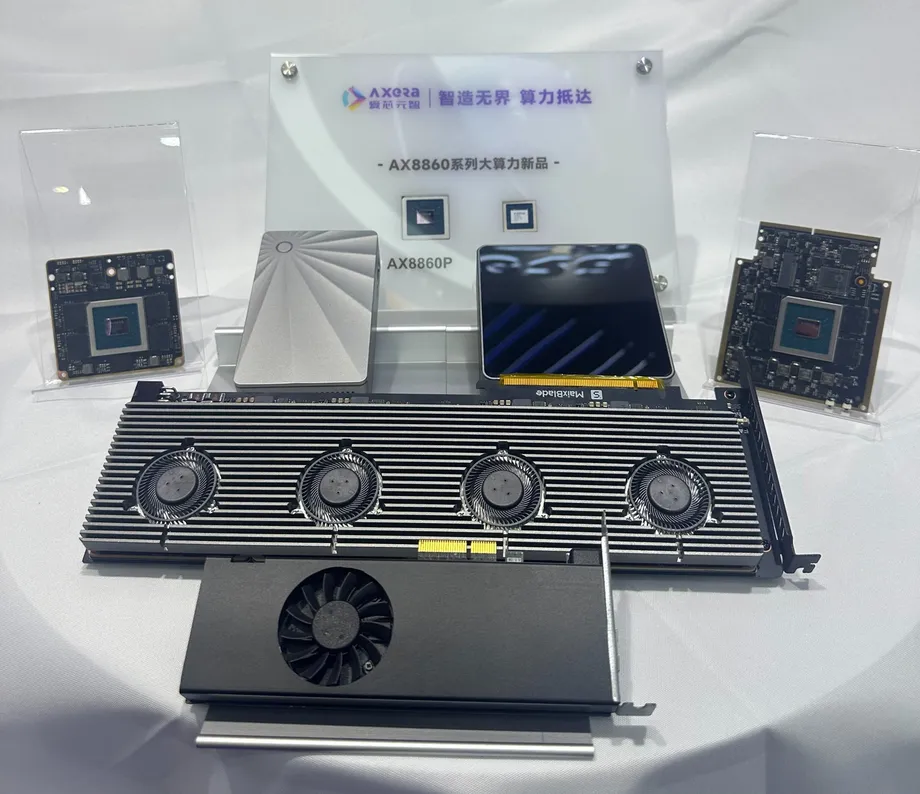
Axera's hardware plans extend beyond the small desktop. Designs include a module, a PCIe card with one chip, and a card with four chips, four fans and a standard power connector with eight pins. Sipeed associates MaixStation Pro and MaixBlade with configurations offering 512 GB or more.
More chips promise capacity, with scaling still a claim
Sipeed says MaixStation can connect up to eight nodes without an external switch, using a connection between chips rated at 256 gigabits per second and expandable to 384 gigabits per second. DGX Spark uses a 200 gigabit connection for linking systems, and a configuration with four Sparks requires an external switch.
The distinction between gigabits and gigabytes matters. A connection rated at 256 gigabits per second corresponds to a raw 32 gigabytes per second before overhead. The 273 gigabytes per second memory bandwidth describes a different, much faster connection inside each machine.
Axera lists two chips at a combined 512 TOPS and four at 1,024 TOPS, alongside a claim of about 80% scaling efficiency. The four chip scaling figure comes from laboratory simulation. Dividing a model across processors also creates communication and synchronisation work, so application speed depends on more than adding their peak computing ratings together.
Axera's roadmap names an AX8950 reaching up to 500 TOPS and an AX8970 exceeding 700 TOPS. Those planned processors would provide later upgrades, but MaixStation's immediate proposition rests on the AX8860P and its software.
The software promise is central to everyday use
Sipeed lists Debian 13 with Linux 6.18, along with support for vLLM, SGLang, PyTorch, llama.cpp and Ollama. Those tools help load models, serve requests and connect AI applications to the hardware. The company also advertises APIs compatible with OpenAI and Anthropic, allowing existing applications to send requests to a local device.
Sipeed's product FAQ explains that the familiar framework names sit above software written for the Axera hardware:
SGLang and vLLM run through a custom hardware-acceleration backend whose kernels are written in AXDSL.
Kernels are small pieces of software that perform core calculations on the accelerator. Sipeed says users can load supported Hugging Face models directly, while new model architectures may require kernels written in AXDSL. It promises to publish kernels and development tools, and says work is under way to open the AX8860 software development kit.
The company advertises models and a browser interface ready at startup. Its suggested uses include coding agents, document processing, video generation and robotics. Linux hosts come first for PCIe cards; Windows support would depend on demand. At the announcement, the NPU toolchain was expected by the end of October.
Price and delivery are now tied to a campaign
Sipeed's expected $3,999 price for 128 GB would be about $2,951, or 42%, below a DGX Spark priced at $6,950. That is a substantial discount, though less than half. It would also put MaixStation close to the roughly $3,999.99 price of an AMD Ryzen AI Halo with 128 GB.
The rollout schedule has changed from the initial expectation of devices arriving during 2026. Reservations have opened, but the official FAQ places Kickstarter at the end of 2026. Sipeed has said shipping is intended within three months after the campaign closes.
- October 13, 2026: Axera introduced the AX8860 family in Shanghai, and Sipeed presented MaixStation.
- End of October 2026: Sipeed expected the NPU toolchain to become available.
- End of 2026: Sipeed plans its MaixStation Kickstarter campaign.
- Within three months after the campaign closes: Sipeed's stated shipping target.
Sipeed has not confirmed a final retail price, a firm delivery date or independently verified MaixStation performance. Production capacity, support arrangements and the price and timing of the 512 GB Pro version also remain unsettled. Remote access and review units are planned during the campaign, giving prospective buyers a next opportunity to examine the claims.
Key Points
- MaixStation targets about $3,999 for 128 GB of memory and an Axera AX8860P processor rated at 256 TOPS in dense FP4.
- Sipeed lists 273 GB per second of memory bandwidth, typical power consumption of 40 watts and an enclosure measuring 11 by 11 by 3 cm.
- The official benchmark page shows lower absolute speeds than earlier published ranges, with results varying by model and processing stage.
- Software support relies on a custom Axera acceleration backend, with development tools and more code promised for public release.
- Kickstarter is planned for the end of 2026, followed by a stated shipping target within three months of the campaign closing.
- Independent testing, final prices and delivery commitments will determine how the proposed system compares with Nvidia and AMD alternatives.