A light source prototype enters public view
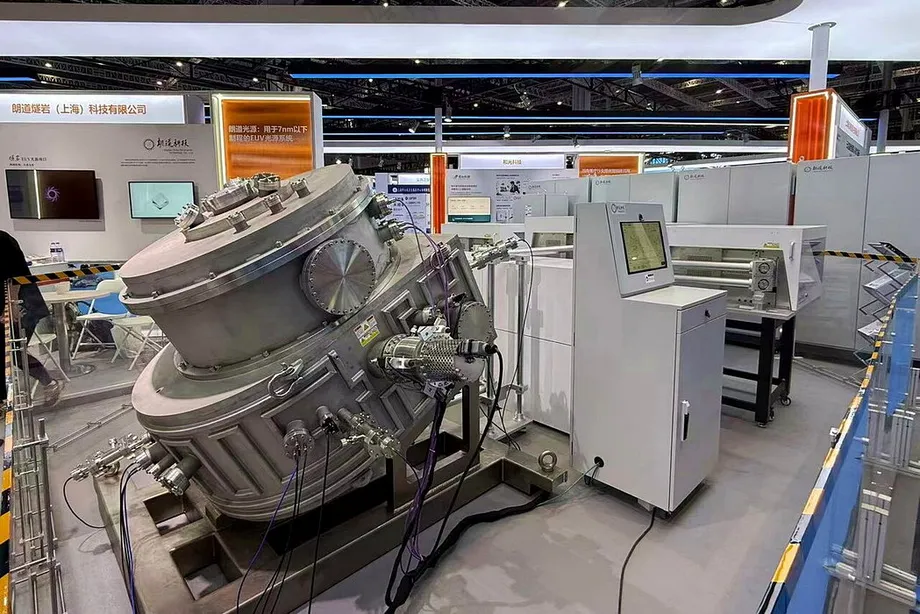
Shanghai startup Langdao Suiyan has displayed a prototype extreme ultraviolet light source at the 26th China International Industry Fair, saying 90 percent of its components are made in China while putting mass production another three to five years away. The display, described in coverage dated October 2026, brings a specific piece of China's advanced chipmaking effort into public view: equipment designed to generate the light used to print tiny circuit patterns.
Contents
- A light source prototype enters public view
- What was shown in Shanghai?
- The published specifications
- How the light is generated
- Why more power and longer life matter
- What the 90 percent domestic share means
- A startup backed by chip industry investors
- Export controls keep pressure on domestic development
- Progress elsewhere puts EUV in perspective
- Key Points
The exhibit is an EUV light source, a major component of a lithography machine. A complete machine also needs precision optics, a platform that positions the silicon wafer, a vacuum system and controls that keep those parts working together. Langdao's timetable concerns development of the light source, with staff identifying higher output and reliable operation over long periods as the main tasks ahead.
Company representatives said the prototype could be used for chip exposure testing. Product specifications attributed to the company list EUV output above 15 watts and continuous operation exceeding 100 hours for its low power FlintNano system. No independent test results or detailed exposure results from the displayed prototype were disclosed, leaving its performance in practical chipmaking tests uncertain.
The development matters because Chinese chipmakers cannot buy EUV lithography machines from Dutch supplier ASML under export restrictions. A domestic light source could eventually support an alternative supply chain. For now, the Shanghai display shows a young company working on one of the most demanding components, with years of engineering still included in its own estimate.
What was shown in Shanghai?
Langdao's prototype occupied a modest position in the Shanghai exhibition area of the fair's innovation technology hall. Its rough exterior attracted attention, while staff declined formal media interviews. Other descriptions of the display recorded technical explanations from company representatives, including the claimed domestic component share and the expected production timetable.
Langdao said it attended at the invitation of the Shanghai Technology Innovation Center. Staff described the appearance as a way to show that a Chinese team was working on EUV light generation and to encourage patience with a development process that would take time.
Lithography works by exposing a light sensitive coating on a silicon wafer to a pattern. Later manufacturing steps turn that pattern into parts of an electronic circuit. EUV light has a wavelength of about 13.5 nanometers, allowing suitable equipment to print very fine patterns. Producing that light is only the beginning: the machine must also direct it accurately and deliver a consistent exposure.
The published specifications
Langdao's FlintNano LPP-OXXO is the low power system for which the most detailed specifications were described. The company places the FlintNano family in a product development and commercialization phase, while its higher power FlintMicro-LPP family has completed principle and feasibility work.
The specifications attributed to Langdao include:
- A driving laser rated at 1,000 watts, operating at frequencies from 1 to 20 kilohertz.
- Conversion efficiency above 2 percent and EUV output above 15 watts.
- Continuous operation exceeding 100 hours.
- A plasma size of 60 micrometers.
- A plasma stability figure within 3 percent RMS and an energy output stability figure of 5 percent.
Watts measure power, or how quickly energy is delivered. The 1,000 watt laser rating describes the power supplied by the driving laser; the EUV output rating describes the useful light produced by the system. These are different stages of the process. Kilohertz measures repetition frequency, with 1 kilohertz meaning 1,000 cycles each second.
The RMS stability measure summarizes fluctuations over a measurement period. For a chip manufacturer, the practical concern is whether each exposure receives a sufficiently consistent amount of light. Variations can affect how accurately a circuit pattern forms in the coating on a wafer.
How the light is generated
Langdao is pursuing laser produced plasma, usually shortened to LPP. In this approach, a powerful laser strikes tiny droplets of tin, creating an extremely hot plasma that emits EUV light. Plasma is a state of matter in which atoms have lost some of their electrons. A collector mirror gathers part of the emitted light and directs it toward the exposure system.
ASML's commercial EUV machines also use an LPP source. The difficult engineering lies in making the process repeat accurately, collecting enough useful light and protecting sensitive equipment from the effects of the plasma. A stable stream of tin droplets, a powerful driving laser and a durable collector mirror all have to work together.
Langdao's wider business reflects those needs. Alongside EUV light sources, it describes work on high power carbon dioxide lasers and plasma simulation software. The lasers provide driving hardware, while simulation software helps engineers study how the plasma behaves and adjust operating conditions.
Chinese research efforts also include alternative approaches, such as laser induced discharge plasma and accelerator based light generation. Those projects have their own development schedules. Langdao's public estimate remains three to five years for its light source to reach mass production.
Why more power and longer life matter
Commercial EUV systems require light sources delivering power in the hundreds of watts, together with reliable operation during intensive manufacturing. Langdao's published output above 15 watts places its low power system in a different operating category. Moving toward factory use means increasing the useful light delivered while keeping the equipment stable.
More usable light can help a lithography system expose wafers faster. That affects how many wafers a factory can process and how much each exposure costs. Reliability matters just as much: an interruption in a machine can delay production and reduce the value of an otherwise powerful source.
The collector mirror presents a particular challenge because it operates close to an energetic plasma. The tin droplet generator must also keep delivering droplets in the right place at the right time. Small changes in either process can affect the light that reaches the wafer.
Langdao's stated operation exceeding 100 hours amounts to more than four days. Factory customers would also need information about maintenance intervals, component replacement and performance across repeated operating cycles. Staff linked the remaining engineering work directly to output and stability.
What the 90 percent domestic share means
Company representatives said 90 percent of the prototype's components were localized, with most core parts developed internally. They also described difficulties obtaining some imported components and said Chinese alternatives still faced a stability gap in certain areas.
Langdao did not specify whether the 90 percent figure was calculated by component count, value or another method. For readers, the useful question is which parts remain difficult to replace and how those parts affect the whole system's reliability. A small share of components can still include equipment essential to continuous operation.
Staff declined to identify the remaining imported parts. Their explanation placed the engineering challenge across a network of suppliers, rather than within a single company's assembly work. Better domestic components would need to arrive with consistent quality and a dependable operating life.
For Chinese wafer factories, a mature local source could eventually reduce exposure to restrictions on equipment and replacement parts. The current task is to turn domestic designs into components that can operate together predictably over long periods.
A startup backed by chip industry investors
Langdao was established in 2024. Founder Wang Hao and his team draw on research from Tsinghua University's Gas Discharge and Plasma Laboratory, concentrating on LPP technology for EUV lithography sources.
The company's development has been accompanied by several financing rounds. Investors named in accounts of the funding include Woyan Capital and China Fortune-Tech Capital, which has ties to Semiconductor Manufacturing International Corporation, China's leading contract chipmaker. Such backing connects the startup with investors familiar with semiconductor equipment and manufacturing.
The reported sequence runs from formation through financing and the public display:
- 2024: Langdao was established and began its EUV light source project.
- October 2025: Suiyue Ventures, associated with Zhangjiang Hi-Tech, provided angel financing.
- January 2026: The company completed an additional angel financing round.
- July 2026: Langdao completed a Series A round.
- October 2026: The light source prototype appeared publicly at the Shanghai industry fair.
Financing gives the company resources for equipment, recruitment and further development. Langdao's own schedule still allows several years for engineering after the public debut, illustrating the distance between funding a prototype and supplying a repeatable industrial product.
Export controls keep pressure on domestic development
ASML is the sole commercial supplier of complete EUV lithography systems. Restrictions prevent sales of those systems to China, making a domestic alternative a strategic priority for Chinese manufacturers. ASML strengthened its light source capabilities through its acquisition of Cymer in 2013, part of the long industrial development behind today's equipment.
Chinese chipmakers continue to use deep ultraviolet equipment, or DUV, for production. DUV uses longer wavelengths than EUV. Manufacturers can use multiple patterning, which divides a complex circuit pattern across several processing steps, to extend what those machines can produce. More steps add manufacturing complexity and cost.
ASML chief executive Christophe Fouquet has expressed skepticism about how quickly China can match the company's technology. Speaking during an investor call, he described the distance China still had to cover:
a very, very long way to go
Langdao's three to five year estimate provides a more specific measure for its own project. Counting from the reported October 2026 appearance, that suggests roughly 2029 to 2031 if development proceeds as expected. It is a timetable for the light source, while an entire lithography machine would require its other major systems to reach compatible levels of performance.
Progress elsewhere puts EUV in perspective
Chinese suppliers are also expanding in manufacturing stages outside lithography. At the semiconductor exhibition in Shenzhen held during the same period, Hwatsing showed an ion implantation machine, Leadmicro displayed equipment for depositing thin films, and Piotech announced carbon film deposition technology for memory and logic chips.
Those developments matter because a wafer factory depends on many kinds of equipment. Ion implantation changes the electrical properties of selected areas of silicon. Deposition adds thin layers of material. Lithography defines patterns that guide later work. Progress across these stages can increase domestic equipment use even while EUV development continues.
Bernstein Research forecast that domestic suppliers would capture 52 percent of China's wafer fabrication equipment market by 2028, compared with an estimated 28 percent in 2026. That is a projected increase of 24 percentage points. The forecast covers a much broader equipment market than EUV lithography.
Langdao's next meaningful developments will concern stronger output, sustained reliability and exposure performance as it moves through its stated engineering period. Chinese internet users have also questioned whether publicity surrounding the exhibit is aimed at fundraising and patriotic enthusiasm. Publishing detailed operating results would give prospective customers and investors more concrete information about the product's progress.
Key Points
- Langdao Suiyan displayed an EUV light source prototype in Shanghai, with company staff claiming 90 percent domestic components.
- The exhibit concerns a light source, one of several major systems needed in a complete EUV lithography machine.
- Published FlintNano specifications include EUV output above 15 watts and operation exceeding 100 hours.
- Staff estimated another three to five years before mass production, with power and reliability the main engineering tasks.
- The company was founded in 2024 and has attracted investors connected to China's semiconductor industry.
- Export restrictions on ASML's EUV machines continue to drive Chinese efforts to develop domestic equipment.