A new bullet train focused on safety and comfort
JR Central plans to launch its new S0 series Shinkansen in July 2029, combining automated driving with a driver on board, faster earthquake braking and a major redesign of premium seating. Announced on October 16, 2026, the train will succeed the N700S as the first complete redesign for the Tokaido Shinkansen in nine years.
Contents
- A new bullet train focused on safety and comfort
- What automated driving will do
- How earthquake braking will change
- Green Cars will offer different levels of privacy
- More luggage space and larger restrooms
- Better connections will arrive before the new train
- A new nose and lower electricity use
- The rollout will span several years
- Passengers will also face higher charges
- Key Points
The company plans to introduce one test train in August 2028, followed by 25 production trains from fiscal 2029 through the first half of fiscal 2032. The S0 will operate on the Tokaido route between Tokyo and Shin-Osaka and the connecting Sanyo Shinkansen through western Japan to Fukuoka Prefecture.
JR Central says earthquake detection information sent directly to trains will cut the time before braking begins from about two seconds to about 0.2 seconds. Improved brake control will also shorten the braking distance from 285 kilometers per hour by approximately 5% compared with the N700S.
Passengers will see more luggage storage, larger overhead racks and new Green Car seats, including seats with substantial partitions. Some improvements will arrive on existing train models before the S0 enters service.
JR Central President Shunsuke Niwa described the company's ambition at a news conference in Tokyo:
We aim to offer an even higher level of service, starting with the S0 model,
The S0 will retain the current maximum operating speeds of 285 kilometers per hour on the Tokaido section and 300 kilometers per hour on the Sanyo section. Its main changes concern how trains operate, respond to earthquakes and accommodate passengers.
What automated driving will do
The S0 will use Grade of Automation 2, or GOA2. In simple terms, the system controls the train's movement between stations while a driver remains in the cab. The driver presses a button to start, after which the train follows a planned speed profile and stops at the intended position at the next station.
A speed profile is a plan for when to accelerate, maintain speed and slow down. JR Central intends to use that plan to balance punctuality with lower electricity consumption, rather than simply running as fast as possible between stops.
From the end of fiscal 2030, the system is scheduled to receive timetable and speed restriction information through millimeter wave train radio operating in the 40 GHz band. Fiscal 2030 ends in March 2031, so this capability is planned for a later stage than the July 2029 launch.
If a sudden restriction forces a train to slow down, the system will update its speed plan using the latest information. It can then adjust the remaining journey within permitted speeds to recover time and limit the delay.
How earthquake braking will change
JR Central plans to use the same radio technology to send earthquake detection information directly to trains. Reducing the response time from about two seconds to 0.2 seconds means braking would begin roughly 1.8 seconds sooner, a reduction of about 90%.
At 285 kilometers per hour, a train travels approximately 79 meters in one second. At a constant speed, it would cover about 143 meters during those 1.8 seconds. That calculation helps explain why even a short reduction in the time before braking matters on a fast railway.
The braking system itself will also change. JR Central expects revised brake control to reduce the distance needed to stop from 285 kilometers per hour during an earthquake by about 5% compared with the N700S. Earlier braking and a shorter braking distance address two different parts of an emergency stop: when slowing begins and how far the train travels while slowing.
Green Cars will offer different levels of privacy
Green Cars, the premium accommodation above ordinary class, will remain in cars 8, 9 and 10. Cars 8 and 9 will have multifunction armrest seats with smartphone holders, drink holders and large tables that fold into the armrests. Car 10 will use partition seats with larger dividers between neighboring passengers.
The announced Green Car seating figures are 68 seats in car 8, 64 in car 9 and 48 in car 10. Car 10 will also offer six semi-private Supreme Class Seats and one fully private Supreme Class Cabin, extending the choice beyond conventional premium seating.
Improved cushioning and footrests that flip upward form part of the seating redesign. Foot space is expected to increase by about 140 millimeters compared with the N700S. In the related Green Car upgrade program, the maximum reclining angle will change from 123 degrees to 116 degrees, giving passengers more room around their feet while reducing the maximum recline.
Car 9 will gain a powder corner where passengers can attend to their appearance away from their seats. The N700S version is specified with a vanity mirror, a mirror showing the full body, a counter and privacy curtains.
Revised control of active dampers is expected to reduce sideways movement when trains pass each other by about 10%. These devices counter unwanted movement of the carriage. On N700S trains receiving the related improvements, the work will cover cars 7 through 10.
More luggage space and larger restrooms
Ordinary class passengers will share several of the S0's practical improvements. Luggage storage areas in the entrance decks will increase from six to nine, with additional provision in cars 3, 7 and 15. That is a 50% increase in the number of storage areas.
Overhead luggage rack space will grow by about 25% in the end cars and 5% in intermediate cars. Together, the changes will provide more places to put bags both near seats and in the entrance areas.
Women-only restrooms will have approximately 25% more space and include a baby bed. Men's restrooms will receive sliding doors, and washbasin entrances will be widened. These changes affect the shared facilities passengers use during a journey, rather than only the seating inside each carriage.
The related N700S improvement program also includes baby chairs in shared restrooms, alongside existing baby beds. In car 9 of newly built N700S trains, sanitary disposal boxes in women-only restrooms will be redesigned so their contents are less visible.
Better connections will arrive before the new train
JR Central and JR West plan to expand the free S Wi-Fi for Biz service from cars 7 and 8 to cars 9 and 10 on N700S trains. Transparent glass antennas compatible with 5G will be installed in cars 8 through 10 to improve connection stability and network capacity.
The antennas use the type already adopted for Supreme Class accommodation. For passengers working or communicating during a journey, the intended benefit is a more stable connection across the Green Car area.
Communications and restroom improvements are scheduled to begin progressively from October 26, 2026. The wider Green Car seating and facility upgrades will follow progressively from December 15, 2027, with new N700S trains introduced from December 2027 receiving improvements ahead of the S0.
N700A trains will also receive selected seating upgrades, except for trainsets due to retire within the next few years. Passengers will therefore encounter the new facilities gradually across the fleet, rather than through a single change on the S0's opening day.
A new nose and lower electricity use
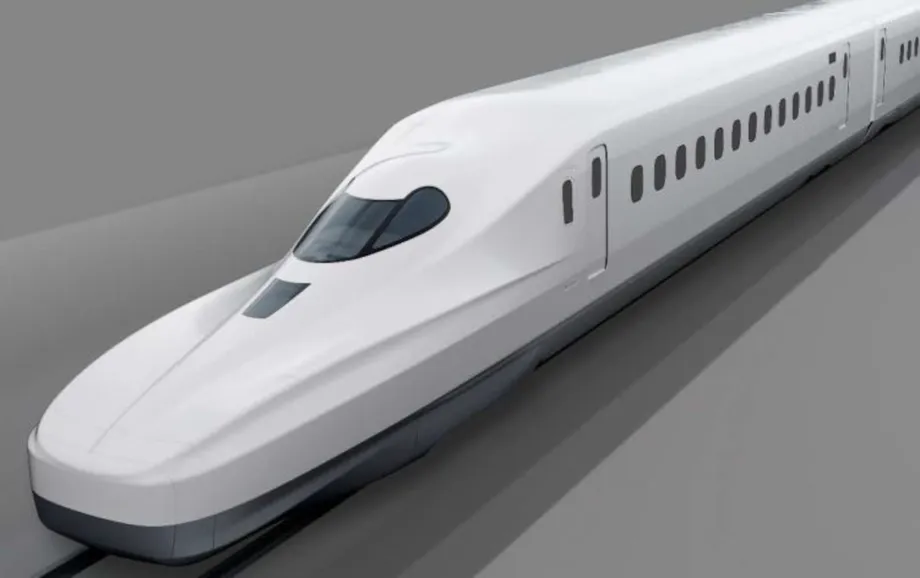
The S0 will introduce a nose shape called Twin Rimex, developed from the N700S Dual Supreme Wing design. Its purpose is to reduce air resistance, one of the forces a train must overcome as it moves.
JR Central expects the new shape, efficient equipment and automated driving together to reduce electricity consumption for an entire trainset by about 6% compared with the N700S. Expressed simply, a comparable operation using 100 units of electricity on the N700S would use about 94 units on the S0 under the company's comparison.
Recycled aluminum will account for about 20% of the car body structure, up from approximately 14%. That is an increase of six percentage points. The program expands the use of aluminum recovered from Shinkansen vehicles in building new ones.
The S0 will retain the N700S approach of a standard train design that can be configured into different train lengths. Its name combines the S from Shinkansen and Supreme with zero, which JR Central describes as a new starting point for the railway's development.
The rollout will span several years
JR Central's production schedule starts with eight trains in fiscal 2029, followed by seven in fiscal 2030, seven in fiscal 2031 and three in the first half of fiscal 2032. Those allocations add up to the planned 25 production trainsets.
The main dates bring together several separate projects, including improvements to existing trains, the S0 launch and later operating capabilities:
- October 26, 2026: Communications and restroom improvements begin progressively on existing trains.
- December 15, 2027: Wider Green Car improvements begin progressively, alongside revised Green Car charges.
- August 2028: One S0 train is scheduled to enter confirmation testing.
- July 2029: S0 commercial services are scheduled to begin.
- October 2029: A program to add selected S0 operating and safety functions to existing trains is scheduled to begin progressively.
- End of fiscal 2030: Automatic speed plan updates using radio transmission of timetable and speed restrictions are scheduled to begin.
- First half of fiscal 2032: The initial deployment of 25 production trains is scheduled to be completed.
The timetable for adding functions to existing N700S trains needs clarification. April 2028 has also been given as a starting point for adding automated driving, earthquake braking and Green Car features, alongside the October 2029 schedule for the broader modification program. The relationship between those dates has not been explained. Deployment plans beyond the first half of fiscal 2032 are undecided.
Passengers will also face higher charges
JR Central separately announced an increase in Nozomi reserved seat surcharges for tickets purchased from July 1, 2027. An adult traveling from Tokyo to Shin-Osaka in an ordinary reserved seat during a regular travel period will pay 15,420 yen, an increase of 700 yen.
The previous price was therefore 14,720 yen, making the increase approximately 4.8%. JR Central says this will be the first such Nozomi price increase since the service began in 1992, apart from changes associated with consumption tax. Nonreserved seat fares will remain unchanged.
JR Central and JR West have also announced reserved seat surcharge increases for Mizuho services from July 2027. Green Car charges will rise for travel from December 15, 2027, with increases ranging from 800 yen to 4,510 yen for a journey in one direction, depending on operating distance.
Dedicated lounges for Green Car and Supreme Class passengers are planned at Nozomi stopping stations from December 2027, with complimentary soft drinks. The combination of higher charges, new seating and station facilities means premium passengers will see changes well before the S0 arrives.
Key Points
- The S0 is scheduled to enter service on the Tokaido and Sanyo Shinkansen in July 2029.
- Automated driving will control movement between stations, with a driver remaining in the cab.
- Earthquake detection to braking time is expected to fall from about two seconds to 0.2 seconds.
- JR Central plans 25 production trains through the first half of fiscal 2032, following a test train in August 2028.
- Green Cars will gain new seats and privacy options, while luggage storage and restroom improvements will also benefit ordinary class passengers.
- Electricity consumption is expected to fall about 6% compared with the N700S, and recycled aluminum use will rise from about 14% to 20% of the car body structure.
- Selected improvements will reach existing trains earlier, while Nozomi reserved seat and Green Car charges will rise in 2027.