Newsroom penalties and a long wait for accountability
The Maldives has introduced foreign currency offences carrying fines of up to MVR 500,000 for individuals and MVR 5 million for businesses, while an independent newsroom challenges its exclusion from presidential briefings and faces criminal proceedings over allegations against President Mohamed Muizzu.
Contents
- Newsroom penalties and a long wait for accountability
- What the foreign currency law says
- A documentary followed by a newsroom search
- Adhadhu challenges its exclusion from briefings
- Criminal proceedings move behind closed doors
- Media regulation was already under pressure
- Living cost demonstrations face police barriers
- Activists spend days in custody
- Rilwan's family seeks the investigation findings
- Rights organisations and courts face their own pressures
- Key Points
The currency provisions took effect on 1 September 2026. They punish advertising or promoting currency transactions outside official rates or bands, using language that includes publication through digital media. Journalists and civil society organisations warn that the rules threaten reporting on the prices people actually pay for foreign currency.
Adhadhu, the outlet behind the documentary Aisha, has meanwhile faced a police raid, travel restrictions on senior staff and exclusion from presidential press conferences. Criminal cases against its executives and a woman accused of participating in the documentary are being heard behind closed doors. The government denies the documentary's allegations and has defended police action.
Opposition demonstrations over living costs have also faced police restrictions and arrests. Together, these developments concern three practical freedoms: asking officials questions, publishing information and gathering publicly to challenge government decisions.
The CIVICUS Monitor rates civic space in the Maldives as obstructed. Its civic freedoms assessment describes threats against journalists, restrictions on demonstrations and failures to resolve past abuses. The longest running case concerns journalist Ahmed Rilwan Abdulla, also known as Rilwan Abdullah, who disappeared on 8 August 2014. Twelve years later, nobody has been held accountable, and his family is still seeking the findings of a presidential investigation.
What the foreign currency law says
The Maldives Monetary Authority's consolidated Foreign Currency Act, Law No. 32/2024, gives the legal detail behind the dispute over exchange rate reporting. Published on 14 December 2024, the original law entered into force on 1 January 2025. Its first amendment, Law No. 13/2026, took effect on 1 September 2026, after Parliament passed the amendments on 26 August.
Section 6(d) requires currency purchases and sales to stay within rates or bands prescribed and published by the authority. Section 6-1 requires money changing businesses to obtain licences and provides for regulations setting fines for unlawful operations.
The provision drawing particular concern from journalists is Section 17-2. It makes advertising or promoting currency transactions outside official rates or bands an offence. Its definition covers public disclosure, publication, reproduction and distribution of information, including through digital platforms, for the purpose of advertising, encouraging or propagating those transactions.
Individuals face fines from MVR 25,000 to MVR 500,000. Section 17-3 sets fines from MVR 100,000 to MVR 5 million for legal entities or registered businesses involved in offences under Sections 17-1 or 17-2.
The Maldives Journalists Association and Transparency Maldives opposed the amendment in August, warning that it could punish publication of parallel market exchange rates. A parallel market is where people trade currency outside official channels, sometimes at a different price. Reporting that price can help readers understand the cost of obtaining foreign money.
The law's wording connects publication to the purpose of encouraging or promoting transactions. Journalists' concern centres on how regulators will apply that language to news reporting, and on the financial pressure that large penalties could place on independent outlets.
A documentary followed by a newsroom search
Adhadhu released Aisha on 28 March 2026. It featured allegations by a former President's Office employee that Muizzu had used his position to sexually manipulate and harass her. The documentary concealed the interviewee's identity and altered her voice. The government denied the allegations.
On 27 April, police searched Adhadhu's headquarters in Malé under a court order and seized electronic devices. According to the Committee to Protect Journalists' statement on the raid, the search warrant cited Section 612(a) of the Penal Code, concerning qazf, or false accusations of adultery under Islamic law.
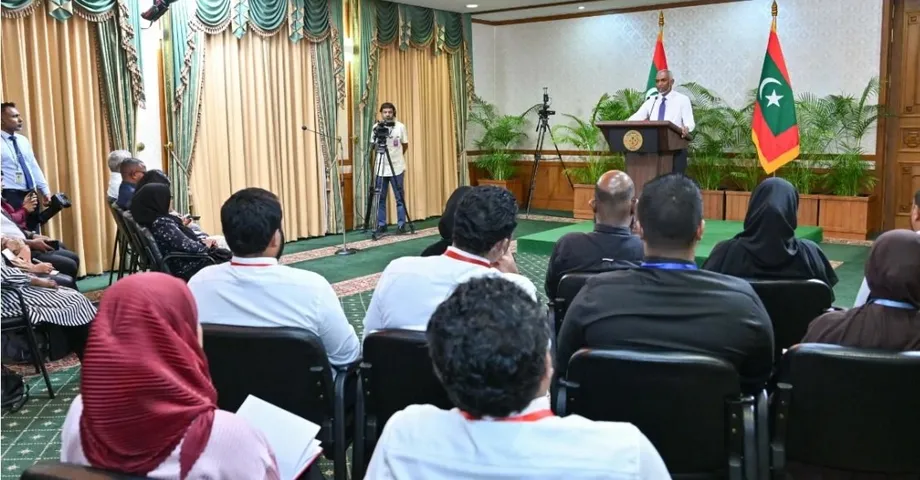
Mohamed Junayd, executive director of the Maldives Journalists Association, said the raid took place hours after an Adhadhu journalist questioned Muizzu about the allegations during a televised press conference. Authorities subsequently imposed travel bans on chief executive Hussain Fiyaz Moosa and managing editor Hassan Mohamed.
Kunal Majumder, the Committee to Protect Journalists' Asia-Pacific programme coordinator, described the raid and travel bans as an effort to criminalise investigative reporting. He said:
Using religious laws to bypass civil media regulations sets a chilling precedent. Authorities must allow the press to hold government offices accountable.
Home Minister Ali Ihusaan defended the police action, presenting it as protection against fabricated allegations rather than interference with journalism. He said:
Spreading fabricated serious accusations is not journalism. Police are upholding the rule of law and the President's constitutional rights. Responsible freedom comes with accountability. No one is above the law.
Adhadhu challenges its exclusion from briefings
Adhadhu filed a Civil Court lawsuit on 19 September 2026 seeking to overturn the President's Office decision to exclude the outlet and its journalists from press conferences. The court registered the case on 15 October.
The outlet argues that the exclusion violates press freedom and access to information, and exceeds the limits on restrictions permitted under Article 16 of the Constitution. That article concerns the conditions under which constitutional rights may be limited in a free and democratic society.
Adhadhu has been excluded from briefings since questioning Muizzu about Aisha. On 6 September, journalist Leevan Ali Nasir was forcibly removed from the President's Office. The government said that day that it was not required to provide written notice of the exclusion.
Chief government spokesperson Mohamed Hussain Shareef denied that Adhadhu had been penalised for performing its responsibilities as a media organisation. The lawsuit seeks a ruling on whether the office can lawfully deny the outlet access.
Presidential briefings give journalists a direct opportunity to question officials and request explanations in public. Adhadhu's exclusion removes that opportunity for its reporters while the dispute over the documentary continues through the criminal courts.
Criminal proceedings move behind closed doors
The Prosecutor General's Office filed a qazf charge against Eesha Ashraf on 27 September 2026, alleging that she was the interviewee in Aisha. On 5 October, the Criminal Court decided to conduct her proceedings behind closed doors.
Section 612 of the Penal Code concerns knowingly making or repeating a false accusation of adultery or fornication. The prosecution's allegation about Eesha's involvement is central because the documentary itself concealed the speaker's identity.
Eesha previously held a political appointment at the President's Office. She was later transferred to positions at two ministries and then dismissed from government employment. Police questioned her and withheld her passport during the investigation. She said she had not received an adequate opportunity to respond to the allegations.
Separate qazf charges were filed against Fiyaz and Hassan over their alleged roles in producing and publishing the documentary. Both exercised their right to remain silent during questioning and have denied the charges in court. Their proceedings are also closed to the public.
The cases connect the same publication to several forms of state action: a search for evidence, restrictions on travel, criminal prosecution and exclusion from government briefings. Closed hearings also limit what the public can observe about the presentation of evidence and the arguments made in court.
Media regulation was already under pressure
A separate media bill revived in Parliament on 18 August 2025 proposed replacing the Maldives Media Council and Maldives Broadcasting Commission with a new Maldives Media and Broadcasting Commission. MP Abdul Hannan Abubakr introduced the proposal after a similar bill was withdrawn in 2024 following opposition from journalists.
The 2025 proposal would allow fines of MVR 5,000 to MVR 25,000 for journalists and up to MVR 100,000 for outlets. It also proposed powers to suspend media registrations during investigations, block newspaper websites and halt broadcasts. The Maldives Journalists Association objected to vague terms and the absence of consultation with journalists, unions and news organisations.
The currency law's maximum business fine of MVR 5 million is 50 times the MVR 100,000 maximum outlet fine proposed in that media bill. For individuals, its MVR 500,000 ceiling is 20 times the proposed MVR 25,000 ceiling for journalists. These are different legal schemes, but the figures show the scale of the financial exposure created by the currency provisions.
The Maldives Media Council had already warned in May 2025 about threats and insults directed at journalists through political platforms and social media. It also reported discriminatory information sharing and called on authorities to give journalists equal access.
Living cost demonstrations face police barriers
In August 2026, police stopped the opposition Maldivian Democratic Party's Dhathivejje march near the Social Centre in Malé, preventing demonstrators from continuing along Majeedhee Magu. The party organised the protest over rising living costs.
Participants included MDP chairperson and former president Mohamed Nasheed, party president Abdulla Shahid and other senior members. The MDP said it selected the densely populated residential area to reach more people.
Home Minister Ihusaan had warned that the march would not be allowed on Majeedhee Magu at the requested time because of peak traffic. The MDP said police had previously assured organisers that the march could proceed there and refused to move it elsewhere.
Under the Freedom of Peaceful Assembly Act 2013, protests may take place without police permission in the Carnival area and three other designated locations in Malé. Elsewhere, permission is required. International human rights standards favour notification, allowing police to prepare for a gathering, rather than requiring organisers to obtain approval before exercising the right to assemble.
Police action against demonstrations had also drawn concern in 2025. On 8 March, officers used pepper spray against opposition protesters, leaving two elderly women with severe breathing difficulties. A Raajje TV journalist injured her elbow when officers pushed the media back. MDP members Ibrahim Abdulla, known as Gabbarey, and Ahmed Shazeen were arrested at a protest the next day without a stated reason.
Activists spend days in custody
MDP Youth Wing vice president Ahmed Maimoon Mohamed, an employee of Malé City Council, was arrested during a rally on 28 August 2026 on allegations of inciting unrest and obstructing police duties. The Criminal Court ordered five days in custody for the investigation. He was released on 6 September.
Police arrested MDP activist and Taxi Drivers Association member Mohamed Shamin at Velana International Airport on 8 September under a Criminal Court warrant. An intelligence report identified him as a threat to public safety.
His lawyers said the arrest concerned allegations that he crossed police barricades at Chandhanee Magu and Didi Goalhi during the 28 August protest. The court initially ordered 10 days in custody, then extended detention by three days. Evidence cited included police statements, CCTV snapshots and an intelligence report. Shamin was released on 22 September.
Youth organisers had faced prosecution the previous year. Aishath Shiman Ahmed and Abdulla Mahzoom Majid were arrested on 2 May 2025 during a protest seeking justice for a 21-year-old found fallen from a building in April. On 3 July, Shiman was charged under Penal Code Section 532A with obstructing law enforcement, while Mahzoom was charged under Section 120B(3) with assault or use of force against law enforcement or military personnel.
Rilwan's family seeks the investigation findings
Rilwan, a reporter for Minivan News, disappeared on 8 August 2014 after receiving repeated death threats from Islamic extremists. His journalism, blog and social media criticised religious fundamentalism and violent extremism. His family's September 2014 petition demanding government action gathered 5,000 signatures.
The International Federation of Journalists' tenth anniversary statement records successive failures to secure accountability. Three early suspects were released without charge. A trial running from September 2017 to August 2018 ended in acquittals, with the judge identifying serious negligence in the investigation and prosecution.
Former president Ibrahim Mohamed Solih created the Presidential Commission on Deaths and Disappearances in 2018. Suspects detained through its investigation in 2022 were released in June and July 2023, and charges were dismissed for lack of evidence. The Criminal Court and Prosecutor General said in late 2023 that the case would not be appealed. Muizzu dissolved the commission in June 2024.
The main stages now stretch across more than a decade:
- 8 August 2014: Rilwan was abducted and disappeared.
- August 2018: A criminal trial ended in acquittals after failures in investigation and prosecution.
- 2018: Solih established the presidential commission.
- June and July 2023: Suspects detained through the commission's investigation were released.
- June 2024: Muizzu dissolved the commission.
- August 2026: Civil society renewed demands for disclosure and accountability on the twelfth anniversary.
The Association for Democracy in the Maldives is calling on Muizzu to publish the commission's findings. It has also criticised the closure of the investigation without public disclosure or a clear route to accountability, and the silence of the Human Rights Commission of the Maldives.
In 2024, the IFJ, the Maldives Journalists Association and 11 other organisations called for publication of the commission's reports and a public inquiry by the human rights commission. No publication date or new accountability timetable has been announced.
Rights organisations and courts face their own pressures
The Maldivian Democracy Network's position shows another restriction on organised civic activity. The organisation was deregistered in December 2019 and its funds seized after a campaign that included hundreds of death threats against its defenders. In July 2024, the UN Human Rights Committee recommended restoring its registration and returning its funds without delay.
CIVICUS documented continued failure to implement that recommendation in its 2025 assessment. MDN's founder had challenged the government's actions in the Civil Court in September 2020. The court upheld the deregistration in 2023, and the appeal was still awaiting a High Court hearing when CIVICUS published its assessment.
Judicial independence also came under scrutiny in 2025. UN Special Rapporteur Margaret Satterthwaite raised concerns about the suspension of Supreme Court justices Azmiralda Zahir, Husnu Al Suood and Mahaz Ali Zahir while the court was considering a constitutional amendment governing lawmakers who leave or are expelled from their parties. One judge resigned in protest.
Satterthwaite also questioned legislation adopted by Parliament on 25 February 2025 to reduce the Supreme Court bench from seven judges to five. The International Bar Association's Human Rights Institute later expressed concern about due process and possible executive interference in the judges' removal.
Those institutional disputes matter to people seeking remedies. Journalists challenging restrictions, organisations contesting deregistration and families demanding investigations all depend on courts and oversight bodies able to examine government action independently.
Key Points
- Foreign currency amendments effective from 1 September 2026 allow fines of up to MVR 500,000 for individuals and MVR 5 million for businesses.
- Journalists warn that broad publication provisions could restrict reporting on parallel market exchange rates.
- Adhadhu is challenging its exclusion from presidential briefings while its executives face criminal cases over Aisha.
- The government denies the documentary's allegations and has defended police action.
- Police restricted opposition demonstrations, and two MDP activists were detained following an August 2026 rally.
- Rilwan's family and civil society continue to seek investigation findings and accountability twelve years after his disappearance.