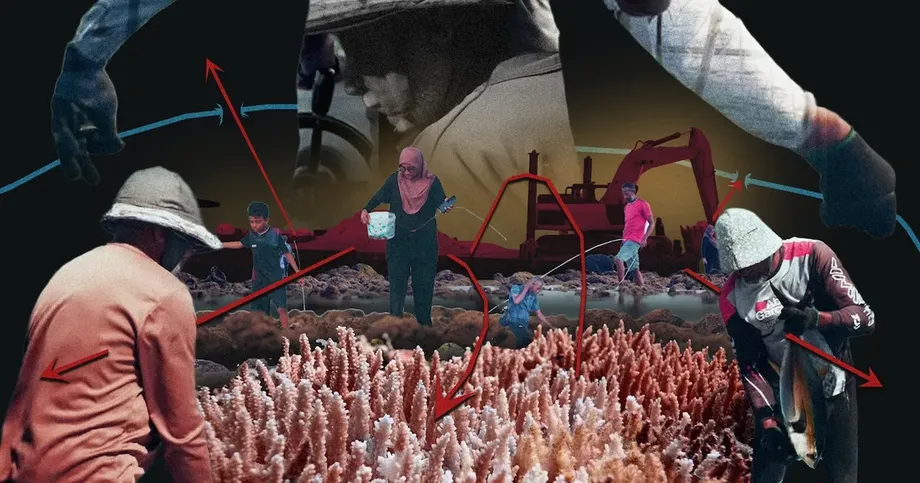
A fishing crisis begins in the lagoons
Maldivian fish exports fell to 16,991 tonnes in the first half of 2026, their lowest level since 2010, while purchases of skipjack tuna from fishing vessels dropped 65 percent compared with the same period a year earlier. For fishing communities, the strain often starts before boats reach the open ocean: finding the small live fish needed to catch tuna.
Contents
- A fishing crisis begins in the lagoons
- Why tiny baitfish matter to the tuna economy
- Earlier records show how bait demand grew
- Fishing methods and construction add pressure
- Warmer water changes where fish can live
- Reefs face heat, fishing and plastic waste
- What the catch projections mean
- Food and household income are exposed
- Fisheries law has a climate mandate, but few triggers
- Existing institutions could act on earlier warnings
- Key Points
On Makunudhoo, the westernmost inhabited island in the Maldives, residents describe a dramatic retreat. The island had 18 yellowfin tuna fishing boats in 2018. Only two remain following the decline of its bait fishery. Resident Suvaidha Adam says silver sprat have not entered the lagoon for a decade.
Abdul Hakeem Amir, a fisher from Kulhudhuffushi, recalls when bait around a single rock could fill a dhoni, the traditional Maldivian fishing boat. In Roadhi, a documentary directed by Nashath Mohamed and released by Maldives Resilient Reefs, he describes the change:
Now you could stop at 10 rocks and not have enough,
The cause of the current national slump remains unresolved. Warmer seas, scarce bait, fuel costs and crew members leaving for government jobs are among the possible explanations. Officials and experts consulted for a fisheries legal review also linked a catch collapse in 2024 to El Niño and Indian Ocean Dipole conditions, climate patterns that alter temperatures, rainfall and currents.
Roadhi, screened in Malé, brings together accounts of longer journeys for bait, disappearing seabirds and damaged reefs. Alongside a scientific review and an examination of fisheries law, it presents a connected problem: ocean warming is increasing pressure on a fishing economy whose essential habitats already face damage from fishing and coastal development.
Why tiny baitfish matter to the tuna economy
Maldivian pole and line fishing depends on two linked fisheries. Crews first collect small live fish from reefs and lagoons, then scatter them beside their boats to attract tuna within reach of individual hooks. A shortage in shallow water can therefore stop fishing far offshore.
Fishers in Roadhi say vessels from Huvadhoo and Addu now travel as far north as Baa and Lhaviyani atolls for bait. One describes a task that once took half an hour at dawn stretching into several hours, leaving less time to catch tuna and adding fuel costs before any income is earned.
Captain Ibrahim Hamid, whose fishing routine in Kanditheemu was described in September 2025, said finding bait during shortages could take up to 10 hours and require snorkellers. On the trip described, his crew collected 200 kilograms of bait and later landed 4.5 tonnes of fish by 2.30pm. Successful tuna fishing still depended on securing that first supply.
Ahmed Ali, a fisher from Makunudhoo interviewed in Roadhi, put the dependence plainly:
If the bait fishery goes, there will be no fishery at all,
Maldives Resilient Reefs' climate and fisheries review identifies rising temperatures, coral bleaching, ocean acidification and changing ocean conditions as pressures on tuna, baitfish and reef fish. Acidification happens as seawater absorbs carbon dioxide, changing its chemistry and making it harder for corals and some other organisms to build their skeletons or shells.
Earlier records show how bait demand grew
A study by R. Charles Anderson of the fisheries ministry's Marine Research Section provides a historical baseline. The livebait status study, hosted by the Food and Agriculture Organization, estimated annual bait use at about 3,000 tonnes in 1978–1981 and 10,600 tonnes in 1994, an increase of roughly three and a half times.
Estimated daily use rose from 30 kilograms per vessel to 48 kilograms over those periods, a 60 percent increase. Anderson linked growing demand to greater fishing effort, larger boats and improved methods of collecting bait. The 1994 national estimate carried an approximate uncertainty range of 25 percent, which the paper described as a reminder of substantial uncertainty.
The study also recorded a different pattern of disruption. In a logbook survey covering 1993–1995, poor bait fishing accounted for only 0.7 percent of days when crews did not go tuna fishing in three sampled islands. Addu, where bait fishing was already difficult, was outside that survey.
Anderson reported that no comprehensive stock assessment had been conducted and that the condition of the bait resource was poorly known. The World Bank's later fisheries study describes bait stocks as apparently stable, while Roadhi records severe shortages in particular places. Bait availability varies by species, location, season and fishing demand, making regular monitoring across islands essential.
Fishing methods and construction add pressure
Powerful lamps, diving equipment and larger nets help crews locate and collect bait. The scientific review warns that fishing pressure and technologies such as submerged lights may currently pose a greater threat than climate change to some baitfish populations.
Fishing captain Samrath Hassan argues in Roadhi that powerful lights threaten the pole and line fishery. A fisher from Haa Dhaal Makunudhoo describes shortages in a lagoon where crews collect bait by freediving during daylight rather than using lights. Their experiences point to several pressures operating in different fishing grounds.
Dredging and land reclamation also feature in the film, with fishers describing sediment smothering bait grounds. These activities can bury or damage the shallow habitats on which baitfish depend. Anderson's historical study likewise identified damage from bait collection, anchoring, coral mining and black coral collection.
Government action to protect those habitats has a long history. A September 1990 President's Office decree banned coral mining on major bait fishing reefs, and a moratorium on black coral collection began on January 1, 1995, for 10 years. Today's debate concerns both newer fishing pressures and habitat problems recognised decades ago.
Warmer water changes where fish can live
The World Bank's fisheries climate assessment records average sea surface warming of 0.4–0.5 degrees Celsius across most Indian Ocean regions between 1998 and 2019. Changes in temperature, oxygen, salinity and currents can shift where tuna find suitable conditions, including into deeper water or beyond Maldivian waters.
Fishers then need more time and fuel to locate schools. Fisher Ahmad Ashfam, describing conditions in June 2024, said both the quantity and size of fish had changed. Maldives Fishermen's Association secretary general Abdulla Shakir Mohamed said some crews were spending at least a week at sea, with rough weather complicating their return.
Fishing schedules differ across fleets and islands. Hamid's crew in Kanditheemu worked long days and accumulated catches over two or three days before delivery because of the distance to a distribution centre. Across these different routines, longer searches increase exposure to weather and operating costs.
Traditional weather knowledge is also becoming harder to apply. In Roadhi, Hamza Hassan of Kulhudhuffushi describes changes to the nakaiy calendar, which divides the year into 27 periods named after stars or constellations. Fishers describe seasonal winds and bait carrying currents arriving at unexpected times.
The World Bank projects the greatest declines in habitat suitability and local disappearance of species in the northeast of the Maldives' exclusive economic zone by the middle to later part of this century. This zone is the offshore area where the country has rights to manage marine resources. Boats based in different atolls will face different changes as fish distributions shift.
Reefs face heat, fishing and plastic waste
Coral bleaching weakens the habitat supporting reef fish and some baitfish. When water becomes too warm, corals expel the microscopic algae that supply much of their food and colour. Prolonged bleaching can kill corals, eventually reducing the complex reef structures where marine life feeds and shelters.
The World Bank assessment projects that coral die off in the Maldives could reach 90 percent by 2100. It also projects much greater accumulated heat stress. Its summary describes increases of up to five times in coral areas by the end of the century; detailed modelling across the wider economic zone gives larger increases under high emissions. The measure, degree heating days, combines how far temperatures exceed a heat threshold with how long that heat lasts.
Marine biologist Emma Keen of Le Meridien Maldives Resort and Spa described restoration work in June 2024, attaching broken coral fragments to frames so they could continue growing. She also warned that prolonged bleaching could kill many corals that summer. Restoration sites face the same warming seas as surrounding reefs.
Plastic waste adds another burden. Figures described in June 2024 put annual plastic waste above 43,000 tonnes, about 12 percent of the country's total waste. UNICEF Maldives representative Edward Addai linked waste and sanitation pressures to urbanisation.
Parley for the Oceans has worked with councils, resorts, fishers and boat operators to collect plastic from land and sea, transport it to Malé and prepare it for recycling abroad. Executive director Shaahina Ali described community participation as central to that effort. Waste collection, habitat protection and fishing management address local pressures while global emissions determine the scale of future warming.
What the catch projections mean
The World Bank assessment projects declines in potential maximum catches of 17 percent under low climate change, 60 percent under a medium scenario and more than 90 percent under a high scenario by 2081–2100. Much of the projected loss comes from pelagic fish, species such as tuna that live in the open sea.
Other parts of the same assessment give different figures. A modelling section describes total maximum catch potential falling to about 30 percent of its historical level under high emissions, equivalent to a decline of roughly 70 percent. Roadhi's closing narration cites research projecting losses of as much as 75 percent. Each figure needs its scenario, period and fishery attached to it.
Maximum catch potential is the amount a model estimates fish populations could support under specified environmental conditions. Actual catches also depend on boats, crew, fuel, fishing rules and access to fish. The World Bank expects relatively small climate effects on potential catches by the 2030s, followed by larger losses and wider differences between emissions scenarios after 2040.
The assessment projects reef associated catches falling by about 4–5 percent by 2081–2100, less than pelagic catches. Yet reef species still receive very high climate risk scores because many depend on particular habitats. A small projected change in total catch can coexist with serious habitat stress and changes in which species are present.
Food and household income are exposed
Maldivians consume an estimated 163 kilograms of tuna per person annually, according to the World Bank assessment. Fisheries accounted for 11 percent of the labour force in 2015 and 3.5 percent of gross domestic product in 2021. In remote islands without tourism development, fishing can be the main source of work.
Hamid described average monthly earnings of 15,000–20,000 rufiyaa in 2025, with about 8,000 rufiyaa possible in a successful week. After expenses such as fuel, profits on his vessel were divided into one share for the owners and two shares for the crew. Longer bait searches reduce the money available for that division.
The scientific review finds that Maldivians increasingly eat reef fish rather than tuna. Fishers have also become more dependent on reef catches partly because bleaching damages bait habitat. Heavier fishing can then weaken reefs further, a cycle the review calls a food security trap.
Maldivian pole and line fishing has an important advantage: it catches relatively few unintended animals. Martin Purves, managing director of the International Pole and Line Foundation, describes the method:
Pole and line fishing for tuna is highly selective, with minimal bycatch.
Figures described in September 2025 put bycatch in Maldivian tuna fisheries as low as 0.65 percent, compared with an average of 28 percent in longline tuna fishing. About 95 percent of the Maldivian bycatch was sold, with the rest released alive. Protecting bait habitats supports a fishing method that limits accidental catches while sustaining island incomes.
Fisheries law has a climate mandate, but few triggers
A legal review prepared by Dr Shaistha Mohamed finds that the Fisheries Act assigns climate adaptation and mitigation responsibilities to the fisheries ministry. Most regulations and management plans, however, do not turn that responsibility into specific operating requirements.
Management plans need not consider climate projections, sea surface temperatures or bleaching alerts. Reviews generally follow fixed cycles of three to five years, without climate conditions automatically triggering an earlier review. The live bait fishery has no specific management plan.
Seagrass is not recognised as fish nursery habitat in fisheries law, and there is no framework for protecting climate refugia, areas expected to retain more suitable conditions as surrounding waters warm. The review also identifies a lack of climate triggered insurance or safety nets for fishers facing catch failures.
Officials and specialists consulted for the review described inactive advisory committees, limited enforcement, shortages of staff and funding, and insufficient analysis of fisheries and vessel tracking data. Fisheries and environment authorities also share overlapping responsibilities for protected areas, bait grounds and coastal development.
Shaha Hashim, executive director of Maldives Resilient Reefs, said legal arrangements need investment and practical action:
We cannot afford to keep destroying the very ecosystems that sustain us while talking about adapting to climate change.
Existing institutions could act on earlier warnings
The legal review recommends strengthening existing institutions. Management plans would assess climate risks and undergo early review when catch rates, fish sizes or habitat condition cross agreed thresholds. Advisory committees would receive an explicit climate responsibility.
Reefs, seagrass and mangroves would receive recognition as habitats critical to fisheries under climate change. Linking the fishermen's registry to social protection could allow assistance to begin when severe catch failures occur. The scientific review also calls for healthy fish populations, better monitoring and support for communities adapting to changing conditions.
A short timeline shows how habitat protection, fishing pressure and climate risks have accumulated:
- September 1990: A President's Office decree banned coral mining on major live bait fishing reefs.
- January 1995: A moratorium on black coral collection began for 10 years.
- 2018: Makunudhoo had 18 yellowfin fishing boats, compared with two described in Roadhi.
- 2024: Officials and experts linked a catch collapse to El Niño and Indian Ocean Dipole conditions.
- First half of 2026: Fish exports fell to 16,991 tonnes, while skipjack purchases dropped 65 percent from a year earlier.
- After 2040: World Bank projections show catch potential declining more sharply as emissions scenarios diverge.
For fishing households, the practical priorities connect directly: keep bait grounds productive, track changes before catches collapse, reduce avoidable habitat damage and provide support when fishing income fails. The Maldives can act on those pressures at home while the scale of future ocean warming depends on emissions worldwide.
Key Points
- Fish exports reached their lowest first half level since 2010 in 2026.
- Bait shortages are forcing longer journeys and reducing time available to catch tuna.
- Warming, reef damage, fishing pressure and coastal development affect connected parts of the fishery.
- World Bank projections show much larger losses under higher emissions, especially for open ocean fish.
- The legal review recommends climate responsive management, stronger habitat protection and support triggered by severe catch failures.