A larger public stake to support a ¥2 trillion borrowing plan
Japan's industry ministry plans to invest another ¥400 billion in Rapidus over fiscal 2027 through 2029, taking the government's cumulative equity investment in the Tokyo semiconductor company to ¥650 billion. The immediate aim is to strengthen the company's finances so commercial lenders will help pay for its move into advanced chip production.
Contents
- A larger public stake to support a ¥2 trillion borrowing plan
- How the new investment would be divided
- What Rapidus has already received
- Why banks want a stronger capital base
- Private financing has several moving parts
- Research support is a separate funding stream
- The production and financing timetable
- From a chip process to a product customers can buy
- Public investment faces annual scrutiny
- Key Points
The Ministry of Economy, Trade and Industry presented the proposal to a Fiscal System Council subcommittee on October 19, 2026, with details public by October 20. Rapidus wants to raise ¥2 trillion in private loans, beginning with about ¥400 billion in fiscal 2027, as it prepares to manufacture chips using its 2 nanometer process.
The proposed government investment would be delivered through the Information-Technology Promotion Agency, known as IPA. Each annual allocation needs approval through Japan's fiscal investment and loan budget process, so the additional ¥400 billion remains a funding request rather than a completed investment.
Rapidus is trying to cross an expensive gap between developing a manufacturing process and operating a factory that reliably produces chips for paying customers. Its plan links public capital, private investment and bank borrowing to production milestones stretching from fiscal 2027 to a proposed stock market listing in fiscal 2031.
How the new investment would be divided
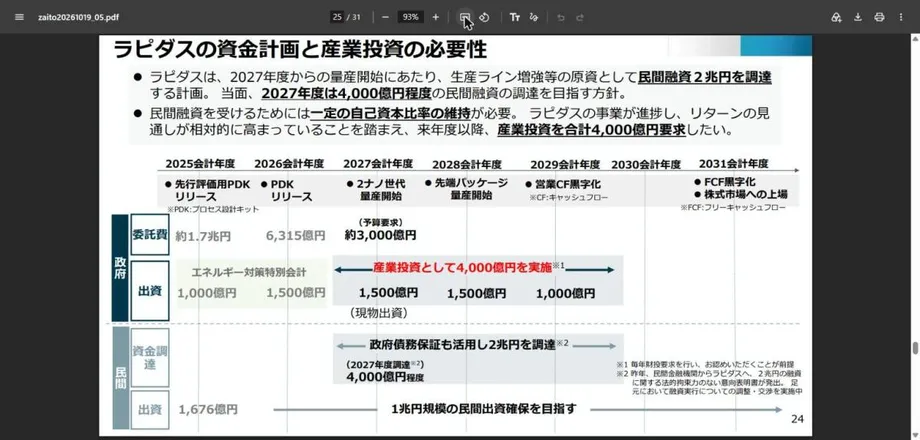
The ministry is seeking ¥150 billion for fiscal 2027, followed by ¥150 billion for fiscal 2028 and ¥100 billion for fiscal 2029. Japan's fiscal year begins in April, so fiscal 2027 runs through March 2028.
The government has already committed ¥250 billion in equity. Adding the proposed ¥400 billion would increase that amount by 160%, bringing cumulative government equity investment to 2.6 times its existing level. The first two years account for ¥300 billion, or three quarters of the proposed increase.
The schedule places the largest annual contributions around the planned start of chip production and the subsequent expansion into advanced packaging. Rapidus needs money during this period to increase manufacturing capacity while building a business capable of paying its operating costs.
What Rapidus has already received
Rapidus confirmed in its June funding announcement that it completed a ¥150 billion investment round from IPA on June 5, 2026. The company identified an earlier ¥100 billion IPA investment, bringing those two government contributions to ¥250 billion.
The investment was made under the Act on Facilitation of Information Processing. IPA is an independent administrative agency under the industry ministry, providing the institutional route through which the state is taking an equity stake in the company.
Rapidus said its stated capital and legal capital surplus together reached ¥424.95 billion after the June transaction. Legal capital surplus is money recorded in a separate capital account when shares are issued. Both categories belong to the company's capital base.
The same announcement identified ¥167.6 billion in private funding from 32 companies, including Canon, Development Bank of Japan, Fujitsu, NTT, SoftBank and Sony Group. Founded on August 10, 2022, Rapidus is therefore drawing on a combination of government institutions and major Japanese businesses as it moves toward commercial production.
Why banks want a stronger capital base
The ministry's central financial argument concerns Rapidus' equity ratio. This measures how much of a company's assets is financed by its own capital rather than liabilities such as borrowing. A stronger equity base gives lenders a larger financial cushion when a project faces losses, delays or unexpected costs.
Chip factories require expensive equipment before they can generate substantial sales. Borrowing pays for equipment and production capacity, but it also creates repayment obligations. Government equity can help a company support more borrowing while keeping its balance sheet within the limits lenders are willing to accept.
The ministry's materials put the average equity ratio at 50.4% for manufacturing generally and 61.0% for manufacturers connected with semiconductors. The average for TSMC, Intel and Samsung Electronics was 65.5%. The semiconductor group therefore stood 10.6 percentage points above manufacturing generally, while the three major chipmakers stood 15.1 points above it.
Those figures explain why the ministry is focusing on capital alongside technology. Rapidus is entering an industry in which established manufacturers maintain substantial equity while spending heavily on facilities. Its actual financing terms will depend on negotiations with lenders and the company's progress.
Private financing has several moving parts
Rapidus plans to obtain ¥2 trillion in commercial loans and roughly ¥1 trillion in equity from private companies. Together, those targets make up about ¥3 trillion in planned private financing. Loans must be repaid, while equity gives investors an ownership stake and exposes them to the company's commercial results.
The initial borrowing target of approximately ¥400 billion in fiscal 2027 represents one fifth of the ¥2 trillion loan plan. That first stage is intended to help finance production line expansion as Rapidus moves toward manufacturing at commercial scale.
Financial institutions submitted letters of intent in 2025 concerning the ¥2 trillion borrowing plan. Those letters were not legally binding, and negotiations over executing the loans are continuing. The government also plans to use debt guarantees, under which it would cover specified lender losses if repayment obligations are not met.
Public support therefore works through several channels. Equity supplies capital directly to Rapidus. Guarantees reduce part of the risk borne by participating lenders. Private investors and banks would supply further money as the company reaches the conditions agreed for their participation.
Research support is a separate funding stream
Rapidus also receives substantial government support for research and development. In April 2026, the New Energy and Industrial Technology Development Organization, known as NEDO, approved a support ceiling of about ¥631.5 billion for fiscal 2026.
That allocation included approximately ¥514.1 billion for research into 2 nanometer semiconductor integration and manufacturing with shorter turnaround times under Japan and United States cooperation. Another ¥117.4 billion covered chiplet packaging design and manufacturing technology. Turnaround time is the period required to complete a manufacturing task or production cycle.
Approved research and development commissioned funding for fiscal 2022 through fiscal 2026 totaled approximately ¥2.354 trillion. The ministry's latest materials also include a request for about ¥300 billion in research and development funding for fiscal 2027.
The industry ministry has put combined government fees and investments in Rapidus at about ¥2.6 trillion by the end of fiscal 2026, in March 2027. The ¥631.5 billion research support ceiling and the newly proposed ¥400 billion equity investment fund different activities through different mechanisms. Research funding pays for specified development work, while equity strengthens the company's capital base.
The production and financing timetable
Rapidus' business plan ties successive funding needs to a series of manufacturing and financial targets. The company aims to begin producing 2 nanometer chips in fiscal 2027, with the more detailed schedule placing that start in the latter half of the fiscal year.
The main milestones are:
- June 5, 2026: Rapidus announced completion of a ¥150 billion IPA investment, following an earlier ¥100 billion contribution.
- October 19, 2026: The industry ministry presented its additional equity investment plan to the Fiscal System Council subcommittee.
- Fiscal 2027: Begin production of 2 nanometer chips, seek about ¥400 billion in initial private loans and receive a proposed ¥150 billion in additional government equity.
- Fiscal 2028: Begin mass production of advanced packaging and receive a proposed further ¥150 billion in government equity.
- Fiscal 2029: Target positive operating cash flow and receive the proposed final ¥100 billion government contribution.
- Fiscal 2031: Target positive free cash flow and a stock market listing.
Operating cash flow measures cash generated or consumed by everyday business activities. Positive operating cash flow would mean those activities bring in more cash than they use. Free cash flow also accounts for spending on assets such as manufacturing equipment, making it a later financial target for a company still building expensive facilities.
From a chip process to a product customers can buy
Rapidus aims to produce advanced logic semiconductors, the chips that carry out calculations and control computing tasks. The 2 nanometer label identifies a generation of chip manufacturing technology. Success depends on making functioning chips consistently, at sufficient volume and at costs customers will accept.
Fujitsu is one of the initial customers Japan hopes will help establish the business, and the latest research support is intended to fund Rapidus' work for the company. IBM is licensing technology to Rapidus, while Dutch equipment supplier ASML is another partner supporting its manufacturing effort.
Rapidus has established an analysis facility in Chitose, Hokkaido, to test and diagnose its chips. This work is intended to improve yield, meaning the proportion of manufactured chips that function as intended. Better yield allows a factory to obtain more usable chips from the same production effort.
The company has also begun operating a development center for backend processes, the stages used to prepare and connect chips after their initial fabrication. Its fiscal 2028 packaging target extends that work. Advanced packaging can connect several smaller chips, called chiplets, so they operate together in a larger computing system.
Public investment faces annual scrutiny
The industry ministry argues that Rapidus' progress has improved the outlook for investment returns. Its case for more capital rests on that progress and on the need to maintain an equity ratio that supports private borrowing.
Members of the Fiscal System Council subcommittee have called for regular checks of both the project's policy purpose and its profitability, with a discussion each year about whether industrial investment should proceed. The council advises the finance minister, giving it a role in examining how public financial resources are used.
Japan's policy objective is to build domestic capacity for advanced semiconductors and reduce dependence on overseas manufacturers, including Taiwan Semiconductor Manufacturing Co. The government connects that ambition with economic security and access to technology needed for artificial intelligence, robotics and quantum computing.
Commercial competition remains demanding. TSMC began volume production of 2 nanometer chips in 2025 and supplies major customers including Nvidia and Apple. Rapidus must establish its process, secure orders and improve manufacturing efficiency while competing with companies already producing at scale.
For taxpayers, the proposed ¥650 billion cumulative equity stake would make the state a larger investor in that effort. For lenders and private shareholders, the next stages center on the terms of their financial commitments and Rapidus' ability to meet its production schedule. The annual approval process gives the government repeated opportunities to review progress before supplying each proposed installment.
Key Points
- Japan plans an additional ¥400 billion in Rapidus equity investment over fiscal 2027 through fiscal 2029, subject to annual approval.
- The proposal would raise cumulative government equity investment from ¥250 billion to ¥650 billion.
- Rapidus aims to raise ¥2 trillion in private loans and roughly ¥1 trillion in private equity.
- The company targets 2 nanometer chip production in fiscal 2027 and advanced packaging production in fiscal 2028.
- Research support is a separate funding stream, with approximately ¥2.354 trillion approved for fiscal 2022 through fiscal 2026.
- Rapidus targets positive operating cash flow in fiscal 2029, followed by positive free cash flow and a stock market listing in fiscal 2031.